
A brief happens before something starts, giving people what they need to prepare. A debrief happens after it ends, helping them reflect on what actually took place. Brief vs debrief confuses people because both words share the same root, yet one pushes information forward and the other pulls it back.
This guide covers what each word means, where they came from, and how professionals actually use them. You’ll see real scenarios — from campaign launches to emergency response teams — so the difference feels concrete. By the end, you’ll know exactly which word fits, every time.
Understanding the Term “Brief” in Communication

“Brief” is one of the most flexible words in professional English. It can describe a document, an action, or a quality — and which one you mean depends entirely on context.
What Does “Brief” Mean? (Definition You Can Use Today)
In simple terms, “brief” means to give someone concise, essential information before they take action — or it can describe something that is short in length or duration.
As a verb:
To brief someone means to prepare them by giving them the key facts, instructions, or context they need before a task begins. A manager might brief a new hire before their first client call, or a pilot might brief the cabin crew before takeoff. The point of briefing is always forward-looking: it sets someone up for what’s about to happen.
As a noun:
A “brief” can also be the document or summary itself. In marketing, a creative brief outlines the goals, audience, and constraints of a campaign. In law, a legal brief is a written argument submitted to a court. In both cases, the noun form refers to a structured piece of information, not just a conversation.
As an adjective:
When used as an adjective, “brief” simply means short — a brief meeting, a brief pause, a brief explanation. This is actually the oldest sense of the word and the root from which the verb and noun forms eventually grew.
Origins & Uses of “Brief” (Keep It Real)
The word traces back to the Latin brevis, meaning short, which entered English through Old French. Its meaning as “short in duration” came first; the verb and legal-document senses developed later as the word moved into professional and institutional use.
Legal Briefs: What They Really Are
A legal brief isn’t necessarily short — some run for dozens of pages. What makes it a “brief” is that it distills a case down to its essential arguments and presents them in a structured, persuasive way for a judge. Lawyers use briefs to summarize facts, cite precedent, and argue a position clearly, without unnecessary padding. This is a good example of how “brief” describes the purpose of the document (getting straight to what matters) rather than its literal word count.
What ‘Debrief’ Means in Different Fields
Where “brief” prepares someone, “debrief” helps them process what already happened. The prefix “de-” reverses the direction of the action: instead of pushing information out, a debrief pulls information back in.
Definition: What Does “Debrief” Mean?
To debrief means to question, review, or discuss an event, mission, or task after it’s finished, with the goal of gathering information and drawing lessons from it. As a noun, “a debrief” refers to that review session or the report that comes out of it. Unlike “brief,” debrief functions almost entirely as a verb or a noun tied to a process — it doesn’t work as an adjective.
Linguistically, debrief is a relatively modern word. It emerged in the 1940s, largely tied to military and intelligence work, which is part of why its tone still feels more formal and procedural than “brief.”
More Related Post Swap vs Swop
Debriefing in Intelligence and Military Operations
This is where the word got its start, and the military and intelligence community still use it in its most literal sense. After a mission, soldiers, pilots, or intelligence officers sit down with commanders or analysts to walk through exactly what happened.
The goal is to extract usable intelligence, confirm outcomes, and identify anything that needs to change before the next operation. A returning field agent, for example, might be debriefed by a superior to reconstruct what was observed and learned during an assignment.
Debriefing in Business and Project Management
Outside the military, debriefing has become a standard part of how teams work. After a product launch, a sales pitch, or a completed sprint, a team gathers to talk through what went well and what didn’t — this is often just called “the debrief” or “the retro.”
A good business debrief might include:
- A quick recap of the original goals versus the actual outcome
- What worked well and should be repeated
- What didn’t work and why
- Specific, assignable action items for next time
- Space for team members to share honest feedback without blame
Done well, a debrief turns a one-time project into a repeatable source of institutional knowledge.
Brief vs Debrief: Linguistic & Functional Differences
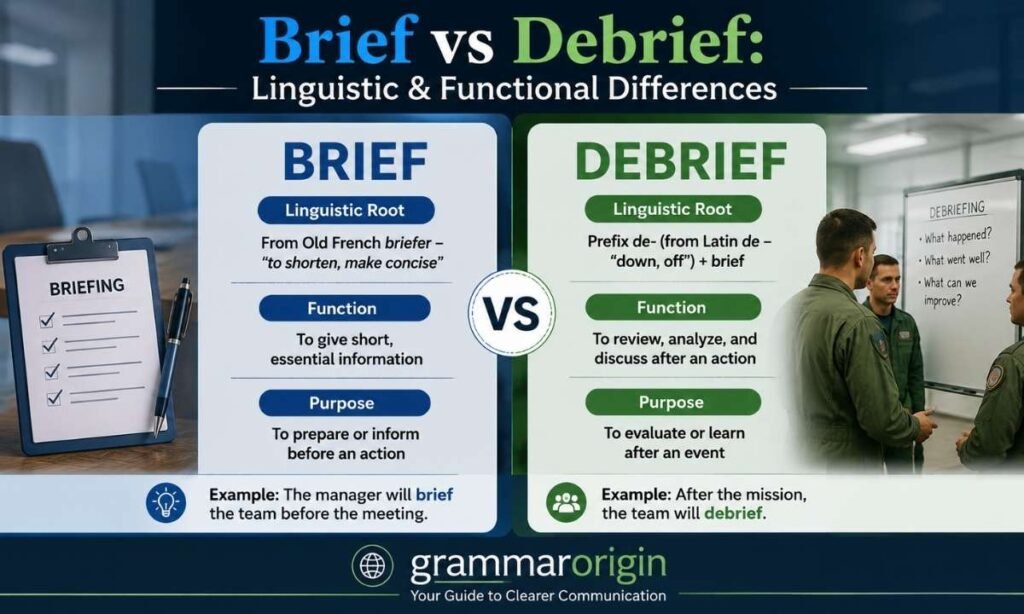
The clearest way to separate these two words is by timing and direction of information. A brief moves information toward the person who’s about to act; a debrief pulls information away from the person who already acted.
| Feature | Brief | Debrief |
| Timing | Before an event or task | After an event or task |
| Direction of information | Given to the person | Gathered from the person |
| Primary goal | Preparation | Reflection and learning |
| Common word forms | Verb, noun, adjective | Verb, noun |
| Typical settings | Business, law, media, military | Military, intelligence, business, psychology |
| First recorded use | Centuries old (from brevis) | 1940s |
Both words share the same root, which is exactly why people confuse them. But once you anchor the difference to “before vs. after,” the distinction becomes easy to keep straight.
When to Brief vs When to Debrief
Choosing the right word comes down to a simple question: has the task already happened, or is it about to?
When to Use a Brief
Use “brief” any time you’re preparing someone for something that hasn’t happened yet — a meeting, a campaign, a mission, or a presentation. If you’re handing someone context, instructions, or goals before they act, you’re briefing them.
Key Benefits of a Good Briefing
- Reduces confusion and wasted time once the task starts
- Aligns everyone on the same goals and constraints
- Sets clear expectations for roles and outcomes
- Cuts down on repeated questions mid-task
When to Use a Debrief
Use “debrief” once the event, mission, or project is already finished and you’re reviewing it. If you’re asking questions to understand what happened after the fact, that’s a debrief — not a brief.
Why Debriefing Matters
- Surfaces mistakes before they get repeated
- Documents lessons learned for future teams
- Gives everyone a chance to process the experience
- Builds a feedback loop into how the organization works
Practical Scenarios (Brief vs Debrief in Action)

Seeing these words in realistic situations makes the distinction stick better than any definition alone.
Case Study 1: Creative Agency Launching a Campaign
Before pitching a new ad campaign, the creative team receives a brief from the client that outlines the target audience, budget, tone, and deadline. The team uses that brief to shape every ad concept they design. Once the campaign wraps and results come in, the account manager runs a debrief with the client to discuss what performed well and what to adjust for the next round.
More Related Post Swap vs Swop
Case Study 2: Emergency Response Team
Before heading into a disaster zone, a response team is briefed on the terrain, known hazards, and the specific roles each person will play. After the operation ends, the team gathers for a debrief to log what conditions they encountered, how well the plan held up, and what protocols need revising before the next deployment.
Case Study 3: Software Development Sprint
At the start of a two-week sprint, the product manager briefs the engineering team on the features to build, the priority order, and any technical constraints. When the sprint ends, the team holds a debrief — often called a sprint retrospective — to talk through what slowed them down and what process changes might speed up the next sprint.
Frequently Asked Questions
Brief vs debrief meaning?
A brief is information given before a task to prepare someone; a debrief is a discussion held after a task to review what happened and learn from it.
Brief vs debrief synonym?
Close synonyms for “brief” include preview, rundown, and instructions. Close synonyms for “debrief” include review, post-mortem, and after-action report. None of these are perfect substitutes, since each carries slightly different professional connotations, but they’re useful stand-ins in casual writing.
Debrief meaning?
Debrief means to question or review someone about a task, mission, or event after it has been completed, in order to gather information and identify lessons for the future. It can also refer to the meeting or report where that review takes place.
Brief vs debrief examples?
“The pilot briefed the crew before takeoff” shows preparation before an event. “The crew was debriefed after landing to review the flight” shows reflection after an event. Keeping that before-and-after test in mind is the fastest way to pick the right word every time.
Final Thoughts
Brief vs debrief mixed up karna easy hai, magar difference simple hai — timing aur direction. A brief prepares you before something starts, and a debrief helps you learn from it after it ends.
Next time you’re not sure which word fits, just ask: is this before the task or after it? That one question will get you the right word every single time.

Muhammad Waqas is an English language teacher and grammar expert with over 8 years of experience helping students and professionals improve their writing skills. He specializes in English grammar, vocabulary, communication, and practical language learning. Through GrammarOrigin, Waqas shares clear, easy-to-understand content that helps readers write and speak English with confidence.