
Dysregulated is the correct spelling, and disregulated is a common mistake. The word starts with the Greek prefix dys-, not dis-, and that one letter trips up a lot of writers.
This dysregulated vs disregulated guide covers the spelling, the meaning, and the pronunciation. You’ll also see how the word differs from unregulated and deregulated, and how to use it in psychology, medicine, and everyday writing.
Why “Dysregulated”?
It’s spelled with dys- because the word is built from the Greek prefix dys- plus regulated. That prefix means bad, hard, or abnormal, so dysregulated describes something that isn’t being controlled well.
You’ve met this prefix before in dysfunction, dyslexia, and dysphoria. In every one of them, dys- hints that something isn’t working the way it should.
The second half traces back to the Latin regulare, which grew out of regula, the word for rule. Join the two parts and the meaning is easy to see: a system that has slipped out of its normal control.
The prefix dis- does a different job. It means not or the opposite of, as in disagree and disconnect, so it doesn’t fit here. That’s why you’ll find dysregulated in dictionaries such as Merriam-Webster, but not disregulated.
Quick example: After a week of night shifts, her sleep cycle felt completely dysregulated.
Pronunciation of Dysregulated
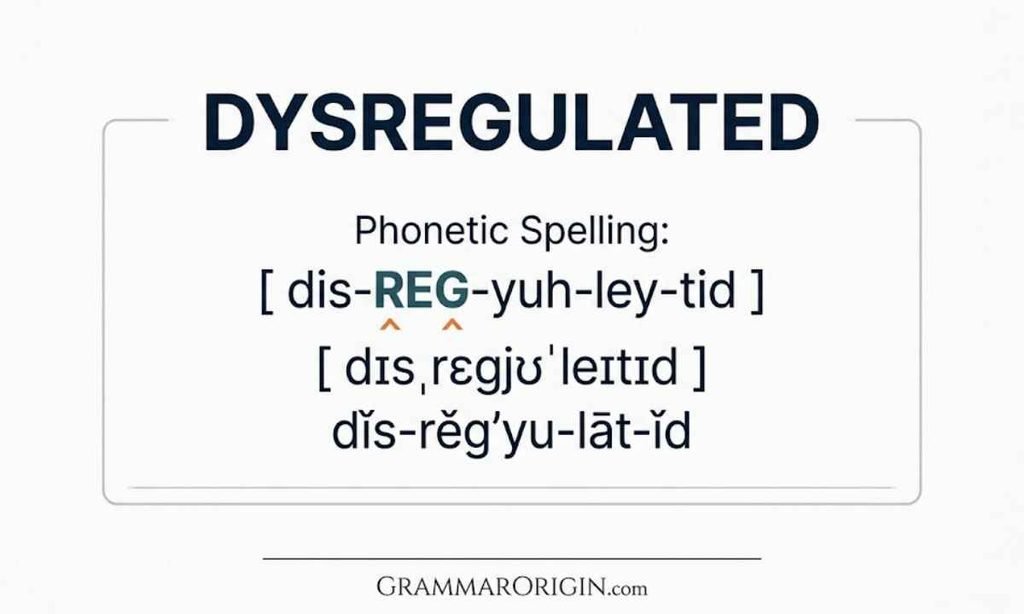
It’s pronounced dis-REG-yuh-lay-tid, and the dys- part sounds exactly like dis-. The stress lands on the second syllable.
Say it slowly: dysregulated = dis-REG-yuh-lay-tid (IPA: /dɪsˈrɛɡjəleɪtɪd/)
Merriam-Webster and Dictionary.com both show the first syllable as “dis” in their pronunciation guides for dysregulation. So when you hear the word, nothing tells your ear there’s a y in it.
That’s the main reason the mistake spreads. Your ear says dis, your habit says dis, and the correct spelling only lives on the page.
Compare it with deregulated, which sounds like dee-REG-yuh-lay-tid, with a long “ee”. If you hear dee, the word is deregulated. If you hear dis, it’s dysregulated.
What Does Dysregulated Mean?
Dysregulated describes something that isn’t being controlled or balanced the way it normally should be. You’ll see it used for emotions, body systems, and any process that has drifted outside its usual range.
In psychology, it usually points to emotional dysregulation. Dictionary.com defines that as struggling to manage emotions in a healthy way, with reactions that look bigger than the situation calls for.
Even a small comment left him feeling dysregulated for the rest of the afternoon.
In medicine and biology, it describes a body process that isn’t working within its normal limits. Merriam-Webster’s medical dictionary defines dysregulation as an impairment of a regulatory mechanism, such as the one that governs metabolism, immune response, or organ function.
Hormones, the immune system, and the stress response are the usual suspects. You’ll also see the word in clinical and research writing, where precise wording matters.
Example: Her blood work showed dysregulated cortisol, so the doctor ordered a few more tests.
Read More Realated Posts Trainor or Trainer? Correct Spelling, Meaning & Examples
Why Do People Write “Disregulated”?
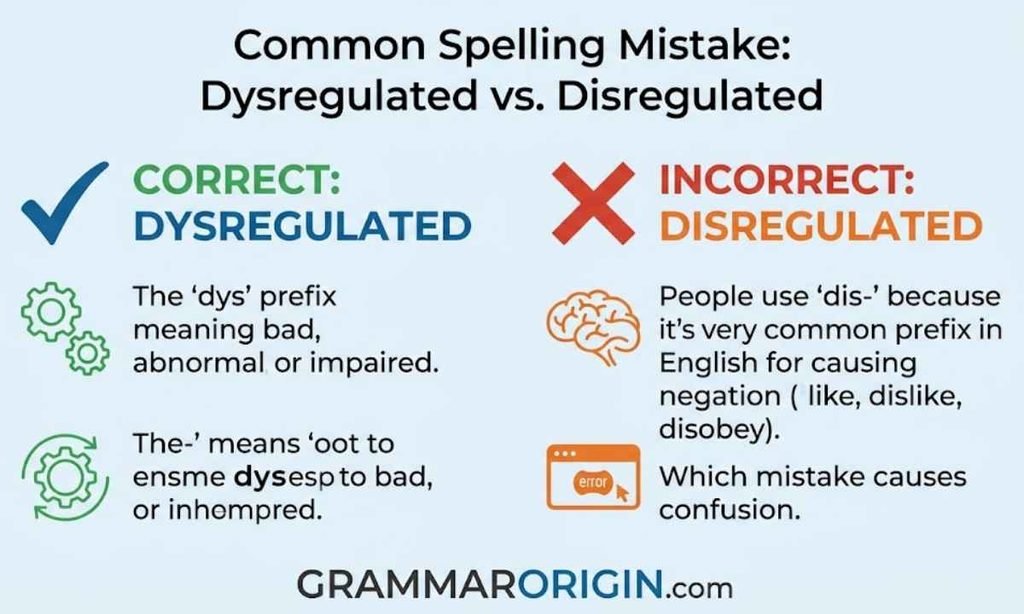
Because dis- is one of the most familiar prefixes in English, and dysregulated sounds the same when you say it. The brain fills in the more common spelling without checking.
Wrong: She felt disregulated after the meeting.
Right: She felt dysregulated after the meeting.
Think about how many everyday words start with dis-. Disagree, disconnect, disorganized, and dismiss show up constantly, so your fingers type dis before you’ve thought about it.
Dys- words are rarer in daily life. Most people meet them in health, school, or science settings, so the spelling hasn’t had much time to stick.
The dysregulated vs disregulated mix-up also survives because spell check doesn’t always explain itself. Most tools will underline the wrong version, but learning the rule once saves you from guessing every time.
Is “Disregulated” Ever Used?
Yes, you’ll find it online, but it’s a misspelling, not an accepted variant. Trusted dictionaries list dysregulated and dysregulation.
You’ll spot disregulated in social posts, comment sections, and quick notes where nobody’s proofreading. In school work, research, therapy notes, or published articles, an editor would change it to dysregulated.
So if you’ve seen it somewhere, don’t treat that as proof it’s right. Plenty of mistakes get repeated just because they’re easy to make.
Before: The report mentioned disregulated hormone levels.
After: The report mentioned dysregulated hormone levels.
Using Dysregulated in a Sentence
Use it as an adjective before a noun or after a linking verb, as in “a dysregulated stress response” or “he felt dysregulated.” Here are six examples from different settings.
After three nights without sleep, his mood felt dysregulated, and every little thing set him off.
The doctor linked her constant fatigue to dysregulated thyroid hormones.
Studies describe dysregulated immune responses in some autoimmune conditions.
Noticing she was dysregulated, Maya paused the call and took a short walk.
A dysregulated stress response can keep the body on high alert long after the danger has passed.
Her teenage son gets dysregulated whenever his routine changes without warning.
Notice the pattern. Each sentence pairs the word with something that should run steadily, like sleep, mood, hormones, or routines. That’s the easiest test for whether it fits.
Read More Realated Posts Trainor or Trainer? Correct Spelling, Meaning & Examples
Related Forms
Dysregulated is the adjective, dysregulation is the noun, and dysregulate is the verb. All three keep the same dys- prefix.
| Form | Part of speech | Example |
| Dysregulate | Verb | Chronic stress can dysregulate the body’s sleep rhythm. |
| Dysregulates | Verb (he, she, it) | Poor sleep dysregulates her mood. |
| Dysregulating | Verb (-ing form) | Skipping meals was dysregulating his energy. |
| Dysregulated | Adjective / past participle | A dysregulated appetite can follow weeks of stress. |
| Dysregulation | Noun | Emotional dysregulation can make small problems feel huge. |
If you can spell dysregulation, you can spell the rest, because only the ending changes. The opposite idea carries no prefix at all: regulation, self-regulation, and emotion regulation.
Synonyms and Antonyms of Dysregulated
Common synonyms are unstable, imbalanced, and disrupted. The main antonyms are regulated, balanced, and stable.
Synonyms: unstable, imbalanced, disrupted, erratic, overwhelmed, out of balance
Antonyms: regulated, balanced, stable, steady, composed, calm
Don’t swap them blindly. In clinical or scientific writing, dysregulated is more precise, because it says the control system itself isn’t working properly. Words like unstable or erratic only describe how things look on the surface.
Example: He went from calm to furious in seconds, a clear sign he’d become dysregulated.
The Quick Answer
Dysregulated is correct, and disregulated is a misspelling. In the dysregulated vs disregulated question, dys- always wins.
Correct: dysregulated
Incorrect: disregulated
Here’s a memory trick. Think of dysfunction, which uses the same prefix for the same idea: something isn’t working right. If you can spell dysfunction, you can spell dysregulated.
Still unsure? Ask yourself what has gone wrong. If the answer is “something is working badly,” the word needs dys-.
Dysregulated vs unregulated
Dysregulated means a control system exists but isn’t working properly, while unregulated means no rules or controls are applied at all. One is a malfunction, and the other is an absence.
The prefixes explain it. Dys- means badly, and un- means not. So think of dysregulated as “regulated badly” and unregulated as “not regulated.”
Her stress response was dysregulated, so even a slammed door made her jump.
The roadside market was unregulated, so nobody checked the scales.
Your body always has built-in control systems. When they misfire, dysregulated is the right word, and unregulated isn’t.
Dysregulated vs Deregulated
Dysregulated means poorly controlled, while deregulated means rules were removed on purpose. One describes a function problem, and the other describes a policy decision.
Example: Chronic stress left his sleep dysregulated.
Example: Congress deregulated the airline industry in 1978.
The prefix de- means remove or reverse, so to deregulate is to take rules away. Oxford Learner’s Dictionary describes it as freeing a business activity from rules and controls. You’ll see it in finance, energy, telecoms, and transport.
The sounds differ too. Deregulated starts with a long “dee”, and dysregulated starts with “dis”.
One wrinkle: you may notice deregulated in some cancer research papers, where it means abnormally controlled cell signaling. Most mental health and general medical writing sticks with dysregulated, so that’s the safer choice.
Dysregulated nervous system
A dysregulated nervous system is one that struggles to move between alert and calm states in a balanced way. It’s a common phrase in therapy and wellness writing, but it isn’t a stand-alone diagnosis.
The autonomic nervous system handles things you don’t think about, like heart rate, breathing, and digestion. It has a fight or flight mode for danger and a rest mode for recovery.
When chronic stress or trauma keeps the stress response switched on, people often describe the system as dysregulated. That can show up as a racing heart, poor sleep, and jumpiness, or the opposite, feeling numb and shut down. Cortisol, the main stress hormone, often comes up in this conversation.
Therapists often suggest grounding exercises, slow breathing, regular routines, and enough sleep. If symptoms stick around, talk to a doctor or a licensed mental health professional. This article is general information, not medical advice.
Example: Months after the accident, her dysregulated nervous system kept her in fight or flight mode, even on quiet evenings.
Signs of Emotional Dysregulation
Emotional dysregulation shows up as reactions that feel too big, too fast, or too hard to calm down from. One rough day doesn’t count, because it’s the repeated pattern that matters.
One unanswered text sent him spiraling for hours, a typical moment of emotional dysregulation.
Common signs include:
- Intense reactions to small triggers
- Trouble calming down once upset
- Fast mood swings
- Emotional outbursts or crying spells
- Shutting down or going numb
- Impulsive choices when upset
- A long recovery time after stress
Emotional dysregulation is often discussed alongside ADHD, anxiety, depression, and trauma-related conditions. It isn’t a diagnosis on its own, and a therapist can help sort out what’s behind it.
If you ever feel unsafe or in crisis, contact local emergency services or a crisis line in your area right away.
Dysregulated vs disregulated child
The correct phrase is dysregulated child, and disregulated child is a misspelling. It describes a child who’s having trouble managing big feelings, energy, or behavior for their age.
When the room got loud, the dysregulated six-year-old burst into tears and hid under the table.
Kids learn self-regulation slowly, and they need adults to help. That support is called co-regulation: a calm adult lends the child a steady rhythm until they can find their own.
Meltdowns, tantrums, and big swings are normal in toddlers and young children. Tiredness, hunger, sensory overload, and changes in routine are common triggers.
What helps? Staying calm yourself, naming the feeling, keeping routines predictable, and making sure the child gets sleep and meals. A quiet corner can also go a long way.
If the outbursts are intense, frequent, or affecting home and school, talk to a pediatrician or child psychologist. And remember, dysregulated describes a moment, not a child’s character.
Summary
Dysregulated vs disregulated comes down to one prefix. Dys-, from Greek, means bad or abnormal, so dysregulated is the correct spelling and disregulated is a misspelling.
Use dysregulated for emotions, the nervous system, hormones, immune responses, and children’s behavior. Choose unregulated when there are no rules, and deregulated when rules were removed.
Frequently Asked Questions
Dysregulated vs disregulated: which one is correct?
Dysregulated is correct. Disregulated is a common misspelling and isn’t the accepted form.
What does dysregulated mean?
It means not controlled or balanced the way it normally should be. People use it for emotions, hormones, the immune system, and the nervous system.
How do you pronounce dysregulated?
It’s dis-REG-yuh-lay-tid, with the stress on the second syllable. The dys- part sounds the same as dis-.
Is dysregulated the same as deregulated?
No. Dysregulated means poorly controlled, while deregulated means rules were taken away on purpose.
Is dysregulation a medical diagnosis?
Not on its own. It’s a term for a pattern of poor control, and it can come up with several conditions, so a professional should assess it.
Is dysregulated vs disregulated a US vs UK spelling difference?
No. It isn’t a regional difference, and dysregulated is the spelling used in both American and British English.

Muhammad Waqas is an English language teacher and grammar expert with over 8 years of experience helping students and professionals improve their writing skills. He specializes in English grammar, vocabulary, communication, and practical language learning. Through GrammarOrigin, Waqas shares clear, easy-to-understand content that helps readers write and speak English with confidence.