
Wondering whether it’s moment vs momment? The correct spelling is moment, with just one “m” in the middle. Momment doesn’t exist in any standard English dictionary, and it never will — it’s simply a spelling error that falls into the broader category of commonly confused words in the English language.
This kind of mix-up happens more often than people admit, especially when typing fast or trusting the way a word sounds. It’s a classic case of a misspelling driven by pronunciation guesswork rather than actual English grammar or orthography rules. Below, you’ll find the exact meaning, correct usage, real examples, and a few memory tricks that make this spelling stick for good — useful for anyone focused on writing accuracy, proofreading, or general vocabulary building.
Quick Answer
Moment is correct. Momment is a spelling mistake, not a variant, dialectal form, or informal spelling.
If you’ve typed “momment” before, you’re not alone — the double consonant pattern from words like comment or common tricks a lot of writers into adding an extra letter here too. But moment stands on its own, spelled m-o-m-e-n-t, and it refers to a brief stretch of time or a point that carries real weight. Stick with one “m,” and you’ll never second-guess this word usage question again. A quick pass through any spell-checker will confirm the same thing every time.
Moment Vs Momment Comparison Table
| Feature | Moment | Momment |
| Correct Spelling | Yes | No |
| Found in Dictionaries | Yes | No |
| Part of Speech | Noun | Not applicable |
| Pronunciation | /ˈmoʊ.mənt/ | Not a recognized word |
| Meaning | A brief period or a significant point in time | No accepted meaning |
| Origin | Latin momentum | None |
| Acceptable in Writing | Yes, formal and informal | No, always flagged as an error |
The table above makes the moment vs momment question easy to settle at a glance. Only one column holds up under scrutiny, and it’s the one with a single “m.” It’s a handy reference for content writing, academic work, or everyday English language use.
Is Momment a Real English Word?
No, momment isn’t a real word. It has no dictionary entry, no formal definition, and no accepted usage in any style guide.
Writers usually land on this spelling because their ear tells them the word should carry a heavier sound in the middle, the way commitment or common do. That instinct is understandable, but English spelling doesn’t always follow pronunciation logic — a common source of confusion for English language learners as well as native speakers. Every major dictionary — Merriam-Webster, Oxford, Cambridge — lists only moment, and spell-checkers will flag momment every single time as a typo.
Understanding the Word “Moment”
A moment is a short stretch of time, or a specific instant that matters. It works as a noun in almost every sentence you’ll use it in, and it’s one of the most frequent time-related words in everyday English vocabulary.
Say “give me a moment” and you’re asking for a few seconds. Say “it was a defining moment” and you’re pointing to something far bigger — a turning point, not a clock reading. That flexibility, or semantic range, is part of why the word shows up so often in daily speech, storytelling, and journalism alike.
The word traces back to the Latin momentum, originally tied to movement and weight or influence. English borrowed it, trimmed the meaning down over centuries, and settled on the sense of “a point in time” that we use today — a small piece of etymology that explains why the word looks and sounds the way it does.
Moment also carries specialized meanings outside everyday conversation. In physics, a moment describes the turning effect of a force around a pivot — engineers calculate it constantly when designing anything that bends, lifts, or rotates. In chemistry and physics alike, a dipole moment measures the separation of electric charge within a molecule, a concept central to understanding polarity. In statistics and math, a moment refers to a quantitative measure tied to the shape of a data distribution, like variance or skewness. None of these technical senses change the spelling — it’s still one middle “m,” no matter the field or terminology involved.
Why the Spelling “Momment” Looks Correct to Some People
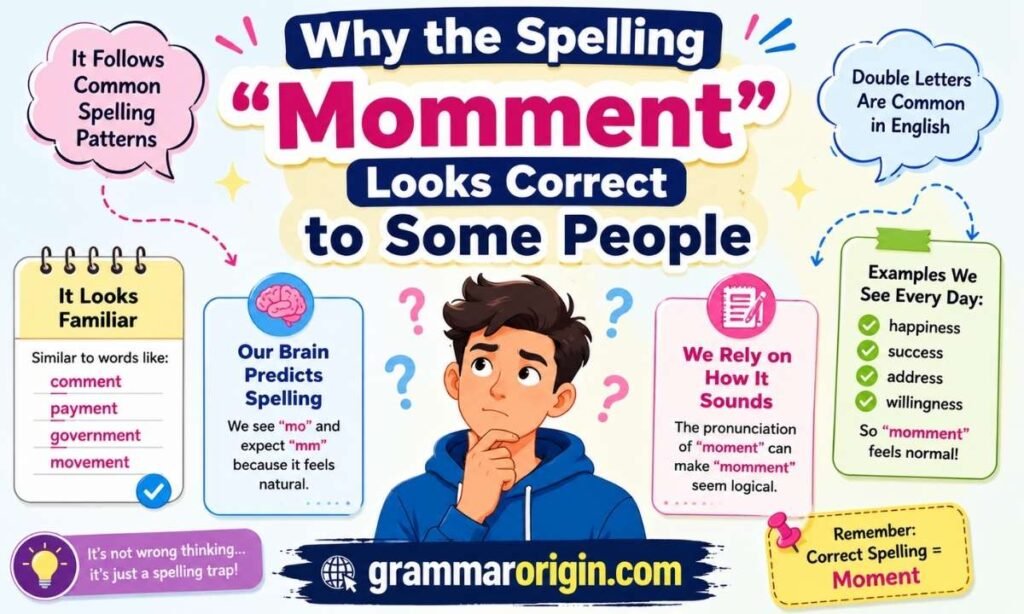
The confusion isn’t random. English is full of double-consonant words, and that pattern quietly misleads people into thinking moment should follow suit — a well-documented type of spelling interference in linguistics.
Words like comment, common, and commitment all double their consonant, so it’s an easy leap to assume moment does the same. Add in fast typing, autocorrect gaps, and a pronunciation that doesn’t clearly signal one “m” versus two, and the mistake spreads. Repeated exposure online makes it worse — once a misspelled word shows up often enough in captions and comments, it starts to look familiar even though it’s wrong. This is sometimes called the illusory truth effect in language use: repetition alone can make an error feel correct.
Read Also This Lead or LEED
How to Use Moment Correctly
Moment functions as a countable noun, so it takes “a,” “the,” or a number in front of it, and it pluralizes as moments. Getting this right is a small but useful part of overall grammar accuracy.
A few natural examples:
- Give me a moment before we start.
- That was a proud moment for the whole team.
- She waited for the right moment to speak.
- We shared some unforgettable moments last summer.
Notice how the word shifts meaning slightly depending on context — sometimes it’s about duration, sometimes about significance. Both uses are completely correct, and neither one ever needs a second “m.”
20 Examples of Moment in Sentences
- Wait a moment, I’m almost ready.
- He froze for a moment before answering.
- That was the best moment of the entire trip.
- I need a moment alone to think this through.
- She smiled the moment she saw the results.
- The room went silent for a moment.
- This is a critical moment for the business.
- They celebrated the moment as if they’d won everything.
- I’ll explain the details in a moment.
- It felt like the perfect moment to ask.
- He captured the moment on his phone.
- Every moment with them felt meaningful.
- The announcement marked a historic moment.
- She hesitated for a moment, then agreed.
- Give me one moment to check the file.
- That moment changed how she saw everything.
- We paused for a quiet moment before dinner.
- The team seized the moment and pulled ahead.
- It was a defining moment in his career.
- For a brief moment, nothing else mattered.
Popular Expressions Containing Moment
English leans on moment heavily in fixed idiomatic phrases, and each one carries its own shade of meaning.
At the Moment
This means “right now.” Example: I’m not free at the moment.
In a Moment
This means “very soon.” Example: I’ll be with you in a moment.
For the Moment
This means “temporarily” or “for now.” Example: We’re staying put for the moment.
The Moment of Truth
This describes a decisive point where the outcome becomes clear. Example: This interview is the moment of truth for her career.
A Defining Moment
This refers to an event that shapes everything after it. Example: Winning that scholarship was a defining moment for him.
Living in the Moment
This means focusing on the present instead of the past or future. Example: He’s learned to enjoy living in the moment rather than worrying ahead.
Synonyms, Antonyms, and Related Words
Synonyms
Instant, Second, Occasion, Point in time, Opportunity, Juncture, Interval
Antonyms
Eternity, Permanence, Continuity, Infinity
Related Words
Duration, Period, Timing, Experience, Timeframe, Occurrence
Swapping in a synonym here and there keeps writing from feeling repetitive, especially in longer pieces where moment might otherwise show up a dozen times. This kind of lexical variety also helps with natural, reader-friendly phrasing.
Common Grammar and Spelling Mistakes Related to Moment
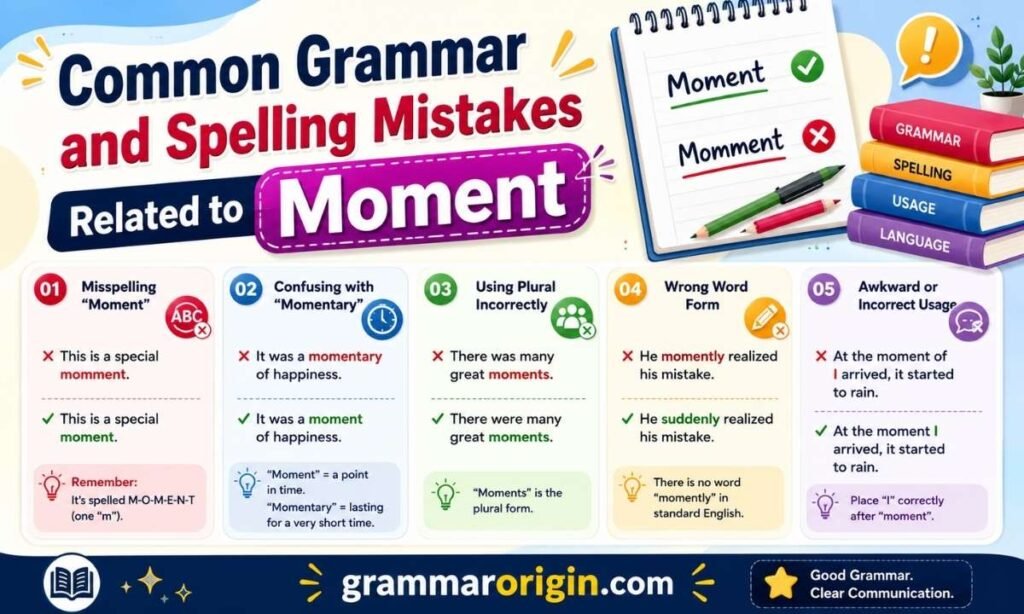
Moment vs Momentum
Moment is about time or a turning effect in physics. Momentum is about force building through motion. Example: The team lost momentum after halftime — not “lost moment.”
Moment vs Moments
Moment is singular. Moments is plural. Example: One moment changed everything versus Those moments stayed with me for years.
Moment vs Momment
Moment is the only correct spelling. Momment carries no meaning and shows up only as a typo.
Moment vs Movement
Moment refers to time. Movement refers to motion, action, or a broader social or physical shift. Example: The dancer’s movement was flawless — not “moment.”
These are all examples of commonly confused words — pairs or near-matches that trip up even confident writers, and worth reviewing alongside any grammar checklist.
Read Also This Lead or LEED
Tips for Remembering the Correct Spelling
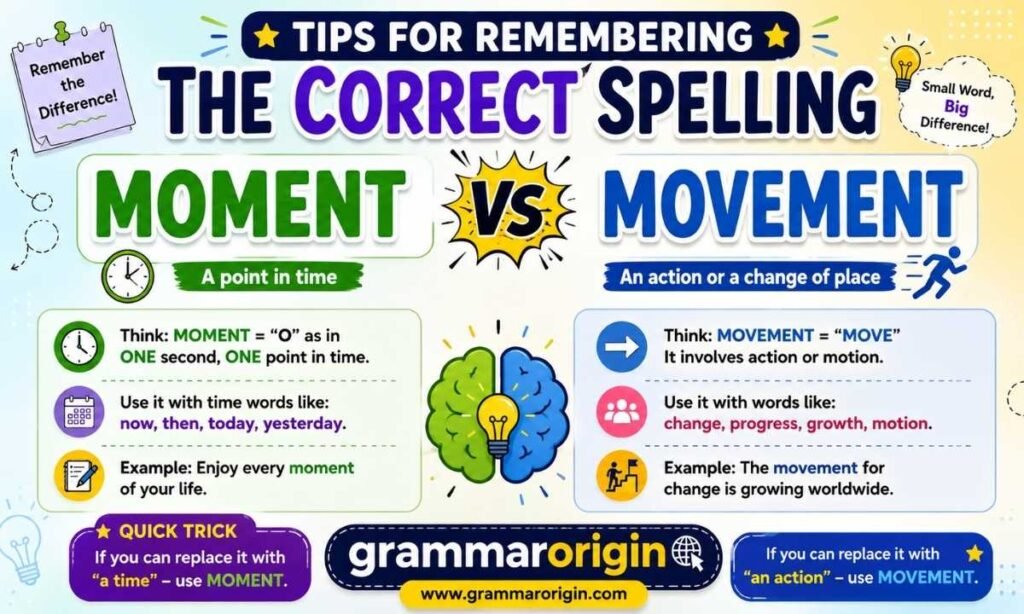
Memory Trick
Think: “a moment lasts one instant, and it needs just one middle letter.” One instant, one “m.”
Visual Learning Method
Break the word apart on paper: mo | ment. Looking at it in two clean chunks makes the missing second “m” obvious — a simple mnemonic device that works well for visual learners.
Pronunciation Method
Say it slowly out loud — “MO-ment” — and notice there’s no stress or pause that would suggest a doubled consonant. Reading your own writing aloud before hitting publish catches this error almost every time, and it’s a good habit for anyone serious about self-editing and proofreading.
Frequently Asked Questions
Is Momment a Word?
No. Momment has no dictionary listing and no accepted meaning. It’s a common misspelling of moment.
What Is the Correct Spelling: Moment or Momment?
Moment is correct, spelled with a single “m” in the middle. Momment is always wrong, in every context and every English variety.
Why Do People Spell Moment as Momment?
Mostly because of pattern confusion with double-consonant words like comment and common, plus fast typing and unclear pronunciation cues.
What Does Moment Mean?
A moment is a short period of time or a specific point that holds significance. It also has technical meanings in physics, chemistry, and statistics.
How Do You Use Moment in a Sentence?
Use it as a noun for time or importance: Please wait a moment, or That was a defining moment in her life.
Is Moment a Noun?
Yes. Moment functions almost exclusively as a countable noun, pluralizing as moments.
Is the Spelling of Moment Different in British and American English?
No. Both British and American English use moment. Momment isn’t accepted in either variety, and no regional dictionary lists it as an alternate spelling.
Conclusion
The moment vs momment debate has a clear resolution: moment is correct, and momment is simply a typo that spreads because of pattern confusion and quick typing. Once you remember the single middle “m,” the mistake becomes easy to avoid for good.
Whether you’re writing an email, an essay, or a caption, choosing moment every time keeps your writing accurate and polished, and reinforces good spelling habits overall. A quick read-aloud check before you hit send is often all it takes to catch the error before anyone else does.

Muhammad Waqas is an English language teacher and grammar expert with over 8 years of experience helping students and professionals improve their writing skills. He specializes in English grammar, vocabulary, communication, and practical language learning. Through GrammarOrigin, Waqas shares clear, easy-to-understand content that helps readers write and speak English with confidence.