
Ever agreed to meet someone “next Friday,” only to find out you had two completely different dates in mind? You’re not alone. Next Friday vs this Friday is one of the most common sources of scheduling confusion in everyday English — and it trips up native speakers just as often as learners.
This guide breaks down exactly what each phrase means, when it changes based on the day you say it, and how to avoid the mix-up entirely. By the end, you’ll know precisely which Friday someone means — every time.
Next Friday vs This Friday: Quick Answer
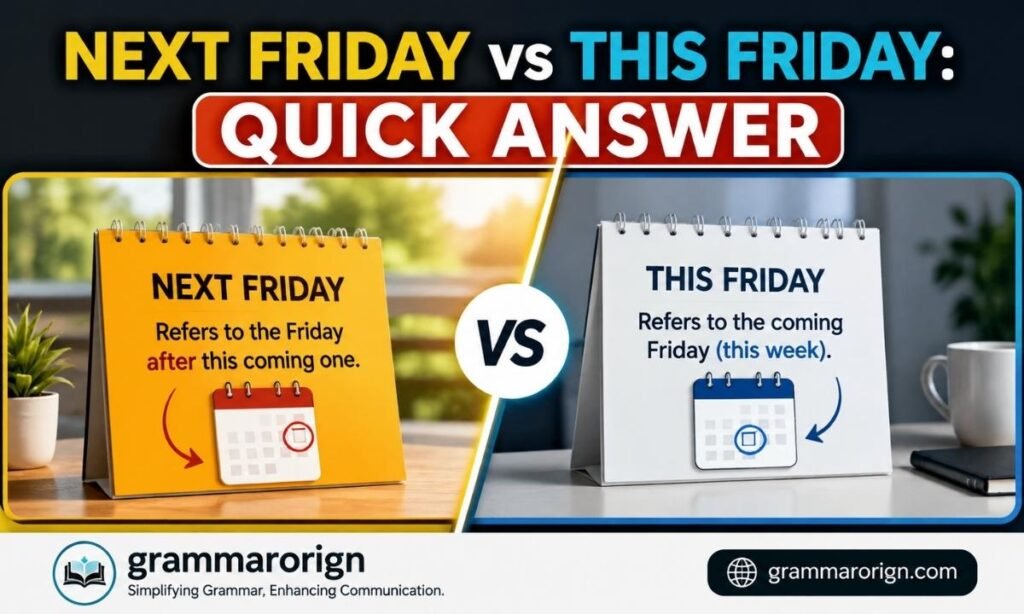
This Friday means the Friday of the current week. Next Friday usually means the Friday of the following week.
If today is Monday, this Friday is just a few days away. Next Friday is a full week after that.
The confusion starts when the day you’re speaking changes how “close” each phrase feels.
Why Does This Confusion Even Happen?
English describes time in relation to now, not fixed dates. Words like “this” and “next” shift depending on where you stand in the week.
There’s no universal rulebook for this. Different people, offices, and regions apply slightly different logic.
That gap between what one person means and what another person hears is exactly where scheduling mistakes come from.
This Friday vs Next Friday: A Simple Rule to Remember
Here’s a rule that works in almost every situation:
This Friday belongs to this week. Next Friday belongs to next week.
Think of it the same way you’d think of “this weekend” and “next weekend.” You wouldn’t confuse those — apply the same logic to Friday.
What “This Friday” Actually Means
“This Friday” refers to the nearest upcoming Friday in the current week.
If it’s Monday, Tuesday, Wednesday, or Thursday, almost everyone agrees on this meaning without needing to double-check.
Examples:
- “The report is due this Friday.”
- “Let’s grab lunch this Friday.”
- “Payment is expected this Friday.”
What “Next Friday” Really Means
“Next Friday” is where most of the disagreement happens. Two interpretations exist, and both are common enough to cause real confusion.
Calendar-Based Interpretation
Some people use “next Friday” to mean the very next Friday on the calendar — essentially the same as “this Friday.”
Under this logic, if today is Monday, next Friday is just four days away.
Conversational Interpretation
Most English speakers, especially in professional settings, use “next Friday” to mean the Friday of the following week — not this week’s Friday.
Under this logic, if today is Monday, next Friday is 11 days away, not four.
This second interpretation is more widely accepted, particularly in workplaces, schools, and formal scheduling.
Using “This Friday” on Friday Itself
Saying “this Friday” on a Friday creates its own small puzzle.
Most people interpret it as today, especially earlier in the day.
By Friday evening, though, some speakers shift toward meaning the following week’s Friday instead. Context and tone usually make the difference clear.
What Happens When the Weekend Starts

Once Saturday or Sunday arrives, “this Friday” almost always shifts to mean the upcoming Friday — the one that just passed no longer feels relevant.
“Next Friday” on a weekend usually means the same thing it always does: the Friday of the following week.
Weekend conversations are actually one of the least confusing times to use these phrases, because there’s no competing “today is Friday” ambiguity.
More Related Post Goodbye vs. Good Bye vs. Good-Bye
What About Other Days? (Monday, Thursday, Saturday)
The same logic extends beyond Friday. It applies to any day of the week.
This Monday vs Next Monday
“This Monday” is the Monday of the current week. “Next Monday” is the Monday of the following week — the same pattern as Friday.
This Thursday vs Next Thursday
Identical rule. “This Thursday” is closer, “next Thursday” is a full week further out.
This Saturday vs Next Saturday
Because Saturday sits right after Friday, confusion here mirrors the Friday problem almost exactly. When in doubt, add the date.
Real-Life Scenarios: “This Friday” in Context
Work deadlines:
“Submit your draft this Friday.” Said on a Tuesday, this is unambiguous — everyone assumes the nearest Friday.
Social plans:
“Dinner this Friday?” Friends default to the closest Friday unless another one was already discussed.
School schedules:
“Class ends this Friday.” Almost always means the current week’s Friday.
Real-Life Scenarios: “Next Friday” in Context
Project timelines:
“We’ll review it next Friday.” In most offices, this signals not this week — the following week instead.
Appointments:
“Your appointment is next Friday at 10.” Higher-stakes bookings often get a spoken clarification anyway.
Late-week conversations:
Said on a Thursday or Friday, “next Friday” almost always means the Friday of the week after.
Common Misconceptions People Make

A lot of confusion comes from assuming your own interpretation is universal. It isn’t — habits vary by workplace, region, and even family.
Grammar alone doesn’t settle the meaning either. Grammar provides structure; shared usage decides what a phrase actually communicates.
Timing matters too. The same sentence spoken on a Monday can land completely differently than it would on a Friday afternoon.
Is “Next Friday” Wrong If People Disagree on It?
No — neither interpretation is grammatically incorrect. Dictionaries define “next” as the one immediately following the current instance, which technically supports both readings depending on what you consider “current.”
The disagreement isn’t about grammar rules. It’s about which mental model — calendar week vs. nearest occurrence — the speaker is using.
Because both are valid, the safest move is confirming the date whenever it matters.
How Digital Calendars & AI Assistants Handle “Next Friday”
Most calendar apps, including Google Calendar, generally resolve “next Friday” as the following week’s Friday — not the nearest one.
This means if you tell a digital assistant “remind me next Friday” on a Monday, it will likely schedule the reminder more than a week out, even if you meant the Friday coming up in a few days.
This mismatch between machine logic and casual conversation is worth knowing — if you want the nearest Friday, it’s safer to say “this Friday” or use the exact date when setting reminders or invites.
Using These Phrases in Texts, Emails & Calendar Invites
Texting and quick messages tend to favor the calendar-based, closest-Friday reading, simply because casual conversation moves fast and people default to proximity.
Emails and formal invites benefit from extra clarity. Instead of just “next Friday,” pairing the phrase with an actual date removes all doubt.
Calendar invites solve the problem automatically, since the software attaches a fixed date regardless of the wording used in the title.
Alternative Phrases That Remove All Doubt
When the stakes are high, skip “this Friday” and “next Friday” altogether. A few safer options:
- Use the exact date: “Friday, August 14.”
- Say “this coming Friday” for the nearest one.
- Say “a week from Friday” or “Friday of next week” for the one further out.
These phrases anchor the meaning so there’s no room for two people to picture different days.
Why This Debate Keeps Coming Up
This isn’t a niche confusion — it’s one of the most commonly debated phrases in everyday English, showing up again and again in workplace disagreements, family group chats, and casual conversations between friends.
The disagreement isn’t going away because there’s no single accepted standard across English speakers. That’s exactly why confirming the date remains the most reliable habit, no matter how confident you feel about your own interpretation.
How to Avoid Confusion Completely
The most reliable fix is also the simplest: use an actual date instead of a relative phrase.
If a date feels too formal, clarifying phrases like “this coming Friday” or “Friday of next week” work almost as well.
When the plan really matters — a client meeting, a flight, a deadline — confirm the date out loud or in writing. It takes seconds and prevents real problems.
More Related Post Goodbye vs. Good Bye vs. Good-Bye
Quick Decision Guide: Which One Should You Use?

Ask yourself three questions before using either phrase:
- Are we talking about this week or next week?
- Is it early or late in the week right now?
- Would a specific date remove any chance of confusion?
If there’s even a small chance of being misunderstood, default to the date.
Quick Quiz: Test Yourself
1. Today is Monday. Someone says “let’s meet next Friday.” Under the conversational interpretation, is that this week or next week? Answer: Next week.
2. It’s Friday evening and a friend says “I’ll call you this Friday.” What do they most likely mean? Answer: Likely today, though context should confirm it.
3. You get an email on Thursday that says “the deadline is next Friday.” What’s the safest response? Answer: Ask for the exact date.
Frequently Asked Questions
Do you say “next Friday” or “this Friday”?
Use “this Friday” for the Friday of the current week and “next Friday” for the Friday of the following week. If today is close to Friday, clarify with a date.
What is the meaning of “next Friday”?
It usually means the Friday of the week after the current one, though some speakers use it to mean the very next Friday on the calendar.
Is it “next Saturday” or “this Saturday”?
The same rule applies as with Friday: “this Saturday” is the current week’s Saturday, and “next Saturday” is the following week’s.
Do you say “this Thursday” or “next Thursday”?
Both are correct depending on timing — “this Thursday” for the current week, “next Thursday” for the week after.
Is it “this Friday” or “these Friday”?
“This Friday” is correct. “These Friday” is grammatically incorrect since “Friday” is singular.
What does “next Friday” mean if said on a Sunday?
On a Sunday, “next Friday” almost always refers to the coming Friday later that same week.
Why do people disagree about what “next Friday” means?
Because English relies on relative time references rather than fixed rules, and different regions, workplaces, and individuals apply different mental models.
Final Takeaway
The difference between next Friday vs this Friday isn’t about right or wrong — it’s about shared understanding. This Friday means the current week’s Friday; next Friday usually means the following week’s.
When it truly matters, skip the guesswork. A specific date takes a few extra seconds and saves you from a missed meeting altogether.

Muhammad Waqas is an English language teacher and grammar expert with over 8 years of experience helping students and professionals improve their writing skills. He specializes in English grammar, vocabulary, communication, and practical language learning. Through GrammarOrigin, Waqas shares clear, easy-to-understand content that helps readers write and speak English with confidence.