
Signup or sign up? Use sign up for the action and signup for the form, page, or sheet where it happens. Two words make a verb, and one word makes a noun.
That small space changes the part of speech, and it trips up writers, marketers, and app designers all the time. Here’s a clear breakdown of every form, with examples you can copy.
Quick Answer
Use “sign up” when someone is doing something, and “signup” when you’re naming something. The hyphenated “sign-up” does the same job as “signup” and is the form most dictionaries list.
A quick test settles most signup or sign up doubts. If “to” fits in front of the word, it’s a verb, so write two words. If “the” or “a” fits in front, it’s a noun, so write one word or add a hyphen.
Try it with these:
- I need to sign up for the newsletter. (verb)
- The signup takes a minute. (noun)
- Here’s the sign-up link. (adjective)
Meaning and Definition of Each Word
Sign up means to join or register, and signup is the registration itself. In the signup or sign up debate, the verb is what you do, and the noun is what you fill out.
Sign Up
“Sign up” is a phrasal verb that means to join, register, or enroll in something. It pairs the verb “sign” with the particle “up,” and grammar books also call it a verb phrase.
Maya signed up for a pottery class last night, and now she won’t stop talking about clay.
Merriam-Webster describes it as signing your name, as to a contract, in order to get, do, or join something. Because it’s a verb, it changes with tense: signs up, signed up, signing up.
Signup
“Signup” is a one-word noun that names the act, the process, or the form where registration happens. It often works as an adjective in front of another noun, as in “signup form.”
You’ll see it most in tech writing, product design, and web addresses. Grammarians call a joined form like this a closed compound. Here’s how it reads:
- The signup takes less than a minute.
- Her signup email never arrived.
Sign-Up (Hyphenated): Noun or Adjective
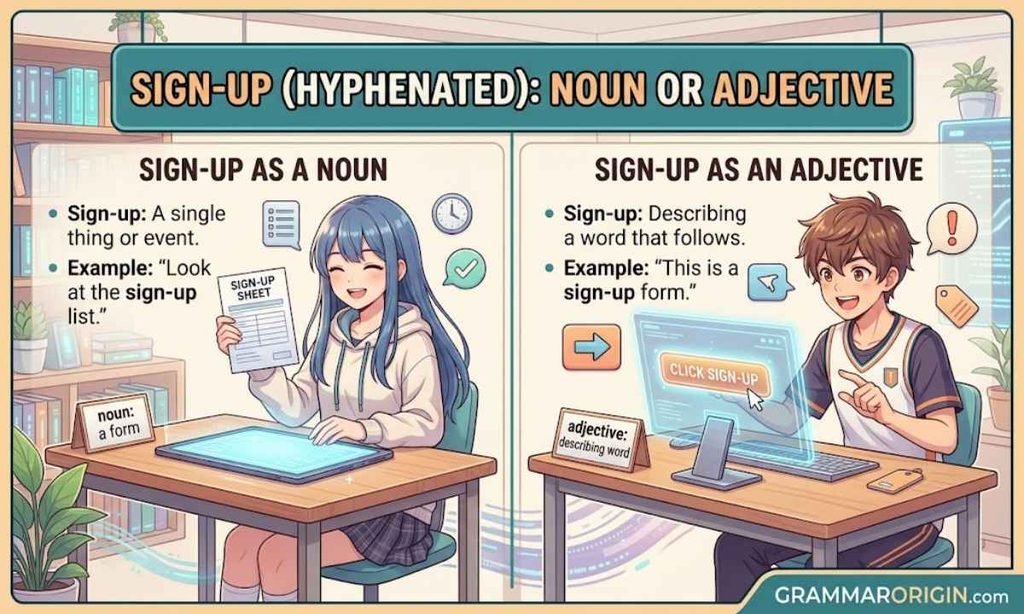
The hyphenated “sign-up” is the noun and adjective form that Merriam-Webster lists, and it means the same as “signup.”
The sign-up deadline is Monday, so don’t wait.
The hyphen links two words into one compound. Writing guides that follow AP style use it too. Pick it for news, academic, and formal writing, and stay with one style inside the same piece.
Key Differences Between the Words
The main difference is the part of speech. “Sign up” is a verb, while “signup” and “sign-up” are nouns or adjectives.
- Sign up is two words, and it changes form with tense.
- Signup is one word, and it never conjugates.
- Sign-up is hyphenated, and it never conjugates either.
Every signup or sign up choice comes back to that split. Look at what the word is doing in the sentence, not at how it looks.
For example: “I’ll sign up tonight, then send you the signup link.”
Signups or Sign-Ups: Which Spelling Is Correct?
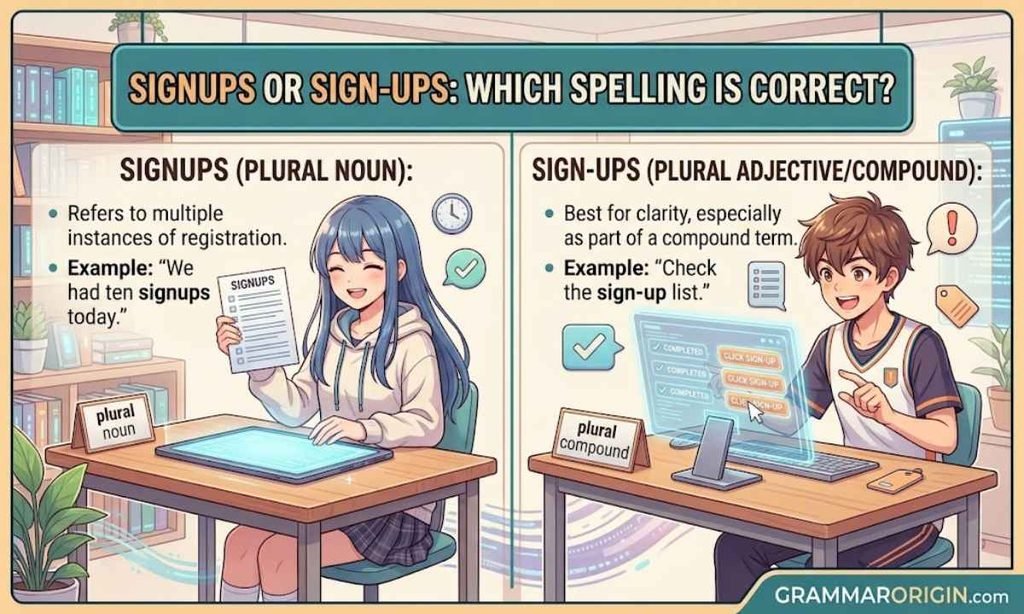
Both are correct. “Signups” matches the one-word noun, and “sign-ups” matches the hyphenated one, so the plural follows whichever noun style you chose.
Skip “sign ups” with a space when you mean the noun. That spelling mixes the verb with a plural ending, and it reads as a typo.
Last month we got 200 signups after the launch. Another team wrote it as 200 sign-ups, which is just as fine. Pick one and keep it.
Comparison Table
Here’s every signup or sign up form side by side:
| Form | Part of speech | Example | Best use |
| Sign up | Verb (phrasal verb) | Please sign up today. | Actions and instructions |
| Signup | Noun, adjective | The signup page loads fast. | Tech writing, labels, URLs |
| Sign-up | Noun, adjective | The sign-up sheet is full. | Formal and news writing |
| Signups | Plural noun | We got 50 signups. | Counting registrations |
| Sign-ups | Plural noun | Check the sign-ups. | Hyphenated style |
Verb Forms Table: Sign Up, Signed Up, Signing Up
Only the word “sign” changes when you conjugate this verb. The “up” always stays put, and the two words stay apart.
| Verb form | Example |
| Base form: sign up | I’ll sign up today. |
| Third person: signs up | She signs up every year. |
| Past: signed up | They signed up yesterday. |
| Past participle: signed up | We’ve signed up already. |
| Present participle: signing up | He’s signing up now. |
The verb is also separable. You can say “sign someone up,” and the object goes in the middle: “Dad signed me up for swim lessons.” Without an object, it’s intransitive: “I’ll sign up.”
Examples in Sentences
Two words fit actions, and one word fits things. Real sentences make the signup or sign up difference clear fast, so here are both sides, grouped by part of speech.
Using Sign Up (Verb)
Choose “sign up” any time somebody takes the action. These examples show the verb in different tenses:
- Please sign up before the seats run out.
- She signed up for a morning yoga class.
- They’re signing up for the school trip now.
- Did you sign up for the webinar?
- I always sign up for the free trial first.
Notice that each sentence has a person doing something. That’s your clue for two words.
Using Signup (Noun/Adjective)
These sentences name the thing itself, or describe another noun:
- The signup closes at noon.
- Please fill out the signup form below.
- Our newsletter signup brought in new readers.
- The signup page asks for an email address.
- A quick signup beats a long registration.
Each one would still make sense if you swapped in “registration.” That swap is a handy backup test.
Signup or Sign Up Gmail
If you mean the action, write “sign up for Gmail.” People often search it this way, even though the process creates a Google Account.
Use “signup” only when you’re naming the page or the form. Compare these:
- I want to sign up for Gmail before college starts. (action)
- The Gmail signup page asks for your name and birthday. (thing)
Your sentence tells you which one to pick. If you’re describing the steps, it’s a verb.
Read More posts Boujee or Bougie? Correct Spelling, Meaning & Difference
Signup or Sign Up Online
Online, both forms show up everywhere, and the same rule holds. Use “sign up” for the action and “signup” for the form, page, or link.
Web teams often use the one-word form in URLs, such as a /signup address. That’s a technical habit, not a grammar change.
A bakery might write: “Sign up online and get 10% off.” Its website might label the page “Online Signup” in the menu. Both are right, because they do different jobs.
Signup or Sign Up Genius
SignUpGenius is a brand name, so you copy the brand’s own spelling, with a capital S, U, and G. It’s an online tool people use to build sign-up sheets for events and volunteers.
A brand name doesn’t set a grammar rule for everyday writing. Outside the name itself, stick with the normal verb and noun split.
Example: “Use SignUpGenius to build a volunteer sign-up sheet.” The brand stays one word, and the sheet takes its normal noun form.
Signup vs Sign In vs Log In
“Sign up” creates a new account, while “sign in” and “log in” open an existing one. Think of sign up as the front door you walk through once.
“Log in” follows the same pattern as the main topic. As a verb it’s two words, and as a noun or adjective it’s one word: “login.”
- New here? Sign up to create your account.
- Back again? Log in to see your orders.
- Forgot your login details? Reset them here.
Mixing these up confuses visitors on a site, so keep the labels clear.
Signup Button or Sign Up Button?
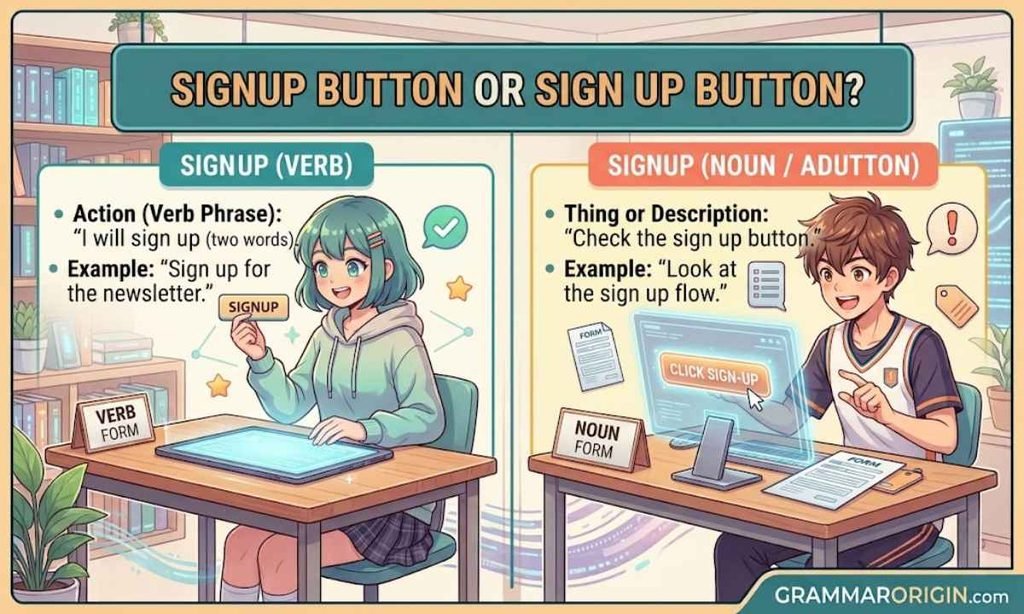
On a button, “Sign up” is usually the better label, because a button asks for an action. UX writing leans toward verb-first calls to action.
Use “signup” when the word describes something, such as a page title or a menu item. For signup or sign up on a screen, the call to action stays a verb, and the heading stays a noun.
For example, the button can say “Sign up free” while the page title says “Newsletter Signup.” Your design team may choose differently, and that’s fine if the whole site stays consistent.
Common Mistakes
Most signup or sign up errors come from using the one-word form as a verb, or the two-word form as a noun. Watch for these:
- Wrong: Please signup by Friday. Right: Please sign up by Friday.
- Wrong: I’ll sign-up tomorrow. Right: I’ll sign up tomorrow.
- Wrong: Check the sign up sheet. Right: Check the sign-up sheet or signup sheet.
- Wrong: We had many sign ups. Right: We had many signups.
- Wrong: She signuped last week. Right: She signed up last week.
The verb never takes a hyphen and never turns into one word. The noun never splits into two when it names a thing. These slips are the most common signup or sign up mistakes in emails and web copy.
Tips to Remember the Difference
A verb needs room to move, so it gets a space. A noun is a solid object, so it stays in one piece.
Here are three more shortcuts you can use:
- Put “to” in front. If it works, write two words.
- Put “the” in front. If it works, write one word or hyphenate it.
- Match the pattern of “log in” and “login.” Both pairs follow the same split.
If you still hesitate over signup or sign up, rewrite the sentence with “register.” When “register” fits as a verb, use two words.
Read More posts Boujee or Bougie? Correct Spelling, Meaning & Difference
Is Sign Up Hyphenated?
Not as a verb. In the signup or sign up puzzle, the hyphen belongs only to the noun and adjective form, “sign-up.”
So “I’ll sign up” has no hyphen, while “the sign-up form” does. Many dictionaries and style guides list the hyphenated noun, but plenty of tech writers drop it and write “signup.”
This isn’t an American English versus British English split. It’s a style choice, so follow the guide your publisher or brand uses.
Example: “Did you sign up?” stays plain, and “The sign-up list is on the door” gets the hyphen.
When to Use Each Word
Match the word to the job it does in your sentence. Then match the signup or sign up style to your audience.
- Use sign up for any action, in any kind of writing.
- Use sign-up for nouns and adjectives in formal, news, or academic pieces.
- Use signup in product copy, interface labels, and web addresses.
- Use the brand’s own spelling for names, like SignUpGenius.
A school newsletter might say: “Please sign up at the front desk. The sign-up closes Friday.” A startup might say: “Sign up now. Your signup takes seconds.” Both read naturally for their audience.
Grammar Rules
These rules keep the signup or sign up choice simple:
- Use two words, “sign up,” whenever it’s a verb.
- Use “signup” or “sign-up” whenever it’s a noun or adjective.
- Conjugate only “sign”: signs up, signed up, signing up.
- Make the plural by adding “s” to the noun: signups or sign-ups.
- Keep the object between the words when needed: sign me up.
- Stay consistent with one noun style across a whole document.
Pronunciation gives another clue. As a noun, the stress usually lands on “sign,” and as a verb, it lands on “up.”
Synonyms or Related Words
Enroll, register, and join are the closest synonyms for the verb, and registration or enrollment fit the noun. Writers who tire of repeating signup or sign up also have subscribe, apply, and opt in.
For the noun, try subscription, application, or opt-in as well. Some are casual and some are formal, so match the tone.
Here’s how they work: “Parents can enroll their kids online” replaces “sign up” in a formal notice. “Readers can subscribe to the newsletter” fits an email list better than a class.
Signup or sign up Gmail
For the noun, say “Gmail signup page” or “Gmail signup form.” The word names a place, not an action.
Marketing writers use this pattern a lot. A help article might say, “The Gmail signup page loads in your browser,” followed by, “Fill in your details and sign up.”
You can see both forms in one short paragraph. Any signup or sign up choice about Gmail follows that split: the first names the page, and the second tells the reader what to do.
Signup or sign up genius
When you’re telling people to take action on the platform, use the verb. “Volunteers can sign up on SignUpGenius” is correct.
The name stays as the brand writes it. The action around it follows normal grammar, so the sentence decides signup or sign up, not the brand.
Another example: “Where do I sign up for the bake sale on SignUpGenius?” The question asks about an action, so it takes two words. The finished list would be a signup sheet.
Summary
The signup or sign up question has one reliable answer. Two words are for the action, and one word or a hyphenated word is for the thing.
Try the “to” and “the” test, and match the style to your audience. Once you see how the verb and the noun differ, signup or sign up gets easy.
Frequently Asked Questions
Is it signup or sign up?
Signup or sign up are both correct, but they’re not interchangeable. Use “sign up” as a verb and “signup” as a noun or adjective. If someone is doing the action, write two words.
Is signup one word or two?
As a noun or adjective, it’s one word, or hyphenated as “sign-up.” As a verb, it’s always two words: “sign up.”
Is sign-up with a hyphen correct?
Yes, for the noun and adjective. Merriam-Webster lists “sign-up” that way. Never hyphenate the verb, so write “I’ll sign up,” not “I’ll sign-up.”
What’s the plural of signup?
Add an “s” to the noun: “signups” or “sign-ups.” Don’t write “sign ups” with a space for the noun.
Should a button say sign up or signup?
“Sign up” is usually better, because a button asks for an action. Use “signup” for page titles and labels that describe something.
Is signup or sign up right for Gmail?
Use “sign up for Gmail” when you mean the action. Use “Gmail signup page” when you name the page. Both can appear in one article.

Muhammad Waqas is an English language teacher and grammar expert with over 8 years of experience helping students and professionals improve their writing skills. He specializes in English grammar, vocabulary, communication, and practical language learning. Through GrammarOrigin, Waqas shares clear, easy-to-understand content that helps readers write and speak English with confidence.