
Too much to bear is the correct spelling, not “too much to bare.” The phrase means something is too painful or stressful to put up with. Only bear carries that meaning.
Because the two words sound identical, too much to bear or bare trips up even careful writers. This guide breaks down each word, shows where people slip, and gives quick tricks to pick the right one every time.
Quick Answer
The correct phrase is “too much to bear.” The version with “bare” is a spelling mistake.
In this idiom, bear is a verb that means to endure or carry a heavy load. Bare means uncovered, so it doesn’t fit pain, stress, or grief. Whenever the too much to bear or bare question pops up, the answer is bear.
Too much to bear meaning: so painful or hard that a person can’t endure it.
Example:
The waiting felt too much to bear.
Meaning and Definition of Each Word
Bear means to endure or carry, while bare means uncovered. They’re homophones, so they sound the same but differ in meaning. That’s why too much to bear or bare causes so many slips.
1. Bear
Bear is mainly a verb that means to carry, hold up, or put up with something. It’s also the noun for the large, furry animal.
Example:
She couldn’t bear the silence after the news.
In that sentence, the verb is about enduring. The same word also covers holding weight, giving birth, and showing a quality, such as a family resemblance. It goes back to the Old English word beran.
2. Bare
Bare is mostly an adjective that means uncovered, empty, or plain. As a verb, it means to uncover or reveal something.
Its verb forms are bares, bared, and baring. It comes from the Old English word bær, so it was a separate word from the start.
Examples:
The shelves were bare by noon.
He bared his teeth at the dog.
Too Much to Bear or Bare: How Do You Pronounce It?
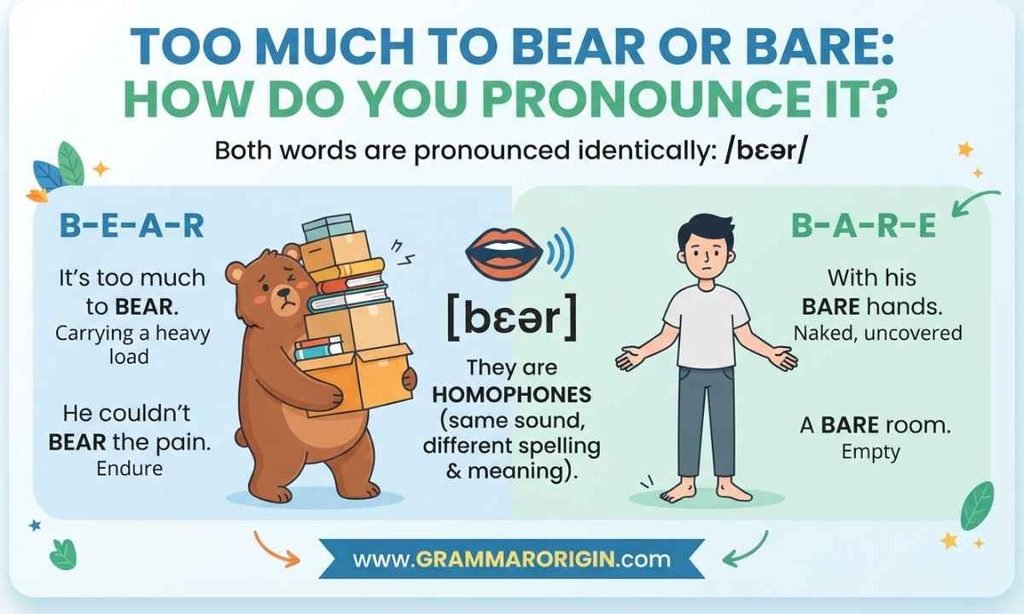
Both words sound exactly the same. Dictionaries usually show /bɛr/ in American English and /beə/ in British English.
Example:
The bear at the zoo and the bare branches in winter sound identical.
That means your ear can’t settle too much to bear or bare. The right choice comes from meaning and spelling, not sound.
Key Differences Between the Words
The main difference in bear vs bare is the job each word does. Bear is about enduring or carrying, while bare is about being uncovered.
Example:
I can’t bear the noise, so I’m leaving the room.
Here’s the split in four quick points:
- Meaning: bear is to endure or carry. Bare is uncovered or to uncover.
- Part of speech: bear is mostly a verb (and an animal noun). Bare is an adjective or a verb.
- Typical setting: bear fits pain, weight, and responsibility. Bare fits skin, surfaces, and secrets.
- Forms: bear is irregular (bore, borne). Bare is regular (bared).
Comparison Table
This table puts both words side by side, so you can settle too much to bear or bare in a few seconds.
| Feature | Bear | Bare |
| Core meaning | To endure, carry, or tolerate | Uncovered, empty, or to uncover |
| Part of speech | Verb (also a noun for the animal) | Adjective or verb |
| Typical use | Pain, stress, weight, responsibility | Skin, surfaces, feelings, secrets |
| Past tense | bore, borne | bared |
| Pronunciation | /bɛr/ | /bɛr/ |
| Right for “too much to ___”? | Yes | No |
If you’re stuck, the last row settles it: only bear fits in this phrase.
Example:
It was too much to bear, but the room was bare.
Examples in Sentences
Bear fits sentences about enduring or carrying, while bare fits sentences about something uncovered. These lists make the too much to bear or bare difference easy to see.
Using “Bear” Correctly
Bear works any time the sentence is about enduring, carrying, or tolerating something.
Examples:
The sadness was too much to bear.
I can’t bear this traffic anymore.
She had to bear a lot of responsibility at work.
He couldn’t bear the thought of leaving.
This heat is too much to bear at noon.
Who will bear the cost of the repairs?
Ask for help if you can’t bear the pain.
Think of bear as the “heavy” word in too much to bear or bare. If the sentence carries weight, pain, or a duty, this is the spelling you want.
Using “Bare” Correctly
Bare works when something is uncovered, empty, or revealed. In too much to bear or bare, it’s the “open” word that doesn’t belong.
Examples:
The kids ran across the grass with bare feet.
The walls were bare except for one clock.
He bared his soul in the final speech.
The mountain stood bare above the tree line.
She bared her feelings in a long letter.
The cupboard was bare by Friday.
Common Mistakes
The most common mistake is writing “too much to bare” instead of “too much to bear.” It’s one of the most common spelling mistakes with homophones, and it shows up most in emotional writing.
Incorrect vs Correct Usage
| Incorrect | Correct |
| The pain was too much to bare. | The pain was too much to bear. |
| I can’t bare this stress. | I can’t bear this stress. |
| Bare with me for a moment. | Bear with me for a moment. |
| Who will bare the cost? | Who will bear the cost? |
| Bare in mind that it’s late. | Bear in mind that it’s late. |
The first row is the classic slip behind the too much to bear or bare confusion.
Why This Happens
The main reason is simple: the words are homophones, so too much to bear or bare looks fine to a fast typist. When you type quickly, your brain pulls up the spelling it has seen most with a certain feeling.
Phrases like “bare your soul” and “laid bare” also tie bare to emotion. That makes “too much to bare” look believable on the page, even though it isn’t. Spell checkers don’t always flag the spelling error either, since both words are real.
Example:
He typed “it was too much to bare,” and spell check didn’t flag it.
Also Read This Hunny or Honey: Which Spelling Is Correct? Meaning
Tips to Remember the Difference
Link bear to burden and bare to body, and you won’t mix them up. These three tricks make too much to bear or bare easy to remember.
1. Bear = Burden
Picture a bear carrying a heavy load on its back. To bear a burden means to carry it, and that’s the sense used in the idiom.
Example:
The family had to bear the burden alone.
Here’s another hook: the word forbear (to hold back or put up with) has bear hidden inside it. If that sticks in your head, you’ll connect bear with enduring.
2. Bare = Body
Think of bare skin, bare feet, and bare hands. All of them are about the body or a surface with nothing covering it.
If the sentence is about something visible, empty, or uncovered, bare is your word.
Example:
He walked across the hot sand in bare feet.
3. Sentence Trick
When too much to bear or bare stumps you, swap in “endure.” If “too much to endure” makes sense, you need bear. If you swap in “uncover” and the sentence sounds odd, bare is wrong.
Example:
“It was too much to bear” becomes “It was too much to endure,” which works.
“It was too much to bare” becomes “too much to uncover,” which doesn’t.
When to Use Each Word
Pick the word by the idea behind the sentence. In too much to bear or bare, burden and endurance call for bear, while exposure and emptiness call for bare.
Use “Bear” When:
Use bear in too much to bear or bare, and in any sentence about enduring, carrying, or tolerating something.
- You’re describing pain, stress, or grief.
- You mean carry or support a weight.
- You mean tolerate or stand something.
- You’re using a fixed phrase like bear with me, bear in mind, or bear fruit.
Examples:
The loss was hard to bear.
These pillars bear the weight of the bridge.
I can’t bear loud chewing.
Use “Bare” When:
Use bare when something is uncovered, empty, plain, or revealed.
Examples:
The floor was bare.
He lives with only the bare necessities.
She bared her secret.
Do the bare minimum to pass.
Those sentences map to four uses of bare:
- Something has no covering.
- Something is empty or plain.
- You mean reveal or expose.
- You’re describing the minimum.
Grammar Rules (If Applicable)
In “too much to bear,” bear is a verb after “to.” Bare is an adjective or a verb, but it never fits here.
In too much to bear or bare, only bear fits. “Too much” says how big the thing is, and “to bear” says what you can’t do with it. This follows a common English grammar pattern: “too much to” plus a verb.
Dictionaries such as Collins and Merriam-Webster list bear mainly as a verb and bare mainly as an adjective.
A few more rules help:
- Bear is irregular: bear, bore, borne. Bare is regular: bare, bared, baring.
- Use borne for carrying or enduring.
- Use born only for birth.
- Bear usually takes an object: you bear something. Bare can stand alone as an adjective.
Examples:
They have borne this burden for years.
He was born in May.
A bare floor needs no verb to work.
Bear Verb Forms Table
Bear is an irregular verb. Its past tense is bore, and its past participle (the form after has or have) is borne or born. Collins English Usage lists bears, bore, and borne as its other forms. In too much to bear or bare, you only need the base form.
| Form | Use | Example |
| bear | Base form | I can’t bear it. |
| bears | Third person singular | She bears the stress well. |
| bore | Simple past | He bore the pain quietly. |
| borne | Past participle (carry, endure) | The cost was borne by the firm. |
| born | Past participle (birth only) | The baby was born at dawn. |
| bearing | Present participle | They’re bearing a heavy load. |
Synonyms or Related Words
Endure, tolerate, and withstand work for bear, while reveal, expose, and uncover work for bare. Testing a synonym is a quick way to settle too much to bear or bare.
Also Read This Hunny or Honey: Which Spelling Is Correct? Meaning
Synonyms of “Bear” (Endure)
Bear has many close synonyms, and most of them point to enduring or carrying.
- Endure
- Tolerate
- Withstand
- Stand
- Handle
- Put up with
- Stomach
- Shoulder
- Carry
Example:
He couldn’t stand the delay, which means he couldn’t bear it.
Of “Bare” (Expose)
Bare has synonyms that point to uncovering, plus a few adjectives for empty or plain things.
Example:
The report laid bare the company’s mistakes, which means it exposed them.
- Uncover
- Reveal
- Expose
- Unveil
- Show
- Lay open
- Naked (adjective)
- Plain (adjective)
- Empty (adjective)
Too Much to Bear or Bare: Common Phrases With Bear and Bare
Bear with me and bare minimum are both correct, but they use different spellings. Many idioms hide the same mix-up as too much to bear or bare.
| Phrase | Meaning | Correct spelling |
| bear with me | Be patient with me | bear |
| bear in mind | Keep in mind | bear |
| bear fruit | Produce good results | bear |
| bear the pain | Endure pain | bear |
| bear a burden | Carry a heavy duty or load | bear |
| bear a grudge | Hold resentment | bear |
| grin and bear it | Accept something unpleasant calmly | bear |
| a cross to bear | A long-term burden | bear |
| bear witness | Give evidence or testify | bear |
| bear arms | Carry weapons | bear |
| bare minimum | The smallest amount possible | bare |
| bare necessities | Only the essentials | bare |
| laid bare | Fully exposed | bare |
| bare your soul | Share your deepest feelings | bare |
| bare arms | Uncovered arms | bare |
The “bear with me or bare with me” question has one answer: bear. Also, “bear arms” and “bare arms” are both real, but they mean different things. One is about carrying weapons, the other about uncovered limbs.
Examples:
Please bear with me while I find the file.
Keep costs to a bare minimum this month.
I can t bear it or bare it
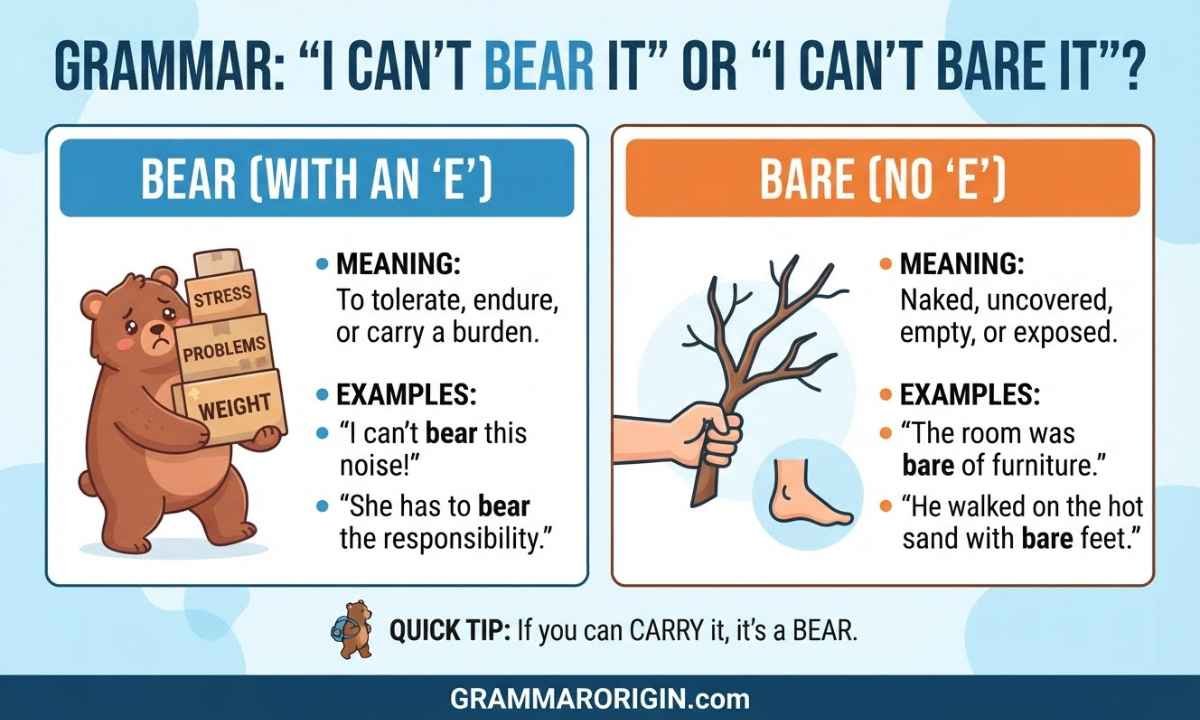
Writing “I can’t bear it” is correct when you mean you can’t stand something. “I can’t bare it” is a spelling error, just like too much to bear or bare gone wrong.
Examples:
I can’t bear to watch this scene.
He’ll bare his chest at the beach.
“Bare it” would mean uncover it, as in “bare it all.” So match the verb to your meaning. The first example is about endurance, and the second is about exposure.
A good habit is to say the sentence with “stand” in place of the verb. If “I can’t stand it” works, write bear.
“Can’t Bear” vs “Can’t Stand”
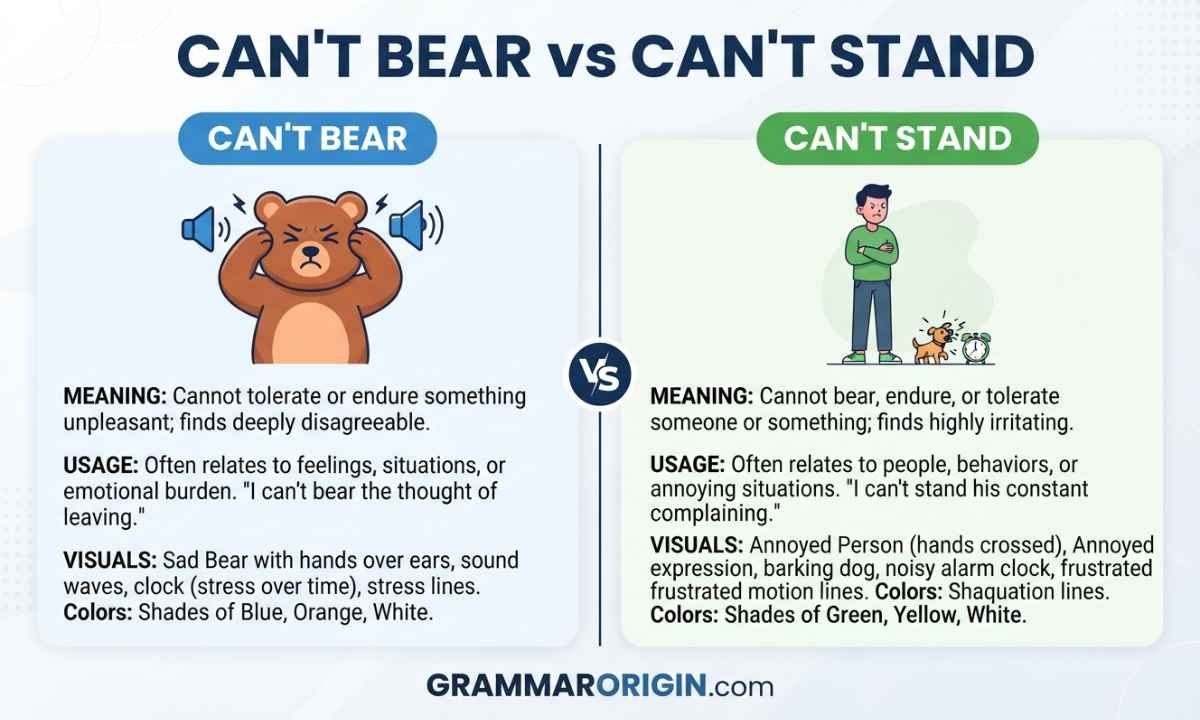
Both express strong dislike or an inability to cope, much like the idea behind too much to bear or bare. “Can’t bear” often sounds more emotional, while “can’t stand” feels more casual.
Either way, bare never belongs in the sentence.
Examples:
I can’t bear to see her cry.
I can’t stand this song.
The first one is about something that hurts, and the second is plain annoyance.
Summary
The answer to the too much to bear or bare question is simple: write bear. It means to endure, and it’s the only spelling that fits when something feels too heavy to handle.
Keep bare for things that are uncovered or revealed, like bare feet or a bare wall. Use the endure test whenever too much to bear or bare comes up, and you’ll get it right.
Frequently Asked Questions
Is it too much to bear or bare?
It’s “too much to bear.” Bear means to endure, while bare means uncovered.
What does “too much to bear” mean?
It means something is so painful or stressful that you can’t cope with it.
Can “bare” ever fit in “too much to bare”?
Only in a joke about showing skin. For a burden, always write bear.
Is it “bear with me” or “bare with me”?
It’s “bear with me,” which means “be patient with me.”
Why do people mix up too much to bear or bare?
The words are homophones, so they sound identical and writers pick by ear.
What is the past tense of bear?
The past tense is “bore,” and the past participle is “borne.” Use “born” only for birth.

Muhammad Waqas is an English language teacher and grammar expert with over 8 years of experience helping students and professionals improve their writing skills. He specializes in English grammar, vocabulary, communication, and practical language learning. Through GrammarOrigin, Waqas shares clear, easy-to-understand content that helps readers write and speak English with confidence.