
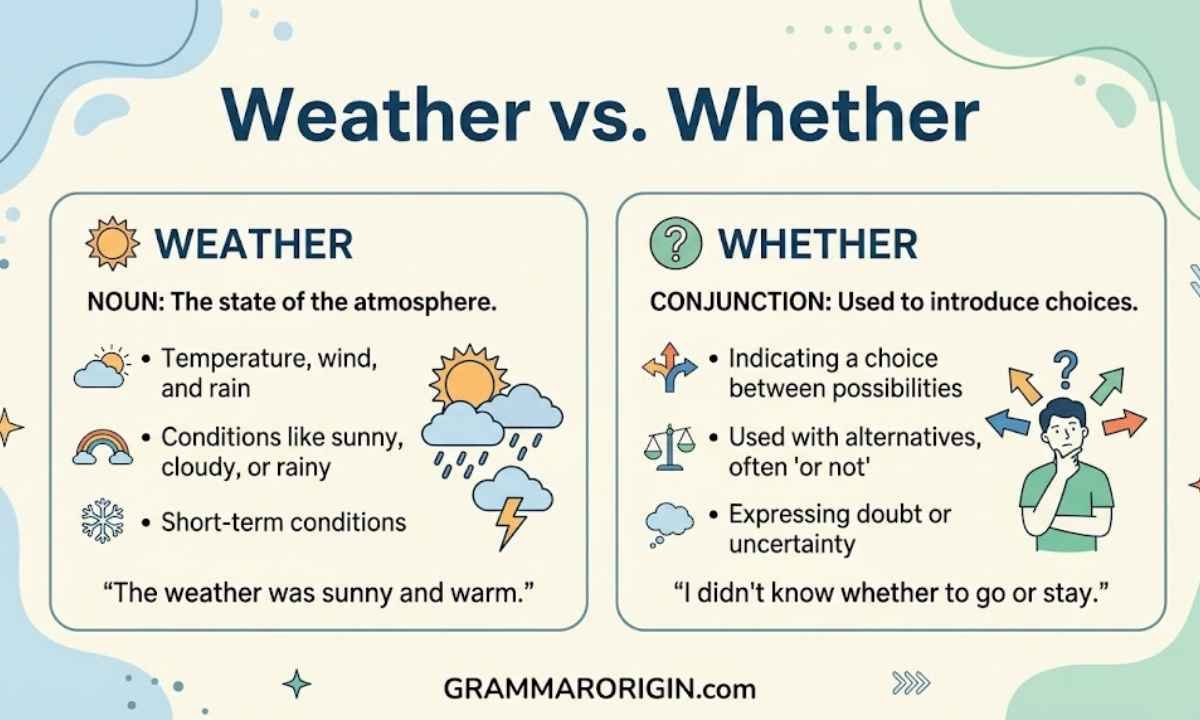
Weather means sky conditions, whether signals a choice, and wether is a neutered ram. That’s the quick answer to Weather, Whether, or Wether, and the sections below show how each word works in real sentences.
These words sound the same in most accents, and spell check won’t catch the slip because all three are real words. You’ll get plain definitions, a simple test, clear examples, and memory tricks that make the right choice automatic.
The Short Answer
Use weather for the sky, whether for choices and doubts, and wether for a castrated male sheep or goat. In everyday writing, only the first two really matter.
Here’s each member of Weather, Whether, or Wether in a sentence:
- The weather looks perfect for a picnic.
- She asked whether the train had left yet.
- The farmer fed the wether first.
The Weather, Whether, or Wether mix-up happens because the words sound alike, not because they mean alike. In the Weather, Whether, or Wether trio, two are everyday words and one is a livestock term. Unless you’re writing about farm animals, you can safely cross wether off your list.
Weather
Weather means the atmospheric conditions at a certain place and time, such as heat, rain, wind, and sunshine. As a verb, it means to get through something hard or to wear down from exposure.
Meteorologists use the noun for temperature, humidity, rainfall, and wind. You’ll also see it in everyday phrases like weather forecast, weather report, and weather app. In those phrases, weather is still a noun.
Grammar books call it an attributive noun, which just means a noun that sits in front of another noun and describes it.
As a noun:
- Weather in the mountains can change within an hour.
- Check the weather before you pack the car.
When weather works as a verb, it has two main meanings. The first is to come through a difficult time. The second is to change or wear away because of sun, wind, and rain.
As a verb:
- Small shops had to weather the recession on thin margins.
- The cliffs have weathered into strange, smooth shapes.
Of everything in Weather, Whether, or Wether, this is the spelling you’ll type most.
Weather as a Verb: Forms Table
As a verb, weather has four forms: weather, weathers, weathered, and weathering. It’s a regular verb, so the endings follow the usual pattern.
| Form | When you use it | Example |
| weather | Base form, or present tense with I, you, we, they | We can weather this storm together. |
| weathers | Present tense with he, she, or it | The old bridge weathers every winter without a crack. |
| weathered | Past tense, past participle, or a describing word | The boat weathered the gale. |
| weathering | The -ing form, or the process itself | Weathering breaks rock down over thousands of years. |
The form weathered also works as an adjective. It describes something that looks worn by the outdoors, and it’s often a compliment.
- Years at sea gave him a weathered face.
- The weathered fence still stood after the flood.
Whether has no verb forms at all, which is a neat clue when you’re sorting out Weather, Whether, or Wether.
Whether
Whether is a linking word (a conjunction) that introduces a choice, a doubt, or an indirect question, which is a question tucked inside a longer sentence. It tells the reader that more than one outcome is possible.
Quick look at how it sounds in use:
- I can’t decide whether to call or send a message.
- He wondered whether anyone had noticed the mistake.
- Whether you love it or hate it, the rule applies.
Whether often travels with “or”, but it doesn’t have to. In “I don’t know whether she’s ready,” the second option is hidden. The sentence quietly means “ready or not ready.”
Think of it as the choice word in Weather, Whether, or Wether. Grammar books call it a subordinating conjunction, because it starts a smaller part of a sentence that depends on the main part.
You’ll meet it in three common jobs. It can offer two options, show doubt after verbs like wonder, ask, and know, or mean “no matter if” at the start of a sentence.
A Quick Test for “Whether”
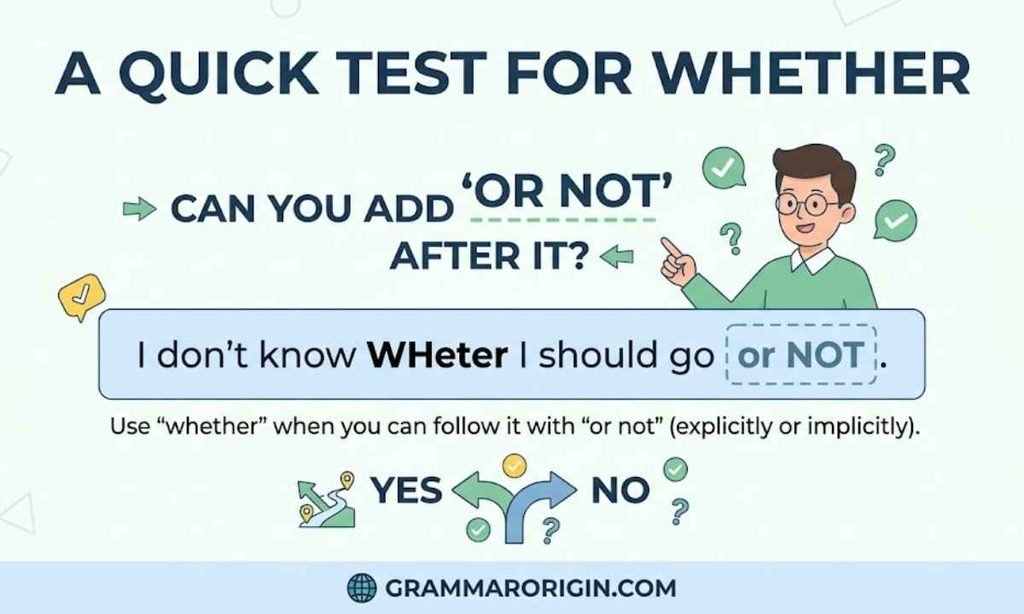
To check whether you need whether or weather, swap in “if” or add “or not” to the end of the clause. If the sentence still makes sense, whether is your word.
Try it on this sentence:
- I’m not sure whether the store is open.
- Swap in “if”: I’m not sure if the store is open. It works.
- Add “or not”: I’m not sure whether the store is open or not. It works.
Now try it on a sentence that needs weather:
- We watched the weather all week.
- Swap in “if”: We watched the if all week. It makes no sense, so the word is weather.
For the Weather, Whether, or Wether question, this test settles most cases in seconds. It’s a shortcut, not a full rule. “If” can’t replace whether in every spot, and the next heading shows exactly where it fails.
Read More Related Post Complimentary vs. Complementary: What Is the Difference?
Whether vs If: When “If” Does Not Work
Use whether when “if” sounds wrong. That happens before “to”, after a preposition, right before “or not”, and at the start of a sentence as the subject.
Mixing up whether and if is a separate problem from Weather, Whether, or Wether, but the two often tangle together. These grammar rules are easy to remember, because only whether fits all four spots below.
Before “to”:
- Incorrect: I can’t decide if to go.
- Correct: I can’t decide whether to go.
After a preposition:
- Incorrect: We argued about if we should move.
- Correct: We argued about whether we should move.
As the subject of a sentence:
- Incorrect: If he wins doesn’t matter to me.
- Correct: Whether he wins doesn’t matter to me.
Right before “or not”:
- Incorrect: Tell me if or not you’re coming.
- Correct: Tell me whether or not you’re coming.
There’s one more difference worth knowing. “If” sets up a real condition, where one thing causes another. Whether means the outcome doesn’t change either way.
- If it rains, we’ll stay home. (Rain decides the plan.)
- Whether it rains or not, we’ll be there. (Rain changes nothing.)
Whether or Not: Is “or not” Needed?
“Whether or not” is correct and very common, but “or not” is often optional. Keep it when you want to stress “regardless”, and drop it in a plain question.
Both of these are fine:
- I wonder whether it will rain.
- I wonder whether or not it will rain.
The first sounds cleaner. The second adds a little emphasis. Style guides lean toward the shorter version when “or not” adds nothing, but neither one is an error.
Where people really slip in Weather, Whether, or Wether is spelling the phrase with the wrong first word. A very common typo is weather or not, and it shows up in emails, captions, and social posts.
- Incorrect: Weather or not you agree, the vote is final.
- Correct: Whether or not you agree, the vote is final.
- Also wrong: If or not you agree. Native speakers don’t say it.
Wether
A wether is a male sheep or goat that was castrated, usually when it was young. In plain terms, it’s a castrated ram or billy goat, and the word belongs to sheep and goat farming.
Wethers are kept for wool, for meat, as calm companions in a flock, and in some places as pack animals. They also show up in junior livestock shows and county fairs. Because they’re neutered, they tend to be gentler and easier to handle than rams and bucks.
These terms help keep the animals straight:
- A ram is a male sheep that hasn’t been castrated, and a ewe is a female sheep.
- A buck, or billy, is a male goat that hasn’t been castrated, and a doe, or nanny, is a female goat.
- A wether is a castrated male of either animal.
Of the Weather, Whether, or Wether set, wether is the only word that names an animal.
Wether in a sentence:
- The student led her wether into the show ring.
- Three wethers grazed beside the barn.
- The farm bought two wethers for their fine wool.
Bellwether and the Origin of “Wether”
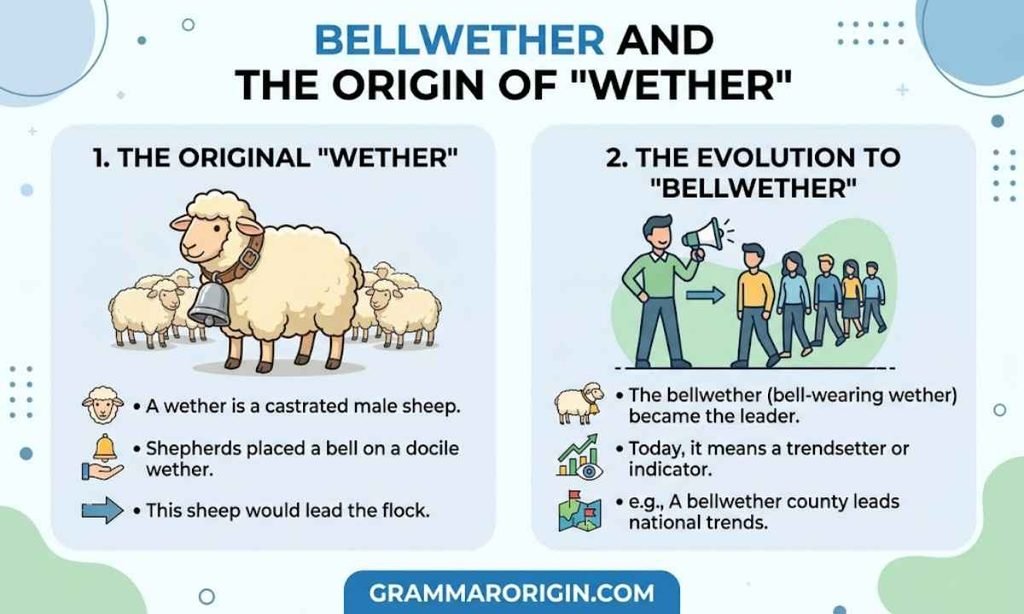
Bellwether comes straight from wether. It was the lead sheep in a flock, wearing a bell around its neck so the rest of the animals and the shepherd could follow the sound.
Today a bellwether is anything that points the way for others. Reporters use it for early signs of a trend, such as a county that tends to match national election results or a stock that predicts market mood. That makes the farm word in Weather, Whether, or Wether more useful than it looks.
- Retail sales are often treated as a bellwether for the wider economy.
- The company’s quiet launch served as a bellwether for the whole industry.
All three words in Weather, Whether, or Wether come from Old English, but they grew from separate roots. That’s why their spellings and meanings drifted apart even though they now sound the same.
Spelling note: the correct form is bellwether, ending in the farm word. The versions bellweather and bellwhether are both misspellings.
Where the Confusion Comes From
Two things cause most Weather, Whether, or Wether mix-ups: the identical sound and fast typing. Weather and whether even share seven letters and the same ending, so they blur together on a screen.
These three are a classic case of commonly confused words. Major dictionaries, including Merriam-Webster and the Oxford English Dictionary, list them as three separate entries.
Spell check makes it worse. Since weather, whether, and wether are all real words, a basic checker has no reason to flag them. That’s why Weather, Whether, or Wether errors survive so many proofreads. Only a careful read-through, or a grammar tool that looks at context, will catch them.
Here’s what the slips look like:
- Incorrect: I can’t tell weather she’s joking.
- Correct: I can’t tell whether she’s joking.
- Incorrect: The whether is lovely today.
- Correct: The weather is lovely today.
- Incorrect: We saw a weather grazing in the paddock.
- Correct: We saw a wether grazing in the paddock.
A frequent slip is typing weather when you mean whether. It’s understandable, since weather is the word people see and type more often.
Pronunciation and Homophones
In most English accents, all three words sound exactly alike. In the International Phonetic Alphabet (IPA), that’s /ˈwɛðər/. Words that sound the same but have different spellings and meanings are called homophones, and Weather, Whether, or Wether is a textbook example.
A few accents, including some Scottish, Irish, and American ones, still keep a breathy “hw” sound at the start of whether, so it can sound like /ˈhwɛðər/. In those accents, whether stands apart from the other two, but everywhere else the three are twins.
Because you can’t hear any difference in Weather, Whether, or Wether, you can’t rely on your ear. Spelling is the only thing that separates them, which is why a few memory tricks help so much.
How to Remember the Difference
For Weather, Whether, or Wether, link each spelling to a picture. Weather has an “a” like atmosphere, whether has the “wh” of which and what, and wether starts with “wet”, like a sheep caught in the rain.
Here are the hooks one by one:
- Weather: the “a” stands for atmosphere, the air around us.
- Whether: it begins with “wh”, just like the question words which, what, and when. It asks you to pick between options.
- Wether: it begins with “wet”. Picture a soggy sheep standing in a field.
An easy memory trick is a sentence that holds all three:
- The shepherd wasn’t sure whether his wether could weather the weather.
That one sentence covers Weather, Whether, or Wether in a single breath. Say it out loud once or twice. It’s a silly tongue twister, but the silliness is exactly why it sticks.
Read More Related Post Complimentary vs. Complementary: What Is the Difference?
Quick Reference
Weather is the sky or surviving hardship, whether is a choice or doubt, and wether is a castrated male sheep or goat. This Weather, Whether, or Wether table puts every key detail in one place.
| Word | Part of speech | Core meaning | Memory hook | Example |
| Weather | Noun, verb | Sky conditions; to endure or wear down | “a” for atmosphere | The weather cleared by noon. |
| Whether | Conjunction | Introduces a choice or doubt | “wh” like which | I don’t know whether he called. |
| Wether | Noun | Castrated male sheep or goat | Starts with “wet” | The wether stayed near the gate. |
When you’re stuck on Weather, Whether, or Wether, ask one question: is this about the sky, a choice, or a sheep? The answer picks the spelling for you.
Weather or whether the storm
The correct phrase is “weather the storm”, with weather, because here it’s a verb meaning to survive. “Whether the storm” is right only when it opens a doubt, like “whether the storm will hit.”
The verb weather takes an object, the thing you come through. That object can be a storm, a crisis, a recession, or a bad year.
Mixing these up in this phrase is a classic Weather, Whether, or Wether error. The phrase has roots in sailing, where a ship that came through rough seas safely was said to have weathered them.
- Incorrect: The company whether the storm of rising costs.
- Correct: The company weathered the storm of rising costs.
Both words can sit in the same sentence without trouble, because each does a different job:
- We don’t know whether the village can weather the storm.
- Whether the team can weather this slump is the big question.
Here’s an easy check. If you can swap in “survive” or “get through”, you need weather. If you can swap in “if” or add “or not”, you need whether.
Weather it be good or bad
The correct version is “whether it be good or bad”, with whether. This typo is the Weather, Whether, or Wether problem in its purest form. The sentence offers two outcomes, and that is exactly the job whether does.
“Whether it be” is a formal, slightly old-fashioned form. In modern writing, most people say “whether it’s good or bad,” and both versions are fine. What isn’t fine is writing weather in that spot.
- Incorrect: Weather it be good or bad, we’ll finish the job.
- Correct: Whether it be good or bad, we’ll finish the job.
- Natural modern version: Whether it’s good or bad, we’ll finish the job.
There’s a catch, though. “Weather it” can be correct when weather is a verb and “it” is the thing being survived. Look at the meaning before you decide.
- Correct: This is a tough year, but we’ll weather it.
- Correct: Can the old roof weather it one more winter?
A handy shortcut is to try “regardless of whether” in the gap. If it fits, spell it with an h. That one habit clears up most Weather, Whether, or Wether slips in this phrase.
Common Phrases and Idioms
Weather shows up in idioms about health, hardship, and loyalty, while whether lives in fixed phrases about choice. Knowing them makes Weather, Whether, or Wether choices far easier.
Under the weather means feeling a little sick.
- She stayed home because she felt under the weather.
Weather the storm means to get through a hard period.
- The restaurant weathered the storm by offering takeout.
Fair-weather friend means someone who’s only around when things go well.
- He turned out to be a fair-weather friend once the money ran out.
Keep a weather eye open means to stay alert for trouble.
- Keep a weather eye open for delays on the highway.
Make heavy weather of is mostly British English and means to make something look harder than it is.
- Don’t make heavy weather of a simple form.
Whether has its own set of fixed phrases. Whether or not and whether you like it or not are the two you’ll hear most.
- Whether or not we win, the effort counts.
- Whether you like it or not, the deadline is Friday.
Weather vs Climate
Weather is what the air and sky are doing right now or this week, while climate is the long-term pattern for a region. Climate is usually averaged over about 30 years, a standard used by the World Meteorological Organization.
A simple way to hold the difference in your head is this: weather is your mood today, and climate is your personality. One changes quickly, and the other changes slowly.
- A desert has a dry climate, but a surprise storm there is still weather.
- Tuesday’s cold snap is weather, while mild winters over decades describe climate.
Climate isn’t part of the Weather, Whether, or Wether mix-up, but it often appears next to weather in writing about forecasts, seasons, and climate change.
Final Thoughts
Weather, Whether, or Wether comes down to three jobs. Weather names the sky and the act of surviving a hard stretch, whether opens a choice or doubt, and wether is a farm word for a neutered male sheep or goat.
Run the quick tests, say the tongue twister once, and the right spelling will start to feel automatic. Save this Weather, Whether, or Wether guide for the next time your fingers type faster than your brain checks.
Frequently Asked Questions
What is the difference between weather, whether, and wether?
Weather means sky conditions, whether introduces a choice or doubt, and a wether is a castrated male sheep or goat. That’s the whole Weather, Whether, or Wether difference.
Is it “whether or not” or “weather or not”?
It’s “whether or not.” Weather can’t introduce a choice.
What is a wether?
A wether is a castrated male sheep or goat. It’s the rarest word in Weather, Whether, or Wether.
Is it “weather the storm” or “whether the storm”?
It’s “weather the storm.” Here weather is a verb meaning to survive.
How do you pronounce weather, whether, and wether?
All three are pronounced /ˈwɛðər/ in most accents. Spelling, not sound, separates the words in Weather, Whether, or Wether.
Can I use “if” instead of “whether”?
Only sometimes. “If” works in casual indirect questions, but not before “to,” after a preposition, or as a sentence subject.

Muhammad Waqas is an English language teacher and grammar expert with over 8 years of experience helping students and professionals improve their writing skills. He specializes in English grammar, vocabulary, communication, and practical language learning. Through GrammarOrigin, Waqas shares clear, easy-to-understand content that helps readers write and speak English with confidence.