
Typed “tripple” and something felt off? You’re right to pause. Triple is the only correct spelling in English — “tripple” is a mistake, not a variation.
This confusion isn’t rare. Because English loves double letters in words like apple and ripple, plenty of writers assume triple needs one too. It doesn’t, and this triple or tripple guide shows you exactly why, along with the origin, examples, and the one rare exception worth knowing.
Triple or Tripple: Quick Answer
- Triple — correct in every form of English
- Tripple — a spelling error, not an accepted variant
- Meaning: three times as much, or made of three parts
Triple works as an adjective, a noun, and a verb. A triple burger, he hit a triple, sales tripled — all correct, all one “p.” Every major dictionary, including Merriam-Webster, Oxford, and Cambridge, lists triple as the standard entry; none of them recognize tripple as a valid alternative spelling.
The Origin of Triple or Tripple
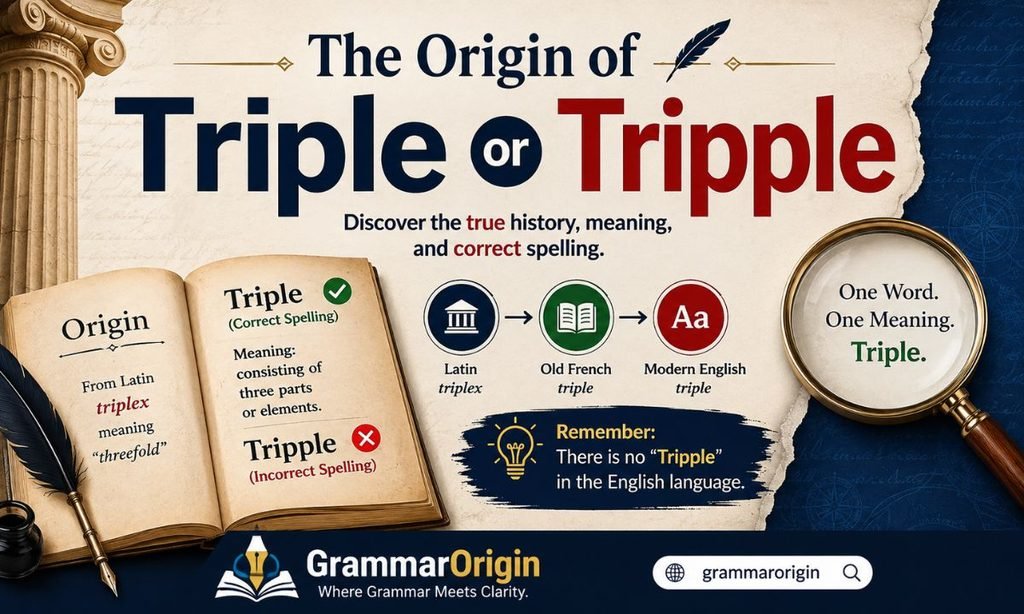
Triple traces back to the Latin word triplus, built from tri- (three) and a root meaning “fold.” That single-P structure carried straight through Old French and into English.
By the time triple entered Middle English, its spelling was already settled. No stage of that journey ever produced a doubled consonant, which is exactly why tripple has no real linguistic history behind it — it’s a modern typing slip, not an old variant that fell out of fashion.
British English vs American English Spelling
Some word pairs split by region — think colour versus color. Triple isn’t one of them. Every major English-speaking country spells it the same way.
Comparison Table
| Region | Correct Spelling | Regional Variation |
| American English | triple | None |
| British English | triple | None |
| Canadian English | triple | None |
| Australian English | triple | None |
No matter who you’re writing for, the spelling never changes.
Which Spelling Should You Use?
Use triple every single time — in emails, essays, business reports, or captions. There’s no context where tripple becomes acceptable in standard writing.
A fast gut-check: if your sentence involves three times, three parts, or three occurrences, you want triple. That covers nearly every situation you’ll ever write in.
This matters more than it seems. A misspelling like tripple can quietly undercut credibility in a job application, a client email, or a published article — readers notice small errors even when they can’t name the grammar rule behind them.
Also Read This Fourteen or Forteen: Which Spelling Is Correct?
How to Spell Triple (Common User Queries)
People search this word in dozens of phrasings: how do you spell triple, spell triple, what’s the correct spelling of triple. The answer is always the same six letters — T-R-I-P-L-E.
Others type it wrong on purpose while searching, just to confirm: is it tripple or triple, triple or tripple spelling. Landing here settles it — triple, one “p,” no exceptions.
A quick trick that sticks: “tri” already tells you it’s three. There’s no reason for the word to carry extra letters on top of that.
Common Mistakes with Triple or Tripple
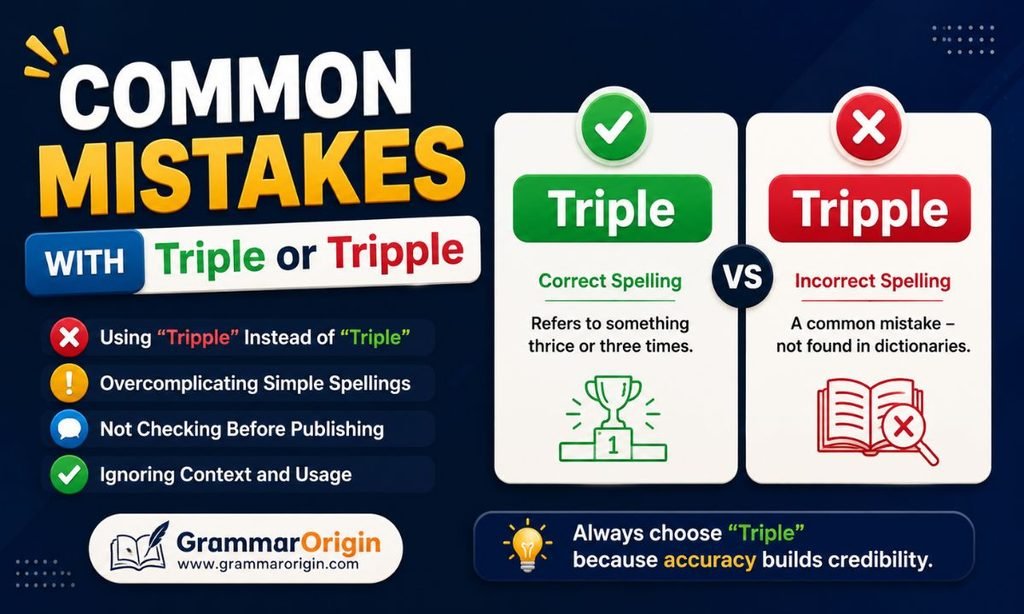
Most triple/tripple errors trace back to a handful of habits. Spotting them makes the mistake much easier to catch before you hit publish.
- Pattern-matching — apple, ripple, and supple all double their consonant, so tripple looks right even though it isn’t.
- Fast typing — triple and tripple sound identical out loud, so a rushed typist won’t notice the extra letter.
- Weak autocorrect — not every app flags tripple, especially casual messaging keyboards.
- Mixing up triple and treble — related in meaning, but not interchangeable (more on that below).
A simple letter count catches it every time: triple has six letters. Seven means you’ve added a “p” that doesn’t belong there.
Running your draft through a spell-check tool or reading it aloud before you proofread catches most of these slips. Since triple and tripple sound the same, your eyes need to do the work your ears can’t.
Triple or Tripple in Everyday Examples
Emails
“Please triple-check these figures before the client sees them.”
“We’re aiming to triple our subscriber list by next quarter.”
News Writing
“The company posted triple-digit growth for a third straight quarter.”
“Reported incidents at the intersection have nearly tripled since March.”
Social Media
“Triple scoop, zero regrets. 🍦”
“She’s a certified triple threat — sings, dances, acts.”
Formal Writing
“The proposal seeks to triple funding for the research division over five years.”
“Regional population figures tripled between the two census periods.”
Triple or Tripple: Google Trends & Usage Data
Search data leans almost entirely toward one pattern: people type tripple because they’re unsure, not because they mean something different. It’s a spelling check, not a separate word search.
Books, news archives, and professional writing show triple appearing consistently for centuries. Tripple shows up mostly in search bars and rough drafts — rarely in anything that’s been edited or published. Search engines routinely prompt “did you mean triple?” whenever someone types the misspelling, which tells you how the algorithms themselves read this pair.
Comparison Table: Triple vs Tripple
| Feature | Triple | Tripple |
| Standard spelling | Yes | No |
| Recognized by dictionaries | Yes | Only as a rare technical term |
| Common meaning | Three times, three parts | Not applicable in general use |
| Flagged by spell-checkers | No | Usually yes |
| Regional differences | None | None |
Triple vs Tripple (Meaning, Usage & Confusion)
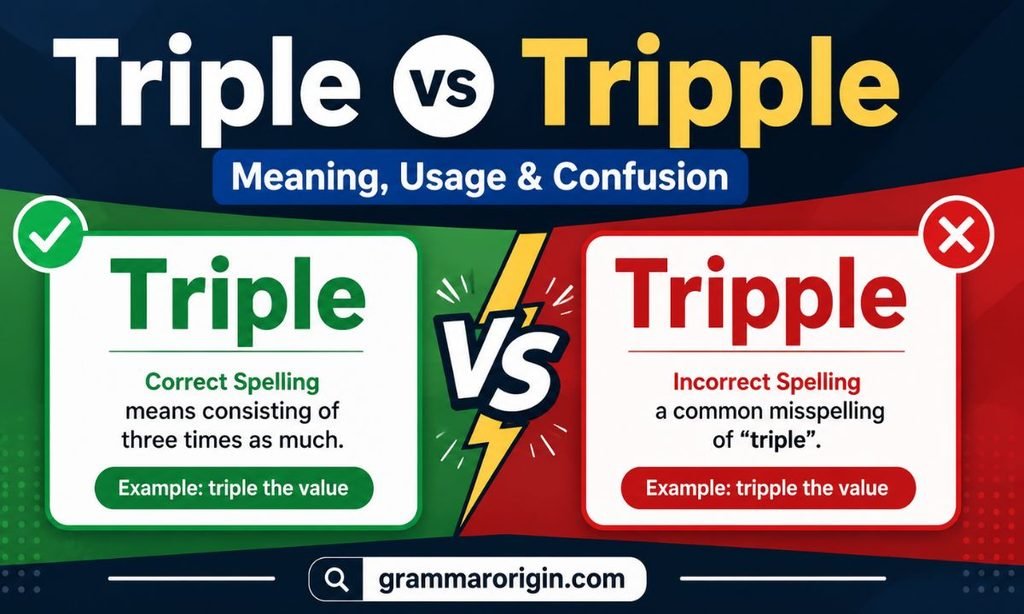
The mix-up almost always comes down to visual habit, not grammar logic. English is full of words — kettle, bottle, apple — that double a consonant before “-le.” Triple simply doesn’t belong to that group.
triple as in 3
At its core, triple always ties back to the number three. Triple a quantity, and you’re multiplying it by three — nothing more, nothing less.
triple or tripple meaning
Triple carries a clear, dictionary-backed meaning: threefold, or three times as much. Tripple carries no standard meaning at all in everyday English — it’s simply an incorrect spelling of triple.
triple examples
“The bakery sells a triple-layer cake.” “His savings tripled in four years.” “She hit a triple in the final inning.” Three different roles, one consistent spelling.
triple pronunciation
Triple is pronounced TRIP-uhl (/ˈtrɪp.əl/), with stress on the first syllable. Say it slowly — “trip,” then “uhl” — and there’s no natural pause that calls for a second “p.”
triple or treble
Treble shows up mostly in British English, especially around music (“treble clef”) and betting (“the prize trebled”). Triple is the more universal choice across both American and British writing, and it’s the safer pick in general use.
triple synonym
Threefold fits formal or academic writing well. Triplicate suits legal or administrative contexts. Trio works when you mean three people or items rather than a multiplied quantity.
triple company
Some brands use “Triple” in their names — think coffee chains, gaming platforms, or product lines built around the number three. As a real word inside a name, it’s spelled correctly with one “p,” just like everywhere else.
double triple
“Double or triple” often shows up together in betting, gym sets, or stakes-related writing — “he doubled, then tripled his bet.” Both words follow the same rule: one consonant before the “-le” ending, no doubling.
Also Read This Fourteen or Forteen: Which Spelling Is Correct?
Is Tripple Ever Correct? (Rare Exceptions)
There’s one narrow case where “tripple” appears in older dictionaries: a specific horse gait, where legs on one side move together before the other side follows. It’s a historical, regional term you’ll almost never see outside equestrian writing.
Beyond that, and beyond intentional brand names, tripple has no accepted place in standard English. If you’re not writing about horses or a proper noun, triple is what you want — and for the vast majority of writers, that horse-gait sense never comes up at all.
Final Thoughts
Triple or tripple isn’t really a close call — triple is correct everywhere, and tripple survives only as a rare exception or a typing slip. The “-ple” ending never doubles its consonant, the same way simple and sample don’t.
Next time your fingers hesitate over that second “p,” remember the root: “tri” means three, and the spelling has stayed exactly that simple for centuries.
Frequently Asked Questions
Is tripple ever a correct spelling?
No, not in standard writing. The only exception is a rare, historical term for a horse’s gait, which almost never appears outside equestrian contexts.
Why do so many people write tripple instead of triple?
Because English has many double-consonant words like apple and ripple, and triple visually resembles that pattern even though it doesn’t follow it.
Does British English spell it differently from American English?
No. Triple is spelled the same way across American, British, Canadian, and Australian English, with no regional variation.
What part of speech is triple?
It can be an adjective (“a triple win”), a noun (“he hit a triple”), or a verb (“sales tripled this year”).
How do you pronounce triple correctly?
Triple is pronounced TRIP-uhl, with the stress on the first syllable and no extra sound between the “p” and the “l.”
Is triple the same as treble?
They’re related but not identical. Treble leans toward British English, music, and betting contexts, while triple is the more general, universal term.
What’s a simple way to remember the correct spelling?
Think of the root “tri,” meaning three. Just like triangle and tricycle keep a single consonant, so does triple.

Muhammad Waqas is an English language teacher and grammar expert with over 8 years of experience helping students and professionals improve their writing skills. He specializes in English grammar, vocabulary, communication, and practical language learning. Through GrammarOrigin, Waqas shares clear, easy-to-understand content that helps readers write and speak English with confidence.