
Swap and swop mean exactly the same thing — to exchange one thing for another — and the only real difference is spelling, not meaning. Swap is the modern, globally accepted form used across American and British English, while swop is an older variant seen mostly in casual British writing.
If you’re unsure which one to use, swap is almost always the safer and more professional choice. This guide breaks down where each spelling came from, how they differ today, and the rare cases where swop still fits.
What Do Swap and Swop Mean?
Both swap and swop describe the act of trading or exchanging one thing for another. You give something up, and you get something back in return. Neither word carries a hidden nuance the other lacks — despite what a few older grammar guides claim about “swop” implying mutual agreement while “swap” implies substitution. In modern usage, both are used interchangeably to mean trade, exchange, or barter.
You’ll also see swap used as a noun, referring to the exchange itself. A “clothes swap,” a “seat swap,” or a “job swap” are all common noun phrases. Swop can technically function as a noun too, but you’ll rarely encounter it that way outside older or regional texts.
Common Examples
- I’ll swap my sandwich for your juice.
- Let’s swap seats so you can see better.
- They swapped phone numbers after the meeting.
- We did a house swap over the summer holidays.
- She offered to swop her shift with a coworker (older British style).
- The kids swopped comic books at recess (dated British usage).
Notice that in every case, replacing “swop” with “swap” changes nothing about the meaning. The sentence still reads naturally and, in most contexts, reads more naturally with swap.
Origins and Historical Roots of Swap vs Swop
Both spellings trace back to the same root word, which makes their shared meaning easy to explain — they never really diverged in definition, only in form.
Where Did “Swap” Come From?
Swap descends from the Middle English word swappen, which originally meant “to strike” or “to strike hands.” That connection makes more sense once you picture how deals used to get made: two people would strike their hands together to seal a bargain, similar to a handshake today. By the late 1300s, the word was already tied to the idea of striking hands “in token of an agreement,” and by the 1590s, it had picked up the meaning we use now — to exchange, barter, or trade.
Interestingly, the earliest recorded senses of swappen had nothing to do with trading at all. They referred to a blow, a slap, or the sound of two things striking together. Some etymologists trace this even further to an onomatopoeic root — the word may have originally imitated the sound of a sharp, resounding smack. Over the following centuries, the “striking a deal” sense won out, and the older “striking a blow” meaning faded from everyday use.
Why Did “Swop” Appear?
Swop developed later as a spelling variant, most commonly associated with British English during the 19th and early 20th centuries. English spelling wasn’t always as standardized as it is today, and vowel variants like “swap” versus “swop” were fairly common across dialects.
As formal dictionaries, national curricula, and mass media pushed for more consistent spelling throughout the 20th century, “swap” gradually became the dominant form, even in the UK. “Swop” survived mainly in informal British writing, older texts, and certain regional pockets, but it never became the standard.
Swap vs Swop: Key Differences Explained
The differences between these two words are narrow, but worth breaking down individually so you know exactly what’s at stake in each one.
Spelling Difference
The only structural difference is the vowel: swap uses an “a,” while swop uses an “o.” Every other letter is identical, and both words follow the same conjugation pattern — swap, swapped, swapping versus swop, swopped, swopping.
Pronunciation
Both words are typically pronounced the same way in most dialects, roughly as /swɒp/ in British English or /swɑp/ in American English. The spelling difference doesn’t reliably change how the word sounds out loud, which is part of why so many writers use the two spellings interchangeably without noticing.
Meaning
There is no meaningful difference in definition. Both words describe the same core action: trading, exchanging, or bartering one thing for another. Any claim that one implies “equal value” and the other doesn’t isn’t supported by how native speakers actually use the words — context, not spelling, determines whether an exchange is equal.
Regional Usage: Who Uses Swap vs Swop?
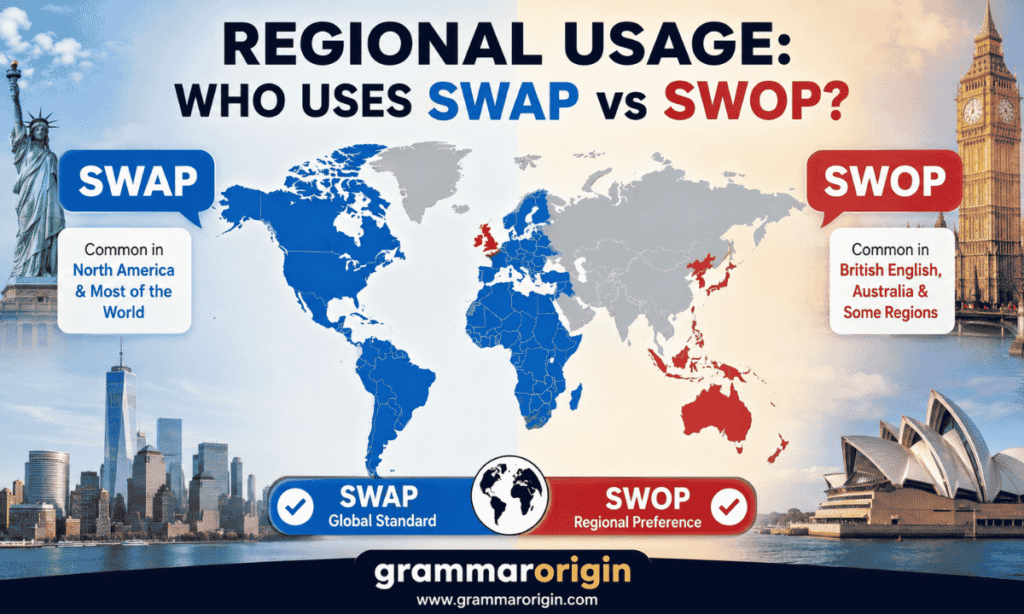
Spelling preference for swap versus swop varies more by region than by context, and understanding these patterns helps you pick the right form for your audience.
United States
American English uses swap almost exclusively. Swop is essentially absent from US newspapers, business writing, and everyday conversation. If you’re writing for a US audience, swap is the only spelling you should use.
United Kingdom
British English has historically been more tolerant of swop, particularly in older or informal writing. However, modern UK media, publishing, and dictionaries increasingly favor swap as well. You may still spot swop in older British novels, nostalgic writing, or casual regional speech, but it’s no longer the expected form in professional or academic British English.
Australia and New Zealand
Australian and New Zealand English generally follow British spelling conventions for many words, but swap has become the dominant choice here too. Swop appears occasionally in older or informal writing but isn’t the standard.
Canada
Canadian English blends American and British spelling habits depending on the word, but for swap versus swop specifically, Canadian writing follows the American pattern closely. Swap is standard; swop is rare.
Other English-Speaking Regions
In South Africa, India, the Caribbean, and other English-speaking regions with historical ties to British spelling conventions, you may occasionally encounter swop in informal writing or older publications. Even so, swap remains the spelling recommended by international style guides and understood without hesitation by readers everywhere.
READ MORE RELATED POST Next Friday vs This Friday
Regional Summary Table
| Region | Preferred Spelling | Notes |
| United States | Swap | Swop is virtually unused |
| United Kingdom | Swap (modern) | Swop appears in older/informal writing |
| Australia & New Zealand | Swap | Swop is rare and dated |
| Canada | Swap | Follows American pattern |
| South Africa, India, Caribbean | Swap | Swop occasionally seen informally |
Data Trends Over Time Swap and Swop
Language trend data consistently shows swap pulling further ahead of swop with each passing decade. Google Ngram-style frequency data, which tracks word usage across millions of published books, shows swap overtaking swop in British texts by the mid-20th century and widening that gap ever since. Search interest data tells a similar story:
far more people search for “swap” in any given context — financial swaps, clothing swaps, shift swaps — than for “swop.” The trend isn’t reversing. If anything, digital publishing, global English, and search-driven writing are accelerating the shift toward a single, standardized spelling.
Dictionary and Style Guide Recommendations
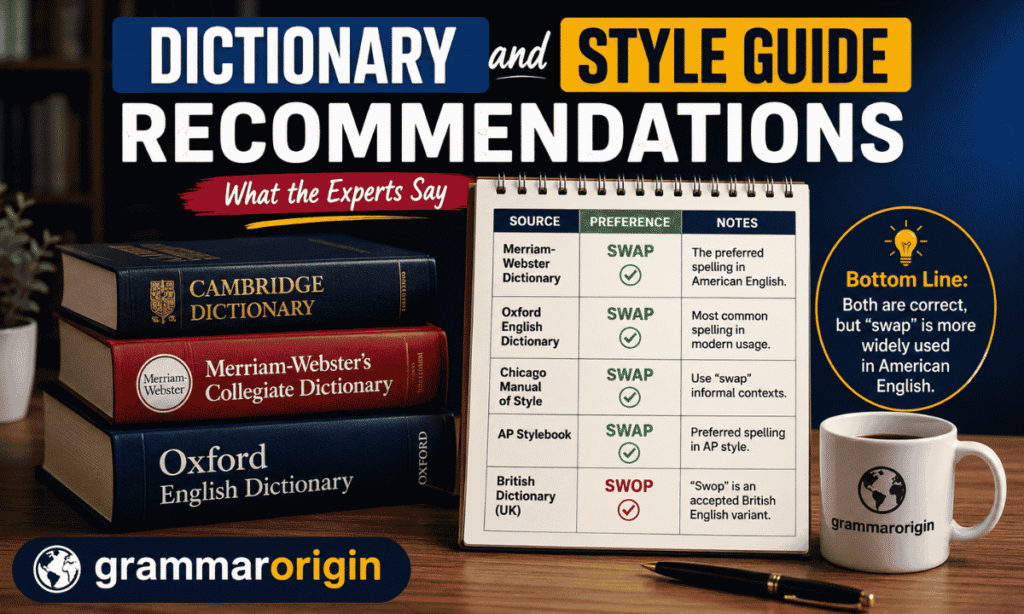
Major dictionaries, including Merriam-Webster and the Oxford English Dictionary, list swap as the primary and preferred spelling, with swop noted as a chiefly British or dated variant. Style guides used in journalism, business writing, and academic publishing overwhelmingly recommend swap for clarity and consistency, especially when writing for an international audience.
If you search “swap vs swop Oxford dictionary,” you’ll find that Oxford references treat swop as a valid but secondary form — acknowledged, but not favored. The consistent guidance across dictionaries and style manuals is simple: default to swap unless you have a specific reason not to.
Real-Life Usage Examples Swap and Swop
Seeing the two spellings side by side in realistic sentences makes the distinction easier to internalize.
Standard Usage (Recommended)
- We decided to swap seats during the flight.
- They swapped contact information after the conference.
- I’m going to swap my old phone for a newer model.
- Let’s swap notes before the exam.
Less Common Variant (British Informal)
- They agreed to swop jerseys after the match.
- She wanted to swop shifts with a colleague.
- The children swopped toys for the afternoon.
Swap as a Noun
- It was a fair swap.
- We arranged a house swap for the holidays.
- The trade involved a straightforward swap of assets.
Case Study: Professional Writing
Imagine two versions of the same sentence in a company newsletter. One reads, “Employees can swop shifts through the new scheduling app.” The other reads, “Employees can swap shifts through the new scheduling app.” Both are grammatically valid, but the second version reads as current, polished, and appropriate for a global or American audience.
The first risks looking like a typo to readers unfamiliar with the British variant, which can quietly undercut a document’s credibility. This is exactly why professional style guides, corporate communications teams, and editorial standards at most publications default to swap: it removes any ambiguity about whether the word was a spelling mistake.
Why Swap Became Dominant
Several forces pushed swap ahead of swop over the last century, and they reinforce each other.
Simplicity
Swap is short, phonetically straightforward, and easy to spell without hesitation. When two spellings compete and one offers no real advantage over the other, the simpler, more familiar form tends to win out over time.
American Influence
American English has an outsized influence on global media, entertainment, business writing, and internet content. Since American English uses swap exclusively, that preference has spread outward through movies, software, journalism, and international business communication, nudging even British writers toward swap.
Digital Spell-Check Systems
Spell-checkers and autocorrect tools built into word processors, browsers, and messaging apps are trained primarily on American English defaults. These tools frequently flag or “correct” swop to swap, which reinforces swap as the standard spelling for casual writers who might not otherwise think twice about it.
Advice for Writers and Learners

If you’re ever unsure which spelling to use, default to swap. It’s understood everywhere, accepted by every major dictionary, and won’t distract or confuse any reader, regardless of where they’re from.
This is especially important advice for English learners: mastering one consistent spelling avoids unnecessary confusion, and swap is the version you’ll encounter far more often in textbooks, media, and everyday communication.
READ MORE RELATED POST Next Friday vs This Friday
When Is Swop Acceptable?
Swop still has a place in a few specific situations:
- Quoting historical or archival British texts exactly as written
- Preserving the original spelling in literary or nostalgic writing
- Referencing older UK publications, dialogue, or dialect-heavy fiction
Outside of these cases, there’s little reason to choose swop over swap in contemporary writing.
Swap vs Swop in Everyday Conversation
In spoken English, the distinction barely registers, since both words are usually pronounced the same way. Where it matters is in writing — text messages, social posts, emails, and casual online discussion. If you search “swap vs swop Reddit,” you’ll find the general consensus among everyday English speakers mirrors what dictionaries say:
swap is what people actually type, and swop reads as either a typo or an intentional bit of British flavor. Casual writers rarely think about the distinction consciously; they simply reach for swap because it’s the form they’ve seen most often.
Why Spelling Consistency Matters
Using one spelling consistently throughout a document, website, or brand voice matters more than most writers realize. Inconsistent spelling — switching between swap and swop in the same article, email, or product description — can look careless, even when both words are technically correct. Consistency also supports SEO and readability:
search engines and readers alike respond better to predictable, standardized language, and picking swap as your default keeps your writing clean and professional across every piece of content you produce.
Common Mistakes to Avoid
A few recurring errors show up again and again when writers aren’t sure which spelling to commit to.
Mixing Both Spellings
Using swap in one paragraph and swop in the next — even within the same piece of writing — creates an inconsistent, unpolished impression. Pick one spelling and stick with it throughout the entire document.
Using Swop in American Contexts
Swop reads as a clear misspelling to American readers, since it almost never appears in US English. If your audience is American, or you’re writing for a general international audience, avoid swop entirely.
Confusing Swap With Similar Words
Some writers accidentally confuse swap with unrelated words like “swab” or “swat,” which have entirely different meanings and origins. Swab refers to a piece of absorbent material or the act of cleaning with one; swat means to hit or strike sharply. Neither is a valid substitute for swap or swop in an exchange-related sentence.
Practical Editing Checklist
Before publishing or sending any piece of writing, run through this quick checklist:
- Have you used swap consistently throughout the entire document?
- Did you avoid swop unless quoting historical or literary text on purpose?
- Does your spell-checker flag any instance of swop that slipped in by habit?
- Is your intended audience American, international, or specifically British — and does your spelling choice match that audience?
- Have you avoided confusing swap with unrelated words like swab or swat?
Swap vs Swop: Final Verdict
Swap and swop mean exactly the same thing, and the choice between them comes down to spelling convention, not meaning. Swap is the modern, globally recognized standard, favored by American English, most British English today, and every major English-speaking region in between. Swop survives only in older British texts, informal regional writing, and deliberate stylistic choices. For everyday writing, professional communication, and anything meant for a broad audience, swap is the clear, confident choice — simple, consistent, and universally understood.
Frequently Asked Questions
What does swap vs swop mean?
Both words mean the same thing — to exchange or trade one thing for another. Swap is the modern spelling, while swop is an older variant with no difference in meaning.
Is swop a real word, or just a misspelling of swap?
Swop is a real, dictionary-recognized word, not a typo. It’s simply an older, less common spelling, mostly seen in British English.
What do dictionaries like Oxford say about swap vs swop?
Oxford and Merriam-Webster both list swap as the primary spelling and swop as a secondary, chiefly British variant. Swap is the recommended choice in nearly every context.
Can you give examples of swap vs swop in sentences?
Sure — “Let’s swap seats” and “Let’s swop seats” mean exactly the same thing. The first is standard everywhere; the second is more common in older or informal British writing.
Do people on Reddit and social media use swap or swop?
Almost everyone online uses swap. Swop rarely appears outside deliberate British stylistic writing or older forum posts.
Should English learners use swap or swop?
Learners should stick with swap. It’s understood globally, used far more often, and avoids any confusion in academic or professional writing.
Conclusion
Swap and swop mean exactly the same thing, and the only real difference between them is spelling, not definition. Swap is the modern, globally recognized standard, while swop survives mainly in older or regional British writing. For clarity and consistency, swap remains the smarter choice in almost every situation.
Whether you’re writing for school, work, or everyday conversation, sticking with one consistent spelling matters more than the spelling itself. Swap is simple, professional, and understood by readers everywhere, making it the safest default. Save swop only for historical quotes or deliberate stylistic writing.

Muhammad Waqas is an English language teacher and grammar expert with over 8 years of experience helping students and professionals improve their writing skills. He specializes in English grammar, vocabulary, communication, and practical language learning. Through GrammarOrigin, Waqas shares clear, easy-to-understand content that helps readers write and speak English with confidence.