
Nighttime is the correct, dictionary-approved spelling in modern English, while night time is an older two-word form still common in casual and British writing. If you’ve ever paused mid-sentence wondering which one to type, you’re not alone — this mix-up trips up students, bloggers, and even experienced editors.
English compounds shift slowly over time, and nighttime vs night time is a clear example of that change still playing out today. Below, you’ll find the grammar behind it, the history of the shift, and real-world examples so you never have to second-guess it again.
🌌 Nighttime or Night Time: Which One Is Correct?
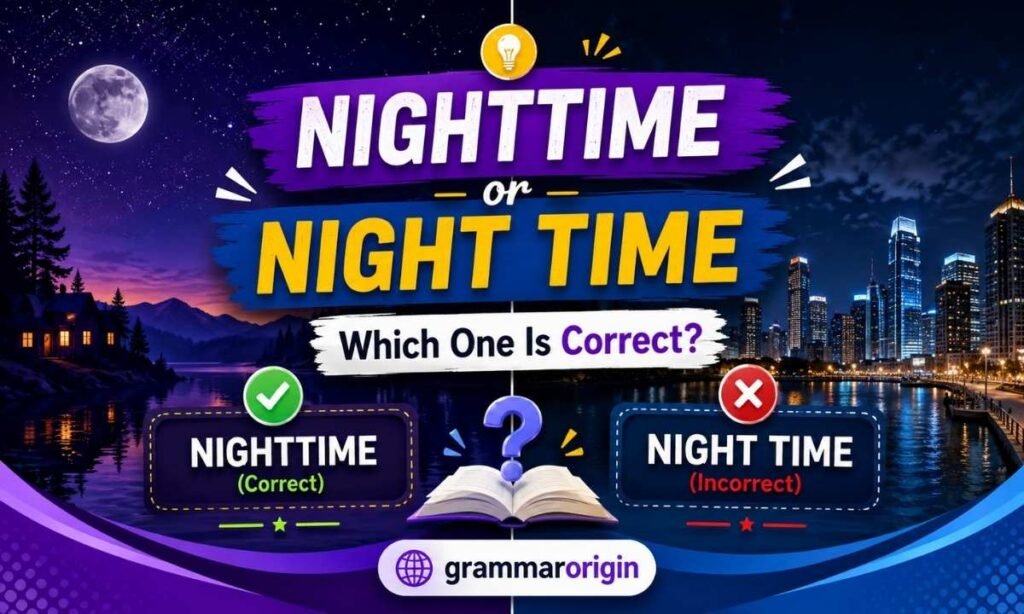
Nighttime is the correct, dictionary-approved spelling in modern English, while “night time” is an older two-word form that still shows up in casual and British writing. If you’ve ever paused mid-sentence wondering which one to type, you’re not alone.
This confusion trips up students, bloggers, copywriters, and even seasoned editors. English compounds shift over decades, and nighttime vs night time is a textbook example of that shift in progress. Below, we’ll break down the grammar, the history, and the real-world usage so you never have to second-guess it again.
Nighttime or Night Time What’s the Correct Term?
“Nighttime” is the standard modern form, while “night time” is the older, less common variant. Style guides and dictionaries have largely settled this debate, though pockets of disagreement remain in casual writing.
The Correct Modern Standard
The widely accepted answer to nighttime vs night time is “nighttime,” written as one solid word. It functions as a closed compound noun, just like “daytime,” “sunrise,” or “bedtime.”
Most major style guides, professional editors, and published books treat nighttime as the default spelling. That said, “night time” isn’t outright incorrect — it’s simply less current. You’ll still spot it in British publications, older texts, and situations where a writer wants to emphasize the literal hours of night rather than the general concept.
Why the Confusion Happens
The mix-up happens because English compound words don’t standardize overnight — they drift slowly, and habits linger. This is exactly why nighttime vs night time still confuses so many writers today. A few reasons this particular pair causes hesitation:
- Compound nouns evolve unpredictably over time
- Writers copy whatever spelling looks familiar to them
- Both versions genuinely look “correct” at a glance
- Classic literature leaned heavily on the two-word form
- Current dictionaries have since standardized the single-word spelling
Once you understand how compound nouns form in English, the reasoning behind this shift becomes much clearer.
Understanding the Word Structure
Nighttime follows a well-worn pattern in English where two frequently paired words merge into one. This process, called compounding, explains why some phrases stick together while others never do.
Compound Nouns
A compound noun is created when two separate words combine to express a single, unified concept. English has done this thousands of times as vocabulary evolved.
| Two Words | Combined Form |
| bed time | bedtime |
| some thing | something |
| day time | daytime |
| any where | anywhere |
Nighttime fits this exact pattern. It names a specific period — the hours of darkness — and English has a strong habit of fusing time-related phrases once they’re used often enough.
Two-Word Phrases That Stay Separate
Not every two-word phrase eventually merges — some stay apart because combining them would blur their meaning. Compounding only happens when it improves clarity, not automatically.
Common examples that remain separate:
- high school
- real estate
- full moon
- night shift
These terms keep their space because fusing them would either look strange or change how readers parse the phrase. “Night shift,” for instance, refers to a work schedule, not a time period, so it never followed nighttime’s path.
The Transition from “Night Time” to “Nighttime”
Over roughly the last 150 years, “night time” gradually gave way to “nighttime” as literacy rates rose and spelling conventions tightened. The nighttime vs night time shift wasn’t a sudden rule change — it was a slow linguistic drift.
A few forces pushed this transition along:
- “Night time” was the dominant form in earlier English writing
- Rising literacy encouraged more consistent compound spelling
- Dictionaries began formally listing “nighttime” as standard
- Newspapers, books, and later digital media reinforced the one-word version
Language naturally compresses phrases that get used constantly, and that’s precisely why nighttime has become the dominant spelling today.
Historical Development

Nighttime’s history shows a steady march from a two-word phrase to a fused compound, mirroring dozens of similar English words. Tracing that path helps explain why the nighttime vs night time debate still lingers for some readers today.
Early Use: “Night Time”
In pre-1900 English literature, “night time” almost always appeared as two separate words. Writers treated it the same way they treated “day time” or “bed time” — as a noun paired with a descriptive word.
This pattern felt intuitive at the time. Authors were simply combining “night” (the noun) with “time” (the descriptor) without any pressure toward fusion.
Emergence of “Nighttime”
“Nighttime” began overtaking “night time” as 20th-century print standards pushed toward compound spellings. Several developments accelerated this shift:
- Print editors advocated for consistent, simplified spelling
- Style guides began recommending fused forms for common time phrases
- Updated dictionaries listed “nighttime” as the preferred entry
This mirrors other well-known transitions, including “any one” becoming anyone, “every day” becoming everyday (in its adjective sense), and “to night” becoming tonight. By the 1950s through the 1970s, “nighttime” had firmly become the primary American spelling.
Dictionaries and Style Guides
Every major English dictionary now lists “nighttime” as the preferred or primary spelling, with “night time” noted as a secondary or regional variant. This consistency across sources settles the nighttime vs night time question for most professional writers.
Major Dictionary Positions (Summarized)
Merriam-Webster, American Heritage, Cambridge, and Oxford all favor “nighttime” as the standard compound. Merriam-Webster and American Heritage list it as the main entry, while Cambridge and Oxford dictionaries acknowledge both spellings but present nighttime as the standard form.
In short: nighttime carries the dictionary authority behind it.
Editorial and Publishing Standards
Professional editors typically default to “nighttime” for news, academic, and corporate writing. “Night time” tends to appear only when a writer wants to stress the literal hours rather than the broader concept.
For example:
- Correct: “Most crimes happen at nighttime.”
- Also correct, but more literal: “He calculated the exact night time temperature drop.”
Modern Usage and Language Trends

American English strongly favors “nighttime,” while British English still shows more tolerance for the two-word form. The nighttime vs night time gap narrows further when you look at international English, which sits somewhere in between, gradually shifting toward the compound spelling.
MORE RELATED POST Brief vs Debrief
American, British, and International English
In the U.S., “nighttime” is overwhelmingly the standard choice across formal and casual writing alike. British English accepts both forms but leans slightly more toward “night time” in everyday, informal contexts. International English users show a mixed pattern, though usage of “nighttime” continues to climb steadily worldwide.
Why the One-Word Form Became Dominant
“Nighttime” won out largely because it’s shorter, cleaner, and matches how English treats other time-period nouns. A few clear reasons:
- It’s more efficient to type and read
- English generally prefers compound nouns for time periods
- Digital publishing rewards standardized, consistent spelling
- Dictionaries list it as the primary entry
- Repeated use across media reinforces the pattern
Put simply, nighttime is the modern default because it’s clearer, shorter, and far more widely used across the English-speaking world.
Grammar Guide: How to Use “Nighttime” Correctly
“Nighttime” works as both a standalone noun and a modifier attached to another noun, without ever needing a hyphen. Understanding this grammar removes most of the remaining nighttime vs night time confusion. Knowing both roles helps you use it confidently in any sentence.
Nighttime as a Noun
As a noun, “nighttime” simply refers to the period between dusk and dawn. For example:
- “Nighttime is quiet in rural areas.”
- “Children often fear nighttime darkness.”
Nighttime as an Adjectival Noun
“Nighttime” can also sit in front of another noun to describe it, functioning much like an adjective. Common examples include:
- “nighttime routine”
- “nighttime temperature”
- “nighttime photography”
In each case, it modifies the following noun without requiring a hyphen or any change in spelling.
Examples of “Nighttime” in Real Writing
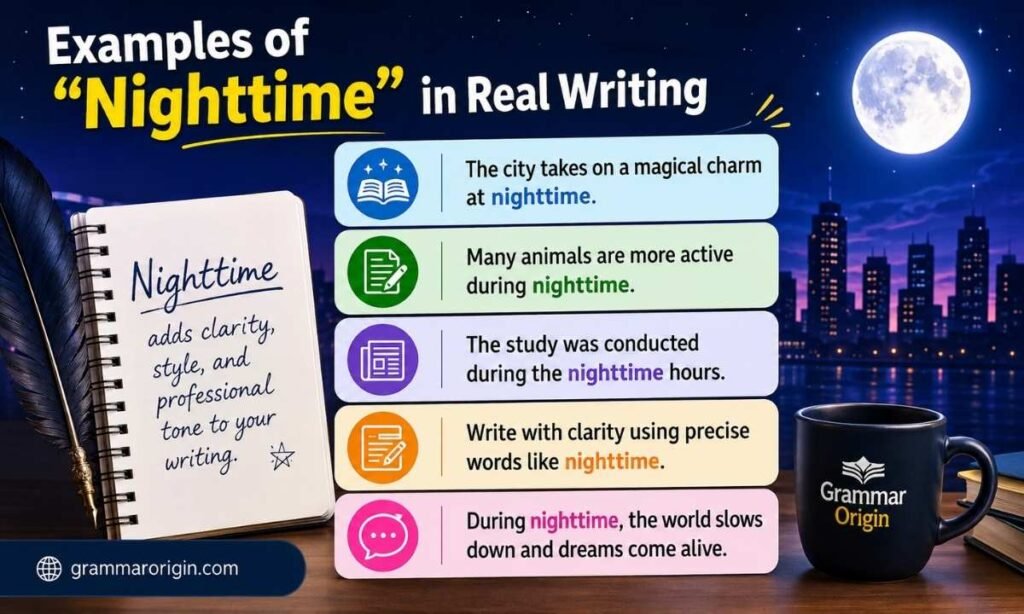
“Nighttime” shows up naturally across casual conversation, literature, and professional or technical writing. Seeing the nighttime vs night time choice in real context makes the correct usage stick.
Everyday Conversation
- “I sleep better in the nighttime.”
- “Nighttime driving feels peaceful.”
Books and Literature
Authors frequently reach for “nighttime” to set mood and atmosphere. For instance: “The nighttime silence wrapped the village like a blanket.”
Professional Writing
Business and research writing also defaults to “nighttime” for precision and formality. Examples include:
- “Nighttime production levels increased by 14%.”
- “The wildlife study focused on nighttime behavior.”
Practical Usage Table
This quick-reference table settles nighttime vs night time for good, showing exactly which form fits which writing situation.
| Situation | Preferred Form | Example |
| Standard writing | nighttime | “Nighttime temperatures dropped to 5°C.” |
| Formal academic writing | nighttime | “Nighttime exposure affects circadian rhythm.” |
| British informal writing | night time | “The night time air felt cold.” |
| Emphasizing literal night hours | night time | “The exact night time measurement was recorded.” |
| Compounds modifying nouns | nighttime | “Nighttime photography is challenging.” |
Nighttime vs Night Time Reddit
Reddit threads on this topic mostly echo the dictionary consensus — commenters overwhelmingly favor “nighttime” as one word. A few posters note that “night time” still feels natural in British forums, but the general community leans firmly toward the compound spelling.
MORE RELATED POST Brief vs Debrief
Nighttime vs Night Time Oxford Dictionary
Oxford’s dictionary entries list “nighttime” as the standard compound while still acknowledging “night time” as an accepted variant. This dual listing reflects British English’s slightly more flexible stance compared to American usage.
Nighttime or Night-Time UK Spelling
In UK writing, you’ll occasionally spot a hyphenated “night-time,” alongside both “nighttime” and “night time.” All three forms circulate in British English, though “nighttime” is increasingly the version favored by UK style guides and major publications.
Frequently Asked Questions
Is it “nighttime” or “night time”?
The nighttime vs night time debate has a clear winner: nighttime is the standard modern spelling, especially in American English. “Night time” is still acceptable but noticeably less common in current writing.
Why is “nighttime” written as one word?
English tends to merge frequently used phrases, especially time-related ones. Like “daytime” or “sunrise,” “night time” naturally evolved into a single compound word.
Are there situations where “night time” is still correct?
Yes. Writers sometimes choose “night time” when referring literally to the hours during the night rather than the general concept of nighttime.
What part of speech is “nighttime”?
It’s primarily a noun, but it also functions as a modifying noun — often called an adjectival noun — when placed before another noun.
What are synonyms for “nighttime”?
Common alternatives include after dark, night hours, late hours, and the nightfall period. “Evening hours” is related but not identical in meaning.
Does British English use “nighttime” or “night time”?
British English accepts both, though it leans slightly more toward “night time” in casual writing compared to American English, which strongly favors “nighttime.”
Is “night-time” with a hyphen ever correct?
A hyphenated “night-time” appears occasionally in UK publications, but it’s far less common than the solid compound “nighttime” or the two-word “night time.”
Conclusion
The nighttime vs night time difference might look small, but picking the right form sharpens your writing’s clarity and professionalism. Nighttime is the modern, dictionary-approved standard, while night time remains an older, still-acceptable variant in certain contexts, especially in British English.
When in doubt, go with nighttime — it’s the safest, most widely recognized choice across American, British, and international writing today.

Muhammad Waqas is an English language teacher and grammar expert with over 8 years of experience helping students and professionals improve their writing skills. He specializes in English grammar, vocabulary, communication, and practical language learning. Through GrammarOrigin, Waqas shares clear, easy-to-understand content that helps readers write and speak English with confidence.