
“Adapter vs adaptor” trips up more writers than almost any other spelling pair in English. Both words are correct, and neither one triggers a red squiggly line in Word. The real question isn’t which spelling is “right” — it’s which one fits your audience.
This guide breaks down what adapter and adaptor actually mean, where the words came from, and how dictionaries, style guides, and everyday speakers use them today. By the end, you’ll know exactly which spelling to reach for and why it matters.
Understanding “Adapter” vs “Adaptor”
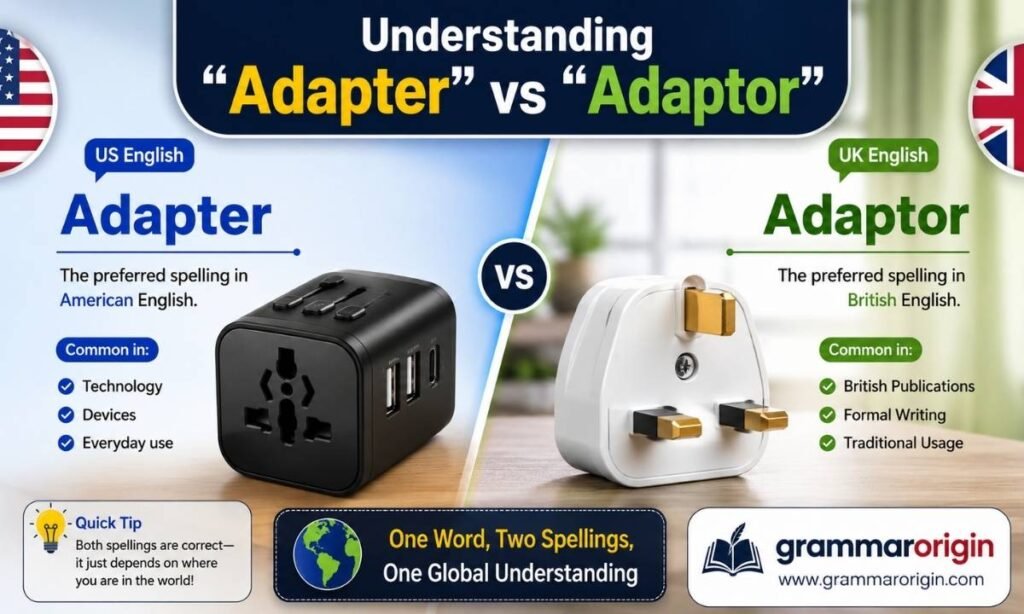
Adapter and adaptor name the exact same thing — a device, or occasionally a person, that lets two otherwise incompatible things work together. The spelling you choose comes down to habit and region, not grammar rules.
What Does Adapter Mean?
An adapter is a small device that lets one piece of equipment connect to, or function with, another that wouldn’t normally fit. Think of a phone charger, an HDMI-to-USB piece, or a plug you pack for a trip abroad.
The word has a second, less common meaning too. In publishing and film, an adapter is a person who reworks a book or play into a screenplay — the writer who turns a novel into a movie script.
- Electronics: chargers, cables, connectors
- Mechanical tools: pipe and shaft fittings
- Networking: cards and interface hardware
- Publishing/film: a person who reworks a text for a new medium
What Does Adaptor Mean?
Adaptor carries the identical meaning as adapter — same device, same job, same pronunciation. It simply uses the older –or ending instead of –er.
You’ll spot it more in British publications and in engineering documents written before the 2000s. Some UK outlets, including The Guardian’s internal style guide, choose to spell it adaptor for devices and adapter for people — but that’s a house preference, not a rule the rest of English follows.
Etymology and History of the Word
Both spellings trace back to the Latin verb adaptare, meaning “to fit” or “to adjust.” English absorbed the word as adapt gained ground during the scientific and industrial growth of the 18th and 19th centuries.
Contrary to popular belief, dictionaries don’t treat one spelling as the original British form and the other as an American shortcut. Historical records show both adapter and adaptor appearing in English texts around the same period, with adapter simply pulling ahead in general use over time.
Usage in Modern English
The adapter vs adaptor split looks different once you check real usage data. Today, adapter is the more common spelling worldwide — including in the UK, where adaptor was once thought to be the default. Product listings, tech manuals, and news writing lean heavily toward the –er ending.
| Region | Typical Preference | Notes |
| United States | Adapter | Near-universal in tech and retail |
| United Kingdom | Mostly Adapter | Adaptor still appears in older texts |
| Canada & Australia | Adapter | Follows US-style tech convention |
| Pakistan & India | Mixed | Adaptor common on electrical packaging; adapter growing in tech/software content |
This shift isn’t about right and wrong — it’s a slow drift in preference driven largely by global tech branding and online commerce, where consistency across markets matters more than local spelling habits.
Technical Context: Where You’ll See Each Spelling
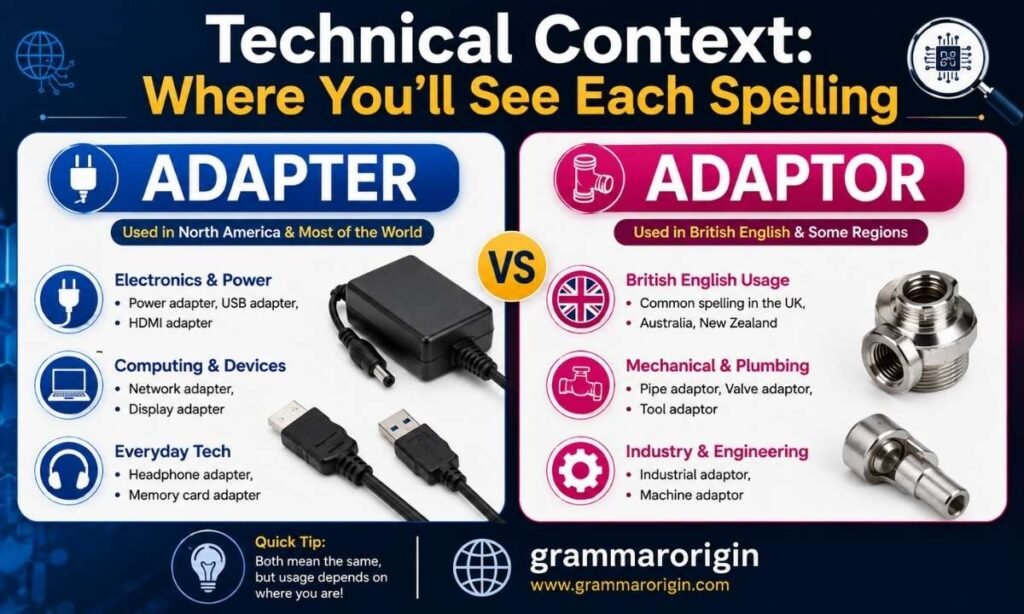
Which spelling shows up often depends on the industry you’re reading, not just the country you’re in.
Electronics and Hardware
Consumer electronics packaging overwhelmingly uses adapter — laptop chargers, audio jacks, and USB hubs almost never say adaptor on the box, regardless of where they’re sold.
Engineering and Mechanical Design
Older mechanical and industrial documentation still leans on adaptor, especially in legacy manuals for pipeline fittings and machine parts. Newer engineering standards are gradually shifting toward adapter.
Software and Network Architecture
In programming, adapter is essentially the only spelling you’ll encounter. The Adapter design pattern — a well-known way to make two incompatible interfaces work together — and terms like “network adapter” are standard across every major operating system and coding textbook.
READ MORE RELATED POST Nighttime vs Night Time
Different Types of Adapters (With Real Examples)
Adapters show up in far more places than most people realize. Here’s a practical breakdown of the categories you’ll run into most often.
Power Adapters
Power adapters convert electrical current so a device can safely draw the power it needs. Every phone charger and laptop brick is technically a power adapter, and they’re one of the most-searched product categories online.
- Charging smartphones and tablets
- Powering laptops and monitors
- Running small appliances and smart-home devices
Travel Adapters
A travel adapter changes the shape of a plug so it physically fits a foreign socket — it does not change the voltage. That distinction trips up a lot of travelers who plug in a device expecting it to just work.
| Region | Common Plug Type |
| Europe | Type C / Type F |
| United Kingdom | Type G |
| United States | Type A / Type B |
| Australia | Type I |
| Pakistan & India | Type C / Type D / Type M |
Computer and Electronic Adapters
Modern computing depends on a whole family of small adapters — HDMI-to-VGA pieces, USB-C hubs, Ethernet dongles, and display-port converters. Multi-port adapter hubs have become almost standard gear for anyone working on a slim laptop.
Mechanical Adapters
In manufacturing, mechanical adapters connect parts that wouldn’t otherwise fit — pipe thread adapters, tool mount adapters, and shaft couplings are common examples. Precision matters here far more than in consumer electronics; a fraction of a millimeter off can cause a failure.
Common Mistakes and Misconceptions
Most confusion around this word pair comes from a handful of myths that get repeated without ever being checked.
“Adaptor is Wrong.”
This claim is simply false. Adaptor appears in every major English dictionary as a valid spelling — it’s just less frequent than adapter in modern writing, not incorrect.
A related myth holds that adaptor always means “changes shape” while adapter always means “changes function.” It’s a tidy idea, and a few engineers informally use it that way, but there’s no dictionary or standards body that officially backs the distinction.
Adapter vs Converter Confusion
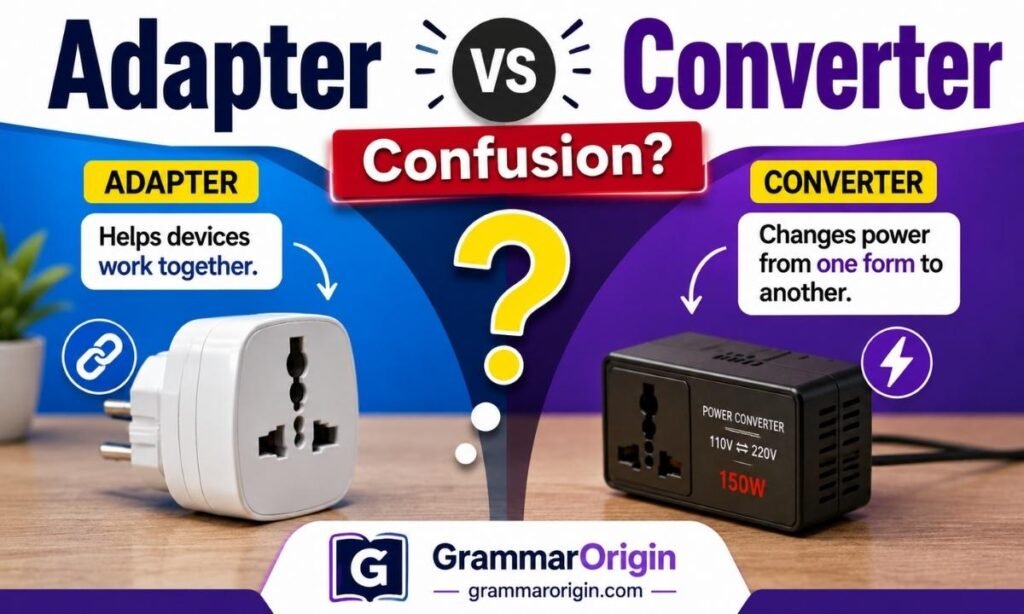
An adapter makes shapes or interfaces compatible; a converter changes the actual electrical current or signal; a transformer specifically alters voltage. Mixing these up is the single most common mistake in this topic.
| Term | What It Actually Does | Example |
| Adapter | Makes plugs or interfaces physically compatible | Travel plug adapter |
| Converter | Changes voltage or signal type | 120V-to-240V voltage converter |
| Transformer | Alters electrical voltage specifically | Step-down transformer for appliances |
A quick rule of thumb: if the plug shape is the problem, reach for an adapter. If the device could get damaged by the wrong voltage, you need a converter too.
Which One Should You Use?
For most writers, the adapter vs adaptor decision comes down to one simple test: who’s reading this? Use adapter for almost everything — it’s the safer, more globally recognized choice for tech and general writing.
Reserve adaptor for UK-focused audiences or when a specific legacy style guide calls for it. Whichever you pick, stay consistent within a single document — switching spellings mid-page reads as careless, even though both are technically correct.
Historical Trend in Usage
Language-frequency data shows a clear, steady move toward adapter over the last century, in both American and British English.
| Period | Adapter | Adaptor |
| Before 1950 | Moderate use | Common, especially in the UK |
| 1950–2000 | Rising steadily | Slowly declining |
| 2000–present | Dominant globally | Niche, mostly legacy texts |
Digital publishing and global e-commerce likely sped this up — once a spelling becomes the default on product pages and in software, it tends to stick.
SEO and Writing Strategy for Adapter vs Adaptor
Ranking for adapter vs adaptor searches means covering both spellings without confusing your reader. If you’re writing for search, lead with adapter as your primary term and mention adaptor once or twice for completeness — that combination captures both search behaviors without diluting your keyword focus.
Avoid randomly alternating between the two spellings across a page. Search engines read that as inconsistency, and readers notice it too, even if they can’t say exactly why something feels off.
Cultural and Language Evolution Insight
English has a long history of trimming spelling toward whatever’s faster to type and read — colour to color, catalogue to catalog, and now, gradually, adaptor to adapter.
Mobile typing and global content consumption have only sped this along. When millions of people search and type the same word daily, the shorter, more common form tends to win out, regardless of where it started.
Real Case Study
Tech Company Product Naming
Look at how major electronics brands label their own products, and the pattern is obvious. Apple, Anker, Belkin, and Ugreen all market their charging accessories as “power adapters” across virtually every region they sell in, including the UK.
This matters for writers because brand naming shapes reader expectations. When someone searches for a product, they’re far more likely to type the spelling they’ve seen on packaging — which today means adapter.
READ MORE RELATED POST Nighttime vs Night Time
Adapter vs adaptor grammar
Grammatically, both words are regular, countable common nouns — there’s nothing irregular about how they behave in a sentence. Plurals form the normal way: adapters and adaptors.
Neither word changes form based on tense, and neither functions as a verb. “I need to adaptor this cable” is incorrect — the verb form is always adapt (“I need to adapt this cable”).
Adapter vs adaptor reddit
Search grammar and engineering forums, and the consensus mirrors what dictionaries already say: both spellings work, adapter shows up far more often, and most posters treat the difference as a non-issue once someone links a dictionary entry.
A recurring theme in these threads is confusion between adapter and converter rather than between adapter and adaptor — which suggests the spelling debate matters less to everyday users than the functional difference does.
Adapter or adaptor Charger
For charging devices specifically, adapter is the near-universal choice. “Power adapter,” “wall adapter,” and “charging adapter” dominate product titles, manuals, and support pages across every major electronics brand.
You’ll rarely, if ever, see “charger adaptor” on a retail listing — even from UK-based sellers. This is one context where the industry has settled the spelling question almost entirely on its own.
Adapter or adaptor Oxford Dictionary
Major English dictionaries list both spellings, with adapter typically shown as the primary or more frequent entry and adaptor noted as an accepted variant.
| Dictionary | Primary Entry | Notes |
| Oxford | Adapter | Lists adaptor as an accepted variant spelling |
| Merriam-Webster | Adapter | American-English focused; adaptor rarely used |
| Cambridge | Adapter / Adaptor | Both listed, British usage notes included |
| Collins | Adapter | Notes adaptor as a valid, less frequent alternative |
No major dictionary marks adaptor as outdated or incorrect — it’s simply the less common entry today, even in British references.
Connector adaptor
One more adapter vs adaptor variant worth knowing: a connector adaptor is a small physical piece built purely to join two different cable ends or ports — like a 3.5mm-to-USB-C adapter or a VGA-to-HDMI connector.
These pieces don’t change voltage or signal type; they exist solely to solve a physical mismatch, which is exactly the core definition of the word adapter itself.
Adaptor Plug
“Adaptor plug” is a common British phrase for what American English usually calls a “plug adapter” — the same object, just with the word order and spelling flipped by region.
You’ll still see “adaptor plug” printed on UK travel-accessory packaging and in older British electrical guides, even as “adapter” gains ground in newer UK retail listings.
Frequently Asked Questions
Is it adapter or adaptor?
Both are correct. Adapter vs adaptor is a spelling preference, not a grammar rule — adapter is more common globally, while adaptor still appears in British and legacy technical writing.
Do Americans use adapter or adaptor?
Americans almost always write adapter. It’s the standard spelling in US style guides, product packaging, and technical documentation.
Is adaptor grammatically incorrect?
No. Adaptor is a fully valid, dictionary-recognized spelling. It’s simply less frequent than adapter in current writing.
What does Oxford Dictionary say about adapter vs adaptor?
Oxford lists adapter as the primary entry and includes adaptor as an accepted variant spelling with the same meaning.
What’s the difference between an adapter and a converter?
An adapter makes plugs or interfaces physically compatible; a converter changes the actual voltage or signal, which an adapter does not do on its own.
Which spelling is better for SEO?
For most SEO content, the adapter vs adaptor choice favors adapter, since it carries higher search volume globally, though adaptor is worth including once for UK-focused content.
Can adapter also mean a person?
Yes. In publishing and film, an adapter is someone who reworks a novel or play into a script for a different medium.
Is adaptor used in Pakistan and India?
Yes, particularly on electrical and travel-plug packaging, where British spelling conventions still carry weight, even as adapter grows more common in tech and software writing.
Conclusion
The adapter vs adaptor debate isn’t really a debate at all — both spellings mean exactly the same thing, and neither one is a mistake. The choice mostly comes down to your audience: adapter for global, American, or tech-focused writing, and adaptor when you’re following British convention or a specific style guide.
What matters more than which spelling you pick is staying consistent once you’ve chosen it. Get that right, and this is one grammar debate you’ll never have to think about twice.

Muhammad Waqas is an English language teacher and grammar expert with over 8 years of experience helping students and professionals improve their writing skills. He specializes in English grammar, vocabulary, communication, and practical language learning. Through GrammarOrigin, Waqas shares clear, easy-to-understand content that helps readers write and speak English with confidence.