
Have you ever paused mid-sentence, unsure which version to type? You’re not alone — this is one of the most commonly misspelled words in English, tripping up even confident writers.
This guide covers the correct spelling of address or adress, its meaning, how to say it, and real examples — so the mix-up never slows you down again.
Address or Adress – Quick Answer
Only one version is correct: it carries a double “d” and a double “s.” The shorter, single-“d” form is not a recognized English word — it’s simply a common typo.
- ✅ Please confirm your correct location details before checkout.
- ❌ Please confirm your shipping “adress” before checkout.
British, American, Canadian, and Australian English all use the same spelling. There’s no regional variation here — just one standard form, accepted everywhere.
The Origin of Address or Adress

This word traces back to the Latin root directus, meaning “straight” or “direct.” Old French speakers reshaped it into adresser, meaning “to direct” or “to guide toward something,” and English borrowed that form during the Middle Ages.
Middle English writers spelled it adressen at first, closer to the French original. Over time, English scribes doubled both consonants to match the pronunciation pattern of other borrowed French words, and the modern form was standardized by the 17th century.
That’s also why similar terms like success and access carry doubled letters — they followed the same French-rooted spelling pattern. The single-“d” variant never became an accepted alternative in standard English; it stayed a simple dropped-letter mistake instead of a legitimate spelling variant, unlike genuine historical shifts such as “colour” becoming “color” in American usage.
Address or Adress Pronunciation
The correct word is pronounced uh-DRESS (/əˈdrɛs/), with stress falling on the second syllable. When used as a noun for a formal speech, some speakers instead stress the first syllable, saying AD-ress but both refer to the same spelling.
There’s no separate pronunciation guide for the shorter typo, since it isn’t a real English term and has no standard sound of its own.
Which Spelling Should You Use?
The rule stays the same no matter your audience.
If You’re Writing for a US Readership
Stick with the standard spelling. American dictionaries, including Merriam-Webster, list only this form as correct.
If You’re Writing for a UK or Commonwealth Readership
The same rule applies. British English doesn’t carry a separate version for this term, unlike “colour” vs. “color.”
If You’re Writing for a Global Audience
Use the standard form regardless of location. It’s the only accepted option across every English-speaking country, so there’s nothing to adjust by region.
Comparison Table – Address vs Adress
| Feature | Address ✅ | Adress ❌ |
| Correct spelling | Yes | No |
| Listed in dictionaries | Yes | No |
| Accepted in formal or professional writing | Yes | No |
| Common typing mistake | No | Yes |
| Recognized in UK & US English | Yes | Nowhere |
This table sums up the core rule: one form belongs in every dictionary and style guide, while the other only ever shows up as a typing slip. Word processors, browsers, and grammar checkers all treat the shorter form as an error, never as a stylistic choice.
Address vs Adres vs Addres – Misspelling Cluster
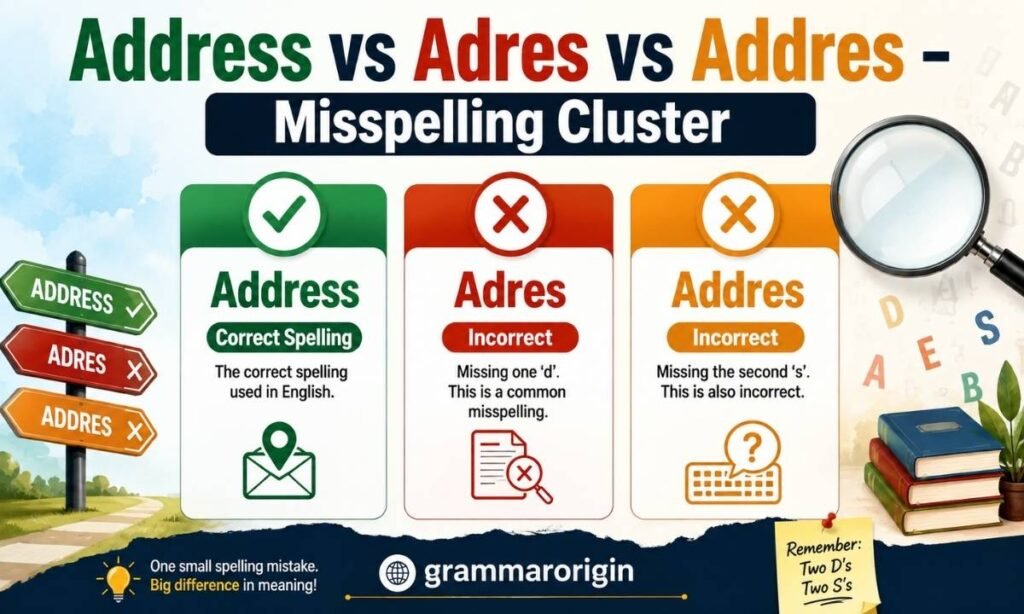
The single-“d” version isn’t the only variant people type by mistake. Here’s how the common misspellings compare, all pointing back to the same correct form:
| Misspelling | Missing Letter(s) | Fix |
| Adress | One “d” | ✅ |
| Adres | One “d” and one “s” | ✅ |
| Addres | One “s” | ✅ |
All three point back to the same correct spelling — they’re simple letter-drop errors, not accepted variants. None appear in any English dictionary, and most spell check tools flag them the same way, treating each as a straightforward typo rather than a grammar issue. If you see a red underline under any of these three in your word processor, trust it — there’s no context where the shorter form is intentional or correct.
This pattern isn’t unique to this word either. Other high-frequency English words such as “receive,” “separate,” and “occurred” get mistyped for similar reasons — guessing based on pronunciation or simplifying doubled consonants. Building a habit of double-checking doubled letters in frequently used words can prevent several common spelling slips at once, not just this one.
Read More Related Post Writing or Writting
Why Do People Misspell “Address”?
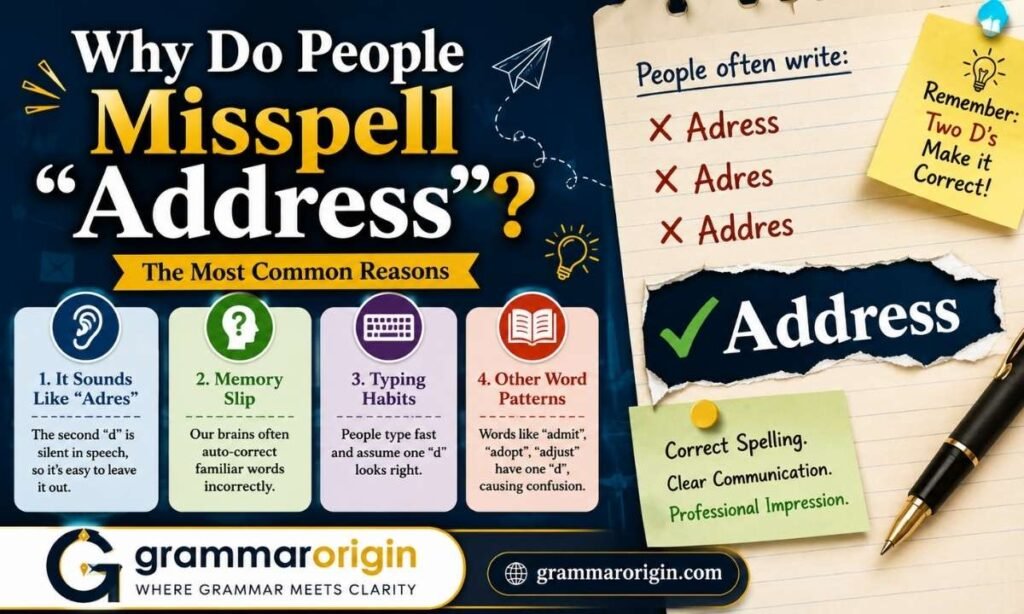
Most writers slip up for one of a few simple, understandable reasons.
Typing Too Fast
Quick typing, especially on a mobile keyboard, often skips a letter without the writer noticing until later.
Pronunciation Confusion
The spoken word doesn’t clearly reveal its double letters, so some people guess based on sound rather than orthography.
Autocorrect Gaps
Spell check tools sometimes miss the error entirely, particularly when it’s buried inside a longer sentence.
Simplifying Double Letters
English learners occasionally assume double consonants are optional, since many other languages don’t follow the same convention.
Visual Similarity to Shorter Words
Because the correct form looks close to shorter, simpler English words, some writers unconsciously trim it while typing quickly, especially in casual chat or messaging apps.
Is “Adress” a Real Word in Another Language?
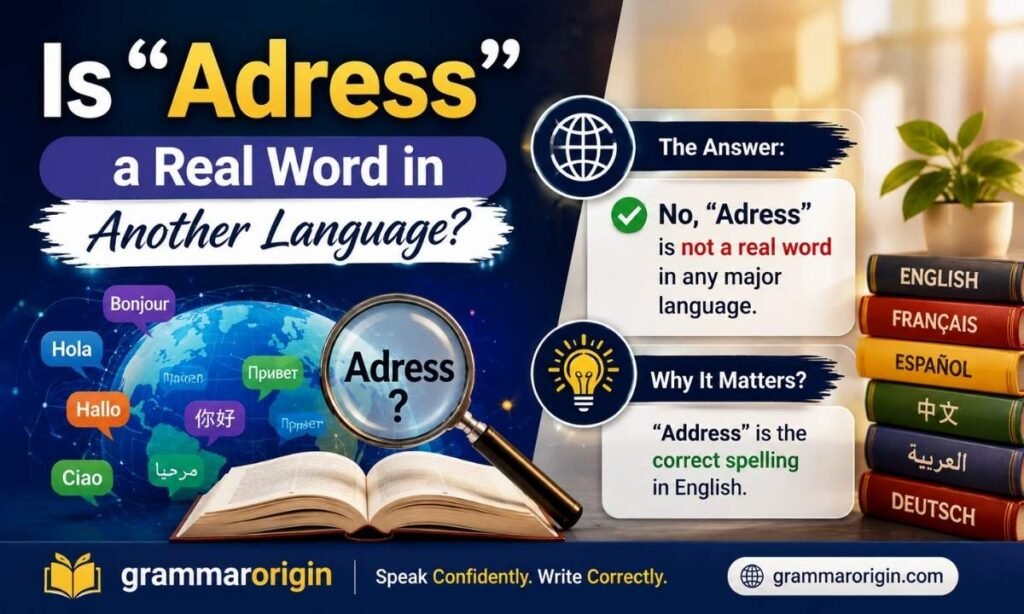
Interestingly, this shorter form is a genuine, correctly spelled word in Norwegian, Danish, and Swedish, where it also refers to a location or postal detail. This is likely one reason the mix-up feels natural to some writers — it’s a legitimate loanword in Scandinavian languages, just missing one “d” compared to English.
In standard English, though, this spelling carries no independent meaning of its own. If you’re writing in English, only the double-lettered form is correct, regardless of how familiar the shorter version looks in other contexts.
Address or Adress in Everyday Examples
Here’s how the correct spelling shows up across different types of writing, from a home mailing address to a company’s official contact details.
Emails
“Please confirm your shipping details before we process the order.”
News
“The company announced a change to its registered office location.”
Social Media
“Drop your email contact below to join the newsletter.”
Formal Writing
“Kindly update your postal details in our records at your earliest convenience.”
Read More Related Post Writing or Writting
Legal and Government Documents
“Applicants must list a current residential location on the visa form, along with a valid contact phone number.”
In every context — casual or formal, physical or digital (including an IP location or web contact) — only the double-lettered spelling is correct. Whether it’s a home mailing detail, a business’s registered location, or a delivery contact point, the rule never changes.
Frequently Asked Questions
Is “adress” ever a correct spelling in English?
No. In the address or adress debate, only the double-lettered form is accepted in standard English dictionaries.
How do you pronounce “address”?
It’s pronounced uh-DRESS (/əˈdrɛs/), with stress on the second syllable.
Is “adress” a real word in any language?
Yes — it exists in Norwegian, Danish, and Swedish, but not in English.
How can I remember the correct spelling?
Think of it as “ad” + “dress”: two syllables, two d’s, two s’s.
Is this word a noun or a verb?
Both. As a noun, it names a location, such as a home or business address. As a verb, it means to speak to or deal with something, such as addressing a problem.
Why do people often misspell this word?
Usually because of fast typing, pronunciation guesses, or spell check tools missing the error.
Does the spelling change between British and American English?
No. Unlike “colour” vs. “color,” this term is spelled the same everywhere.
What is the plural form?
The plural is “addresses,” adding “-es” because the singular already ends in a double “s.”
Can spell check tools always catch this mistake?
Not always. If the shorter form is buried inside a long sentence or an unusual context, some grammar checkers miss it, so it’s worth proofreading manually too.
Final Thoughts
The address or adress confusion comes down to one simple rule: always use the version with a double “d” and double “s.” The shorter form isn’t accepted in standard English writing, no matter the audience or context.
Once you remember the doubled letters — and maybe the Scandinavian twist behind the mix-up — this spelling becomes second nature. Keep this guide handy the next time you pause before typing your mailing address, email contact, or any official location detail.

Muhammad Waqas is an English language teacher and grammar expert with over 8 years of experience helping students and professionals improve their writing skills. He specializes in English grammar, vocabulary, communication, and practical language learning. Through GrammarOrigin, Waqas shares clear, easy-to-understand content that helps readers write and speak English with confidence.