
You’ve probably typed this word a hundred times, then paused right before hitting send. Is it writing or writting? Only one of these is a real English word, and the mix-up trips up even confident English speakers.
The correct spelling is writing, with a single “t.” Writting isn’t a recognized word in any English dictionary, no matter how natural it might look on the page. Here’s exactly why one form works and the other doesn’t, plus how to stop second-guessing yourself for good.
Writing or Writting – Quick Answer
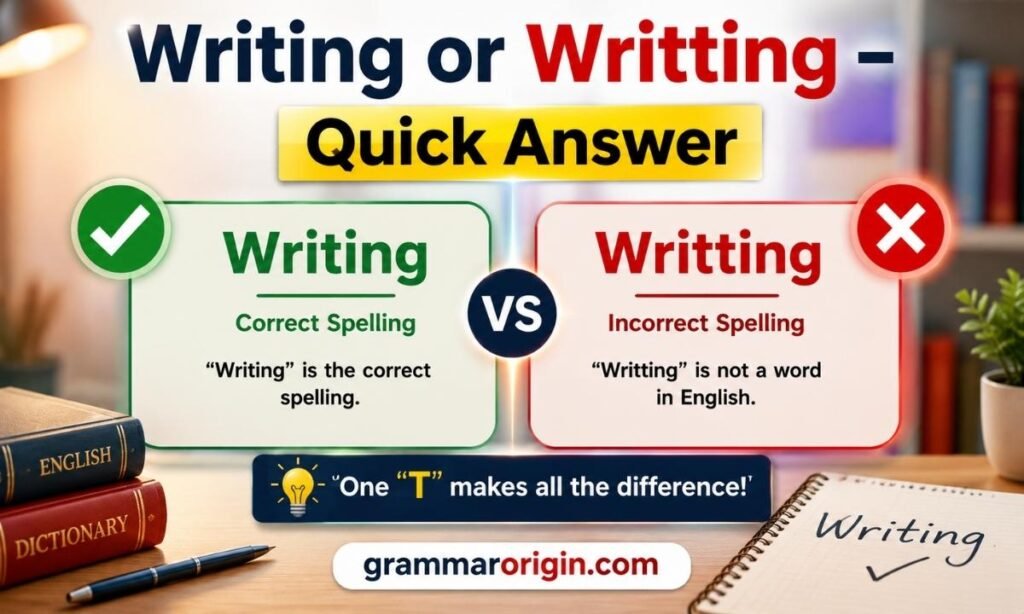
Writing is correct. Writting is a spelling error that doesn’t exist in standard English.
The word comes from write, and when you add “-ing,” the silent “e” simply drops off. No letter gets doubled in the process.
- Correct: writing
- Incorrect: writting
Examples
He’s writing a letter to his old college roommate right now.
Correct: “She kept writing until midnight.”
Incorrect: “She kept writting until midnight.”
A simpler way to remember it: drop the “e,” add “-ing,” and stop there.
The Origin of Writing or Writting
The word traces back to the Old English verb “writan,” which described carving or scratching marks into wood, stone, or bark. That’s the root of every modern sense of it.
Centuries later, as pen and paper replaced chisels, the meaning shifted toward putting words down on a page. The spelling, though, followed a separate path shaped by how English forms its “-ing” verbs.
Verbs ending in a silent “e” — like write, make, or hope — lose that “e” before “-ing” gets added.
| Base Verb | Correct -ing Form |
| write | writing |
| hope | hoping |
| make | making |
| ride | riding |
Because this rule has stayed consistent for centuries, writting never became an accepted alternative — it’s simply a slip that ignores how the silent “e” behaves.
British English vs American English Spelling
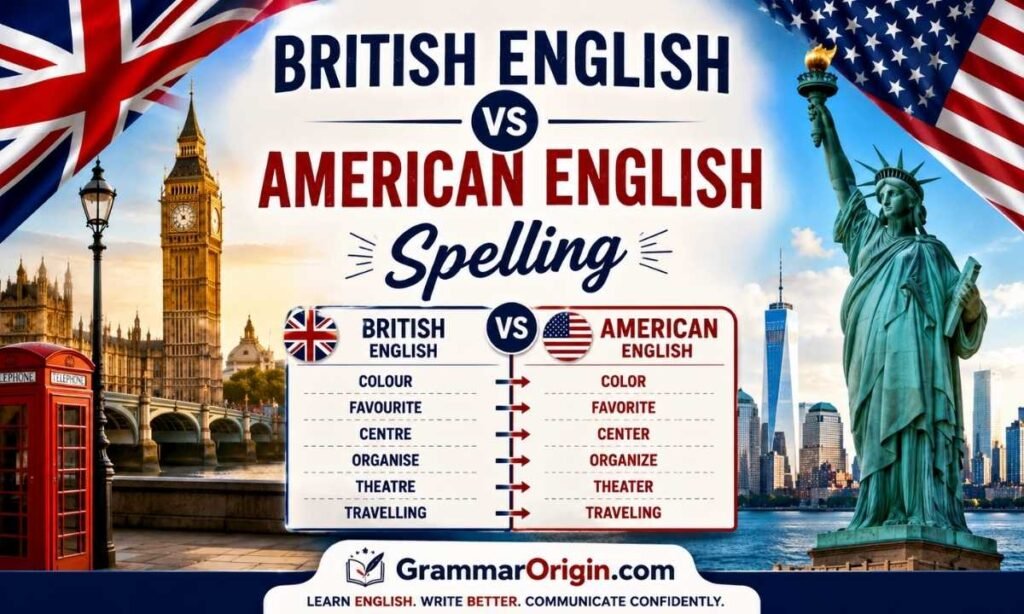
There’s no split here. Writing is spelled identically in British and American English, unlike words such as “colour/color” or “realise/realize.”
| Word | British English | American English |
| Writing | Writing | Writing |
| Writting | Not used | Not used |
So switching between UK and US style guides won’t change anything about this particular word — you’re safe using it everywhere.
Which Spelling Should You Use?
Use writing every time, regardless of context — email, essay, résumé, or a quick text to a friend.
There’s no formal, informal, regional, or academic setting where writting is acceptable. It’s not a stylistic choice; it’s simply not a word.
Examples
“Good writing takes practice, not talent alone.”
“I’ve been writing this proposal since Tuesday.”
Common Mistakes with Writing or Writting
Most people who type writting aren’t careless — they’re applying a spelling pattern that works for other words but not this one.
Mistake 1
Doubling the “t” out of habit, the way you would with “sit → sitting” or “run → running.” Write doesn’t follow that rule because of its silent “e.”
Mistake 2
Typing fast and letting muscle memory take over. The extra “t” often sneaks in during quick messages or notes, not real carelessness.
Mistake 3
Assuming every one-syllable verb doubles its final consonant before “-ing.” That rule only applies to short-vowel words like “sit” or “hit,” not long-vowel words like “write.”
Quick Memory Trick to Remember Writing (Not Writting)
Picture the word “write,” cross out the silent “e” with your finger, then add “ing.” What’s left has exactly one “t” — because you never touched it.
Here’s a short line that sticks: “Drop the e before you flee — one t is all you need.”
If you’re ever unsure mid-sentence, just say the base word “write” out loud first. It has one “t,” and that never changes when “-ing” joins it.
More Related Post How-to vs How-tos
Writing or Writting in Everyday Examples
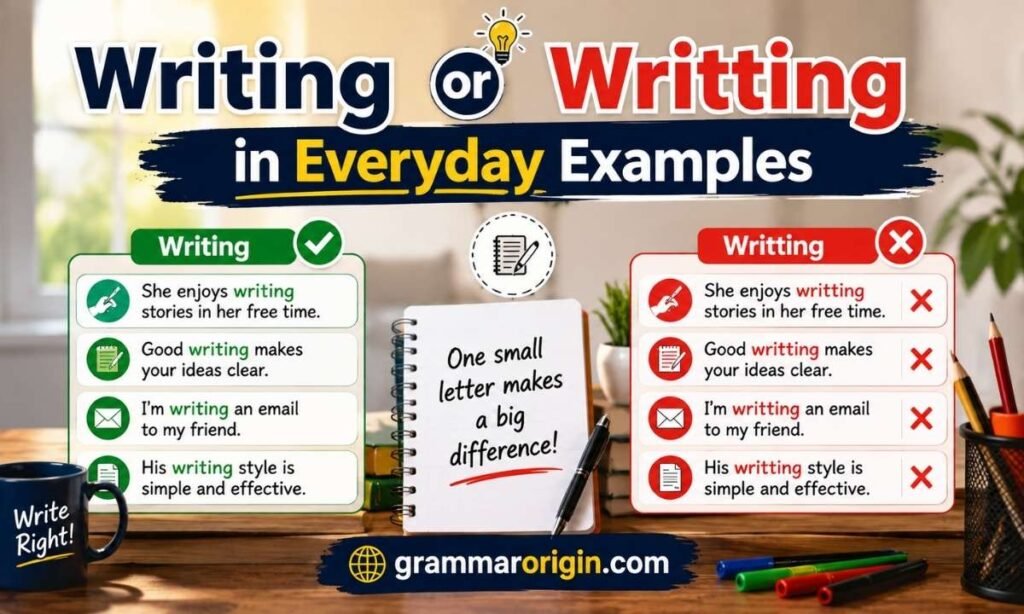
Seeing the correct form in real situations makes it easier to remember than any rule on its own.
“I’m writing to follow up on our conversation from last week.”
News
“The columnist has spent two decades writing about local politics.”
Social Media
“Finally sat down and started writing my first short story tonight.”
Formal Writing
“Precise writing reduces the chance of a report being misread.”
Writing or Writting – Google Trends & Usage Data

Searches for this exact phrase tend to cluster around school terms, exam seasons, and moments when people are drafting formal emails for the first time. It’s a spelling-confusion search, not a debate between two valid options.
Most people typing “writting” are checking themselves mid-sentence rather than genuinely unsure which word means what — the confusion is purely about spelling, not meaning.
Countries where the query appears often
Based on general search-behavior patterns for this type of spelling query, interest tends to run highest in regions with large English-as-a-second-language populations:
- India
- Pakistan
- United States
- Philippines
- Nigeria
These regions share a common thread: many people are communicating in English as an additional language, where spelling rules like the silent “e” drop aren’t always taught explicitly. (Note: this list reflects typical patterns for ESL-heavy regions rather than a pulled Google Trends report — check Google Trends directly if you need exact figures.)
Comparison Table: Writing vs Writting
| Feature | Writing | Writting |
| Correct spelling | Yes | No |
| Appears in dictionaries | Yes | No |
| Accepted in exams | Yes | Marked incorrect |
| Used in professional documents | Yes | No |
| Follows silent-e rule | Yes | Breaks the rule |
| Grammatically valid | Yes | Never |
Writing or writting grammar
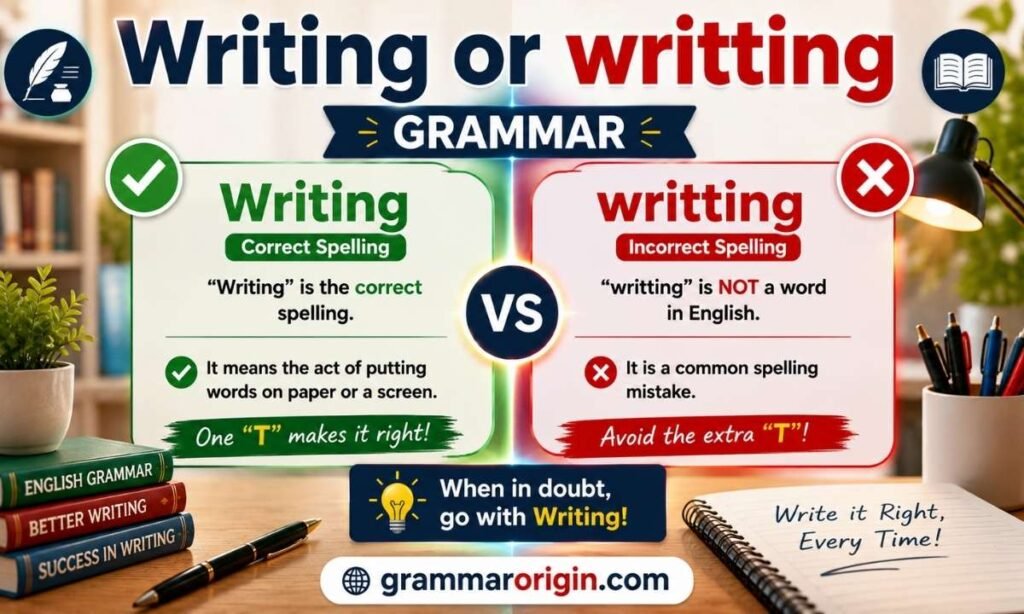
Grammatically, writing functions two ways: as the present participle of “write” (used in continuous tenses) and as a gerund (acting like a noun).
“She is writing a novel” uses it as part of a verb phrase. “Writing is her favorite way to unwind” uses it as a noun. Writting can’t fill either role because it isn’t a recognized word form.
The grammar rule behind the spelling is simple: verbs ending in a silent “e” drop that “e” before any “-ing” suffix, full stop. Write, hope, and move all follow this same pattern.
Writing or writting exercises
Test yourself with these. Fill in each blank with the correct spelling.
- She is _____ a letter to her grandmother.
- His _____ has improved a lot since last year.
- They spent the afternoon _____ song lyrics together.
- I am _____ this email to confirm our appointment.
- Good _____ starts with a clear outline.
- He’s been _____ that screenplay for three years.
Answer key: every blank above takes the same word — writing. If that’s what you filled in each time, you’ve already internalized the rule better than most people who search this term.
More Related Post How-to vs How-tos
Writing spelling words
A handful of related words follow the exact same silent-e pattern, which makes them useful to learn together.
| Word | Related -ing Form |
| write | writing |
| written | (past participle — double t, different rule) |
| rewrite | rewriting |
| writer | (noun, no -ing needed) |
| unwritten | (past participle form) |
Notice that “written” does carry a double “t” — but that’s a past participle rule, separate from the “-ing” rule covered earlier.
Writing styles
Beyond spelling, “writing” also describes distinct approaches people use depending on purpose and audience.
- Narrative — tells a story, often with a clear beginning, middle, and end
- Persuasive — argues a point, common in opinion pieces and ads
- Expository — explains or informs, seen in guides and manuals
- Descriptive — paints a picture using sensory detail
- Technical — focuses on clarity and precision, used in manuals and documentation
Each style still relies on the same spelling rule — the word itself never changes, only how it’s used.
Frequently Asked Questions
Is writting ever a correct spelling?
No. Writting isn’t listed in any standard English dictionary and is always treated as a misspelling of writing.
Why do so many people spell it as writting?
They’re applying the double-consonant pattern from words like “sitting” or “running,” which doesn’t apply to “write” because of its silent “e.”
What’s the actual rule behind write becoming writing?
Drop the silent “e” from “write,” then add “-ing.” No letters get doubled at any point.
Does British English spell it differently than American English?
No. Both use writing, with no regional variation for this particular word.
Is writing a noun or a verb?
Both. As a verb form: “She is writing a report.” As a noun: “His writing is very clear.”
Why does written have a double t if writing doesn’t?
Written is a past participle, which follows a different formation rule than the present participle “writing.” The double “t” signals a shortened vowel sound, not a spelling exception.
Can spell-check catch writting automatically?
Yes, virtually every spell-checker and word processor flags writting and suggests writing as the correction.
Does this spelling mistake actually matter in professional settings?
Yes. A misspelled word like writting in an email or report can come across as careless, especially in job applications or client-facing documents.
Final Thoughts
The mix-up between writing and writting almost always comes down to one misapplied rule assuming every short verb doubles its last letter before “-ing.” Write doesn’t, because its silent “e” gets dropped instead.
Once that one distinction clicks, the confusion disappears for good. Stick with writing in every context, and you’ll never need to second-guess this word again.

Muhammad Waqas is an English language teacher and grammar expert with over 8 years of experience helping students and professionals improve their writing skills. He specializes in English grammar, vocabulary, communication, and practical language learning. Through GrammarOrigin, Waqas shares clear, easy-to-understand content that helps readers write and speak English with confidence.