
Lead or LEED — which one do you actually need? These two words look almost identical on the page, but they come from completely different corners of the English language. One is an everyday word you’ll use in emails and conversation. The other is a certification name from the construction world.
This guide breaks down what each term means, how to say it out loud, and where most people slip up. By the time you finish, you won’t second-guess lead or LEED again.
Quick Answer
Lead and LEED aren’t interchangeable — they belong to two separate vocabularies entirely. Lead is a standard English word that works as a verb, a noun, and a metal name. LEED is an acronym for a green building certification program, and nothing else.
At its core, the lead or leed meaning question always comes down to one thing: everyday English versus a fixed certification name.
What is the difference between lead and LEED?
Lead can mean to guide someone, to hold first place, or to describe a heavy metal — the meaning shifts with context. LEED only ever means one thing: a rating system that scores how sustainable a building is. There’s no overlap in what these two words actually refer to, even though they look and often sound alike.
Are they pronounced the same?
Sometimes, yes — but not always. Lead rhymes with “seed” when it means to guide, and it rhymes with “bed” when it names the metal. LEED, on the other hand, is fixed — it always rhymes with “seed,” no exceptions.
One-Sentence Rule You’ll Never Forget
If the sentence is about grammar, metal, sales, or guiding people, reach for lead. If it’s about green buildings or sustainability scores, reach for LEED. That single test resolves almost every lead or LEED mix-up you’ll ever run into.
Lead vs LEED vs Led: Quick Visual Summary
Here’s a fast reference before we go deeper into each term.
| Word | Sounds Like | Meaning | Example |
| Lead (verb) | leed | To guide or direct | She will lead the meeting. |
| Lead (metal) | led | A heavy, soft element | The pipe is made of lead. |
| Led | led | Past tense of lead | She led the meeting yesterday. |
| LEED | leed | Green building certification | The office earned LEED Gold. |
Why People Confuse Lead and LEED
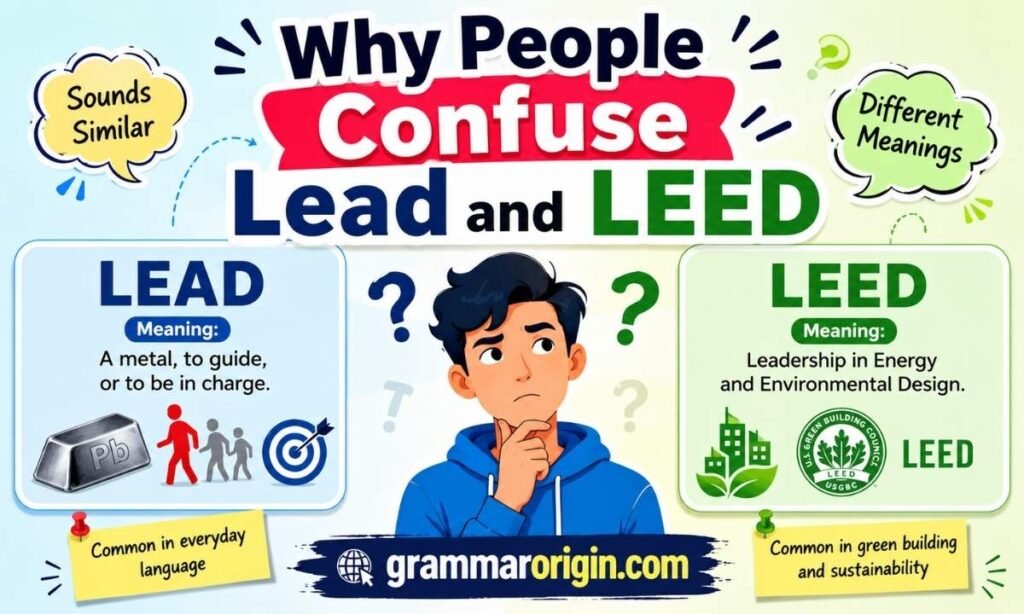
The mix-up isn’t random — it comes down to three specific habits in how English sounds and how search engines interpret intent. Once you see the pattern, the confusion mostly disappears.
Homophones Explained
A homophone is a word that sounds like another word but carries a different meaning. Lead (the verb “to guide”) and LEED both land on the exact same sound — “leed” — even though nothing else about them matches.
That shared sound is really the root of the whole lead or leed debate online.
Capitalization Confusion
Case matters more than most writers assume. LEED is written entirely in capital letters because it’s an acronym, never a regular word. Lead, meanwhile, stays lowercase unless it opens a sentence — writers who ignore that distinction end up with awkward, inconsistent copy.
Google Search Intent Differences
Someone typing “lead meaning” almost always wants a grammar answer. Someone typing “LEED certification” is usually researching architecture or construction standards. Search engines separate these two intents cleanly, so blending them in one confusing piece of content can actually hurt how a page ranks.
What Does “Lead” Mean?
Lead carries several unrelated meanings, and only the surrounding sentence tells you which one applies. Here’s each version broken down on its own.
Lead as a Verb – To Guide
Used as a verb, lead means to guide, direct, or take charge of something. “She will lead the design team” and “Teachers lead students toward better habits” both use this sense, and both are pronounced “leed.”
Lead as a Noun – Position of Advantage
As a noun, lead can describe first place or a measurable advantage. “Our team built a solid lead by halftime” still uses the “leed” pronunciation, just in noun form instead of verb form.
Lead as a Metal – Pronunciation Changes
This is where the trap sits. Lead the metal — a heavy, soft element once common in pipes and paint — is pronounced “led,” not “leed,” even though the spelling never changes.
That single sound shift is why linguists call lead a homograph: identical spelling, two separate pronunciations and meanings.
Lead in Marketing and Sales
In business contexts, a lead is a potential customer who’s shown interest in a product. “The team followed up with 40 new leads this week” is a phrase you’ll hear constantly in sales and digital marketing.
What Is LEED?

LEED sits on the opposite side of this comparison — it’s a fixed, single-purpose acronym rather than a flexible word.
What LEED Stands For
LEED stands for Leadership in Energy and Environmental Design. It’s a rating framework used to measure how environmentally responsible a building actually is, from energy use to water conservation.
Also Read This And vs Or
Who Created It
The U.S. Green Building Council developed the LEED system to push construction toward measurable sustainability standards. The council still maintains and updates the framework today.
Why LEED Certification Matters
Buildings earn LEED points across categories like energy efficiency, water use, indoor air quality, and material sourcing. Developers chase certification because it can lower long-term operating costs and raise a property’s resale value.
Certification comes in four tiers, based on total points scored:
| Level | Points Required |
| Certified | 40–49 |
| Silver | 50–59 |
| Gold | 60–79 |
| Platinum | 80+ |
Global Adoption and Impact
Schools, hospitals, offices, and even private homes now pursue LEED status across dozens of countries. That global reach shows exactly why LEED belongs to architecture and sustainability — never to grammar.
Pronunciation Breakdown
Getting the sound right is often the fastest way to stop confusing these words in speech.
/leed/ vs /led/
Lead as a verb or “first place” noun is pronounced /liːd/. Lead as the metal is pronounced /lɛd/. LEED is always /liːd/, matching only the guiding sense of “lead,” never the metal.
Why “Lead” Changes Sound
English kept the same spelling for lead across centuries while its pronunciation split by meaning. The metal sense traces back further in the language’s history, which is part of why it kept a different vowel sound than the verb form.
Side-by-Side Comparison Table
A single table clears up most of what’s confusing about lead or LEED at a glance.
| Category | Lead | LEED |
| Meaning | To guide, an advantage, a metal, or a sales prospect | A green building certification system |
| Pronunciation | “leed” or “led,” depending on sense | Always “leed” |
| Usage Field | Grammar, business, chemistry, marketing | Architecture, construction, sustainability |
| Capitalization | Lowercase unless starting a sentence | Always uppercase |
| Part of Speech | Verb or noun | Acronym / proper noun |
Common Mistakes and How to Avoid Them
Most lead or LEED errors repeat themselves across emails, essays, and even published articles.
Writing “leed” Instead of “lead”
Outside of the certification name, “leed” isn’t a real English word. If you’re guiding a team, guiding a project, or taking first place, the correct spelling stays “lead.”
Mispronouncing the Metal
Saying “leed pipe” instead of “led pipe” is a common slip, especially among learners. Remember: the metal always takes the short “e” sound, never the long one.
Pencil Lead or Led?
The stuff inside a pencil is casually called “lead,” pronounced “led,” even though it’s actually made of graphite, not the metal. It’s never spelled or said as “led” in past tense — it’s a fixed noun usage that just borrows the metal’s pronunciation.
Also Read This And vs Or
Capitalization Errors
LEED should never appear as “Leed” or “leed” in formal writing — it’s an acronym and stays fully capitalized. Before you publish anything, ask whether you mean the grammar word or the certification system, since that answer decides both spelling and case.
British English vs American English Spelling
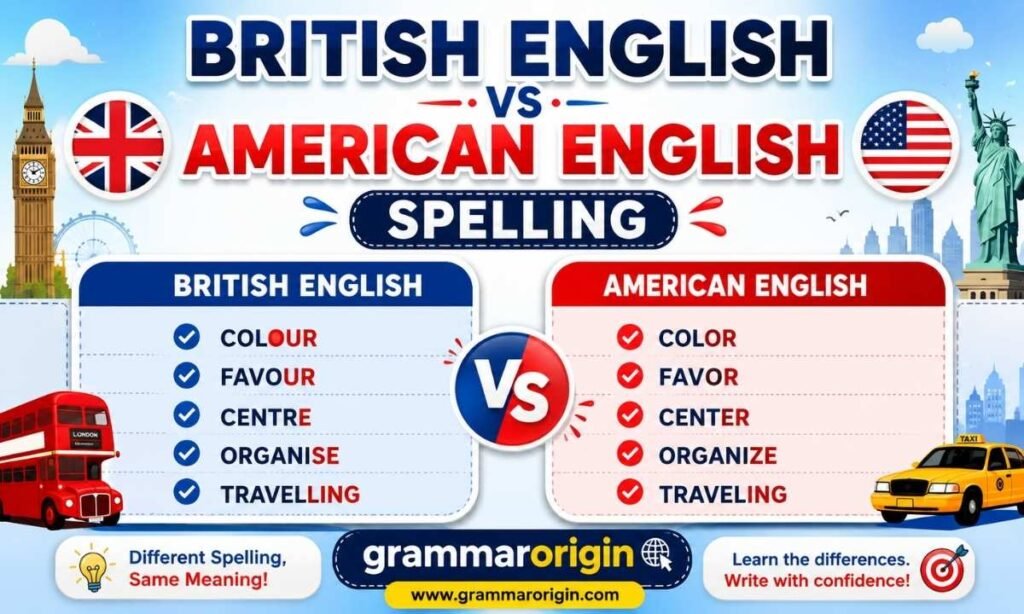
This isn’t a regional spelling split like “color” versus “colour.” Lead is spelled identically in American and British English, and so is LEED — the only real difference between the two dialects shows up in accent, not spelling. A UK speaker saying “lead the meeting” and a US speaker saying the same phrase use the exact same spelling and roughly the same “leed” pronunciation.
Examples in Real Sentences
Seeing both terms in context makes the rule stick faster than any explanation.
Academic Writing
- The professor will lead the seminar next week.
- The new library achieved LEED Gold certification.
Business Context
- She took the lead during contract negotiations.
- Our headquarters sits inside a LEED-certified tower.
Construction Context
- Crews removed the old lead pipes from the basement.
- The developer is targeting LEED Platinum for this project.
Resume Writing
- “Led a team of 12 engineers through a full product launch” is the correct past-tense phrasing for professional resumes — not “lead a team.”
Lead or Leed – Google Trends & Usage Data
Search behavior backs up everything covered above. “Lead” sees consistently high search volume as a standard English word used across grammar, business, and marketing queries. “LEED” trends separately, spiking around real-estate, architecture, and green-building news cycles rather than grammar searches.
“Leed” as a standalone spelling barely registers outside of typo-driven searches — it isn’t a recognized alternative spelling in any English dictionary.
See How Much You Have Learned With Our Quiz
Test yourself with these five quick questions before moving on.
- Which word is always spelled in capital letters — lead or LEED?
- What’s the past tense of “lead”?
- How is “lead” pronounced when it refers to the metal?
- What does LEED stand for?
- Is “leed” ever a correct English spelling outside the acronym?
Answer key: 1) LEED — 2) Led — 3) “led,” rhyming with “bed” — 4) Leadership in Energy and Environmental Design — 5) No, it’s always a spelling mistake.
Final Takeaway
Picture a tall, eco-friendly building with giant green letters spelling LEED across its front — that image locks in both the capitalization and the certification meaning instantly. Everything else — guiding, advantage, metal, sales prospect — falls under everyday lowercase “lead.”
Once you separate the acronym from the ordinary word, lead or LEED stops being confusing at all. Context, sound, and capitalization are really the only three checks you ever need.
Frequently Asked Questions
What Is the Difference Between LEED and Lead?
Lead is a flexible English word covering guidance, advantage, and a metal, while LEED is a single-purpose acronym for a green building certification. They share a sound but nothing else.
Is It Lead or LEED Time?
It’s “lead time” — a business term for how long a process takes from start to finish. LEED never applies here, since the phrase has nothing to do with certification.
What Are Two Meanings of Lead?
Lead can mean to guide or direct someone, and it can also name the heavy metal once common in plumbing and paint. A third common meaning, a sales prospect, shows up constantly in marketing.
What Is the Past Tense of Lead?
The past tense of lead is “led,” not “lead” or “leed.” Writing “she lead the team yesterday” is one of the most common grammar mistakes tied to this word.
Is Student Lead or Led Correct in a Sentence?
“Student-led” is correct when describing something guided by students, as in “a student-led initiative.” “Student lead” without the “-ed” would only work if “lead” were functioning as a present-tense verb in a different sentence structure.
What’s a Synonym for Lead (the Verb)?
Common synonyms include guide, direct, head, and command, depending on context. None of these apply to LEED, since it isn’t a descriptive verb at all.
Is Lead Spelled Differently in British English?
No. Lead keeps the same spelling in both British and American English, and so does LEED. Only pronunciation accent shifts slightly between the two dialects, not the letters themselves.

Muhammad Waqas is an English language teacher and grammar expert with over 8 years of experience helping students and professionals improve their writing skills. He specializes in English grammar, vocabulary, communication, and practical language learning. Through GrammarOrigin, Waqas shares clear, easy-to-understand content that helps readers write and speak English with confidence.