
If you’ve ever typed “swang” and then hit backspace, you’re not the only one. The past tense of swing trips up native speakers just as often as learners, mostly because it doesn’t play by the usual “-ed” rules.
This guide walks through every form of swing, why swung wins over swang, how to use it across tenses, and where the confusion actually comes from. You’ll also find pronunciation notes, real sentences, and a quick quiz at the end.
Quick Answer
What is the past tense of swing?
The past tense of swing is swung. That’s the only form standard English accepts for a completed action in the past.
“She swung the racket before the ball even landed” — that’s swung doing its job as simple past.
What is the past participle of swing?
Swing’s past participle is also swung. English doesn’t give this verb a separate form for perfect tenses, which honestly makes it easier to remember.
“He has swung that door a thousand times” uses swung with “has” to build present perfect.
Is swang ever correct?
Not in modern standard English. Swang shows up in some regional speech and older texts, but dictionaries and style guides don’t recognize it as correct today.
If you’re writing anything formal — an email, an essay, a report — swung is the only safe choice.
One-line rule you’ll never forget
Swing turns into swung, the same way sing turns into sung — not sang.
Why “Swing” Becomes “Swung” (The Pattern Behind It)
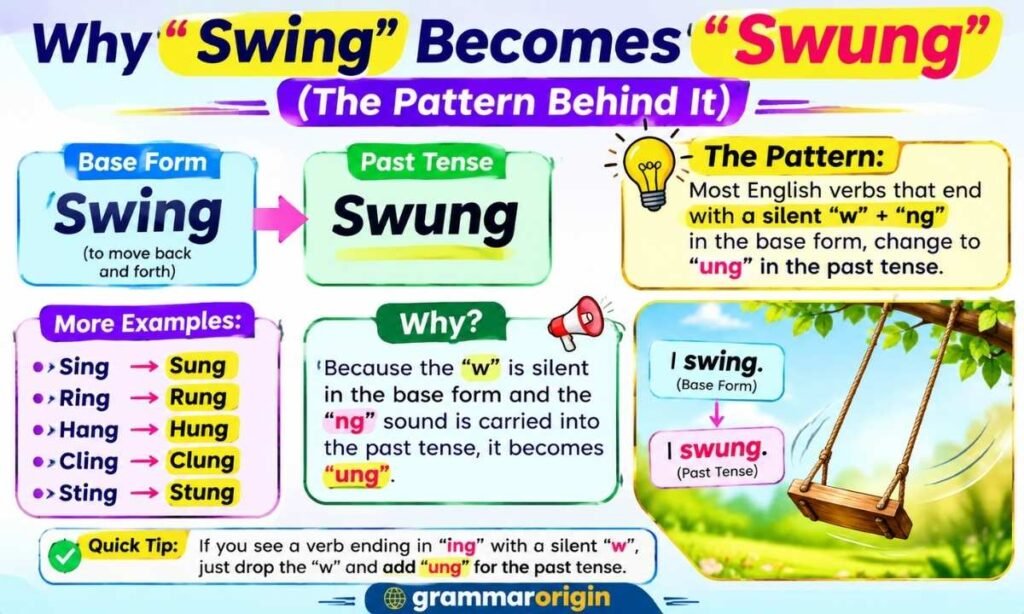
Swing belongs to a small club of English verbs that change their vowel sound instead of adding “-ed.” Once you spot the pattern, the whole thing stops feeling random.
The irregular verb family pattern
Look at these side by side:
- Sing → sang → sung
- Ring → rang → rung
- Cling → clung → clung
- Swing → swung → swung
Notice something odd? Swing skips the middle step. Some of these verbs have three distinct forms, but swing only needs two — base and swung — because the past tense and past participle are identical. If you’re memorizing this as a chain, “swing, swung, swung” is the whole conjugation — no third form to juggle.
Why English drops the “-ed”
These verbs are leftovers from Old English’s “strong verb” system, where the vowel inside the word carried the grammatical change instead of a suffix tacked on the end. Regular verbs like “walk” and “jump” came later and settled into the simpler “-ed” pattern.
That’s why “swinged” sounds wrong the moment you say it out loud — your ear already knows swing doesn’t belong to the regular crowd.
Swing and Its Irregular Verb Cousins
Swing isn’t alone. A whole family of English verbs follows the same internal vowel-shift habit, and once you recognize a few, you can often guess the rest.
| Base Form | Simple Past | Past Participle |
| swing | swung | swung |
| sing | sang | sung |
| ring | rang | rung |
| cling | clung | clung |
| sting | stung | stung |
| fling | flung | flung |
| spring | sprang / sprung | sprung |
Spring is the odd one out here — it still allows two accepted past-tense forms in different regions, which is a good reminder that not every irregular verb behaves identically. Swing, thankfully, keeps it simple with one form for both slots.
Swing in Every Tense (Clear Table + Real Sentences)
Seeing swing move through every tense makes the pattern stick faster than memorizing a rule on its own.
| Tense | Form | Example |
| Present Simple | swing | The gate swings shut on its own. |
| Past Simple | swung | The gate swung shut before I could catch it. |
| Present Perfect | has/have swung | The gate has swung open all morning. |
| Past Perfect | had swung | The gate had swung shut by the time we arrived. |
| Future | will swing | The gate will swing open once the wind picks up. |
| Present Continuous | is swinging | The gate is swinging in the storm right now. |
| Past Continuous | was swinging | The gate was swinging loudly last night. |
| Passive Voice | was/is swung | The gate was swung shut by the caretaker. |
Present Simple
Base form, no change: “The team swings for the fences every inning.”
Past Simple
This is where swung takes over: “The team swung for the fences last night and lost by one run.”
Present Perfect
Pairs swung with has or have: “They have swung wildly between confidence and doubt this season.”
Past Perfect
Uses had plus swung to mark an earlier past action: “The mood had already swung by the time he walked in.”
Future
Keep the base form after will: “Prices will swing higher once demand picks up again.”
Continuous Forms
Continuous tenses use swinging, not swung, since -ing forms are always regular: “She was swinging her arms to warm up before the match.”
Passive Voice
Passive sentences lean on the past participle: “The decision was swung by a single vote on the board.”
Swing vs Swung vs Swang (Why People Get Confused)
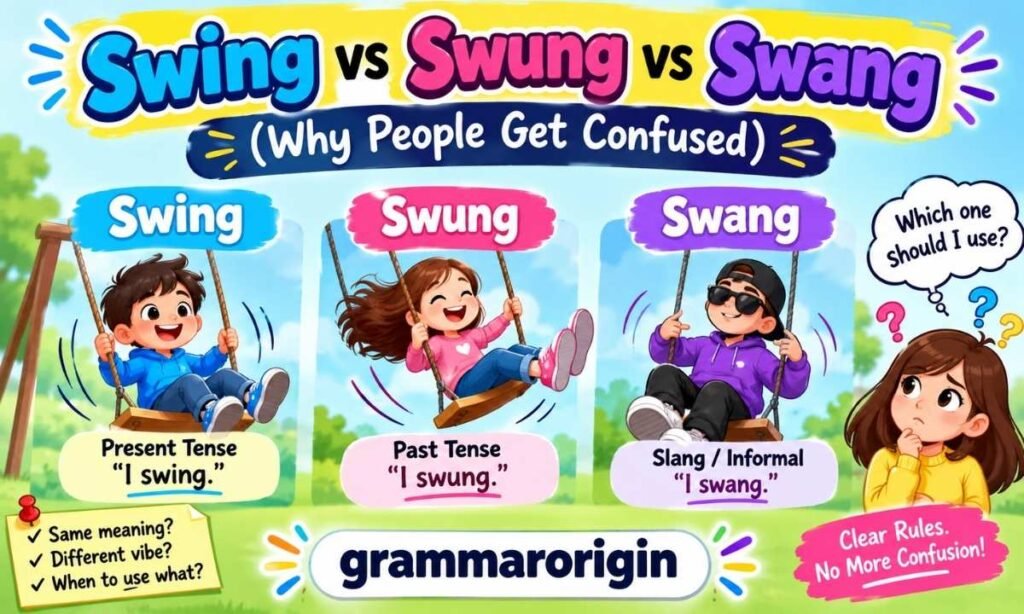
Most of the confusion around swang has a logical root — it just happens to lead somewhere wrong.
The “sing–sang–sung” influence
People hear sing → sang and assume swing should follow the same three-step path. It’s a reasonable guess, but swing skips straight to swung for both past forms.
Regional dialect influence
Swang does turn up in casual speech in parts of the American South and in some older rural dialects. It’s a real spoken variant — just not one that formal writing recognizes.
Historical usage of swang
Older English texts occasionally used swang before the language settled on swung as the standard. Dialect dictionaries, including regional collections of American speech, still record swang as a documented — if archaic — variant.
Also Read This Moment Vs Momment
Internet myths vs dictionary truth
Search around and you’ll find posts claiming swang is “technically fine” in casual writing. Every major dictionary disagrees. If you’re aiming for correctness, swung is the only form worth using.
Pronunciation of Swing, Swung, and Swang
Hearing the vowel shift out loud makes the difference between these three forms much easier to lock in.
| Form | IPA | Rhymes With |
| swing | /swɪŋ/ | ring, sting |
| swung | /swʌŋ/ | sung, hung |
| swang | /swæŋ/ | bang, rang (archaic use) |
Say all three back to back — swing, swung, swang — and you’ll notice swung is the one that actually sounds settled in modern conversation. Swang feels dated the moment it leaves your mouth, which is a decent gut check if you’re ever unsure.
Where Does “Swing” Come From? A Quick Look at Its Origin
Swing traces back to the Old English verb “swingan,” meaning to strike, whip, or move violently. That root already carried the strong-verb pattern, which is why the vowel shift in swung isn’t a modern quirk — it’s inherited straight from Old English grammar.
Over centuries, the meaning softened from “strike” toward the gentler back-and-forth motion we associate with playground swings and pendulums today. The grammar, though, barely changed at all.
15 Real-Life Examples You’ll Actually Use
Swing shows up everywhere — sports commentary, playground chatter, boardrooms, and even election night coverage. Here’s a set of swing past tense sentences showing swung doing real work across different situations.
Sports
- The pitcher swung his arm back before the throw.
- She swung her golf club just off the mark.
- The striker swung a wild kick that missed the goal entirely.
Playground
- The kids swung from the monkey bars until dinner was called.
- He swung too high and scared his little sister.
- She swung gently, humming to herself.
Business Decisions
- The startup swung its entire budget toward paid ads last quarter.
- Investors swung back toward caution after the earnings call.
- The company swung from layoffs to hiring within six months.
Mood Shifts
- His temper swung from calm to furious in seconds.
- The room’s energy swung the moment she walked in.
- Her confidence swung wildly before the interview.
Politics
- The district swung red after years of leaning blue.
- Public support swung against the bill overnight.
- Undecided voters swung the final result in the last week.
“Swung Into Action” — What Does It Mean?
“Swung into action” means someone started working, responding, or moving quickly and decisively. It’s an idiom, not a literal description of swinging anything.
“The rescue team swung into action the moment the alarm sounded” doesn’t involve any physical swinging — it just means they moved fast and got to work. You’ll hear this phrase constantly in news reports, emergency stories, and workplace updates.
Common Mistakes (And How to Fix Them Instantly)
A handful of errors account for almost every mistake people make with this verb.
Mistake 1: Swinged
Wrong: “He swinged the bat too early.” Right: “He swung the bat too early.”
Swing never takes “-ed.” If you catch yourself typing “swinged,” stop and swap it for swung.
Mistake 2: Swang
Wrong: “She swang the door shut.” Right: “She swung the door shut.”
Swang might sound natural in casual speech, but standard writing always calls for swung.
Mistake 3: Misusing the present perfect
Wrong: “They have swing the vote in their favor.” Right: “They have swung the vote in their favor.”
Perfect tenses always need the past participle — swung, never swing.
Mistake 4: Preposition errors
Swing pairs with specific prepositions depending on meaning:
- Swing at — “He swung at the pitch and missed.”
- Swing on — “She swung on the old rope swing.”
- Swing by — “I’ll swing by the office around noon.”
Mixing these up won’t confuse a native speaker, but getting them right makes your English sound more natural.
Memory Trick That Makes It Impossible to Forget

Anchor swung to a word you already know cold: sung.
Sing – sang – sung Swing – (skip) – swung
Both end in that “-ung” sound, so if sung feels automatic, swung should too. Try saying this out loud a few times: “Yesterday I swung the door, and I’ve swung it every day since.” The repetition does most of the work for you.
Also Read This Moment Vs Momment
Mini Practice Quiz
Fill in each blank with the correct past tense form of swing.
- The dog ___ its tail excitedly.
- She has ___ that bat a hundred times this season.
- The mood in the office ___ after the announcement.
- He had already ___ the gate shut before I noticed.
- They ___ toward the underdog in the final vote.
Answers: 1. swung 2. swung 3. swung 4. swung 5. swung
If every blank you filled in said swung, you’ve got this verb down for good.
Frequently Asked Questions
Is swang the past tense of swing?
No. Swang appears in some dialects and older writing, but swung is the only past tense form accepted in standard modern English.
What does swung mean?
Swung is simply the past tense and past participle of swing — describing a completed back-and-forth motion or a shift in opinion, mood, or direction.
How do you pronounce swung?
Swung is pronounced /swʌŋ/, rhyming with “sung” and “hung,” with a short “uh” vowel sound in the middle.
What does “swung into action” mean?
It means someone responded or started working quickly and decisively — it’s a figurative idiom, not a literal swinging motion.
What is the past tense of swim?
The past tense of swim is swam, and its past participle is swum — a similar but separate irregular pattern from swing’s swung.
How do you say “swung” in other languages?
Common translations include “balancé” (French), “columpiado” (Spanish), and “jhoola jhoola” or “ghumaya” as rough equivalents in Hindi/Urdu, though exact translation depends heavily on context since swing covers both literal and figurative movement.
Is swung used the same way in American and British English?
Yes. Both American and British English treat swung as the standard simple past and past participle of swing, with no regional split on the correct form.
Final Takeaway
The past tense of swing is swung, and the same word covers the past participle too — no need to memorize two separate forms. Swang might turn up in casual talk or older writing, but it has no place in standard modern English.
Once the sing-sung pattern clicks, swung stops requiring any thought at all. Use it in speech, writing, and everything in between, and you’ll never second-guess this verb again.

Muhammad Waqas is an English language teacher and grammar expert with over 8 years of experience helping students and professionals improve their writing skills. He specializes in English grammar, vocabulary, communication, and practical language learning. Through GrammarOrigin, Waqas shares clear, easy-to-understand content that helps readers write and speak English with confidence.