
If you’ve ever paused mid-sentence wondering about tying or tieing, you’re not alone. This is one of the most common spelling mix-ups in English, and the short answer is simple: tying is correct, and tieing is not a standard word.
This guide breaks down the tying meaning, the spelling rule behind it, real examples, and every situation where people get it wrong, from tying shoes to tying the score in sports. By the end, you’ll never second-guess the tying or tieing question again.
Comparison Overview
Before digging into the grammar rule, here’s a quick side-by-side look at how the two spellings stack up.
| Feature | Tying | Tieing |
| Part of speech | Present participle / gerund | Not a recognized spelling |
| Standard English | Yes | No |
| Found in major dictionaries | Yes | No |
| Used in formal writing | Yes | No |
| Common in casual typing errors | No | Yes |
Definition of Tying
Tying is the present participle and gerund form of the verb tie. It describes the ongoing act of fastening, securing, or connecting something.
You’ll see it in sentences like “She’s tying her shoes” or “The teams are tying for first place.” It works equally well as a verb form (“is tying”) and as a noun-like gerund (“tying knots is relaxing”).
Definition of Tieing
Tieing shows up online fairly often, but it isn’t an accepted spelling in modern English. It’s what happens when someone adds -ing straight onto tie without applying the spelling shift the rule requires.
You might spot it in rushed messages, social posts, or early drafts. Even so, it should always be corrected to tying before anything gets published or submitted.
Main Differences Between Tying and Tieing
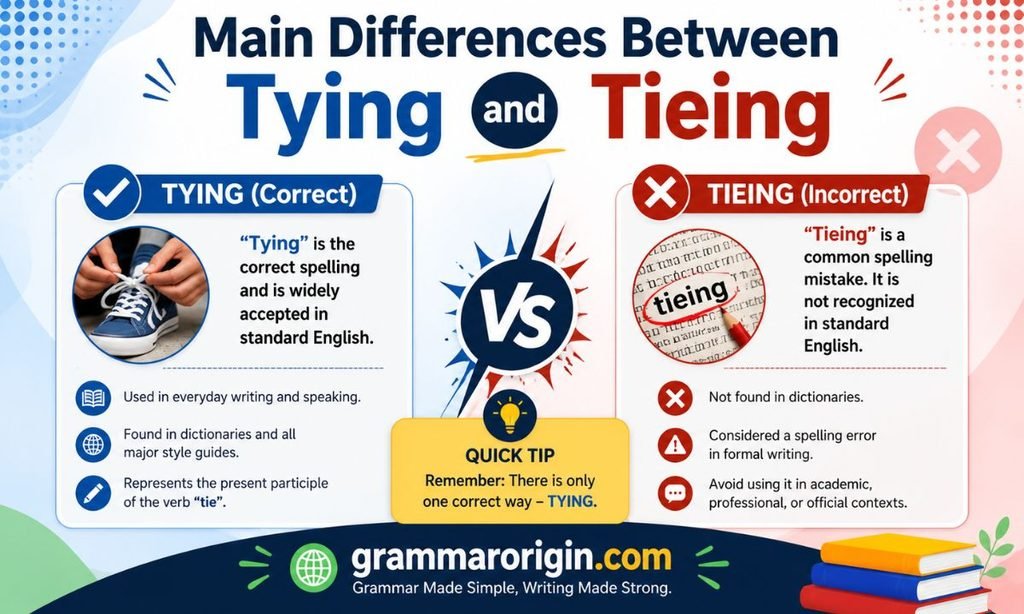
The gap between these two comes down to one thing: only one of them follows English spelling conventions.
| Aspect | Tying | Tieing |
| Follows the -ie to -y rule | Yes | No |
| Accepted by dictionaries | Yes | No |
| Safe for exams and resumes | Yes | No |
| Likely to get flagged by spellcheck | No | Yes |
Word processors and grammar checkers will almost always auto-correct tieing to tying, which is a good sign of where the line sits between the two.
Why Is Tying Spelled This Way?
English has a quiet rule for verbs that end in -ie: swap the -ie for a -y before adding -ing. Adding -ing directly would stack three vowels together, which is awkward to read and say out loud.
That’s the whole story behind tying. It’s the same reason die becomes dying and lie becomes lying. Nothing random about it, just a consistent pattern.
Also Read This Persue or Pursue: Which Spelling Is Correct?
Tie, Tied, Tying: The Full Verb Form Table
Seeing every form of the verb side by side makes the pattern click faster.
| Base Form | Past Tense | Past Participle | Present Participle / Gerund |
| Tie | Tied | Tied | Tying |
Note that the past tense doesn’t follow the -ie to -y swap at all. It simply adds -d. That’s part of why the confusion happens: learners assume every form changes the same way, but only the -ing form does.
Etymology: Where Does “Tying” Come From?
The verb traces back to Old English tigan, meaning to fasten or bind, which became teien in Middle English before settling into the modern tie. The -ing form has carried the -y spelling for centuries, long before modern style guides ever existed.
Over time, phrases like “tying the knot” picked up figurative meanings tied to marriage. The literal sense, fastening something with rope, string, or thread, never changed.
Synonyms of Tying
When you want variety in your writing, these words cover similar ground:
- Binding
- Fastening
- Securing
- Knotting
- Lacing
- Linking
- Attaching
- Tethering
Each carries a slightly different flavor. Lacing suits shoes and corsets, tethering fits animals or objects kept in place, and linking works better for ideas than physical objects.
Idioms and Phrases With “Tie”
A handful of everyday expressions build directly on this word:
- Tying the knot: getting married
- Tie one on: to get drunk
- Tied up in knots: confused, anxious, or stressed
- Someone’s hands are tied: unable to act due to restrictions
- Tying up loose ends: finishing pending tasks
These show up constantly in casual speech, so recognizing them helps with both reading comprehension and natural-sounding writing.
What Do Dictionaries Say?
Major dictionaries, including Merriam-Webster, Oxford, and Cambridge, all list tying as the present participle of tie. None of them recognize tieing as an alternate or historical spelling worth including.
This matters because dictionary inclusion is usually the fastest way to settle any tying or tieing debate. If a spelling doesn’t appear in a reputable dictionary, it’s safe to treat it as incorrect.
Common Situations Where Tying Is Used
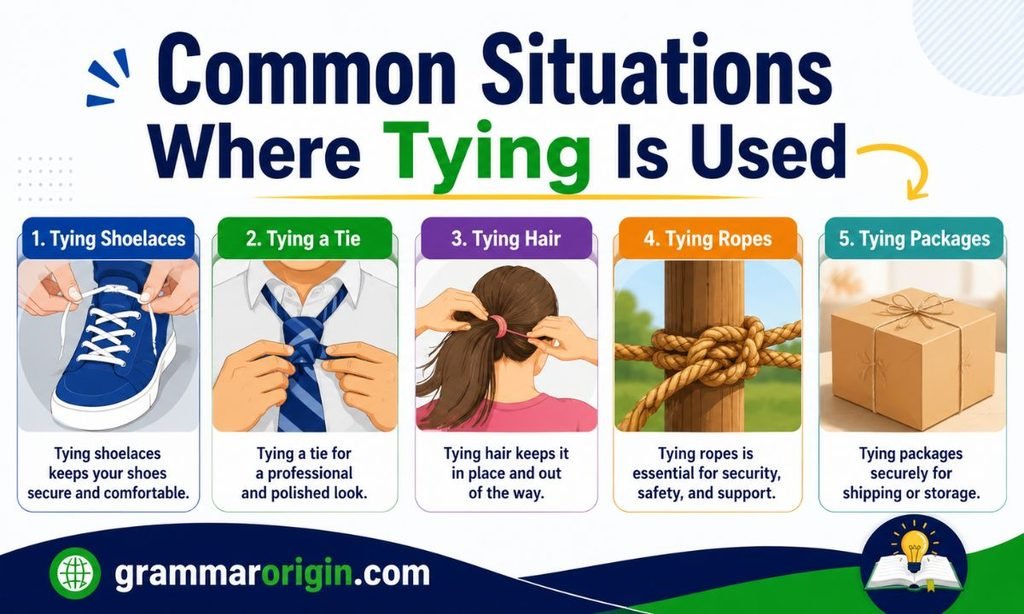
The word shows up far more often than people realize, across both literal and figurative contexts:
- Tying shoes or shoelaces
- Tying a knot or rope
- Tying the score in a game
- Tying the game in overtime
- Tying ideas together in an essay
- Tying a ribbon around a gift
- Tying loose ends at work
Sports commentary leans on this word constantly. “Tying the score” or “tying as in draw” both describe two sides reaching an equal result before a match ends.
Grammar Guide
How Each Term Is Used in Sentences
Tying
The typical pattern looks like this: subject + be-verb + tying + object.
- She is tying her sneakers before the run.
- They were tying the boat to the dock.
- We’re tying the last few boxes shut.
Tieing
This spelling shouldn’t appear in finished writing at all. Here’s what it looks like when it slips through, and how to fix it.
- Incorrect: He is tieing his tie before the interview.
- Correct: He is tying his tie before the interview.
Common Mistakes Learners Make
- Adding -ing straight to tie without changing anything
- Assuming tie behaves like see, which simply becomes seeing
- Typing tieing quickly and never proofreading
- Trusting auto-suggestions from casual apps instead of a dictionary
- Forgetting the -ie to -y swap applies here at all
Simple Rules to Remember
- Verbs ending in -ie swap it for -y before -ing
- Tie becomes tying, just like die becomes dying and lie becomes lying
- Tieing has no place in formal or academic writing
- When unsure, picture the lying and dying pattern and copy it
Quick Tips for Writing and Speaking
- Default to tying every time, since there’s no real exception
- Run a spellcheck pass on anything typed quickly
- Say the word out loud; tying flows more naturally than tieing
- Keep a mental list of similar verbs (die, lie, vie) as a memory anchor
When to Use Each One
Use Tying When:
- Writing essays, reports, or emails
- Describing knots, laces, or fastening objects
- Talking about a sports score or a draw
- Referring to marriage (“tying the knot”)
- Connecting ideas in an argument or summary
Use Tieing When:
There’s really no scenario in current English where tieing is the right call. If it shows up in a draft, swap it for tying before moving on.
Also Read This Persue or Pursue: Which Spelling Is Correct?
When NOT to Use Each One
Do Not Use Tying
Don’t reach for tying when you need a past-tense verb instead.
- Incorrect: He tying his shoes yesterday morning.
- Correct: He tied his shoes yesterday morning.
Do Not Use Tieing
Avoid this spelling everywhere, including:
- Academic essays and exam answers
- Resumes, cover letters, and business emails
- Published articles, blogs, or books
- Any spellcheck-enabled document, since it will get flagged anyway
Which One to Use (Decision Guide)
Run through these quick questions whenever you’re stuck:
- Are you describing an action happening right now or continuously? Use tying.
- Is this for school, work, or anything formal? Use tying.
- Genuinely unsure which spelling looks right? Default to tying. It’s always the safe choice.
| Situation | Correct Choice |
| Present participle | Tying |
| Gerund form | Tying |
| Formal or academic writing | Tying |
| Everyday casual writing | Tying |
| Any context at all | Tying |
Real-World Practical Examples

Tying Examples
- The runner spent a few seconds tying her laces before the race.
- The analyst kept tying the sales data back to last quarter’s numbers.
- The captain was tying the boat down before the storm hit.
- Fans watched the visiting team keep tying the score in the fourth quarter.
- The editor spent the afternoon tying loose threads in the manuscript together.
Tieing Examples
- She is tieing her scarf before heading out. (incorrect)
- They kept tieing the game late into overtime. (incorrect)
- We were tieing the packages for shipping. (incorrect)
- He is tieing his shoelaces near the door. (incorrect)
- The coach discussed tieing the match in his post-game notes. (incorrect)
Every one of these needs to read tying instead. None of them are acceptable as written.
Self-Assessment (Fill in the Blanks)
- The correct spelling for fastening shoelaces is ______.
- She is ______ a ribbon around the birthday present.
- The two teams ended up ______ the score at the buzzer.
- He spent the morning ______ knots for his sailing class.
- The word ______ is never acceptable in a formal essay.
- We are ______ the last few loose ends before the deadline.
- The correct gerund form of tie is ______.
- The couple talked about ______ the knot next spring.
- The sailor kept ______ the rope to the post.
- The wrong spelling that spellcheck usually flags is ______.
Answers
- Tying
- Tying
- Tying
- Tying
- Tieing
- Tying
- Tying
- Tying
- Tying
- Tieing
Final Thoughts
Settling the tying or tieing question comes down to one small spelling rule: verbs ending in -ie trade that ending for a -y before -ing gets added. That single fact explains every example in this guide, from shoelaces to sports scores.
Stick with tying in every context, formal, casual, or anywhere in between, and you’ll never trip over this spelling again.
Frequently Asked Questions
Which is correct, tieing or tying?
Tying is correct. Tieing doesn’t appear in standard dictionaries and isn’t accepted in formal or casual writing.
What is the meaning of tieing?
Tieing has no accepted meaning of its own. It’s simply a misspelling of tying, which means fastening, securing, or connecting something.
Is it tieing the knot or tying the knot?
It’s always tying the knot. This phrase, commonly used to mean getting married, follows the same spelling rule as every other form of tie.
Is tying or tieing used for shoes?
Tying is the correct word for shoes, as in “tying shoes” or “tying shoelaces.” Tieing should never appear here.
What does tying mean in sports, like tying the game or tying the score?
In sports, tying the score or tying the game means both sides have reached an equal result, often described as tying as in draw. It’s the same verb, just applied to a scoreboard instead of a knot.
Why does tie become tying instead of tieing?
English changes -ie to -y before adding -ing for verbs like tie, die, and lie. This avoids an awkward vowel cluster and keeps the word easier to read and pronounce.
Can tying be used as both a verb and a noun?
Yes. It functions as a verb in phrases like “she is tying her shoes,” and as a gerund (acting like a noun) in phrases like “tying knots takes practice.”

Muhammad Waqas is an English language teacher and grammar expert with over 8 years of experience helping students and professionals improve their writing skills. He specializes in English grammar, vocabulary, communication, and practical language learning. Through GrammarOrigin, Waqas shares clear, easy-to-understand content that helps readers write and speak English with confidence.