
If you’ve typed persue or pursue and paused to double-check yourself, you’re dealing with one of the most common spelling slips in English. The correct spelling is pursue, and persue is not a recognized word in any standard dictionary.
This guide covers the pursue meaning, pronunciation, word forms, common mix-ups like pursue vs persuade, and every context where this verb shows up, from careers to relationships. By the end, the persue or pursue question won’t trip you up again.
Quick Answer
Pursue is correct. Persue is a misspelling caused by mixing up letter order and following pronunciation instead of the actual spelling.
Use pursue whenever you mean to follow, chase, seek, or work toward something, whether that’s a goal, a career, or a person.
Persuing or Pursuing: What’s the Difference?
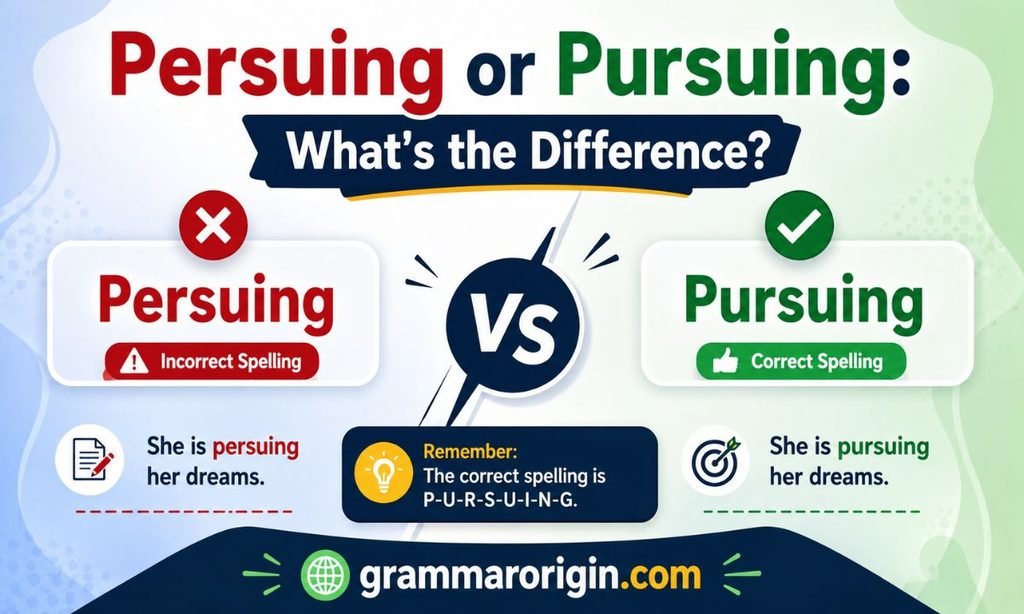
Only one of these two forms exists in real English. Pursuing is correct, and persuing is simply pursuing spelled wrong.
The confusion happens because people build the wrong base word first. If you assume the root is “persue,” you’ll naturally write “persuing” too.
Pursuing
Pursuing is the present participle of pursue, describing an action that’s still in progress.
- She’s pursuing a nursing degree this year.
- The company is pursuing new markets overseas.
- He’s been pursuing that lead for weeks.
Persuing
Persuing carries no meaning of its own in standard English. It’s a spelling error, not an alternate form.
Key Difference
The difference comes down to accuracy, not meaning. Pursuing is the real word; persuing is what happens when someone spells it by ear instead of by rule.
Also Read This Ourselves vs Ourself: The Correct Usage Explained
The Correct Spelling: “Pursue”
Pursue is spelled with two Us: one right after the P, and one near the end before the E.
Every major English dictionary lists this as the only accepted spelling of the verb.
Examples
- She wants to pursue a law degree after college.
- He decided to pursue his passion for photography.
- They plan to pursue new opportunities next quarter.
- The company will pursue expansion into new regions.
Why “Persue” Is Always Incorrect
Persue doesn’t appear in any dictionary because it isn’t a word, just a common typo built from how the word sounds when spoken quickly.
People tend to swap the r and s, or assume the word starts with “per-” like person or percent. Spellcheck tools catch this instantly and flag it every time, which is exactly why the persue or pursue mix-up rarely survives a proofread.
Pronunciation: How to Say “Pursue” Correctly
Pursue pronunciation is /pərˈsuː/, or “per-SOO,” with the stress landing on the second syllable.
The first syllable sounds soft and quick, almost like “per,” while “sue” carries the main emphasis. That soft first sound is exactly why so many people guess the spelling wrong.
Pursue, Pursued, Pursuing, Pursuer: The Full Word-Form Table
Seeing every related form side by side makes the whole word family easier to remember.
| Form | Function | Example |
| Pursue | Base verb | I pursue new challenges. |
| Pursued | Past tense | She pursued a medical career. |
| Pursuing | Present participle | They are pursuing funding. |
| Pursuer | Noun (person who pursues) | The pursuer never gave up. |
| Pursuit | Pursue noun form | Her pursuit of excellence paid off. |
Notice that pursuit is the pursue noun form, used when you’re naming the activity itself rather than describing an action. “In pursuit of happiness” is a classic example of pursuit meaning the ongoing effort itself, not just a single action.
People also search for “pursue or pursued” when unsure which tense fits a sentence. Use pursue for a present or general action and pursued once the action is already finished.
Meaning and Usage of “Pursue” in American English
Pursue means to follow, chase, seek, or work toward something with intention, whether that something is physical, professional, or personal.
In American English, you’ll hear it applied to careers, legal cases, education, hobbies, and even romantic interest. It works equally well in formal writing and casual conversation.
- Police pursue a suspect.
- She plans to pursue higher education.
- He chose to pursue happiness over a bigger paycheck.
Synonyms of “Pursue” and Proper Context
Different synonyms fit different situations better than others.
| Synonym | Meaning | Best Context |
| Follow | Go after | Directions, tracking |
| Chase | Run after | Physical action |
| Seek | Look for | Goals, information |
| Continue | Carry on | Ongoing efforts |
| Strive for | Work hard toward | Ambitions |
| Aim for | Target | Achievement |
Daily English Example Sentences
- I want to pursue my interests outside of work.
- She’s pursuing new opportunities in tech.
- He pursued the idea until it finally worked.
- They pursue their goals with real determination.
- We’re pursuing a better work-life balance this year.
Contextual Applications of “Pursue”
The word adjusts naturally to whatever setting you’re writing in, from courtrooms to relationships.
Legal Context
In legal writing, pursue usually refers to continuing a formal claim or case.
- The lawyer will pursue the case through appeal.
- The company pursued legal action against the supplier.
Academic and Research Context
Here, pursue connects to studies, degrees, or ongoing research.
- She decided to pursue a PhD in chemistry.
- He pursued independent research for two years.
Career and Professional Context
In the workplace, it points toward long-term goals or advancement.
- He wants to pursue a career in finance.
- She actively pursued a promotion this quarter.
Personal Goals and Life Context
In everyday life, pursue often connects to dreams, fulfillment, and relationships.
- She chose to pursue her dreams instead of playing it safe.
- He pursued happiness over money.
Pursue meaning in relationship contexts usually points to romantic effort. When someone asks about “pursue me meaning,” they’re typically referring to a partner actively showing interest, making plans, and putting in visible effort rather than staying passive.
Literal vs Figurative Use of “Pursue”
Pursue works both as a physical action and as a metaphor for chasing a goal.
| Use Type | Meaning | Example |
| Literal | Physical chasing | The dog pursued the ball across the yard. |
| Figurative | Aiming for a goal | She pursued success for years before it paid off. |
Pursue vs Peruse vs Presume vs Persuade
These four words get mixed up constantly because they share similar letters and rhythm, even though their meanings don’t overlap at all.
| Word | Meaning | Example |
| Pursue | To follow, chase, or work toward | She pursues a career in design. |
| Peruse | To read or examine carefully | He perused the contract before signing. |
| Presume | To assume without proof | I presume you’ve already left. |
| Persuade | To convince someone | She persuaded him to apply. |
Persuade meaning specifically involves changing someone’s mind or getting them to act, which is a completely different idea from pursue vs persuade confusion might suggest. Pursue is about chasing something yourself; persuade is about moving someone else.
How to Remember the Correct Spelling
A simple trick locks this spelling into memory faster than repetition alone.
Think of the word “sue” hiding inside pursue, since both end the same way. Picture yourself pursuing a goal the same way a lawyer might pursue a case, and the “sue” ending sticks.
Also Read This Ourselves vs Ourself: The Correct Usage Explained
Mini Quiz
Choose the correct spelling for each sentence.
- I want to ______ my goals. (Answer: pursue)
- She is ______ a new career. (Answer: pursuing)
- They ______ the opportunity last year. (Answer: pursued)
Etymology and Historical Roots of “Pursue”
Pursue traces back to Old French poursuir and Latin prosequi, both meaning to follow after or continue chasing.
Middle English texts show several early spellings, including poursue and pursuwe, with the modern form settling once printing presses and dictionaries standardized English spelling in the 1600s.
“Pursue” in Literature and Famous Quotes
Writers have leaned on pursue for centuries to express ambition, longing, and determination.
Classic Literature References
The word appears throughout classic literature whenever characters chase justice, love, freedom, or knowledge.
Inspirational Quotes
- “Pursue what sets your soul on fire.”
- “The goals we pursue are always veiled until we reach them.”
The word’s staying power in quotes and speeches comes from how naturally it captures long-term effort toward something meaningful.
What Do Dictionaries Say?
Merriam-Webster, Oxford, and Cambridge dictionaries all list pursue as the only correct spelling of the verb, with no historical or regional variant listed for “persue.”
That agreement across major dictionaries is usually the fastest way to settle any spelling debate. If a word doesn’t appear in a reputable dictionary, it’s safe to treat it as an error rather than a valid alternative.
Common Mistakes and How to Avoid Them
Most spelling mistakes here come from writing based on sound instead of checking the actual word, which is how the persue or pursue confusion spreads in the first place.
Frequent Wrong Spellings
| Incorrect | Correct |
| Persue | Pursue |
| Persuing | Pursuing |
| Persued | Pursued |
| Persuer | Pursuer |
Quick Fix Tips
- Always double-check the spelling before submitting formal writing.
- Run a spellcheck pass on anything typed quickly.
- Remember that the word starts with “pur,” never “per.”
- Say the word slowly and compare it to how you typed it.
Using “Pursue” in Different Writing Styles
Pursue adapts smoothly across formal, academic, business, and casual writing.
- Academic: “Researchers pursue evidence-based conclusions.”
- Business: “We intend to pursue new markets this year.”
- Casual: “I’m pursuing a new hobby this summer.”
Correction Examples from Real Sentences
Seeing the wrong and right versions side by side makes the fix obvious.
| Incorrect | Correct |
| She will persue her goals. | She will pursue her goals. |
| He is persuing success. | He is pursuing success. |
| They persued the opportunity. | They pursued the opportunity. |
Case Study: Why Spelling Accuracy Matters Professionally

Picture two resumes landing on the same hiring manager’s desk. One reads “pursued leadership opportunities,” and the other reads “persued leadership opportunities.”
The meaning comes through either way, but the second version signals carelessness. A single spelling slip like this can quietly cost an applicant credibility before anyone even reads the rest of the page.
Self-Assessment Check
Answer these quickly to check your understanding.
- Is “persue” ever correct in standard English?
- What is the correct present participle of pursue?
- Can pursue describe a physical chase?
- What is the noun form of pursue?
Answer to Self-Assessment
- No, it’s always incorrect.
- Pursuing.
- Yes, as in an animal pursuing prey.
- Pursuit.
Related Grammar Guides
A few other word pairs trip up writers in similar ways and are worth reviewing alongside this one.
- Affect vs Effect
- Advise vs Advice
- Accept vs Except
- Principal vs Principle
- Complement vs Compliment
Frequently Asked Questions
What does persue mean?
Persue has no meaning of its own. It’s simply a common misspelling of pursue, which means to follow, chase, or work toward something.
What is a persue?
There’s no such thing as a “persue” in standard English. Any time you see it, it should be corrected to pursue.
How do you use pursue in a sentence?
Use pursue as a verb before a goal, object, or person, such as “She decided to pursue a career in law” or “He pursued his dream despite the setbacks.”
Which is correct, persue or pursue?
Pursue is correct. Dictionaries and grammar checkers universally reject “persue” as a spelling error.
What does pursue mean in a relationship?
In dating contexts, pursuing someone means actively showing interest through effort, attention, and follow-through, rather than waiting passively for things to happen.
What is the difference between pursue and persuade?
Pursue means to chase or work toward something yourself, while persuade means to convince someone else to think or act differently. They’re unrelated in meaning despite looking similar.
Is pursuit the noun form of pursue?
Yes. Pursuit is the noun form of pursue, used to describe the act or process of pursuing something, as in “the pursuit of happiness.”
Summary
Settling the persue or pursue question comes down to one fact: only pursue exists in standard English, and every dictionary agrees on it. Persue is simply a phonetic guess that never became a real word.
Whether you’re writing about careers, relationships, or legal action, stick with pursue every time, and the spelling mistake becomes easy to avoid for good.

Muhammad Waqas is an English language teacher and grammar expert with over 8 years of experience helping students and professionals improve their writing skills. He specializes in English grammar, vocabulary, communication, and practical language learning. Through GrammarOrigin, Waqas shares clear, easy-to-understand content that helps readers write and speak English with confidence.