
Only “too many” works when you’re talking about an excessive amount. Too many vs to many trips people up constantly because “to” and “too” sound identical when spoken out loud.
This guide breaks down the grammar rule, shows when each spelling actually belongs, and clears up related mix-ups like too much, so many, and too many more.
Too Many vs To Many
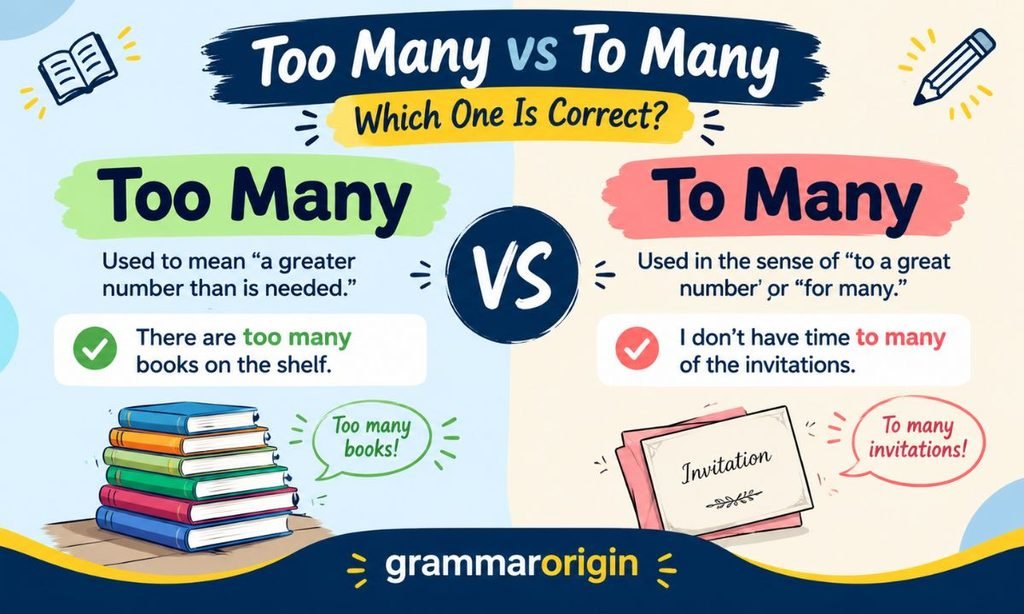
“Too many” is the correct phrase for describing an excessive number of countable things. “To many” isn’t a fixed phrase on its own, though it can appear correctly in a different kind of sentence. That distinction is the whole key to this mix-up, and only one form is grammatically correct when quantity is what you mean.
- Too many meaning: more than what’s needed or acceptable
- To many meaning: only valid when “to” is doing its normal job as a preposition
- The two aren’t interchangeable, even though they sound the same
Grammar Rule Behind “Too Many”
“Too many” pairs the intensifier “too” with the countable quantifier “many” to signal an amount that’s gone past a reasonable limit. “Too” adds emphasis on excess, and “many” only ever attaches to things you can count.
Put them together and you get a phrase built specifically for overflow. Too many boxes, too many emails, too many excuses. All of it works because the nouns are countable.
What Does “To Many” Actually Mean?
“To many” is only correct when “to” functions as a preposition showing direction or a recipient, not as a stand-in for “too.” It shows up in sentences like “She sent the invite to many friends” or “The award went to many deserving students.”
In these cases, “to many” isn’t describing excess at all. It’s describing where or to whom something was directed. Swap the meaning and you’ll swap the spelling too.
- “To many” = toward many people or things
- “Too many” = more than is needed
- Reading the sentence for meaning, not sound, settles it every time
Difference Between Too Many, Too Much, and Too Few
“Too many” pairs with countable nouns, “too much” pairs with uncountable ones, and “too few” flips the direction to describe a shortage. Getting the noun type right solves most of this confusion instantly.
- Too many cars, too many mistakes, too many messages (countable)
- Too much water, too much noise, too much stress (uncountable)
- Too few chairs, too few volunteers (a shortage, not an excess)
A quick too much and too many examples check: “too much homework” is correct because homework isn’t counted individually, while “too many assignments” works because assignments are.
Also Read This If He Was or If He Were: Clear Grammar Guide
How to Identify Countable and Uncountable Nouns
Try adding a number in front of the noun. If it sounds natural, the noun is countable and pairs with “too many.” If a number sounds odd, you’re dealing with an uncountable noun and “too much” instead.
- Countable: three books, five cars, ten mistakes
- Uncountable: water, air, information, advice
- If you can’t count it one by one, “too many” doesn’t belong there
Common Real-Life Usage of Too Many
People reach for “too many” constantly in everyday speech, work emails, and casual writing to describe feeling overloaded. It’s one of the most natural complaint phrases in English.
- Too many notifications on my phone today
- Too many meetings booked back to back
- Too many cooks in the kitchen, as the saying goes
Tips to Avoid Confusing Too Many and To Many
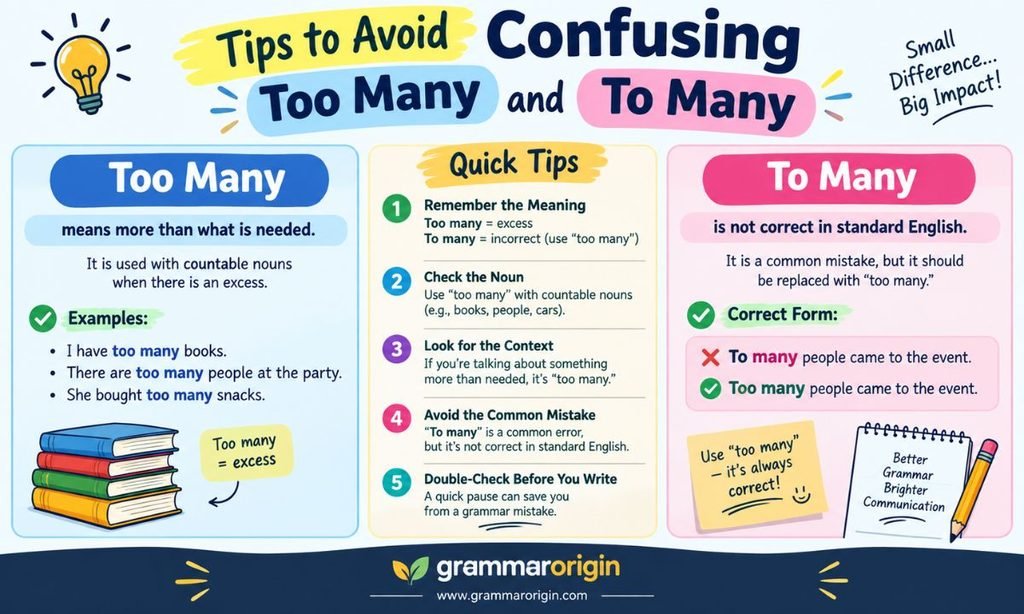
Ask yourself whether you’re describing an amount or a destination. Amount means “too many,” destination means “to.” That single question resolves almost every case.
- Read the sentence out loud slowly, since your eyes catch spelling mistakes your ear misses
- Check whether a number or quantity word could replace “many”
- When in doubt, rewrite the sentence without “many” and see if “to” still makes sense alone
What Does Too Many Mean?
“Too many” describes a quantity of countable things that has gone beyond a comfortable or acceptable limit. It always signals excess, never a neutral count.
- There are too many emails sitting in my inbox.
- He asked too many questions during the interview.
- Too many people showed up for a room that size.
Should I Write To Many or Too Many?
Write “too many” whenever you’re expressing quantity. Only use “to many” when “to” is genuinely functioning as a preposition pointing somewhere. Most writers only ever need “too many.”
- “To” alone is never a quantity word
- Confusion happens purely because of matching pronunciation
- Grammar rules support “too many” for anything related to excess
Too Many Sentence Examples
Seeing correct usage side by side makes the pattern click fast.
- She has too many books for one shelf.
- Too many cars on this road cause daily traffic.
- We asked too many questions during the meeting.
- There are too many more delays to count at this point.
To Many Sentence Examples (Why They’re Wrong)
Most “to many” sentences are wrong specifically because “to” is being used where “too” belongs, not because “to many” is always invalid. Here’s the distinction in action.
- To many people came (incorrect), Too many people came (correct)
- He has to many tasks (incorrect), He has too many tasks (correct)
- She gave the flyer to many neighbors (correct: direction, not excess)
- The email was sent to many recipients (correct: recipient, not quantity)
Comparison Table: Too Many vs To Many
| Phrase | Correct or Incorrect | Meaning | Example |
| Too many | Correct for excess | Excessive countable quantity | Too many errors |
| To many | Correct for direction only | Toward multiple people or things | Sent to many clients |
| To many (as quantity) | Incorrect | No valid quantity meaning | To many errors (wrong) |
Common Grammar Mistakes Learners Make
The most common slip is writing “to” when the sentence actually calls for the intensifier “too.” A few related mistakes tend to travel alongside it.
- Using “to” instead of “too” purely because of pronunciation
- Pairing “too many” with an uncountable noun by accident
- Forgetting that “many” always needs a plural, countable noun
Example fix: “Too many water” is wrong; “Too much water” is correct.
Related Phrases: Too Many More, So Many, and Too Many to Mention
“Too many more” adds extra emphasis to an already large amount, “so many” highlights a large quantity without necessarily meaning excess, and “too many to mention” is a fixed idiom meaning the list is too long to list out. Each phrase does a slightly different job.
- Too many more meaning: an additional excessive amount is coming, as in “I can’t handle too many more setbacks.”
- Too many or so many: “so many” often just expresses surprise at quantity (“So many people showed up!”), while “too many” always implies the amount is a problem.
- Too many to mention: a common idiom for a list too long to spell out, as in “There are too many reasons to mention here.”
- To many more or too many more years: “too many more years” works when describing an excessive stretch of time still ahead, like “I can’t wait too many more years for this.”
Too Many vs To Many in British and American English
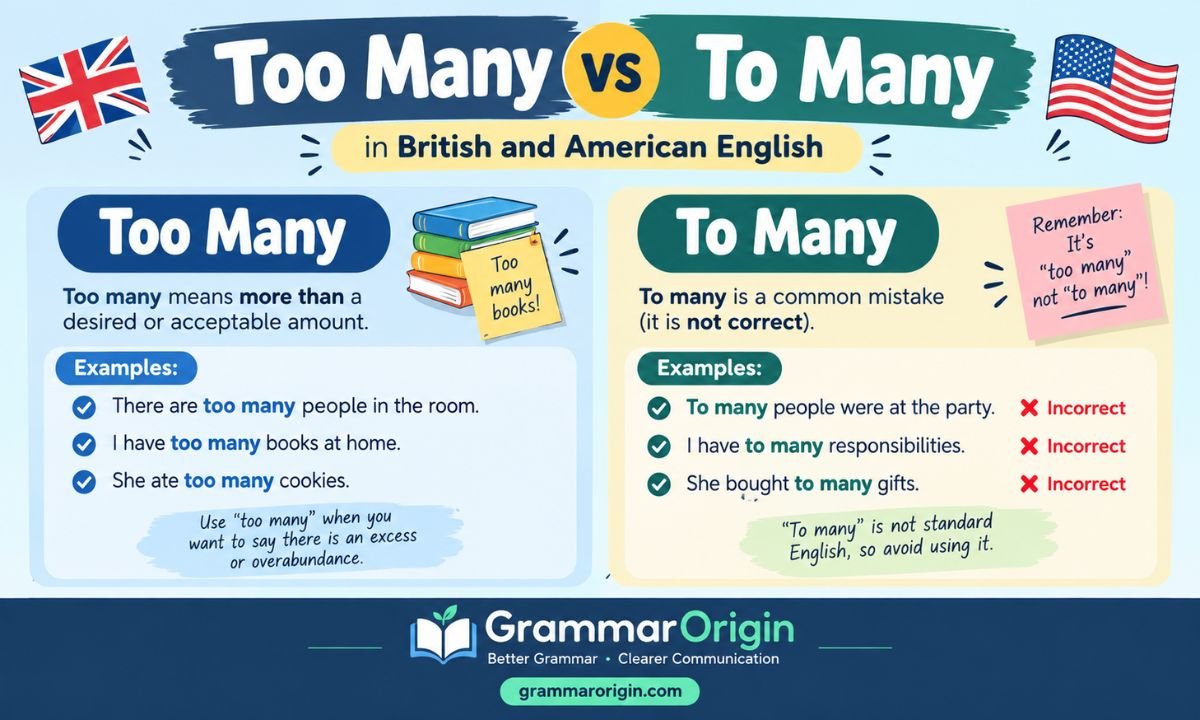
Both British and American English follow the exact same rule here: “too many” for excess, “to many” only for direction. There’s no regional split on this one, unlike spelling differences such as “colour” and “color.”
Dictionaries and style guides on both sides of the Atlantic agree completely. Wherever your audience is, the grammar rule doesn’t change.
Also Read This If He Was or If He Were: Clear Grammar Guide
Linguistic Insight: Why This Confusion Happens
This mix-up survives mainly because “to” and “too” are homophones, meaning they sound exactly alike in speech. Spelling errors like this are common whenever pronunciation doesn’t map cleanly to spelling.
- Fast typing skips the extra letter without anyone noticing
- Learners often trust their ear over the actual spelling rule
- Autocorrect doesn’t always catch context-based errors like this one
Expert Opinion on Correct Usage
Style guides and grammar references consistently treat “too many” as the only correct form for expressing excess, with no exceptions. Formal writing and academic work follow this rule without variation.
- Editors flag “to many” as an error whenever it’s meant to show quantity
- Grammar textbooks list this among the most common homophone mistakes
- Professional writing always defaults to “too many” for excess
Wrapping Up: Should I Use Too Many or To Many?
Use “too many” whenever you mean an excessive amount, and reserve “to many” for sentences where something is being directed toward multiple people or things. That’s the entire rule in one line.
- Excess quantity always takes “too many”
- Direction or recipient can correctly take “to many”
- The extra “o” in “too” is your visual reminder of “more”
Write Better Perfectly
A few small habits make this mistake disappear for good. None of them require memorizing complicated grammar terms.
- Proofread slowly for small, sound-based spelling errors
- Keep a short list of tricky word pairs like this one for quick reference
- Practice writing real sentences instead of just reading the rule
Self Assessment
Choose the correct option for each sentence:
- There are ______ emails in my inbox.
- She sent the invitation ______ guests.
- He has ______ tasks on his plate today.
- We can’t handle ______ more delays this month.
- The gift was given ______ children at the event.
- ______ people showed up for the small room.
- I have ______ reasons to mention them all here.
- She drank ______ coffee before bed. (too much / too many)
- Invitations were sent ______ attendees.
- There are ______ mistakes in this report.
Answer Key
- too many
- to many
- too many
- too many
- to many
- too many
- too many
- too much
- to many
- too many
Final Thoughts
Too many vs to many really comes down to one question: are you describing an amount, or a destination? Amount always takes “too many,” and destination is the only time “to many” works.
Once that rule sticks, the sound-alike trap stops causing mistakes, whether you’re writing a quick text or a formal report.
Frequently Asked Questions
What does too many mean?
Too many describes a quantity of countable things that has gone past what’s needed or acceptable. It always signals excess, such as “too many emails” or “too many mistakes.”
How do you use to or too?
Use “to” as a preposition showing direction, purpose, or connection, like “going to work.” Use “too” to mean “also” or “excessively,” as in “too many” or “too tired.”
Which is correct, to much or too much?
“Too much” is correct. “To much” is never a valid phrase, since “much” always needs the intensifier “too” in front of it when describing an uncountable excess.
Is “to many” ever correct in English?
Yes, but only when “to” is functioning as a preposition pointing toward people or things, such as “sent to many customers.” It’s never correct as a stand-in for quantity.
Can too many be used with uncountable nouns?
No. Uncountable nouns pair with “too much” instead, as in “too much sugar” rather than “too many sugar.”
What’s the difference between too many and so many?
“Too many” implies the amount is a problem or exceeds a limit. “So many” simply emphasizes a large quantity, often with surprise, without necessarily meaning it’s excessive.
How can I remember the correct form quickly?
Think of the extra “o” in “too” as standing for “over the limit.” If the sentence describes an excess amount, “too many” is almost always the answer.

Muhammad Waqas is an English language teacher and grammar expert with over 8 years of experience helping students and professionals improve their writing skills. He specializes in English grammar, vocabulary, communication, and practical language learning. Through GrammarOrigin, Waqas shares clear, easy-to-understand content that helps readers write and speak English with confidence.