
Most people trip over this one without even noticing. If he was or if he were: the phrase looks tiny, but it hides a real grammar rule about fact versus imagination.
Once you see the pattern, you’ll stop guessing. This guide breaks the rule into plain steps, with examples, a comparison table, a quiz, and a flowchart you can actually use.
Definition of If He Was or If He Were
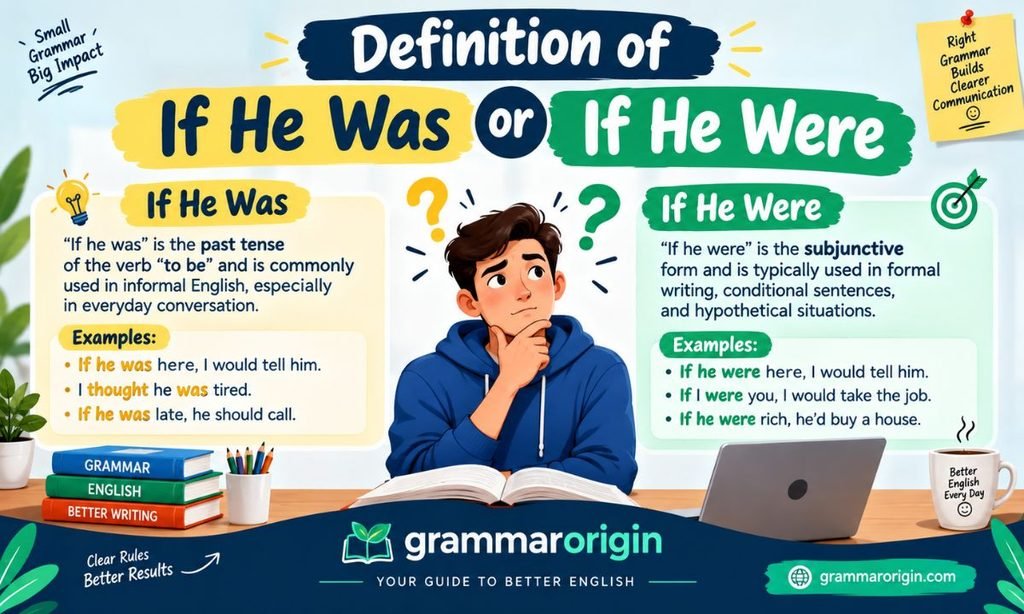
“If he was” is used for real or possible past events. “If he were” is used for imaginary, wished-for, or contrary-to-fact situations. That’s the whole rule in one line.
“Was” sits in the indicative mood, the mood English uses for facts and open possibilities. “Were” belongs to the subjunctive mood, reserved for things that aren’t true right now.
Say “if he was late” and you’re leaving room for reality: maybe he really was late. Say “if he were late” and you’re painting a scene that isn’t happening.
Understanding the Subjunctive Mood
The subjunctive mood signals that a statement is hypothetical, wished, or untrue. English keeps a fossil of it alive in exactly this kind of sentence.
You’ll spot it most often in second conditionals, the “if this, then that would happen” structure.
- If he were taller, he’d reach the top shelf.
- I wish he were here.
- If he were in charge, the whole plan would change.
Notice something odd: even with a singular subject like “he,” the verb stays “were,” not “was.” That’s the subjunctive breaking the usual agreement rule on purpose.
The History: How English Got Complicated
English used to have a much richer subjunctive system, and centuries of simplification wore most of it away. What’s left is this one stubborn holdout.
Old English marked mood on verbs far more consistently than modern English does. As grammar simplified over time, most of those distinctions merged into a single past-tense form.
- Old English had separate subjunctive verb endings
- Middle English started collapsing those distinctions
- Modern English kept “were” for unreal conditions
- Everyday speech increasingly swaps in “was” anyway
That last point is why the confusion feels so modern, even though the rule itself is old.
The Modern Divide: Subjunctive vs. Indicative Mood
Today, the split between “if he was” and “if he were” comes down to whether the event could be real or is purely imagined. Tense isn’t the deciding factor. Meaning is.
“If he was” leaves the door open. Something might genuinely have happened.
“If he were” closes that door. You’re describing a world that isn’t the actual one.
Subjunctive vs Indicative Comparison
| Feature | If He Was | If He Were |
| Grammar mood | Indicative | Subjunctive |
| Situation type | Possible or real | Hypothetical or unreal |
| Typical tone | Neutral, everyday | Formal, imaginative |
| Common use | Doubt about a past fact | Wishes, unreal conditions |
- If he was at the party, I must have missed him.
- If he were at the party, he’d be the one dancing on the table.
“If He Was” — When It’s Actually Correct
Use “if he was” when you’re describing a real past situation you’re simply unsure about. It’s the everyday, fact-based option.
This form shows up constantly in reported speech and honest uncertainty.
- If he was late, that would explain the missed call.
- She wondered if he was ready to leave.
- If he was home, he didn’t pick up the phone.
When to Use “If He Was”
Reach for this version when:
- The event genuinely could have happened
- You’re unsure about a real-world detail
- You’re reporting someone else’s question
- You’re asking about a past fact, not imagining one
A couple more natural examples: “I bet he was nervous,” or “If he was tired, he hid it well.” Both describe something that plausibly occurred.
“If He Were” — The Hypothetical Heavyweight
“If he were” signals a situation that isn’t real: a wish, a daydream, or a pure hypothetical. It shows up constantly in second conditional sentences.
- If he were here, he’d know exactly what to do.
- If he were wealthy, he’d probably travel nonstop.
- I wish he were a little more patient.
Key Uses of “If He Were”
This structure fits when:
- The condition is flatly contrary to fact
- You’re expressing a wish, not a fact
- The register is formal or literary
- The scenario is unlikely or purely imagined
Two more patterns worth knowing: “If he were the boss, the whole culture would shift,” and “She talks as if he were still around.” Both describe a world that isn’t the actual one.
Also Read This Quieter Vs More Quiet: Complete Grammar Guide
Key Differences Summarized
The short version: reality gets “was,” imagination gets “were.” Everything else in this guide is just detail on that one idea.
Quick Grammar Comparison
| Context | Correct Form |
| Real past doubt | If he was |
| Unreal present situation | If he were |
| Wish or desire | If he were |
| Genuine factual uncertainty | If he was |
Why the Confusion Happens
People mix up “if he was” and “if he were” mainly because casual speech has quietly dropped the subjunctive in most everyday sentences. Writing rules haven’t caught up to how people talk.
A few forces are driving that drift:
- Informal conversation dominates daily language
- Classrooms rarely explain the subjunctive in depth
- The two forms overlap enough to sound “close enough”
- Regional speech patterns nudge people toward “was”
Main Reasons:
- Grammar instruction glosses over this rule
- The subjunctive rarely appears outside conditionals
- “Was” and “were” blur together in fast speech
- Simpler verb forms just feel more natural to say
Subtle Nuances in Tone and Meaning
“If he were” tends to sound formal or literary, while “if he was” reads as relaxed and conversational. Same grammar point, different social signal.
- Formal: If he were present, he would raise an objection.
- Casual: If he was there, I didn’t notice him.
Academic and professional writing still leans toward the subjunctive for anything clearly unreal.
Case Study: Formal vs. Casual English
Formal writing protects the subjunctive; casual speech quietly lets it slide. That gap is one of the clearest style markers in English.
- Academic: If he were accountable, the results would look different.
- Everyday talk: If he was accountable, nobody mentioned it.
Comparison Table
| Context | Preferred Form |
| Academic writing | If he were |
| Business communication | If he were |
| Casual conversation | If he was (widely accepted) |
| Informal texting or chat | If he was |
Practical Tips to Remember
The fastest test: swap in “would” and check if the sentence describes something untrue. If it does, use “were.”
- Ask yourself: is this real, or am I imagining it?
- Look for “would” in the other half of the sentence
- Wishes always take “were”
- Genuine doubt about a fact takes “was”
Common Mistakes to Avoid
Watch out for these slip-ups:
- Using “was” in an obviously imaginary scenario
- Blending a real condition with an unreal result
- Missing the “would” clue that flags a second conditional
Incorrect: If he was you, I’d apologize immediately. Correct: If he were you, I’d apologize immediately.
Examples in Literature and Pop Culture
Writers and songwriters lean on the subjunctive because it signals imagination instantly. That’s why “were” survives so well in creative work.
- “If I Were a Rich Man” leans entirely on the subjunctive for its wistful tone
- Speeches use “were” to frame bold, hypothetical futures
- Fiction often prefers “were” for a more polished, literary voice
These examples show the form still carries real stylistic weight, even outside grammar textbooks.
Linguistic Insight & Expert Opinion
Language specialists generally agree that “were” survives specifically because it marks unreality so clearly. Style guides and grammar references consistently recommend it as the grammatically correct verb form for hypothetical conditionals in formal writing, even as casual speech simplifies the distinction.
- Both forms are grammatically valid in their own contexts
- Meaning, not habit, should guide the choice
- Formal writing still favors the subjunctive form
Quick Reference Guide
When in doubt, ask one question: could this actually be true? Yes points to “was.” No points to “were.”
| Question | Choose |
| Is the situation real or possible? | If he was |
| Is it purely imaginary? | If he were |
| Are you expressing a wish? | If he were |
| Are you doubting a real fact? | If he was |
Common Variations: If I Was/Were, If There Was/Were, and More
The same rule extends past “he.” Here’s how it plays out with other pronouns and structures:
| Variation | Correct Form | Example |
| if i was or if i were | Depends on reality | “If I was late, I’m sorry” (real) vs. “If I were you, I’d wait” (hypothetical) |
| if there was or if there were | Depends on reality | “If there was a problem, no one reported it” vs. “If there were more time, we’d finish” |
| if he were alive or if he was alive | If he were alive (subjunctive, since he isn’t) | “If he were alive today, he’d be amazed by this” |
| if he were here or if he was here | If he were here (hypothetical absence) | “If he were here, this would be so much easier” |
| if he were or if he was (second conditional) | If he were | Second conditionals are built to describe unreal present situations, so “were” fits by design |
If he were meaning, in short, always points to something imagined rather than something that happened. Keep that in mind and every variation above follows the same logic.
Also Read This Quieter Vs More Quiet: Complete Grammar Guide
Flowchart: Should You Use Was or Were?
Follow this simple decision path any time you’re stuck between the two.
- Start: Could this situation actually be true or have happened?
- If yes → use “was.” You’re describing a real possibility.
- If no → check the next step.
- Is the sentence a wish, a dream, or clearly untrue right now?
- If yes → use “were.” You’re in subjunctive territory.
- Bonus check: Does the other half of the sentence use “would”? If so, “were” is almost always the answer.
Self-Assessment Quiz
Pick the correct word for each sentence:
- If he ___ taller, he could reach the top shelf.
- I wonder if he ___ at yesterday’s meeting.
- If he ___ more careful, he wouldn’t keep making mistakes.
- She asked if he ___ finished with the report.
- If he ___ the president, what’s the first thing he’d change?
Answer Key
- were
- was
- were
- was
- were
Final thoughts
Choosing between if he was or if he were really comes down to one question: is this real, or are you imagining it? Real or possible situations take “was,” while wishes and unreal conditions take “were.”
Run your sentence through the flowchart above whenever you’re unsure, and check for “would” in the other clause. The choice becomes automatic with practice, even as everyday speech keeps blurring the line.
Frequently Asked Questions
What’s the main difference between “if he was” and “if he were”?
“If he was” describes a real or possible past situation, using the indicative mood. “If he were” describes something imaginary or contrary to fact, using the subjunctive mood. The deciding factor is whether the situation could genuinely be true.
Can I say “if he was” instead of “if he were”?
In casual conversation, yes. Plenty of native speakers do it without a second thought. In formal or academic writing, though, “if he were” remains the standard choice for anything hypothetical.
Why does English still use “if he were” at all?
It survives because it clearly flags a sentence as unreal, which helps avoid ambiguity. Even though most other subjunctive forms disappeared over time, this one stuck around for precision’s sake.
Is “if he were” considered old-fashioned now?
Not really. It’s less common in casual chat, but it’s still fully standard in formal writing, literature, and academic contexts. Calling it outdated would be inaccurate.
What’s an easy way to remember which one to use?
Check whether “would” shows up in the rest of the sentence, and ask if the situation is actually possible. If it’s unreal and paired with “would,” go with “were.” If it’s a genuine past doubt, go with “was.”
Does “if I were” follow the exact same rule?
Yes, the logic is identical. “If I were you” is correct because it’s describing a hypothetical, not a real possibility. The pronoun changes, but the rule doesn’t.
Do people actually follow this rule in real conversation?
Not consistently. Casual speech leans on “was” far more often than grammar guides recommend, even in clearly hypothetical sentences. Formal writing, however, still holds the line on the traditional distinction.

Muhammad Waqas is an English language teacher and grammar expert with over 8 years of experience helping students and professionals improve their writing skills. He specializes in English grammar, vocabulary, communication, and practical language learning. Through GrammarOrigin, Waqas shares clear, easy-to-understand content that helps readers write and speak English with confidence.