
Mixing up taken vs taking is one of the most common slips English learners make, and even fluent speakers pause over it sometimes. Both words come from the same verb, “take,” but they don’t do the same job in a sentence.
The short version: taking describes something happening right now, while taken describes something already finished or acted upon. This guide breaks down exactly when to use each one, with rules, tables, and real examples you can apply immediately.
Taken vs Taking: The Core Difference
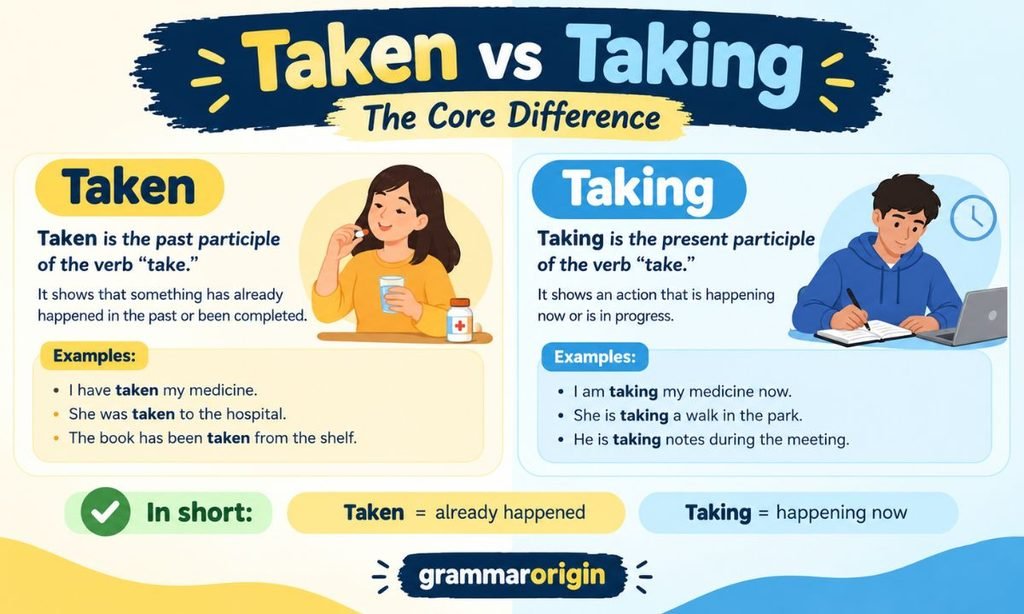
Taking is the present participle of “take” and shows an action in progress. Taken is the past participle and shows a completed or passive action.
Think of it this way: “taking” pairs with words like am, is, are, was, and were. “Taken” pairs with has, have, had, or a passive form of “be.”
- She is taking the 6 PM train. (happening now)
- She has taken the 6 PM train before. (already done)
The word choice isn’t random. It follows the grammar structure around it, not just how the sentence “sounds.”
Understanding the Verb “Take”
“Take” is one of the most irregular and flexible verbs in English, which is exactly why its forms trip people up so often.
Meaning of “Take”
At its root, “take” means to grab, receive, or accept something. But it stretches into dozens of everyday meanings.
- To grab: She took the pen from the desk.
- To need time: It takes an hour to bake this.
- To accept a role: He took the job offer.
Because one verb covers so much ground, its participle forms show up constantly in daily conversation, writing, and idioms.
Forms of “Take”
| Base Form | Past Simple | Past Participle | Present Participle |
| take | took | taken | taking |
Note that took is only for simple past statements (“I took the bus”), never paired with a helping verb. Taken always needs one (“I have taken the bus”).
Quick Summary of Grammatical Functions
Here’s a quick snapshot of how each form behaves grammatically. These grammatical functions, verb tense, participle type, and sentence voice, form the semantic backbone of the taken vs taking rule.
| Verb Form | Part of Speech | Common Helpers | Sentence Focus |
| Taking | Present participle / gerund | am, is, are, was, were | Action in progress |
| Taken | Past participle | has, have, had, was, been | Completed or passive result |
Keep this table in mind as a quick filter whenever you’re stuck choosing between the two.
Understanding Participles and Gerunds
A participle is a verb form that usually teams up with a helping verb to build a tense. A gerund is a verb form (ending in “-ing”) that acts as a noun instead.
“Taking” can be either a participle or a gerund, depending on the sentence. “Taken,” on the other hand, never functions as a noun. It stays a verb form, and this distinction sits at the heart of the taken vs taking rule.
- Participle: She is taking a photo. (part of the verb tense)
- Gerund: Taking photos relaxes her. (acts as the subject)
When to Use “Taking”
Use taking when an action is ongoing, was ongoing, or will be ongoing, and also when the word functions as a noun.
“Taking” in Continuous (Progressive) Tenses
Structure: am/is/are/was/were + taking
- Present continuous: He is taking a break.
- Past continuous: They were taking notes when the bell rang.
- Future continuous: We will be taking the early flight.
Each of these describes movement, an action stretched across time rather than a single finished moment.
“Taking” as a Gerund (Noun Form)
Here, “taking” behaves like a thing rather than an action word.
- Taking risks builds confidence.
- He avoids taking shortcuts.
- Her taking of the initiative surprised everyone.
A quick test: if you can swap “taking [something]” with a plain noun like “this habit” and the sentence still makes sense, it’s a gerund.
Also Read This Too Many vs To Many: Which One Is Correct?
“Taking” as an Adjective (Rare Use)
Less commonly, “taking” describes something charming or attractive. This is an older, slightly literary usage.
- She has a taking smile.
- There’s something taking about his manner.
You won’t see this often in modern writing, but it does appear in classic literature and formal English.
Common Expressions and Phrasal Verbs with “Taking”
English leans on “taking” in several fixed phrases and phrasal verbs.
- Taking off: a plane leaving the ground, or gaining sudden popularity
- Taking over: assuming control
- Taking up: starting a hobby or occupying space
- Taking part in: participating
- Taking care of: looking after something
Quick Reference Table for “Taking”
| Use | Function | Example |
| Continuous tense | Verb | She is taking a class. |
| Gerund | Noun | Taking classes helps her grow. |
| Adjective | Describing word | He has a taking personality. |
When to Use “Taken”
Use taken for actions that are already complete, or when the sentence structure is passive.
“Taken” in Perfect Tenses
Structure: has/have/had + taken
- Present perfect: She has taken the exam.
- Past perfect: They had taken the wrong exit before turning back.
- Future perfect: By June, he will have taken every course in the program.
If “have” or “has” fits naturally before the word, “taken” is almost certainly correct.
“Taken” in the Passive Voice
Structure: be (is/was/were/been) + taken
- The decision was taken by the board.
- Photos are taken here every weekend.
- Action has been taken to fix the leak.
Passive sentences shift the spotlight from who did something to what happened, and “taken” carries that shift.
“Taken” as an Adjective (Romantically Unavailable)
“Taken” also works as a standalone adjective meaning someone is already in a relationship.
- Sorry, I’m taken.
- She’s been taken for two years now.
This is one of the few times “taken” appears without a helping verb and still sounds correct, because it’s functioning as a description, not a verb.
Common Expressions with “Taken”
- Taken aback: caught off guard
- Taken for granted: underappreciated
- Taken ill: suddenly became sick
- Taken into account: considered
- Taken by surprise: shocked
Quick Reference Table for “Taken”
| Use | Tense/Voice | Example |
| Perfect tense | Completed action | He has taken the call. |
| Passive voice | Result-focused | The seat was taken. |
| Adjective | Description | He’s already taken. |
Common Prepositions Used with Taken and Taking
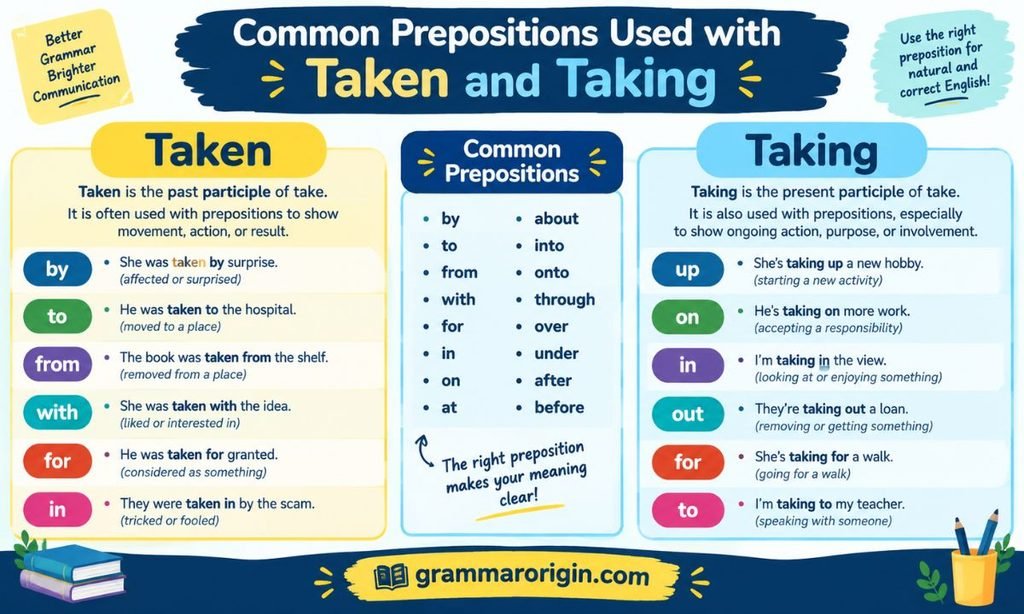
The word right after “taken” or “taking” can shift the meaning noticeably.
- Taken by: shows the doer in a passive sentence, as in The award was taken by the youngest player.
- Taken with: means charmed by something, as in He was quite taken with the idea.
- Taking from: means removing, as in She’s taking supplies from the storage room.
- Taking to: means developing a liking for something, as in The kids are taking to the new teacher quickly.
Active vs. Passive Voice with Taken and Taking
In active voice, the subject performs the action. In passive voice, the subject receives it, and this is where the two words split paths sharply.
| Voice | Form Used | Example |
| Active | Taking | The clinic is taking new patients. |
| Passive | Taken | New patients are being taken on this week. |
No matter the overall tense, past, present, or future, passive voice always calls for taken, never “taking.”
Comparing “Taken” vs “Taking”
Common Confusions
The most frequent slip is dropping the helping verb entirely.
- Incorrect: He is taken lunch.
- Correct: He is taking lunch.
Another common mix-up happens with completed actions.
- Incorrect: I taken the test yesterday.
- Correct: I took the test yesterday, or I have taken the test.
Tricky Pairs Explained
Some phrases look almost identical but shift meaning depending on the form.
- Taking place means happening now, as in The wedding is taking place today.
- Has taken place means already happened, as in The wedding has taken place.
- Taken together is used when combining facts or ideas for one conclusion, as in Taken together, the results suggest a clear trend.
- Taking together is not correct in standard English. The fixed expression is always “taken together,” never “taking together.”
Where Does “Take” Come From?
“Take” traces back to Old Norse “taka,” meaning to grasp or seize, and entered English through Old English usage over a thousand years ago. That long history explains why it’s irregular. Older, high-frequency verbs in English tend to resist the standard “-ed” pattern.
Knowing the root doesn’t change the grammar rule, but it explains why “take” behaves so differently from regular verbs like “walk” or “play.”
Other Tricky Irregular Verb Pairs
The taken/taking pattern isn’t unique. Several other irregular verbs follow the same logic.
| Base Verb | Present Participle | Past Participle |
| eat | eating | eaten |
| write | writing | written |
| speak | speaking | spoken |
| break | breaking | broken |
| choose | choosing | chosen |
Once you understand “taken vs taking,” this same rule unlocks dozens of other confusing verb pairs.
Real English in Action
Seeing these words in natural context makes the rule stick faster than memorizing definitions alone.
- From film: “Everything has been taken from me.” This line is built entirely around loss and completion.
- From news writing: “Action taken against the company follows months of investigation.”
- From daily speech: “I’m taking Friday off.”
- From academic writing: “Data were taken from three separate studies.”
Notice how formal writing leans on “taken,” while casual speech reaches for “taking” more often.
Which Form Is More Common: Spoken vs Written English
Taking shows up more in everyday conversation because people constantly describe things happening in real time, including plans, routines, and current activities.
Taken dominates in news reports, research papers, and formal writing, where actions are described as already resolved. A headline like “Steps taken to reduce delays” sounds far more natural than a continuous version of the same idea.
Quick Grammar Hacks to Remember
- If “am/is/are/was/were” fits before the word, use taking
- If “has/have/had” fits before the word, use taken
- If the word can be replaced with “this activity,” it’s a gerund, so use taking
- If someone else caused the action to the subject, use taken
Common Mistakes to Avoid
- Incorrect: She has taking the medicine. Correct: She has taken the medicine.
- Incorrect: He was taken a walk when I called. Correct: He was taking a walk when I called.
- Incorrect: The event is taken place tonight. Correct: The event is taking place tonight.
Most taken vs taking errors come from pairing the wrong helping verb with the wrong participle.
Examples Section: Taken vs Taking in Sentences
These example sentences show the taken vs taking rule at work in different everyday situations.
- She is taking her final exam right now.
- The results have already been taken into account.
- Taking breaks between study sessions improves focus.
- His car was taken without permission.
- They’re taking the scenic route this time.
- The photo was taken during golden hour.
Case Study: Fixing Taken vs Taking Mistakes in Real Writing

A workplace example makes this rule concrete. An employee once wrote in a team update: “I am taken your feedback seriously.” It read awkwardly to every manager who saw it.
Once corrected to “I am taking your feedback seriously,” the sentence matched the ongoing, active tone the writer actually intended. The fix took seconds once the helping verb was checked against the participle.
Also Read This Too Many vs To Many: Which One Is Correct?
Self Assessment: Test Yourself
Test how well you’ve absorbed the taken vs taking rule by filling in the blank with the correct form:
- She has ___ full responsibility for the project.
- He is ___ the dog for a walk.
- ___ notes during lectures helps memory.
- The award was ___ by a first-time author.
- They were ___ pictures when the storm started.
Self Assessment Answers
- taken
- taking
- Taking
- taken
- taking
Frequently Asked Questions About Taken vs Taking
What is the main difference between taken and taking?
“Taken” shows a completed or passive action, while “taking” shows an action in progress or works as a noun. The helping verb around each word usually confirms which one fits.
When should I use taken vs taking in a sentence?
Use “taking” when the action is happening now, was happening, or will be happening, and pair it with a form of “be.” Use “taken” for completed actions with “have/has/had,” or for passive sentences.
What’s the difference between take, took, and taken?
“Take” is the base form, “took” is the simple past used alone, and “taken” is the past participle that always needs a helping verb like “has” or “have.” Saying “I taken it” without a helper is incorrect.
Can “taken together” and “taking together” both be correct?
No. “Taken together” is the correct, fixed phrase used to combine ideas or evidence, as in “Taken together, these results are convincing.” “Taking together” is not standard English.
Is “taken” ever used as an adjective?
Yes. “Taken” can describe someone who is already in a relationship, as in “Sorry, he’s taken.” In this case, it stands alone without needing a helping verb.
Which form is used in passive voice, taken or taking?
Passive voice always uses “taken,” regardless of tense, as in “The seats were taken” or “Action has been taken.” “Taking” is never used in a passive construction.
Which one is more common in spoken English?
“Taking” appears more often in casual, spoken English because people frequently talk about ongoing actions. “Taken” is more common in formal writing, news, and reports.
Final Thoughts
Choosing between taken vs taking comes down to one simple check: look at the helping verb and ask whether the action is finished or still happening. “Taking” moves with the action; “taken” marks its end.
Once you start noticing this pattern in everyday sentences, films, and headlines, the confusion fades fast. The same logic will help you with other irregular verbs too.

Muhammad Waqas is an English language teacher and grammar expert with over 8 years of experience helping students and professionals improve their writing skills. He specializes in English grammar, vocabulary, communication, and practical language learning. Through GrammarOrigin, Waqas shares clear, easy-to-understand content that helps readers write and speak English with confidence.