
“Batton or baton?” is one of the most common spelling mix-ups in English. If you’ve typed both versions before hitting send, you’re not alone.
Here’s the short version: baton is the correct spelling, and batton isn’t a recognized word in any standard dictionary. This guide covers the meaning, the pronunciation, where the confusion comes from, and exactly when to use each form.
Comparison Overview
Baton is the word you want in almost every situation. Batton only shows up as a name or as a typo.
| Feature | Batton | Baton |
| Recognized word | No | Yes |
| Dictionary status | Not listed | Standard entry |
| Part of speech | N/A | Noun |
| Typical appearance | Misspelling, rare surname | Music, sports, police, ceremonies |
| Safe for formal writing | No | Yes |
Example: “The judge asked for the baton, not the batton,” is a simple way to remember which spelling belongs in real writing.
Definition of Batton
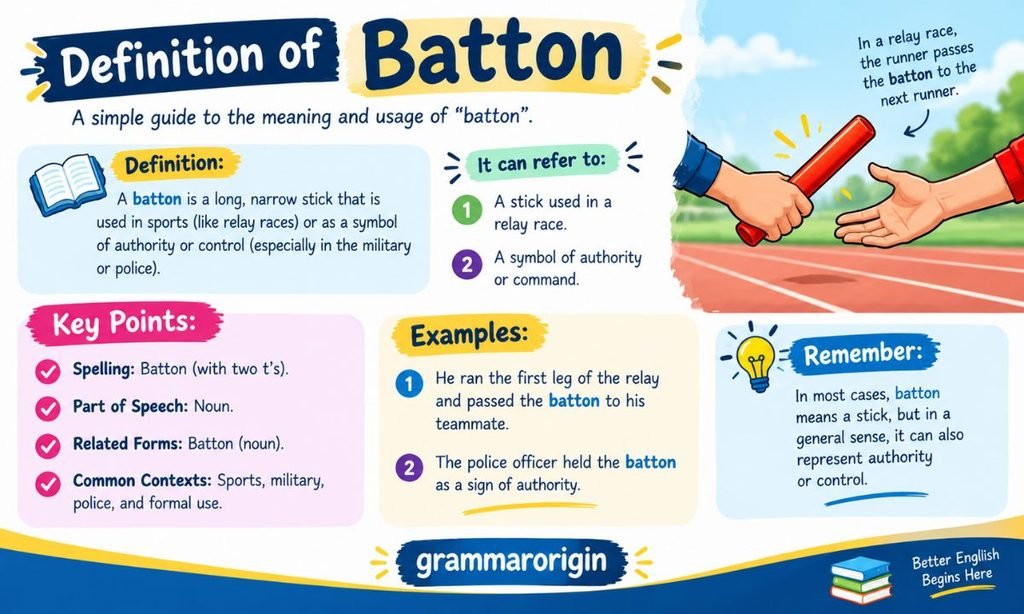
Batton has no accepted meaning in modern English. It’s almost always a typo for baton, made by adding an extra “t” out of habit.
Occasionally, Batton shows up as a surname or a business name, but outside of that narrow use, it’s simply a spelling mistake.
Example: “Mr. Batton runs the accounting department” is fine as a name, but “she passed the batton” is wrong every time.
Definition of Baton
A baton is a short stick or rod, and its exact meaning depends on where it’s used.
The word covers a conductor’s wand, a relay-race stick, a police weapon, and a ceremonial staff, all under one spelling. Related words like rod, wand, and staff describe similar objects, but baton is the term that sticks across every one of these settings.
Example: The conductor tapped her baton twice before the orchestra began.
Common Uses of Baton
Baton shows up across more fields than most people expect:
- Music conducting
- Track and field relay races
- Law enforcement equipment
- Military and public ceremonies
- Baton twirling as a performance sport
Example: A single relay baton can pass through four different runners’ hands in under a minute.
Main Differences Between Batton and Baton
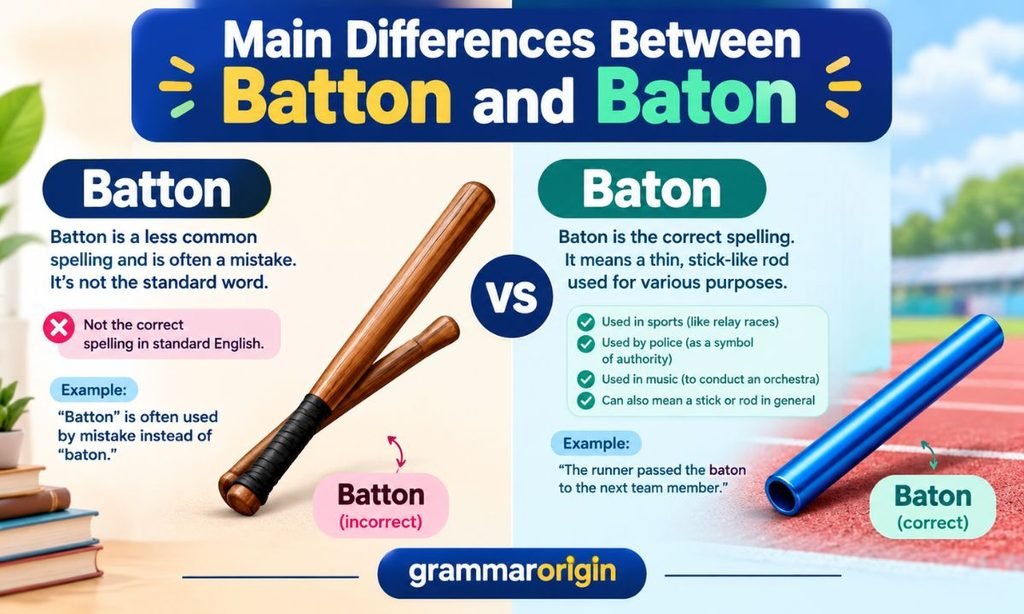
Meaning
Baton names a real object. Batton names nothing at all in standard usage.
Usage
Baton fits formal writing, casual speech, and everything in between. Batton doesn’t belong in any of them.
Context
Use baton whenever you’re describing the physical stick itself. Batton only survives as a rare proper noun.
Example: “He gripped the baton tightly” works in a sports article, a novel, or a police report, since it’s the same correct word in every context.
Common Contexts Where Baton Is Used
In Music
A conductor raises the baton to set the tempo, cue different sections, and shape the performance as it happens.
Example: The baton dipped lower as the orchestra slowed into the final movement.
In Sports
Relay runners hand off the baton inside a marked exchange zone, and a dropped baton can cost the team the entire race.
Example: Team USA lost the relay after a runner fumbled the baton near the second exchange zone.
In Law Enforcement
Officers may carry a baton, sometimes called a truncheon or nightstick, for defense or crowd control.
Example: The officer’s baton stayed clipped to her belt for the entire shift.
In Ceremonies
Drum majors and military officials often carry a decorated baton as a visible mark of leadership.
Example: The drum major’s baton caught the light as she led the marching band onto the field.
Etymology & Origin of Baton
Baton traces back to the French word bâton, meaning “stick” or “staff,” which came from the Late Latin word bastum.
English picked up the word in the 17th century, first for ceremonial staffs and later for the musical and athletic uses we know today. Batton was never a separate word with its own background; it’s simply a spelling error that stuck around.
Example: Old French records use bâton the same way modern English uses baton, as a general word for a stick or staff of authority.
Also Read This Fight Past Tense
Pronunciation of Baton – US vs UK
American and British speakers say baton differently, and that gap is part of why the extra “t” creeps in.
- American English: /bəˈtɑːn/, close to “buh-TAHN”
- British English: /ˈbæt.ɒn/, closer to “BAT-on”
Example: A US news anchor might say the baton as “buh-TAHN,” while a UK commentator says the same word as “BAT-on.”
Grammar Guide
How Each Term Is Used in Sentences
Baton works as a countable noun and takes a normal plural: batons.
Batton isn’t used in grammar at all, since it isn’t a recognized word to begin with.
Example: “The runners exchanged batons smoothly” is correct; “the runners exchanged battons” is not.
Common Mistakes Learners Make
- Adding an extra “t” out of habit while typing quickly
- Assuming spellcheck will always catch the error
- Using batton in a resume, essay, or business email
- Mixing up baton with “button” when typing fast
- Confusing baton with the cooking term “batonnet,” a thin vegetable cut
Example: A student once wrote “the batton twirler” in a school report, and the spellcheck tool missed it completely.
Simple Rules to Remember
Baton has one “t,” just like the number “one” has one syllable.
If you can picture a relay race, a conductor, or a police officer, the word you want is baton.
Example: Picture a runner’s hand closing around a smooth wooden baton, and you’ll remember the single “t” every time.
Quick Tips for Writing and Speaking
- Proofread by hand; some spellcheckers miss “batton” next to other proper nouns
- Say the word out loud before writing it, since the rhythm often exposes the extra letter
- Bookmark a dictionary page for baton if you write about sports or music often
Example: Reading a sentence about a baton exchange out loud can help you catch a stray extra “t” before you hit publish.
Is Batton Ever Correct?
Batton is acceptable only when it’s someone’s actual last name or part of a registered business name.
Outside of a proper noun, there’s no situation, casual or formal, where batton is the right choice.
Example: “The Batton family owns the local hardware store” is fine, but “she carried the batton into the stadium” should always read baton.
When to Use Each One
Use Baton When:
- Describing a relay-race handoff
- Referring to a conductor’s wand
- Writing about police or security equipment
- Mentioning a ceremonial or military staff
Use Batton When:
- Referring to a person or business genuinely named Batton
- Quoting a source where “Batton” is an intentional proper noun
Example: A biography about the Batton family would keep the name as written, even though every other mention of the object stays baton.
When NOT to Use Each One
Do Not Use Batton
Avoid batton in essays, reports, resumes, news writing, or any professional document. It will read as a spelling error every time.
Do Not Use Baton
Don’t swap in baton when a text is specifically about a person or place actually named Batton, since that would change a proper noun.
Example: A report about “Batton Street” should keep the street name as is, while every mention of the object a police officer carries should read baton.
Which One to Use (Decision Guide)
Ask yourself these quick questions before you type:
- Are you talking about the physical stick or rod? Use baton.
- Is it a relay race, orchestra, or police reference? Use baton.
- Is “Batton” someone’s actual surname? Use Batton.
- Still unsure? Default to baton, since it’s correct in nearly every case.
Example: A quick mental check before sending an email, “Am I talking about a person named Batton, or the object?”, settles the spelling in seconds.
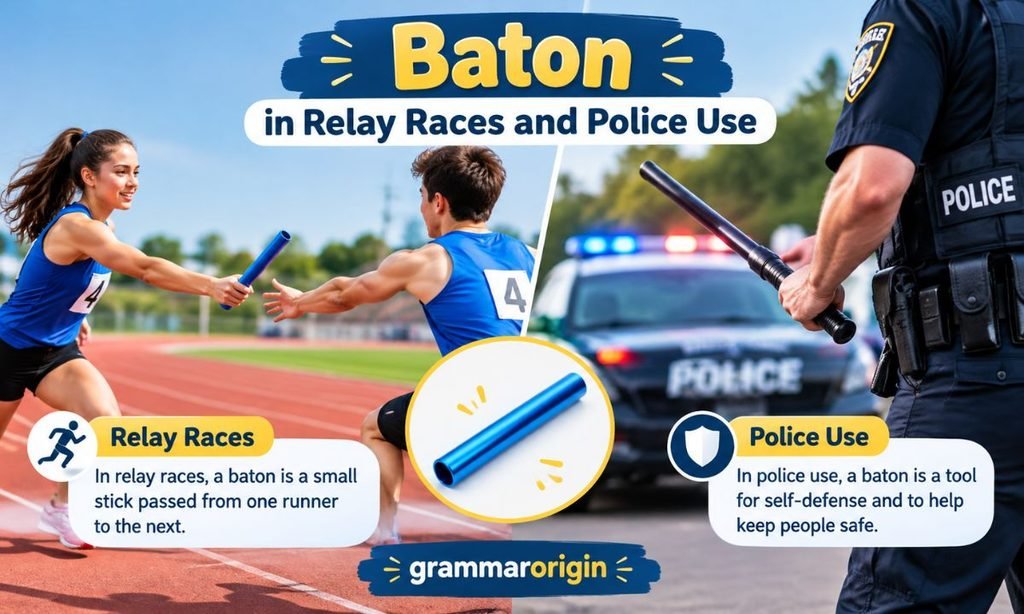
Baton in Relay Races and Police Use
The batton or baton relay question comes up constantly in sports writing, and the answer is always baton. A dropped baton during a hand-off is one of the most common ways relay teams lose time or get disqualified.
On the law-enforcement side, a police baton ranges from a short fixed rod to a collapsible model, and officers train specifically on smooth, controlled use rather than aggression.
Example: The coach reminded her team that a clean baton exchange matters more than raw speed.
Also Read This Fight Past Tense
Real-World Practical Examples
Batton Examples
- Mr. Batton chaired the committee meeting on Tuesday.
- The Batton family has run this bakery for three generations.
- Sarah Batton was named employee of the month.
Baton Examples
- The sprinter nearly dropped the baton on the final exchange.
- The conductor lowered his baton to signal a quiet passage.
- The officer clipped her baton back onto her duty belt.
- The parade marshal carried a ceremonial baton at the front of the line.
Self-Assessment (Fill in the Blanks)
- The conductor raised the ______ to begin the symphony.
- The runner nearly dropped the ______ during the handoff.
- The correct spelling has only one ______ letter “t.”
- Mr. ______ signed the lease for the new office space.
- The officer’s ______ stayed clipped to her belt all shift.
- In British English, ______ is pronounced closer to “BAT-on.”
- The word ______ comes from the French term for “stick.”
- The drum major twirled the ______ before the halftime show.
- Spellcheck sometimes misses ______ when it’s typed quickly.
- The correct word for a relay-race stick is ______.
Answers
- baton
- baton
- baton
- Batton
- baton
- baton
- baton
- baton
- batton
- baton
Final Verdict
Baton wins in nearly every context you’ll ever write in: sports, music, law enforcement, and ceremony all rely on this one spelling. Batton survives only as an occasional surname, nothing more.
Conclusion About Batton or Baton
Choosing between batton and baton comes down to one simple habit: default to baton unless you’re naming an actual person called Batton. Once that rule sticks, the confusion disappears for good.
Frequently Asked Questions
Is it batton or baton?
Baton is the correct spelling. Batton is a common misspelling with no standard dictionary entry.
How do you pronounce baton?
American English says it close to “buh-TAHN,” while British English leans toward “BAT-on.”
Is batton ever correct in writing?
Only when it’s an actual surname or business name. Otherwise, baton is always the right choice.
What does a batton or baton relay involve?
It involves runners physically passing a baton within a marked exchange zone, and dropping it can disqualify the team.
Why do people confuse batton and baton?
The extra “t” usually slips in from fast typing or from mishearing how the word is pronounced.
Is a police baton the same word as a music baton?
Yes. Both use the identical spelling, baton, even though the object serves very different purposes.
Does baton have a plural form?
Yes, the plural is simply batons, following normal noun rules.

Muhammad Waqas is an English language teacher and grammar expert with over 8 years of experience helping students and professionals improve their writing skills. He specializes in English grammar, vocabulary, communication, and practical language learning. Through GrammarOrigin, Waqas shares clear, easy-to-understand content that helps readers write and speak English with confidence.