
Privilege or Priviledge If you’ve typed this word and then stared at it, wondering if something looks off, you’re not imagining things. Privilege is the correct spelling. Priviledge is simply a spelling mistake that many confident writers still make.
This mix-up isn’t a grammar problem at all. It’s a spelling trap that hides in plain sight, and this guide breaks down the meaning, the reason for the confusion, and how to get it right every time.
Comparison Overview
Privilege is a real, dictionary-approved English word. Priviledge is not. It’s a common misspelling that adds an extra letter where one doesn’t belong.
| Term | Status | Meaning | Used in Dictionaries |
| Privilege | Correct | A special right, benefit, or advantage | Yes |
| Priviledge | Incorrect | Misspelling of privilege | No |
Example: “Working from the office library is a privilege, not a priviledge.” Only the first half of that sentence uses correct spelling.
Pronunciation of Privilege
Said out loud, this word sounds like PRIV-uh-lij (/ˈprɪv.əl.ɪdʒ/). There’s no hard “d” sound before the final “j,” and that missing sound is the clue to spelling it correctly.
Definition of Privilege
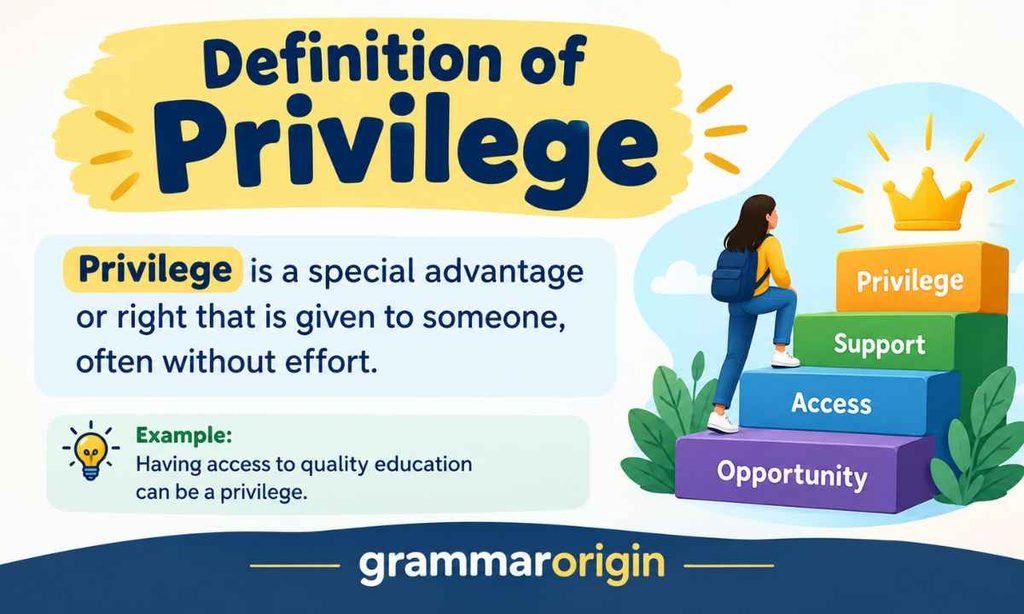
Privilege is a noun, and sometimes a verb, that describes a special right, benefit, or advantage given to a person or group. It isn’t something everyone automatically has.
As a noun, it points to something earned, inherited, or granted. As a verb, it means to favor one person or group over another.
Examples of Privilege
- Example: Getting front-row concert tickets was a privilege reserved for members.
- Example: She grew up with the privilege of attending a well-funded school.
- Example: The review policy tends to privilege senior staff over new hires.
Definition of Priviledge
Priviledge doesn’t exist as a real word in any standard English dictionary. It’s simply a common misspelling of privilege.
It shows up often in emails, comments, and rushed writing, but no dictionary, British or American, lists it as an accepted spelling.
Examples of Incorrect Usage
- Incorrect: It was a priviledge to attend the ceremony.
- Incorrect: Not everyone gets that kind of priviledge.
- Incorrect: Staff enjoy several workplace priviledges.
Example (corrected): “It was a privilege to attend the ceremony” is the version to use in anything you plan to send or publish.
Also Read This Batton or Baton: Meaning, Correct Spelling & Usage Guide
Main Differences Between Privilege and Priviledge
| Feature | Privilege | Priviledge |
| Spelling | Correct | Incorrect |
| Found in dictionaries | Yes | No |
| Fine for formal writing | Yes | No |
| Fine for casual writing | Yes | No |
| Part of speech | Noun, verb | None |
Key Difference
There’s exactly one difference here: spelling. Privilege carries a real meaning and grammatical role. Priviledge carries none, because it isn’t a recognized word.
Why Do People Misspell Privilege?
Most people misspell this word because their brain reaches for a familiar pattern, the “-ledge” ending found in words like knowledge, acknowledge, and sledge.
This word doesn’t follow that pattern, though. It comes from the Latin privilegium, meaning a law made for one person, which is why it ends in “-lege” instead of “-ledge.”
Memory Trick
Break the word into three small parts: priv + i + lege. There’s no “d” near the ending, and there’s no ledge to stand on, in meaning or in spelling.
Comparison Table
| Aspect | Privilege | Priviledge |
| Valid word | Yes | No |
| Dictionary entry | Yes | No |
| Safe for essays | Yes | No |
| Safe for business writing | Yes | No |
| Safe for legal documents | Yes | No |
| Recommended by style guides | Yes | No |
Grammar Guide
This word behaves differently depending on where it sits in a sentence, and knowing the pattern helps the correct spelling stick.
How Each Term Is Used in Sentences
As a noun: Subject + is/was + a privilege, as in “It is a privilege to lead this project.”
As a verb: Subject + privileges + object, as in “The new rule privileges early applicants.” The incorrect spelling has no grammatical role, since it isn’t a recognized word.
Common Mistakes Learners Make
- Spelling it like “knowledge” instead of following its own pattern.
- Assuming autocorrect will always catch the error. It doesn’t, in every app.
- Copying a spelling seen in a comment or forum without checking it first.
- Skipping a final proofread on formal documents.
Example: A learner writes “I feel priviledged,” then later notices that “privileged” is the version every dictionary actually lists.
Simple Rules to Remember
- Always use the correct spelling. Never write the incorrect version.
- No “d” appears before the final “g.”
- Correct it the moment you spot it in your own writing.
- When unsure, check a dictionary instead of guessing.
Quick Tips for Writing and Speaking
- Turn on spell-check, but don’t rely on it blindly.
- Read your sentence aloud. The missing “d” sound is a giveaway.
- Type the correct spelling a few times until it feels automatic.
- Keep a short list of words you tend to misspell, and review it now and then.
When to Use Each One
Use Privilege When
- You’re describing a benefit or right that not everyone shares.
- You’re writing a resume, essay, or business email.
- You’re referring to access levels in software or technology.
- You’re discussing legal protections, such as attorney-client privilege.
Example: “Admin privileges let you install new software” fits every one of these situations.
Use Priviledge When
There isn’t a context where this spelling is acceptable. If you’ve written it, the fix is always the same: change it to the correct form.
When NOT to Use Each One
Do Not Use Privilege Incorrectly
Avoid this word when you actually mean a duty or requirement rather than an advantage.
Example: Saying “Paying rent is a privilege” reads oddly. “Paying rent is a responsibility” fits the meaning far better.
Do Not Use Priviledge
Never use this spelling in essays, resumes, contracts, or any writing meant for other people to read. It’s always flagged as an error, with no exceptions.
Also Read This Batton or Baton: Meaning, Correct Spelling & Usage Guide
Which One to Use (Decision Guide)
Ask yourself one simple question: are you referring to a special right, honor, or advantage? If yes, use the spelling with no “d” before the “g.”
| Situation | Correct Choice |
| Academic writing | Privilege |
| Business emails | Privilege |
| Legal documents | Privilege |
| Casual texting | Privilege |
| Any situation at all | Privilege |
Privilege or Priviledge: UK vs US Spelling
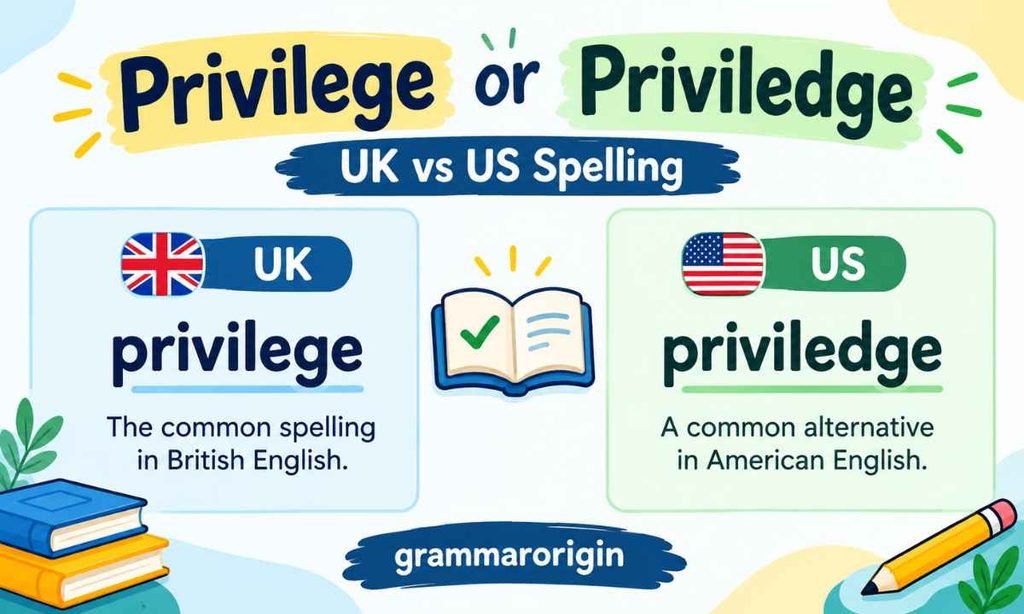
Here’s some good news if you’ve searched “privilege or priviledge UK” or “privilege or priviledge US” separately. There’s no split to worry about.
Unlike word pairs such as color and colour, this word is spelled the same way in both British and American English. The incorrect spelling is wrong on either side of the Atlantic, since regional spelling variation simply doesn’t apply here.
What Do Dictionaries Say? (Oxford, Merriam-Webster, Cambridge)
Every major dictionary, including the Oxford English Dictionary, Merriam-Webster, and Cambridge Dictionary, lists only one spelling. None of them recognize the incorrect form as an alternate spelling or informal variant.
This agreement matters. In professional and academic writing, there’s no dictionary you could point to as backup for the wrong version.
Real-World Practical Examples
Privilege Examples
- Scholarship recipients described studying abroad as the privilege of a lifetime.
- The company reviews admin privileges every quarter for security reasons.
- Historians often note that education was once limited to the wealthy.
- It was a genuine privilege to interview the retiring professor.
- Union membership came with certain workplace privileges.
Priviledge Examples
- Incorrect: “Attending was a priviledge I won’t forget.” Correct: “Attending was a privilege I won’t forget.”
- Incorrect: “The pass gives you special priviledges.” Correct: “The pass gives you special privileges.”
- Incorrect: “Education shouldn’t be a priviledge.” Correct: “Education shouldn’t be a privilege.”
Self-Assessment (Fill in the Blanks)
- It was a ______ to meet the author in person.
- Education should never be treated as a rare ______.
- The dictionary only accepts the spelling ______.
- Employees receive several workplace ______ (plural).
- The commonly misspelled version people often type is ______.
- Attorney-client ______ protects certain communications.
- Admin ______ let a user install new programs.
- It is a ______ to be trusted with this responsibility.
- The scholarship gave her the ______ of studying overseas.
- Grammar checkers usually flag ______ as an error.
Answers
- privilege
- privilege
- privilege
- privileges
- priviledge
- privilege
- privileges
- privilege
- privilege
- priviledge
Final Verdict
There’s only one correct answer here. Every major dictionary, style guide, and grammar authority agrees on the same spelling, whether you’re writing for a UK or US audience.
The incorrect version is a misspelling caused by a pattern mismatch with words like knowledge. It’s understandable, but never correct in any form of writing.
Conclusion About Privilege or Priviledge
Choosing between these two spellings comes down to one memorable rule: there’s no “d” before the “g,” and the other version simply isn’t a recognized word anywhere.
Once that rule sticks, spelling this word correctly stops being a guessing game, whether you’re writing an email, an essay, a resume, or anything else meant for other people to read.
Frequently Asked Questions
Is it privilege or priviledge?
Privilege is correct. The other spelling is a common mistake and isn’t recognized by any English dictionary.
Is privilege spelled the same in UK and US English?
Yes. Unlike many British-American spelling differences, this word uses the identical spelling in both UK and US English.
What does the Oxford Dictionary say about priviledge or privilege?
The Oxford Dictionary, like every other major dictionary, lists only the correct spelling as a valid entry. The other version does not appear as an alternate spelling.
Why do so many people misspell this word?
The confusion comes from words like knowledge and acknowledge, which end in “-ledge.” This word follows a different pattern and ends in “-lege” instead.
Can privilege be used as a verb?
Yes. As a verb, it means to give special treatment or advantage to a person or group, as in “the policy privileges early applicants.”
Is the incorrect spelling acceptable in informal writing, like texting?
No. There’s no context, formal or informal, where it’s considered correct. It should always be corrected.
What’s an easy way to remember the correct spelling?
Break it into priv, i, and lege, and remember there’s no “d” before the final “g.” Saying the word aloud also helps, since the missing “d” sound matches the missing letter.

Muhammad Waqas is an English language teacher and grammar expert with over 8 years of experience helping students and professionals improve their writing skills. He specializes in English grammar, vocabulary, communication, and practical language learning. Through GrammarOrigin, Waqas shares clear, easy-to-understand content that helps readers write and speak English with confidence.