
Fight Past Tense You’re writing a sentence about yesterday’s argument or last season’s championship game, and you pause: is the fight past tense “fighted” or something else entirely? This single verb trips up more learners than almost any other irregular form in English.
The answer is short and easy to remember once you see the pattern behind it. This guide walks through the correct form, where it comes from, and exactly when to use it in real sentences.
Quick Answer
The past tense of fight is fought, and fought also serves as the past participle. There is no separate form for each function, which makes this verb simpler than it first appears.
- Fight = present tense
- Fought = past tense
- Fought = past participle
Simple Background
Fight means to battle, to argue, or to struggle against something or someone. As a verb, it describes conflict in both physical and non-physical situations.
Unlike regular verbs, fight doesn’t take an “-ed” ending in the past. Instead, the whole word changes: fight becomes fought, a pattern known as an irregular verb.
Where Does “Fight” Come From?
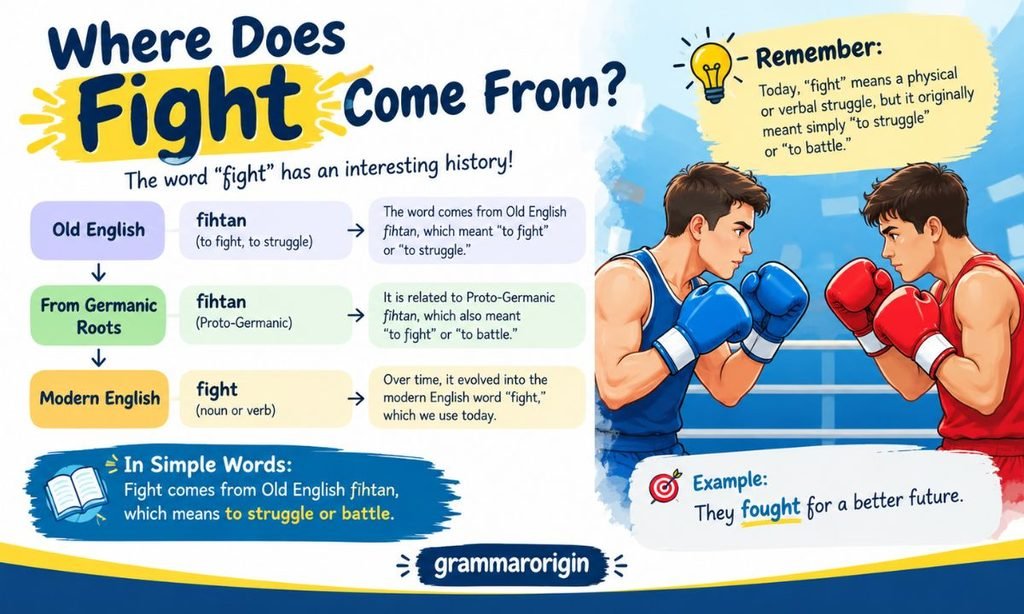
The verb traces back to Old English feohtan, a word already tied to combat and struggle over a thousand years ago. Its irregular past form has survived through Middle English into modern usage largely unchanged.
This long history explains why fought doesn’t follow the modern “-ed” rule. The verb kept its old vowel-change pattern instead of switching to the newer “-ed” pattern most English verbs use today.
Standard dictionaries, including Merriam-Webster, confirm fought as the correct past tense and past participle in every use of the verb.
Clear Explanation of the Difference
What is “Fight”?
Fight is the base form, used for the present tense and for talking about habits, routines, or general truths. It stays the same regardless of most subjects, aside from a final “-s” for he, she, or it.
- “They fight for their rights every year.”
- “The immune system fights off infections.”
What is “Fought”?
Fought covers both the simple past tense and the past participle, so it appears in past-tense sentences and in perfect tenses alike. Nothing else changes based on which job it’s doing.
- Simple past: “They fought bravely last night.”
- Past participle: “She has fought for this cause for a decade.”
Comparison Table
| Verb Form | Word | Example Sentence |
| Base Form | Fight | “They fight fairly in every match.” |
| Past Tense | Fought | “They fought fiercely yesterday.” |
| Past Participle | Fought | “They have fought this battle before.” |
Fight vs. Fought vs. Fighting at a Glance
Beyond the base and past forms, “fighting” covers ongoing or continuous action, and keeping all three straight avoids most common errors.
| Form | Function | Example |
| Fight | Present, everyday action | I fight for what’s right. |
| Fought | Past action, or past participle | I fought for it last year. |
| Fighting | Ongoing action, present participle | I am fighting for it right now. |
Full Tense Table for “Fight”
Seeing every tense side by side helps remove any doubt about which form belongs where, especially in perfect and continuous constructions.
| Tense | Example |
| Simple Present | I fight for my team. |
| Simple Past | I fought for my team. |
| Simple Future | I will fight for my team. |
| Present Continuous | I am fighting for my team. |
| Past Continuous | I was fighting for my team. |
| Present Perfect | I have fought for my team. |
| Past Perfect | I had fought for my team. |
| Future Perfect | I will have fought for my team. |
Similar Irregular Verbs Like “Fight”
Fight belongs to a small family of English verbs that swap their vowel sound instead of adding “-ed,” and recognizing the pattern makes each new verb easier to learn.
- Bring becomes Brought
- Catch becomes Caught
- Teach becomes Taught
- Think becomes Thought
Notice the shared “-ought” or “-aught” sound. Once that pattern clicks, fought stops feeling like a random exception and starts feeling like part of a family.
Also Read This Lieing or Lying?
Which One to Use and When
Use fight for the present tense, for habits, and for scheduled future events written in present form. Use fought for anything that already happened, and for perfect tenses built with has, have, or had.
- “I fight for my beliefs.” (present habit)
- “I fought for my beliefs.” (completed past action)
- “I have fought for my beliefs.” (present perfect, unspecified time)
Simple Tip to Remember
Picture a timeline: today sits on “fight,” and yesterday sits on “fought.” There’s no in-between spelling to memorize, just the one swap.
- Today: fight
- Yesterday: fought
Fight Past Tense Pronunciation
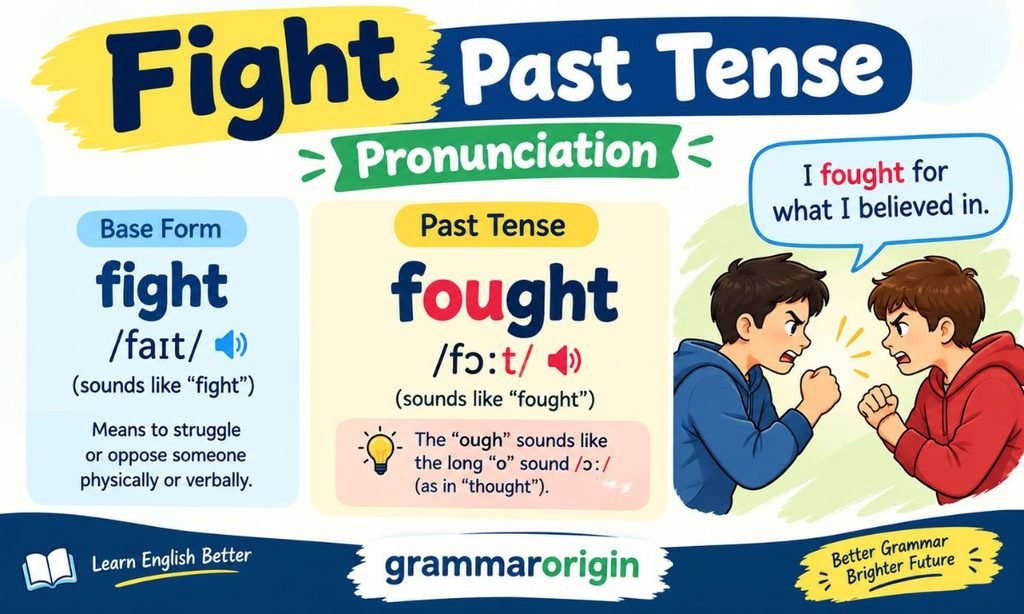
Fought is pronounced /fɔːt/, rhyming with “caught,” “taught,” and “bought.” The vowel sound is longer and rounder than the short “i” in fight.
A quick warning worth knowing: fought sounds close to the word “fort,” a walled military structure, though the two spellings and meanings are completely unrelated. Context always makes the difference clear in speech.
Common Mistakes People Make
1. Saying “fighted”
This is the single most common error, since most verbs simply add “-ed” for the past tense. Fight refuses that pattern entirely.
- Incorrect: “He fighted with his brother.”
- Correct: “He fought with his brother.”
2. Using present tense for past actions
Writers sometimes leave the verb in its base form even when describing something that already finished. The timeline of the sentence should always match the verb form.
- Incorrect: “They fight yesterday.”
- Correct: “They fought yesterday.”
3. Forgetting irregular verb patterns
Because fight doesn’t follow the standard “-ed” rule, learners sometimes copy the pattern from regular verbs and guess wrong. Memorizing fought as one whole word, instead of building it from a rule, fixes this for good.
Idioms and Common Phrases With “Fight”
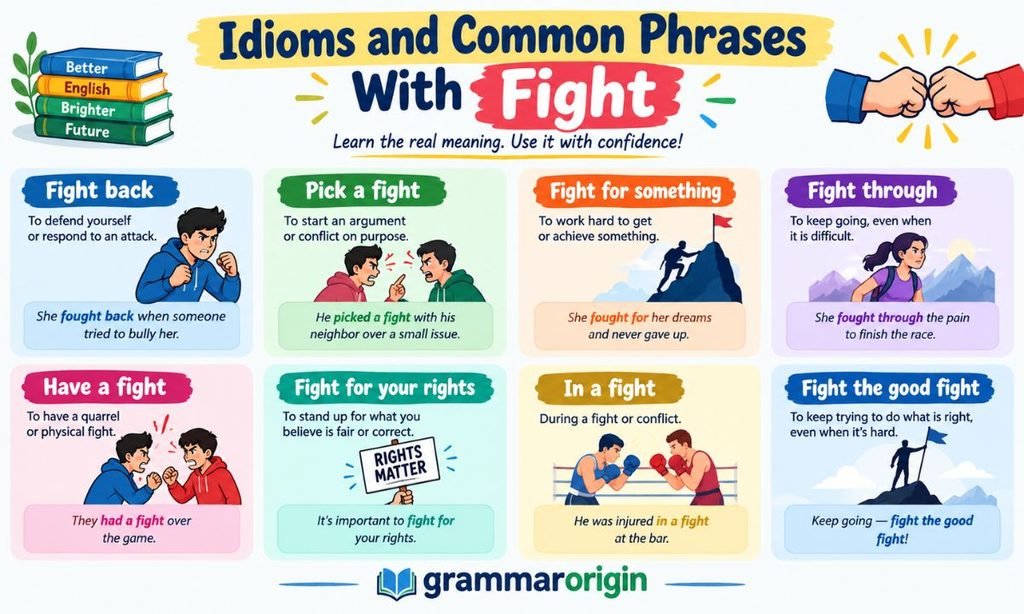
English uses “fight” in several set phrases that go beyond literal combat, and knowing these helps your everyday English sound more natural.
- Fight tooth and nail: to struggle with total effort and determination
- Fight a losing battle: to struggle against something that can’t be won
- Fight fire with fire: to respond to a challenge using the same tactics
- Pick a fight: to deliberately start a conflict or argument
Everyday Real Life Examples
In School
- “The boys fought after class over a misunderstanding.”
- “She has fought hard to improve her grades this term.”
In Sports
- “The team fought back in the final quarter to win the game.”
- “He fought for every point during the match.”
In Movies
- “The hero fought the villain in the film’s final scene.”
- “They fought side by side until the very end.”
In Daily Life
- “They fought about money again last night.”
- “She fought for her dream job for years before landing it.”
Short Learning Section for Students
Step 1: Learn the forms
Start with just two words: fight for now, fought for before. Everything else builds from that single contrast.
Step 2: Practice
Write five sentences using fight and five using fought. Reading them back out loud locks the pattern into memory faster than silent review.
Step 3: Use memory trick
Link fought with its rhyming cousins: bought, caught, taught. If those already feel automatic, fought will follow naturally.
Step 4: Practice speaking aloud
Say full sentences rather than isolated words, since spoken repetition trains your ear as much as your memory. Try reading the examples above until they feel effortless.
Also Read This Lieing or Lying?
Fight Past Perfect Tense
The past perfect form of fight is had fought, used to show one past action finished before another past action started. It always pairs the helper word “had” with fought.
- “By the time the referee arrived, they had already fought for ten minutes.”
- “She had fought for her rights long before the law finally changed.”
Find Past Tense
While this guide focuses on fight, a related irregular verb worth knowing is find, whose past tense is found. It follows the same pattern of a single unchanging form for both past tense and past participle.
- “I find my keys every morning.” (present)
- “I found my keys this morning.” (past)
Fly Past Tense
Another common irregular verb people search alongside fight is fly, whose past tense is flew, with flown as a separate past participle. Unlike fight, fly uses three distinct forms instead of two.
- “The birds fly south every winter.” (present)
- “The birds flew south last month.” (past)
- “The birds have flown south already.” (past participle)
Frequently Asked Questions
What is the fight past tense form?
The fight past tense form is fought, used for any completed action that already happened. It stays the same regardless of the subject.
Is “fighted” ever correct?
No. “Fighted” is not accepted in standard English in any situation, since fight is an irregular verb.
Is fight a regular or irregular verb?
Fight is an irregular verb, meaning its past tense doesn’t follow the standard “-ed” pattern used by most English verbs.
What is the past participle of fight?
The past participle of fight is fought, the same word as the simple past tense. It appears in perfect tenses and passive voice sentences.
Why is fought pronounced differently from fight?
The vowel sound changes because fought comes from an older form of English that shifted over time, unlike newer regular verbs that just add a simple “-ed” ending.
Can fought be used in both American and British English?
Yes. Fought is the accepted past tense and past participle of fight in both American and British English, with no regional spelling differences.
How can I stop confusing fight and fought?
Practice the timeline trick: today uses fight, yesterday uses fought, and pairing it with rhyming words like caught and taught builds the habit quickly.
Summary
The fight past tense comes down to one simple swap: fight becomes fought, whether you’re describing yesterday’s event or something completed further in the past. There is no separate spelling for the past participle, which makes this irregular verb easier than it first looks.
Once you link fought with its rhyming relatives like bought, caught, and taught, the correct form becomes automatic every time you write or speak.

Muhammad Waqas is an English language teacher and grammar expert with over 8 years of experience helping students and professionals improve their writing skills. He specializes in English grammar, vocabulary, communication, and practical language learning. Through GrammarOrigin, Waqas shares clear, easy-to-understand content that helps readers write and speak English with confidence.