
Labeller or labeler? Both work: labeler is the US spelling, labeller is the UK one. They mean the same thing, so the real question is which version suits your readers.
Below, you’ll see who uses which spelling, where the difference came from, and how to pick one with confidence. A short quiz at the end lets you test yourself.
Is It Labeller or Labeler?
Both are correct, so labeller or labeler isn’t a right-or-wrong question. Labeler is the American English spelling. Labeller is the British English spelling, and Australia, New Zealand and Ireland use it too.
Example: A Boston pharmacy orders a labeler. A Bristol pharmacy orders a labeller. It’s the same machine with a different spelling.
Labeler in American English
In the labeller or labeler choice, American dictionaries list labeler first. Merriam-Webster gives it as the main entry and shows labeller as a variant spelling.
Its definition of labeler is simple: one who labels things, such as products, by hand or by machine.
Example: The night-shift labeler checked every barcode before the pallets left the dock.
Labeller in British English
On labeller or labeler, British dictionaries choose the double l. Collins Dictionary treats labeller as the main form and calls labeler the US spelling.
Writers in Australia, New Zealand and Ireland follow the British spelling too.
Example: The labeller on line two jammed twice before lunch.
Quick Answer
Use labeler for US readers and labeller for most other English-speaking readers. This table shows the right choice for labeller or labeler, with the matching word forms.
| Where your readers live | Noun | -ing form | Past tense |
| United States | labeler | labeling | labeled |
| United Kingdom | labeller | labelling | labelled |
| Ireland | labeller | labelling | labelled |
| Canada | labeller | labelling | labelled |
| Australia and New Zealand | labeller | labelling | labelled |
| South Africa | labeller | labelling | labelled |
| India and Pakistan (usually) | labeller | labelling | labelled |
Canada follows the British double-l habit in words like labelled and travelling. In India and Pakistan, British-style spelling is usual, but style guides can differ.
Example: On labeller or labeler, a Toronto print shop that advertises a new labeller is using normal Canadian spelling.
What Does Labeler or Labeller Mean?
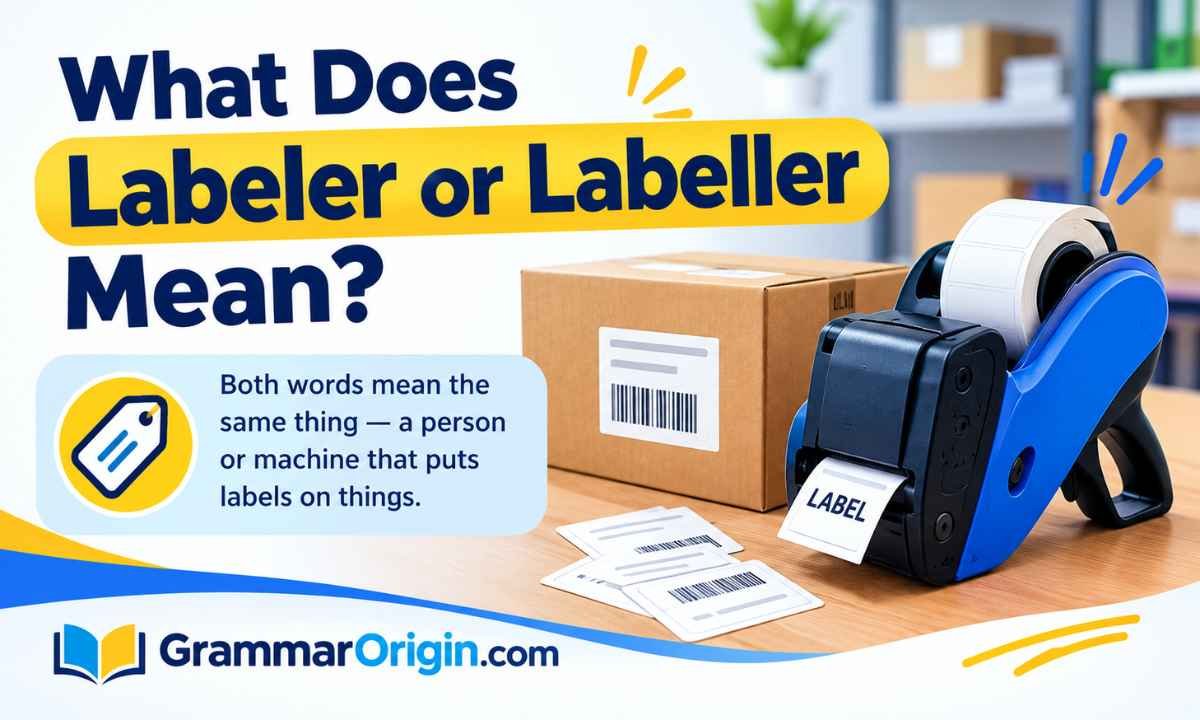
A labeler or labeller is a person or machine that puts labels on things. Whether you write labeller or labeler, the meaning is the same. The job can be done by a person, a machine or software.
Example: A grocery packer, a bottling machine and an AI data worker can all be called a labeler.
A Person Who Labels Things
A labeler is a worker who puts labels on products, files, shelves or parcels. As a job title, labeller or labeler is common in packaging and shipping.
Example: The pharmacy hired a part-time labeler to prepare medicine bags.
A Machine or Device That Applies Labels
A labeler can also be a machine, so labeller or labeler both fit. Industrial labelers put labels on products, packs, containers or pallets. Some work fully on their own, and some need a little help from a person.
They can label items that stand still or items that move along a conveyor belt.
Example: A conveyor labeller labels each jar as it rolls past.
Data Labeler in AI and Machine Learning
A data labeler is a person who adds tags to raw data, such as images, text or audio. AI systems then learn from those tags. Job ads often use “data labeler” and “data annotator” for the same role, although some companies use “annotation” for more detailed work.
The labeller or labeler split shows up here too. Indeed’s job description uses the one-l form, while RWS calls its service “Data Labelling.”
Example: She works as a data labeler, marking traffic signs in street photos for a driver-assistance project.
Labeler vs Label Maker
A label maker is usually a small gadget for the office or home that prints labels. Labeller or labeler is the wider word. It can mean a person, a small device or a big machine on a production line.
Example: A label maker sits in a desk drawer, but a plant manager buys a labeler for the packing line.
Also Read This Taught or Tought: The Correct Spelling Explained
Why Are There Two Different Spellings?
Labeller or labeler exists because British and American English treat the last l differently when an ending is added. British English doubles it (labeller). American English usually keeps one l (labeler). The meaning stays the same.
This is a normal American vs British spelling difference, and it creates many spelling variants.
Example: The same split gives you traveler in the US and traveller in the UK.
How the Word Is Formed
Take the verb label and add -er. This ending names a person or thing that does the action. Americans keep one l and write labeler. British writers double the l and write labeller.
The word label began in Middle English, around 1300, as a term for a narrow strip of cloth. It came from Old French. The meaning “tag or sticker” shows up in the 1670s.
The Oxford English Dictionary’s earliest example of the noun is from about 1392.
Example: label + -er gives labeler in the US. Label + an extra l + -er gives labeller in the UK.
Where Noah Webster Fits In
Noah Webster helped shape American spelling, and that’s part of why the labeller or labeler split exists. Merriam-Webster says he dropped the second l in past-tense verbs such as travel and cancel.
The change was slow. His 1806 dictionary still listed traveller with two l’s, and his American Dictionary came out in 1828.
Example: Webster’s influence is why Americans write canceled and traveled, and later labeler.
Why Dictionaries Accept Both Spellings
Dictionaries record how people really write, and both sides of labeller or labeler are in real use. Merriam-Webster lists labeler first with labeller as a variant. Collins does the reverse.
Neither dictionary calls the other spelling wrong. Each one simply follows its home market and its regional spelling habits.
Example: When a British editor changes labeler to labeller, that’s a house-style edit, not the fix of a mistake.
Common Examples of Labeler and Labeller in Everyday English
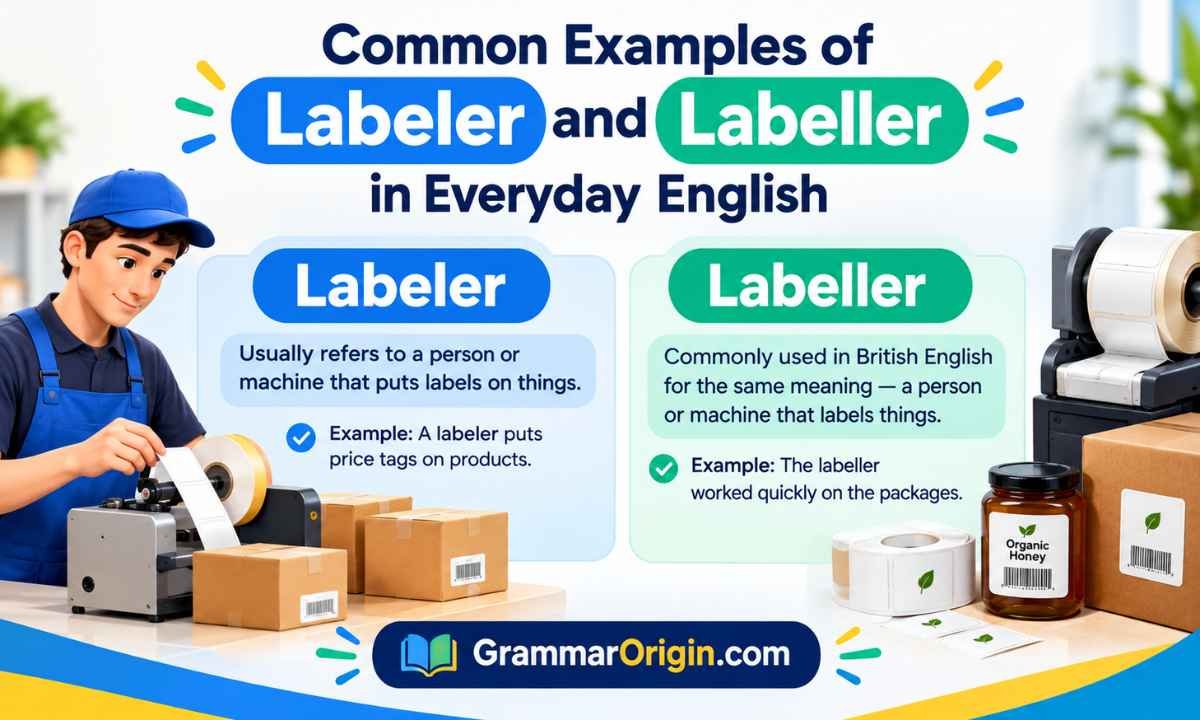
You’ll meet labeller or labeler in warehouses, clinics, offices and data teams. The sentences below show each spelling in use, followed by the related word forms that need to match.
Example: A US job ad might say “machine labeler wanted,” while a UK equipment manual says “clean the labeller weekly.”
Examples with “Labeler”
Use these sentences when labeller or labeler needs to read as American.
- The bakery’s new labeler prints allergen warnings on every loaf bag.
- Our clinic’s labeler prints patient IDs on test tubes.
- Marcus took a night job as a pallet labeler at the distribution center.
- The intern trained as a data labeler for a computer-vision project.
- We ordered extra labeler tape for the handheld labeler in the supply closet.
- A barcode labeler sits beside every packing table.
Examples with “Labeller”
Use these sentences when labeller or labeler needs to read as British.
- The brewery’s bottle labeller puts a batch number on each bottle before crating.
- Every automatic labeller in the plant is serviced on the first Monday of the month.
- Priya works as a labeller on a packing line outside Leeds.
- The shop’s price labeller stamps a new price on each tin.
- The council’s records team used a handheld labeller for archive boxes.
Related Word Forms
Every word related to labeller or labeler follows the same split. Labeling vs labelling and labeled vs labelled work like labeler vs labeller: American English uses one l, and British-style English uses two. If you pick one column, stay in that column.
| Form | American English | British English |
| Noun (person or machine) | labeler | labeller |
| Plural | labelers | labellers |
| Verb, -ing form | labeling | labelling |
| Past tense | labeled | labelled |
| Not labeled | unlabeled | unlabelled |
| Labeled wrongly | mislabeled | mislabelled |
| Labeled again | relabeled | relabelled |
Example: The US depot mislabeled one crate, and the UK depot mislabelled another.
The Grammar Rule Behind Labeller vs Labeler
The rule behind labeller or labeler is about the last l of a word. It applies when you add an ending such as -er, -ing or -ed. This is often called the double L rule, and it’s a type of consonant doubling rule.
British English doubles the l after a single vowel, whichever syllable is stressed. American English doubles it only when the last syllable is stressed. (The stressed syllable is the one you say loudest.)
Example: Adding -er to label gives labeller in Britain and labeler in America.
British English Pattern
In labeller or labeler terms, British spelling doubles the last l even when the final syllable is not stressed. That’s why labelled, cancelled, signalling and travelling all have two l’s.
| Base word | British forms |
| label | labeller, labelling, labelled |
| travel | traveller, travelling, travelled |
| cancel | cancelling, cancelled |
| model | modelling, modelled |
| signal | signalling, signalled |
Example: cancelled and labelled follow exactly the same pattern.
American English Pattern
For labeller or labeler in American English, the l stays single when the stress is early in the word. Say LAY-bel out loud. The stress is on LAY, so label plus -er stays labeler.
When the stress falls on the last syllable, Americans double the l too. Control becomes controlled, and expel becomes expelled.
Example: labeled and traveled stay single, but controlled doubles.
Exceptions Worth Knowing
A few words break the pattern that shapes labeller or labeler. Parallel keeps one l in both varieties, as in paralleled. Some words keep one l even in British English, such as appealed, devilish, loyalist and travelogue.
Some verbs differ at the base. British English writes enrol and fulfil but doubles the l before endings (enrolled, fulfilled). American English writes enroll and fulfill.
Example: paralleled is spelled the same in London and Los Angeles.
Remember This Simple Rule
For labeller or labeler, remember this: label plus an ending means one l in American English and two l’s in British-style English. Then check that the related words match.
Example: US set: labeler, labeling, labeled. UK set: labeller, labelling, labelled.
How to Pronounce Labeller and Labeler
In labeller or labeler, both spellings sound the same: LAY-buh-ler. The stress is on the first syllable. The extra l changes only the spelling, not the sound.
Merriam-Webster shows the ending as a soft “buh-ler,” so listeners can’t tell which spelling you typed.
Example: Say LAY-buh-ler whether you write labeler or labeller.
Real-World Case Study: How One Company Improved Content Consistency
The fix for labeller or labeler mix-ups is a style sheet for each region, with paired words side by side. The story below is made up to show the idea. It isn’t about a real named company, but the problem is common.
Imagine an online shop that sells barcode printers and shipping supplies to customers in the US and the UK. It uses one English website for both. Product titles say labeler, descriptions say labelling, and the UK category page mixes both in one paragraph.
The team writes two short style sheets, one for US English and one for UK English. Each has a list of paired words: labeler and labeller, labeling and labelling, labeled and labelled, unlabeled and unlabelled.
They fix page templates first, then product text, then meta descriptions and image alt text. Each visitor now sees a US page or a UK page with the matching spelling.
Before launch, they search the US pages for double-l words and the UK pages for single-l words. That catches the last mistakes.
Editors stop arguing about spelling case by case. The style sheet gives the answer, and new products follow it from day one.
Example: The US title reads “Handheld Labeler” with labeling in the text. The UK title reads “Handheld Labeller” with labelling in the text.
Language Usage Trends (2025–2026)
The labeller or labeler pattern has stayed the same: labeler leads in American writing, and labeller leads in British-style writing. The big change is that “data labeler” now appears often in US job ads.
Exact counts for this one word are hard to find, so treat the points below as signs, not hard numbers.
Example: A 2026 US job description lists “Data Labeler” as another name for a data annotator.
What Current Usage Shows
The signs for labeller or labeler point the same way across several sources.
- Dictionaries follow their home market. Merriam-Webster lists labeler first, and Collins lists labeller first. Cambridge Dictionary uses the double-l form labelling, with examples such as food labelling.
- AI hiring made “data labeler” and “data annotator” everyday words, and US job sites such as Indeed use the one-l spelling. RWS titles its service page “Data Labelling,” so the double-l form lives in the same industry.
- Many apps start in US English, so labeller may get a red line until you change the language. Grammarly lets you pick a dialect, such as American, Canadian, Australian or Indian.
- Canadian usage sits with the British rule. The Royal Military College of Canada’s spelling guide lists labelled next to traveller as normal.
Example: labeler in a Silicon Valley hiring post, and labelling on a UK vendor’s service page.
Labeler or Labeller Machine: Types, Terms and Product-Page Spelling
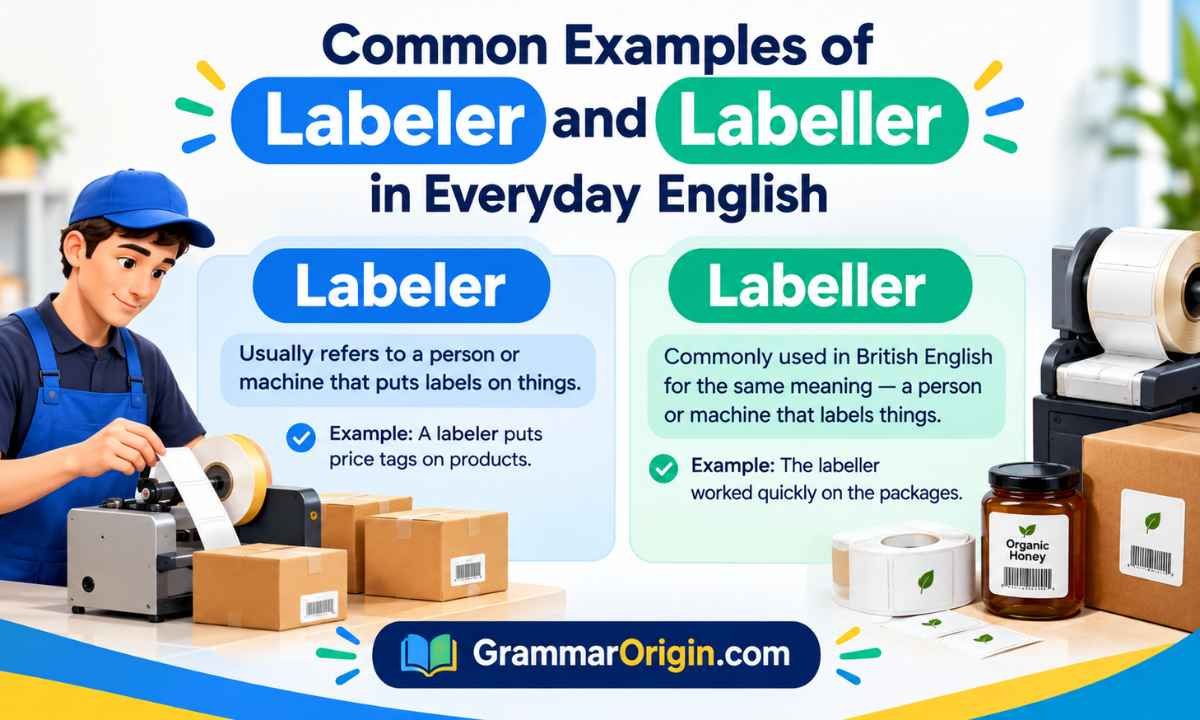
A labeler or labeller machine puts labels on products, packs or pallets. Use the spelling your market expects, but never change a brand name.
Example: A US catalog lists an automatic bottle labeler, and a UK catalog lists an automatic bottle labeller.
Common Types of Labeling Machines
Trade guides group every labeller or labeler machine by how it handles labels. Roll-fed labelers take labels from a long reel. Pre-cut label applicators, also called cut-and-stack labelers, use stacks of cut labels.
Stretch sleeve labelers put an elastic plastic sleeve around a container, with no glue or heat. Other equipment applies RFID or security labels. The print method matters too, because thermal transfer and direct thermal printing suit different needs for sharpness and durability.
Example: A roll-fed labeler pulls labels off a reel, and a stretch sleeve labeler wraps a sleeve around the container.
Labeler vs Label Applicator vs Label Dispenser
A label dispenser hands a ready-printed label to a person, who sticks it on by hand. A label applicator is part of an automatic line, and it sticks the label on for you.
In casual talk, people use labeller or labeler for both.
Example: A bench-top dispenser gives out one label at a time, but a conveyor labeller finishes every carton without an operator.
Spelling in Product Listings and Manuals
Follow your market’s version of labeller or labeler in titles, specs and support pages. Leave registered brand names exactly as they are.
Brand names show both forms. P.E. Labellers keeps the double l in its name and lists contacts in North America, Brazil and Europe. Easy Labeler uses one l.
People may search either way, so a short note like “labeler (also spelled labeller)” in a spec sheet can help.
Example: Write “Automatic Bottle Labeler” for a US page, but keep “P.E. Labellers” as printed when you name that company.
Also Read This Taught or Tought: The Correct Spelling Explained
Common Mistakes to Avoid
Most errors come from mixing regional spellings or trusting a spell checker’s default. These four mistakes show up often when people choose between labeller or labeler.
Example: “The labeler finished labelling the crates” mixes two spelling systems in one sentence.
Mixing British and American Spellings
Pick one side of labeller or labeler and use it for every related word. Mixing a US noun with a British verb looks careless, even if each word is correct on its own.
Wrong: The technician cleaned the labeller and relabeled the crates.
Right (US): The technician cleaned the labeler and relabeled the crates.
Right (UK): The technician cleaned the labeller and relabelled the crates.
Changing Spellings Mid-Article
Choose between labeller or labeler before you start, and keep it to the last line. That includes headings, image alt text and the meta description. A sudden switch looks like an editing slip.
Before you publish, search for “labell” to find every double-l word on the page.
Example: A heading says labeller, but the paragraph under it says labeler.
Ignoring Your Audience
Choosing labeller or labeler by your own habit, not your readers’ habit, is an easy slip. Neither spelling is wrong, but the wrong one can feel out of place.
Example: A Sydney distributor’s website that says labeler everywhere sounds like it was written for another country.
Trusting Auto-Correct Without Checking
On labeller or labeler, a spell checker follows its language setting, not your audience. So a correct spelling can still get a red line. Check the language before you accept any change.
Example: Word set to English (US) underlines labeller, even though it’s right for British readers.
How to Switch Your Spell-Check Language
- Microsoft Word: go to Review, then Language, then Set Proofing Language. Choose English (United Kingdom) or English (United States).
- Google Docs: open File, then Language. Pick the English version your readers use.
- Grammarly: open your settings and choose the English dialect that matches your audience.
Example: Switching to English (United Kingdom) removes the red line under labeller.
Step-by-Step Guide: How to Choose the Correct Spelling
To settle labeller or labeler, check four things: your audience, your style guide, your related words and your final draft. It only takes a few minutes.
Example: For a UK client, the finished set is labeller, labelling and labelled.
Step 1: Identify Your Audience
For labeller or labeler, find out where most of your readers live. Then use that country’s spelling. Your site analytics, your client’s location or your publication’s home market can tell you.
Example: A newsletter read mostly in Ontario should use labeller.
Step 2: Check Your Style Guide
If your team has a style guide, it decides labeller or labeler for you. US guides such as the Chicago Manual of Style and the AP Stylebook use American spelling. British guides such as the Oxford Style Manual use British spelling.
No guide? Follow your earlier published work.
Example: A guide that says “British spelling throughout” means labeller, every time.
Step 3: Keep Related Words Consistent
In labeller or labeler, match the noun to its other forms. Labeler goes with labeling and labeled. Labeller goes with labelling and labelled.
Example: labeler, labeling and labeled all belong to one system.
Step 4: Review Before Publishing
Search the finished draft for every form of labeller or labeler. Then check the language setting in your editor. Don’t forget headings, alt text and meta fields.
Example: In a US document, search for “labell.” Every match, such as labelled, needs a fix.
Expert Tips for Writers
Treat labeller or labeler as a choice you make once, then back it up with a short checklist.
- Write a one-line note at the top of your draft, such as “US English: labeler, labeling, labeled.”
- Leave brand names, book titles and direct quotes as they were first spelled.
- For a global audience, follow your biggest group of readers, or split pages by region.
- Keep a word list for pairs like labeller or labeler, traveler/traveller and canceled/cancelled.
- Do a final proofreading search for double-l words before you publish.
Example: A US packaging article that quotes a supplier should keep “Labellers” in P.E. Labellers, even if the rest of the piece uses labeler.
Mini Quiz: Labeller or Labeler
These 15 quick questions test what you know about labeller or labeler. The answer is under each question.
Example: Which would a Leeds warehouse write, labeler or labeller? Answer: labeller.
Quiz 1: Which Spelling Fits American English?
A Chicago warehouse is posting a job ad. Which title matches American spelling?
- A) Packaging Labeller
- B) Packaging Labeler
- C) Packaging Labler
Answer: B. American English uses a single l, so labeler is the fit.
Quiz 2: Fill in the Blank
A Manchester packaging firm just bought a new bottle ________. (British English)
Answer: labeller.
Quiz 3: True or False
Labeller is a misspelling of labeler.
Answer: False. It’s the standard British spelling of the same word.
Quiz 4: Choose the Correct Sentence
Which sentence is consistent British English?
- A) The labeler was labelling every jar.
- B) The labeller was labelling every jar.
Answer: B. Both the noun and the verb use the double l.
Quiz 5: Fill in the Blank
The US intern ________ every carton before lunch. (past tense, American English)
Answer: labeled.
Quiz 6: What Does It Mean?
On a machine-learning team, a data labeler is:
- A) Someone who tags data so models can learn from it
- B) A printer for shipping tags
- C) A file format for images
- D) A dictionary editor
Answer: A. A data labeler adds tags to raw data.
Quiz 7: Spot the Audience
A product page uses labelled, labelling and labeller throughout. Who is it probably written for?
- A) Readers in the United States
- B) Readers in the UK, Australia or New Zealand
- C) Nobody, because it’s full of typos
Answer: B. The double-l pattern signals British-style spelling.
Quiz 8: Fill in the Blank
She worked as a data ________ for an AI start-up in Austin. (American English)
Answer: labeler.
Quiz 9: True or False
A spell checker set to English (US) may underline labeller, even though it’s correct in British English.
Answer: True. The checker follows its language setting, not your audience.
Quiz 10: Which Pair Matches?
Which trio is fully consistent American spelling?
- A) labeler, labelling, labeled
- B) labeler, labeling, labeled
- C) labeller, labeling, labeled
Answer: B. labeler, labeling and labeled all use one l.
Quiz 11: Fill in the Blank
The team spent Friday ________ every crate for export. (British English, -ing form)
Answer: labelling.
Quiz 12: Quick Choice
Which spelling is standard in Canadian English?
- A) labeler
- B) labeller
Answer: B. Canadian English doubles the l in words like labelled and travelling, so labeller fits.
Quiz 13: Complete the Sentence
Our Denver office keeps a handheld ________ next to the printer. (American English)
Answer: labeler.
Quiz 14: Which Statement Is Correct?
- A) Labeler is only used in the US, and the UK never uses it.
- B) Labeler and labeller are one word with two regional spellings.
- C) Labeller means a person, and labeler means a machine.
Answer: B. The meaning is the same, and only the regional spelling differs.
Quiz 15: Fill in the Blank
Canadian English usually follows the ________ double-l pattern in words like labelled.
Answer: British.
Frequently Asked Questions
Is labeller or labeler the correct spelling?
Both are correct. Labeler is the standard spelling in American English. Labeller is the standard spelling in British English and in regions that follow British spelling. The meaning is the same.
Example: A US supplier’s site says labeler, and a UK supplier’s site says labeller.
Which should a global website use, labeller or labeler?
A global website should use the spelling its biggest audience expects, or it can show region-specific pages with the matching spelling. Either way, keep one spelling on each page.
Example: The US page uses labeler, and the UK page uses labeller.
Is a labeler the same as a label maker?
Not quite. A label maker is usually a small office or home device. A labeler can be a person, a small tool or an industrial machine.
Example: You’d say label maker for a desk gadget and labeler for a production-line machine.
Do labeling and labelling follow the same rule as labeler and labeller?
Yes. American English uses one l in labeler, labeling and labeled. British-style English uses two l’s in labeller, labelling and labelled.
Example: labeling in Chicago, and labelling in Cardiff.
What spelling does Canada use?
Canadian English usually doubles the l before an ending, so labelled and labeller are the standard choices. The Royal Military College of Canada’s spelling guide gives labelled as a normal case.
Example: A Toronto packaging firm would write labeller.
Why does my spell checker underline labeller?
Your editor is probably set to US English. Change the proofing language to English (UK), and the red line goes away.
Example: With the language set to United Kingdom, labeller passes without a flag.
Is labeler wrong in the UK?
No. British readers understand labeler, and Collins lists it as the US spelling of labeller. In British writing, though, labeller is the normal choice.
Example: A UK bakery’s manual should say labeller, not labeler.
Final Thoughts
Labeller or labeler comes down to your readers: labeler for the US, labeller for the UK and most other English-speaking countries. The meaning stays the same either way.
Pick one side of labeller or labeler, match labeling or labelling to it, and check your draft once before it goes out. Consistency is what readers notice. That’s the whole job.

Muhammad Waqas is an English language teacher and grammar expert with over 8 years of experience helping students and professionals improve their writing skills. He specializes in English grammar, vocabulary, communication, and practical language learning. Through GrammarOrigin, Waqas shares clear, easy-to-understand content that helps readers write and speak English with confidence.