
Both well deserved vs well-deserved are correct — the only thing that changes is where the phrase sits in your sentence. Use the hyphen when it comes right before a noun, and drop it when it follows a verb like is or was. That one placement rule clears up almost every mix-up writers run into.
This guide walks through exactly when to hyphenate, backs it up with real style-guide rules, and covers examples from workplace emails to sports headlines. By the end, that hyphen won’t slow you down again.
The Short Answer: Well Deserved or Well-Deserved?
Write well-deserved with a hyphen when it sits directly in front of a noun. Write well deserved with no hyphen when it follows a linking verb such as is, was, or seems.
That’s really the entire rule. Everything else in this article is just showing you how it plays out in real sentences.
Example: She got a well-deserved raise this year. Her raise was well deserved.
What Does “Well Deserved” Mean?
Well deserved means something was earned fairly, usually through effort, skill, or good conduct. It tells the reader that a result wasn’t luck — it was justified.
People reach for this phrase when praising an outcome rather than describing a person directly. It works after verbs like is, was, seems, and felt.
Dictionary Meaning
Dictionaries generally treat “deserved” as the past participle of deserve, paired with the adverb well to intensify the sense of fairness. Together, the phrase signals that a reward matches the effort behind it.
Example: After three years of overtime, the promotion felt entirely deserved.
What Does “Well-Deserved” Mean?
Well-deserved carries the same core meaning as its unhyphenated twin, but it works as a single descriptive unit placed before a noun. Grammatically, this is called a compound adjective.
The hyphen tells the reader that “well” and “deserved” are acting as one word, not two separate ones modifying the noun independently.
Example: He finally took a well-deserved vacation after the product launch.
The Grammar Rule Behind the Hyphen
Hyphens in English exist to prevent confusion, and compound adjectives are where they matter most. When two words team up to describe a noun that follows them, English usually links them with a hyphen.
Once the same words move to a different spot in the sentence — after the noun, following a verb — that partnership breaks, and the hyphen becomes unnecessary.
Formula to Remember
Before noun → hyphen. After verb → no hyphen. That’s the whole formula, and it applies whether the sentence is about an award, a nap, or a football trophy.
Example: A well-deserved trophy sat on the shelf. The trophy was well deserved.
When to Use “Well-Deserved”
Use the hyphenated form whenever the phrase sits immediately before the noun it’s describing. Think of it as glue holding “well” and “deserved” together so they read as a single adjective.
This is the form you’ll see most in headlines, formal writing, and anywhere a noun follows right after.
Examples
- A well-deserved bonus landed in her account on Friday.
- They celebrated a well-deserved championship win.
- He earned a well-deserved reputation for reliability.
Why the Hyphen Matters
Without the hyphen, a reader’s eye can stumble, briefly unsure whether “well” is modifying “deserved” or something else entirely. The hyphen removes that half-second of hesitation.
In professional documents especially, a missing hyphen here can look like a typo rather than a stylistic choice, which chips away at credibility.
Also Read This Authorized or Authorised: Which Spelling Is Correct?
When to Use “Well Deserved”

Drop the hyphen once the phrase moves after the noun it describes, typically following a linking verb. In this position, “well deserved” functions as a predicate adjective rather than a compound modifier.
Example: Her medal was well deserved after four years of training.
Examples
- The applause was well deserved.
- Their victory felt well deserved after such a long season.
- His rest was well deserved following the move.
Why This Rule Exists
Predicate adjectives don’t need a hyphen because there’s no noun directly beside them to create ambiguity. The verb already separates the two words clearly enough that a hyphen would be redundant.
English generally avoids extra punctuation once clarity is already built into the sentence structure.
Side-by-Side Comparison of Well Deserved vs Well-Deserved
| Feature | Well Deserved | Well-Deserved |
| Position | After a linking verb | Before a noun |
| Hyphen | Not used | Required |
| Grammatical role | Predicate adjective | Compound adjective |
| Example | The award was well deserved. | She won a well-deserved award. |
Examples From Everyday Writing
Seeing the rule applied across different settings makes it stick faster than any explanation alone.
Workplace Examples
Example: The team received a well-deserved bonus after hitting every quarterly target.
Sports Examples
Example: The striker’s hat-trick earned him a well-deserved spot on the podium.
Education Examples
Example: Her scholarship was well deserved given four years of straight A’s.
Personal Life Examples
Example: After moving apartments alone, he treated himself to a well-deserved dinner out.
Well Deserved vs Well-Deserved Common Mistakes People Make
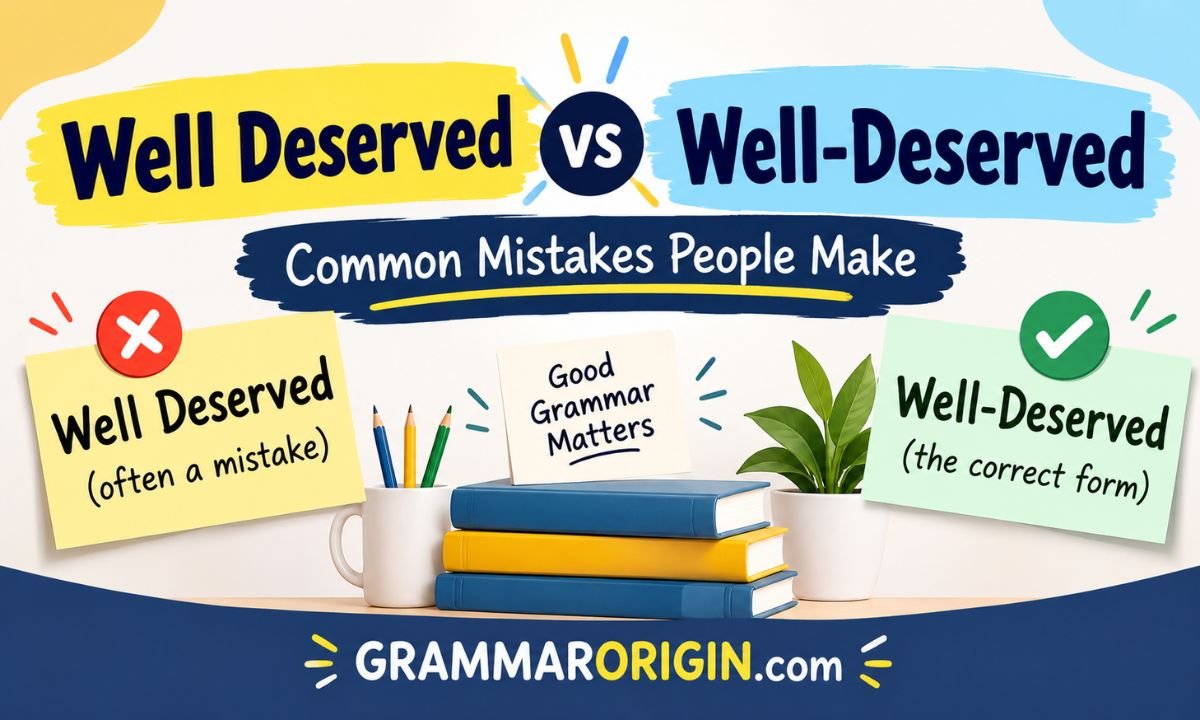
Even confident writers slip on this one, usually in one of three predictable ways.
Forgetting the Hyphen Before a Noun
Writing “a well deserved award” without the hyphen is the single most common error. Readers can usually still follow the meaning, but it reads as slightly careless in formal contexts.
Adding a Hyphen Everywhere
The opposite mistake shows up just as often — hyphenating even after a verb, as in “the award was well-deserved.” It’s not technically wrong to some style guides, but most modern guides prefer it open here.
Assuming One Form Is Always Correct
Some writers pick one version and stick with it regardless of position, which trips up the sentence half the time. Position decides the form — not personal preference.
A Quick Memory Trick
Picture the hyphen as a bridge that only exists when the noun is standing right there waiting to be crossed. No noun close by, no bridge needed.
Example: A well-deserved promotion (bridge to “promotion”) versus The promotion was well deserved (no bridge needed).
Case Study: Why Professional Editors Prefer Hyphenation
Copyeditors at major newsrooms treat compound-adjective hyphens as a readability tool, not decoration. When a headline reads “well deserved victory” instead of “well-deserved victory,” a reader’s eye briefly treats “well” and “victory” as unrelated before backtracking.
That tiny stumble adds up across thousands of readers, which is exactly why style guides insist on the hyphen before a noun rather than leaving it optional.
What Major Style Guides Say
Different guides agree on the core rule, though they emphasize different edge cases.
Associated Press Stylebook (AP Style)
AP style follows the standard before-noun/after-verb split, and this shows up constantly in headline writing, where space is tight and clarity still has to hold. A headline like “Well-Deserved Win for Local Team” keeps the compound adjective intact even in title case.
Chicago Manual of Style
Chicago treats this as a textbook case of a temporary compound modifier, hyphenated only when it precedes the noun it modifies. After a verb, Chicago drops the hyphen just like AP does.
Merriam-Webster
Merriam-Webster lists “well-deserved” as a standalone hyphenated adjective entry, reinforcing that the compound form is recognized as its own dictionary word when used attributively.
Similar Expressions That Follow the Same Rule
This isn’t a one-off rule invented for this phrase — plenty of adverb-plus-participle combinations behave identically.
- A well-known author. The author is well known.
- A well-written essay. The essay was well written.
- A hard-earned victory. The victory was hard earned.
- A long-awaited reunion. The reunion was long awaited.
Why Writers Get Confused
If the rule is this simple, why does the mistake keep showing up? A few reasons explain most of the confusion.
Search Engines Show Both Versions
Type either form into Google and you’ll get results for both, because both are genuinely correct in different contexts. That mixed signal makes writers assume the hyphen is optional everywhere.
Grammar Rules Change Over Time
Hyphenation conventions have loosened generally across English over the past few decades, and some once-mandatory hyphens have faded from common compounds. That broader trend bleeds into how confident people feel about this one.
Informal Writing Ignores Rules
Texts, social captions, and quick comments rarely bother with hyphens at all. Readers absorb that casual pattern and carry it into more formal writing without noticing.
Also Read This 31st or 31th: Which One Is Correct?
Examples in Professional Writing
Formal contexts tend to enforce the rule more strictly than casual writing does.
Business
Example: The board approved a well-deserved severance package for the retiring director.
Journalism
Example: Reporters called it a well-deserved resignation after months of scandal.
Sports
Example: Commentators praised the well-deserved red card following the tackle.
Education
Example: The professor called the award well deserved during the ceremony speech.
Mini Grammar Exercise
Fill in each blank with well deserved or well-deserved.
- She accepted a _______ award on stage.
- His recognition was _______ after the merger closed.
- They took a _______ break after finals week.
- The praise felt _______ given her effort.
Answers
- well-deserved (before the noun “award”)
- well deserved (after the verb “was”)
- well-deserved (before the noun “break”)
- well deserved (after the verb “felt”)
Frequently Asked Questions
Is it “well deserved” or “well-deserved”?
Both are correct, and the choice depends entirely on sentence position. Hyphenate before a noun; leave it open after a verb.
What’s the difference between well deserved and much deserved?
Well deserved emphasizes fairness and justification, while much deserved leans slightly more toward the size or intensity of the reward. In practice, they’re near-interchangeable, though “well deserved” is far more common in modern writing.
How do you use “well-deserved” in a sentence?
Place it directly before the noun it describes, as in: “They enjoyed a well-deserved holiday after a brutal quarter.” The hyphen keeps the compound adjective intact.
Is “well deserved win” correct?
Only in casual speech or when following a verb elsewhere in the sentence. As a noun phrase on its own, it should read “well-deserved win” with the hyphen, since “win” is the noun being modified.
Is “well deserved” one word or two words?
It’s always two words, whether hyphenated or not — the hyphen connects them without merging them into a single word.
Can you say “very well-deserved”?
Yes, adding “very” for emphasis is grammatically fine and common in both speech and writing. The hyphenation rule stays exactly the same: hyphenate before a noun, drop it after a verb.
Final Thoughts
The hyphen in well-deserved isn’t random punctuation — it’s doing real work, signaling that the phrase is acting as one compound adjective right before a noun. Drop the noun, and the hyphen goes with it.
Once that single positional rule clicks, there’s nothing left to memorize. Every example in this guide, from workplace bonuses to championship trophies, follows the exact same pattern.

Muhammad Waqas is an English language teacher and grammar expert with over 8 years of experience helping students and professionals improve their writing skills. He specializes in English grammar, vocabulary, communication, and practical language learning. Through GrammarOrigin, Waqas shares clear, easy-to-understand content that helps readers write and speak English with confidence.