
If you’ve ever paused mid-sentence wondering whether to type “authorized” or “authorised,” you’re not alone. This tiny spelling gap trips up writers, students, and even editors every single day.
The good news? Both spellings are correct, and you just need to know which one fits your reader. This guide breaks down the authorized or authorised debate with real examples, history, and a simple rule you’ll never forget.
Authorized
Authorized (spelled with a “z”) is the American English version, common across the US, Canada, and most North American businesses.
Open any US government form, tech policy, or corporate memo, and this is the spelling staring back at you.
Example: “The manager authorized the refund after reviewing the receipt.”
Authorised
Authorised (spelled with an “s”) belongs to British English, standard across the UK, Australia, New Zealand, and much of the Commonwealth.
Newspapers, government documents, and legal contracts in these regions almost always use this form.
Example: “Only authorised staff are permitted beyond this point.”
Authorized or Authorised: Quick Answer
Short on time? Here’s the answer in one glance.
| Question | Answer |
| Is one spelling wrong? | No, both are correct |
| American English uses | Authorized |
| British/Commonwealth English uses | Authorised |
| Same meaning? | Yes, identical |
| Older spelling | The “z” form |
Pick based on your audience, not on which one “looks right” to you.
The Origin of Authorized or Authorised
The word didn’t start as a spelling fight. It started as one single form. Both versions trace back to the Latin auctorizare, meaning “to grant authority.”
For hundreds of years, English writers on both sides of the Atlantic used the “-ize” ending without a second thought. Shakespeare himself used the word “unauthorized” in Othello.
Things shifted in the 1800s when American lexicographer Noah Webster set out to simplify American spelling. He locked in “-ize” endings for words like organize, realize, and authorize, and America followed his lead. Merriam-Webster still lists this “-ize” form as the American standard today.
Britain, meanwhile, drifted the other way. French spelling habits and changing British style trends pushed publishers toward “-ise” instead. By the 1900s, the “s” spelling had become the default across the UK.
Example: A 1920s British newspaper clipping would almost always print “authorised,” while an American paper from the same decade would print “authorized.”
British English vs American English Spelling
This isn’t a one-word quirk. It’s part of a much bigger spelling pattern that runs across dozens of English verbs.
Main Rule
American English leans on “-ize”. British English leans on “-ise”. That’s the whole rule, and it applies well beyond just this one word.
Once this clicks, you can predict the spelling of similar words without looking them up.
Examples
| American (-ize) | British (-ise) |
| Authorized | Authorised |
| Organize | Organise |
| Recognize | Recognise |
| Realize | Realise |
| Customize | Customise |
Example: An American IT policy reads “recognize authorized devices,” while a UK version of the same policy reads “recognise authorised devices.”
Comparison Table
Here’s how the two spellings stack up side by side.
| Feature | Authorized | Authorised |
| Spelling pattern | -ize | -ise |
| Common regions | USA, Canada | UK, Australia, NZ |
| Formality level | Standard | Standard |
| Legal use | US law and contracts | UK/Commonwealth law |
| Meaning | Officially permitted | Officially permitted |
Neither version carries more weight or professionalism than the other. The split is purely regional.
Authorized or Authorised by Style Guide
Most style guides don’t invent a new rule here. They simply follow regional convention.
AP Style and APA both default to American spelling, so they’ll always print the “z” version. The Oxford Style Guide, despite being British, actually recommends “-ize” too, which surprises a lot of writers. Gov.uk content guidelines, on the other hand, require the “s” form for all UK government pages.
Example: A UK government website copywriter following Gov.uk guidelines would write “authorised personnel only,” even though Oxford’s own style guide would technically prefer the “z” version.
How To Use “Authorised” In A Sentence
Whichever spelling you pick, the word behaves the same way grammatically, working as a verb or an adjective.
As a past-tense verb, you’d write: “The board authorised the new budget on Tuesday.” As an adjective, it looks like: “She’s an authorised repair technician for the brand.”
Example: “The document has been authorised by two senior partners before release.”
Once you settle on a spelling, stick with it through the entire piece. Switching mid-document is the fastest way to look careless.
Also Read This Congratulations or Congradulations? The Correct Spelling Explained
Synonyms and Opposites
Repeating the same word five times in one paragraph gets tiring fast, so it helps to know a few swaps.
Common synonyms include approved, permitted, sanctioned, licensed, and accredited. On the flip side, opposites include unauthorized, forbidden, and prohibited.
Authorized or Authorised Synonym
Example: “An accredited seller of the brand” works as a natural swap for “authorised dealer.”
Which Spelling Should You Use?
The choice really comes down to one question: who’s reading this?
Writing for a US audience, an American company, or anything following APA or Chicago style? Go with the “z” form. Writing for the UK, Australia, or a Commonwealth-based organization? The “s” form is your pick.
If your audience is genuinely global with no regional lean, either works. Just don’t flip-flop between the two in the same document.
Example: A SaaS company selling only in the US would use “authorized user” throughout its terms of service, even if a few UK customers sign up.
Common Mistakes with Authorized or Authorised
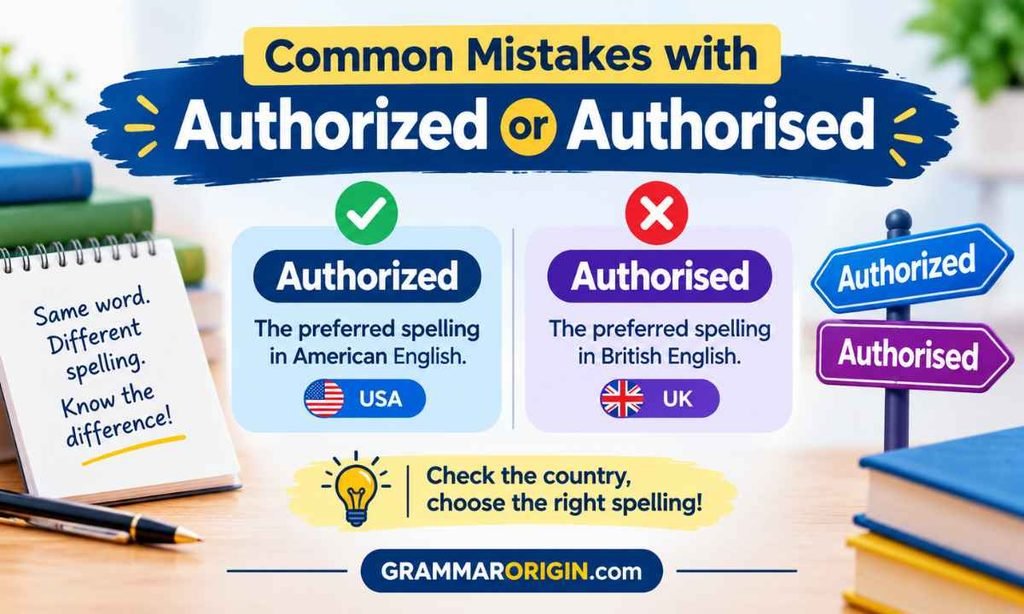
The biggest slip-up writers make is mixing both spellings in a single piece of content. One paragraph says “authorized,” the next says “authorised.” It reads as sloppy, even if each version is technically correct on its own.
A second common error is assuming one spelling is more formal or more “correct” than the other. It isn’t. Formality comes from tone and context, not from a letter choice.
Example: A contract that opens with “the authorized signatory” but later refers to “authorised access” would confuse a proofreader and signal an inconsistent editing pass.
Also Read This 31st or 31th: Which One Is Correct?
Authorized or Authorised in Everyday Examples
Seeing the word in real contexts makes the regional split easier to remember.
In tech: “Your device isn’t authorized to connect to this network” (US) versus “Only authorised accounts can initiate a transfer” (UK). In publishing: “An authorized biography” (US) versus “An authorised biography” (UK), same meaning, different spelling entirely.
Authorized or Authorised Example
Example: “Congress authorized emergency relief funds” reflects US legislative language, while “The minister authorised the new policy” reflects UK government language.
Authorized or Authorised in Software, Apps & Legal Documents
Spelling choice matters more than people think in software and legal writing, because consistency affects both user trust and search visibility.
A US-based SaaS platform will hardcode the “z” spelling into its login flows, error messages, and terms of service. A UK fintech app, by contrast, uses the “s” form throughout its compliance pages, especially since UK financial regulators like the FCA use that spelling in official documentation.
Example: A banking app built for UK users displays “Authorised Payment” on transaction confirmations, matching FCA regulatory language.
Mixing spellings across a product’s UI (one screen shows one form, another shows the other) creates a jarring, unpolished experience for users.
Authorized or Authorised: Google Trends & Usage Data
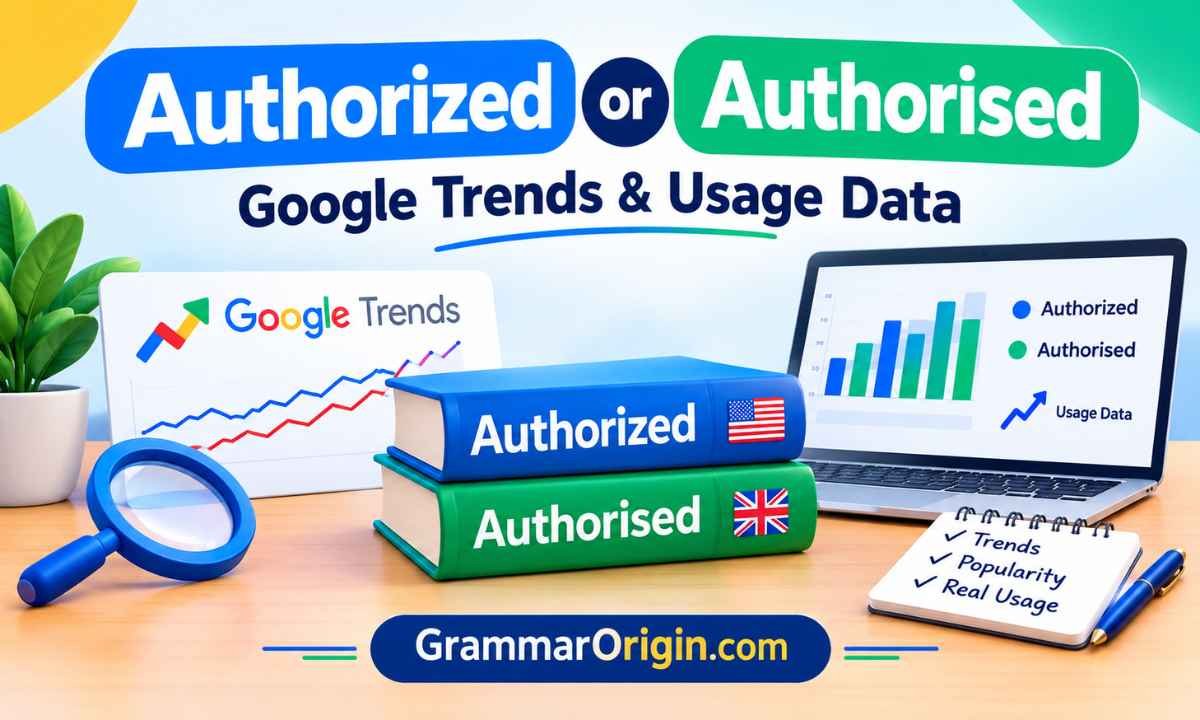
Search and usage data confirm the regional pattern is very real, not just a style preference.
Independent usage-tracking data from Sapling AI shows a clear split: the American form holds a 99% preference in the US and 94% in Canada, while the British form leads 77% in the UK, 83% in Australia, and 73% in New Zealand. India shows a mixed pattern, with the British form ahead but not dominant.
Grammarist’s analysis of published news content adds another data point: British news publications use “authorise” roughly seven times more often than “authorize,” with an even wider gap in Australian and New Zealand press.
Example: A UK-based news outlet like the BBC would almost never print the “z” version, reflecting this near-total regional preference.
Keyword Comparison Table
A single reference table to keep both forms straight across all contexts.
| Term | Region | Typical Use |
| Authorized | USA, Canada | Tech, business, government |
| Authorised | UK, Australia, NZ | Law, finance, publishing |
| Authorization | USA, Canada | Formal noun form |
| Authorisation | UK, Australia | Formal noun form |
| Authorizing / Authorising | Both | Present-participle verb form |
Which Spelling Do International Organizations Use?
Global bodies tend to pick one house style and apply it consistently, regardless of where individual staff are based.
The United Nations generally favors British spelling conventions across its official documents, so the “s” form appears more frequently in UN publications. The World Health Organization follows a similar pattern, while many US-headquartered international bodies, like the World Bank, lean toward the “z” version.
Example: A UN resolution document is more likely to read “authorised by the Security Council” than “authorized by the Security Council.”
Frequently Asked Questions
Is “authorized” or “authorised” the correct spelling?
Both are correct. One is standard American English, and the other is standard British English. The meaning never changes.
Which spelling does the Oxford Dictionary actually prefer?
Oxford lists the “z” version as its primary spelling, which surprises many people given its British roots.
Can Americans use the British spelling without it being wrong?
Yes, technically, but it will read as unusual or foreign to a US audience used to seeing the “z” form everywhere.
Does choosing one spelling change the meaning of the word?
No. Both versions mean exactly the same thing: official permission or approval.
What about “authorization” versus “authorisation”?
The same regional rule applies here. One is American, the other is British, and both carry identical meaning.
Is one spelling considered more formal than the other?
Not at all. Formality depends on tone and context, not on whether you use a “z” or an “s.”
Which spelling should I use for a global website with no specific region?
Pick one and stay consistent throughout the site. The American form tends to reach a slightly wider global audience simply due to US internet volume, but the British form works equally well for international content.
Final thoughts
The authorized or authorised debate isn’t really a debate at all. It’s a regional preference, and both spellings are fully correct.
Match your spelling to your audience, keep it consistent across your entire document, and you’ll never second-guess this word again.

Muhammad Waqas is an English language teacher and grammar expert with over 8 years of experience helping students and professionals improve their writing skills. He specializes in English grammar, vocabulary, communication, and practical language learning. Through GrammarOrigin, Waqas shares clear, easy-to-understand content that helps readers write and speak English with confidence.