
Typed “comprable” and had a nagging feeling something was off? You’re right to pause. Between comparable vs comprable, only one spelling actually exists in English.
The short answer: comparable is correct, and “comprable” is a misspelling that shows up when a letter gets dropped while typing fast. This guide breaks down the meaning, the pronunciation, and exactly when to use the word with confidence.
The Quick Answer: Comparable or Comprable?
Comparable is the only correct spelling. “Comprable” isn’t recognized by any major dictionary and should never appear in your writing.
Correct Examples
- These two laptops are comparable in performance.
- Her salary is comparable to what other managers earn.
Incorrect Examples
- These two laptops are comprable in performance.
- Her salary is comprable to what other managers earn.
Example: Swapping “comparable” for “comprable” in either sentence instantly makes it look like a typo.
Is “Comprable” a Real Word?
No, “comprable” isn’t a real English word. It has no dictionary entry, no defined meaning, and no accepted use in formal or casual writing.
Why Does It Look Correct?
It looks plausible because it’s just one letter short of “comparable,” and the missing “a” is easy to miss when reading quickly. Familiarity with the real word tricks the eye into accepting the fake one.
Example: Someone skimming a report might read past “comprable” without noticing anything wrong.
What Does Comparable Mean?
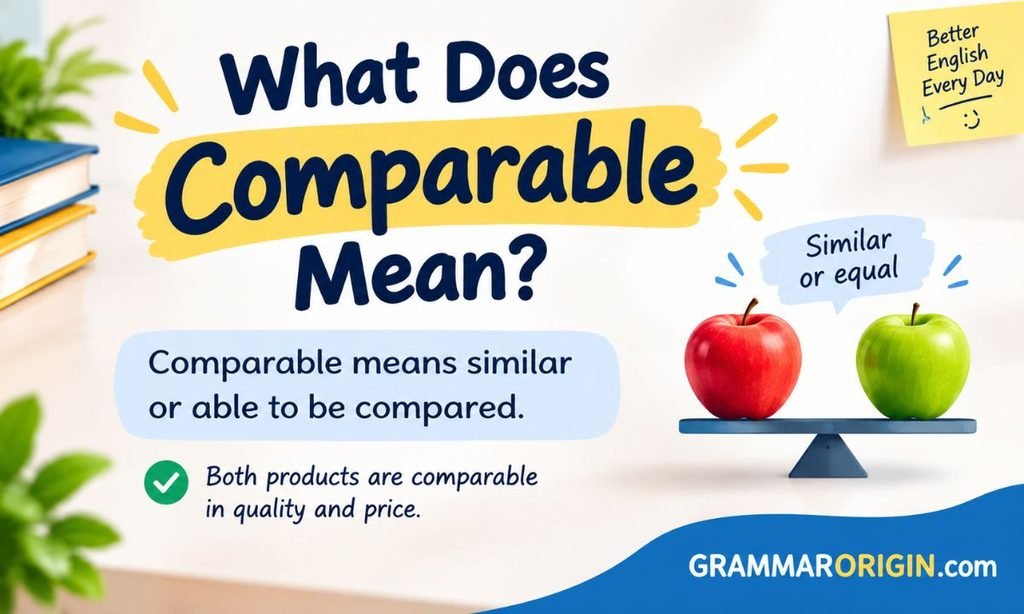
“Comparable” describes two or more things that share enough traits to be measured against each other. It’s used constantly in business, science, and everyday conversation.
Simple Definition
If two things are comparable, they’re similar enough that comparing them actually makes sense.
Examples
- The two job offers were comparable in pay and benefits.
- Sales this quarter were comparable to last year’s numbers.
Example: Saying two houses are comparable means they’re close enough in size, condition, or price to be judged side by side.
The Origin of the Word Comparable
“Comparable” traces back to the Latin word comparabilis, built from comparare, meaning “to compare.” It entered English through Old French during the late Middle Ages.
The word has kept its core meaning for centuries: describing things worth setting side by side. That stability is part of why the spelling has never shifted toward “comprable.”
Example: The Latin root also gives us “comparative” and “comparison,” both of which keep the same “compar-” spelling pattern.
Also Read This Skis or Skiis: Which Spelling Is Correct?
Why People Misspell Comparable as Comprable
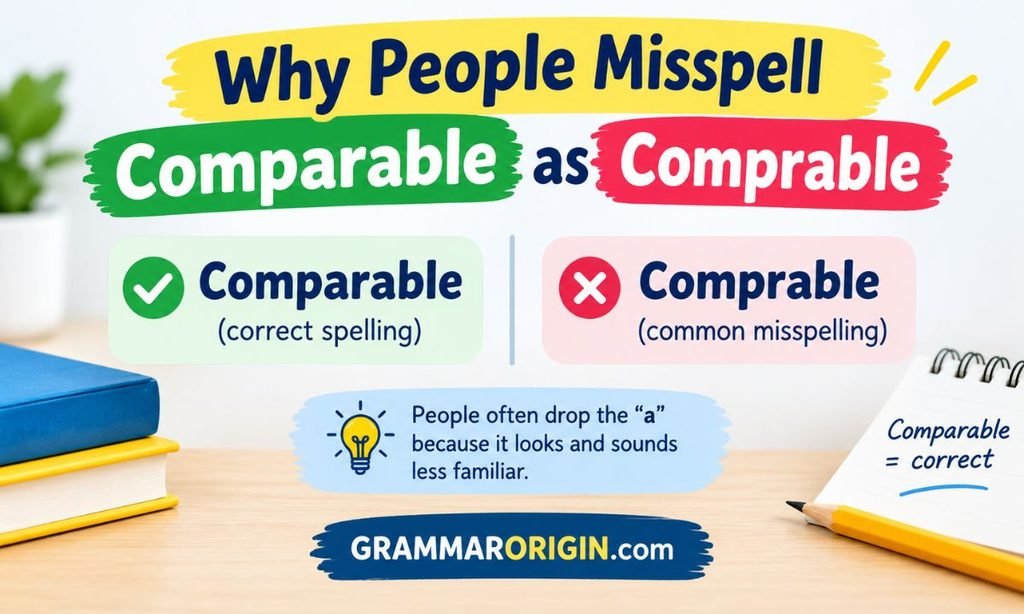
Most misspellings here come down to speed, not a real misunderstanding of the word. A few habits explain almost every case.
Fast Pronunciation
When people say “comparable” quickly, the middle “a” sound gets swallowed, which can trick writers into typing what they hear instead of what’s actually spelled out.
Example: Saying the word fast sounds close to “com-pruh-ble,” nudging some writers toward “comprable.”
Typing Too Quickly
Rushed typing drops letters more often than people realize, and a middle vowel is one of the easiest letters to skip without noticing.
Example: Typing “comparable” fast on a phone keyboard can easily produce “comprable” by accident.
Autocorrect Errors
Some autocorrect tools fail to catch “comprable” because it’s close enough to a real word that the spell-checker doesn’t always flag it.
Example: A document might pass a quick spell-check with “comprable” still sitting in the text, unflagged.
Influence of Accents
Certain accents naturally compress the middle syllables of longer words, which can carry over into spelling for non-native and native speakers alike.
Example: A speaker who naturally shortens “comparable” in speech may unconsciously shorten it in writing too.
How to Pronounce Comparable Correctly
“Comparable” is pronounced KOM-per-uh-bul, with the stress on the first syllable, not the second.
American English
In American English, it’s pronounced /ˈkɑːmpərəbəl/, with a flat “a” sound at the start.
Example: Say “COM-pruh-ble,” stressing the first part, the way most American speakers do.
British English
British English pronounces it /kəmˈpærəbəl/, occasionally shifting the stress slightly, though the spelling stays identical either way.
Example: A British speaker might say “com-PAIR-uh-bul” in casual conversation, but writes it exactly the same way.
Easy Pronunciation Trick
Break the word into three chunks: “COM-pruh-ble.” Saying it slowly in pieces makes the correct spelling easier to remember too.
Example: Repeating “COM-pruh-ble” a few times out loud helps the spelling stick alongside the sound.
How to Use Comparable in a Sentence
“Comparable” fits naturally into almost any context where you’re measuring two things against each other.
Business Examples
“Their revenue growth is comparable to their closest competitor’s.”
Academic Examples
“The study used a comparable sample size to earlier research.”
Everyday Examples
“This restaurant’s prices are comparable to the one down the street.”
Negative Sentences
“The two results aren’t comparable because the testing conditions were different.”
Example: Adding “not” before “comparable” is the simplest way to signal that two things shouldn’t be measured against each other.
Also Read This Other Than or Other Then: Which One Is Correct?
Comparable vs. Similar: Are They the Same?
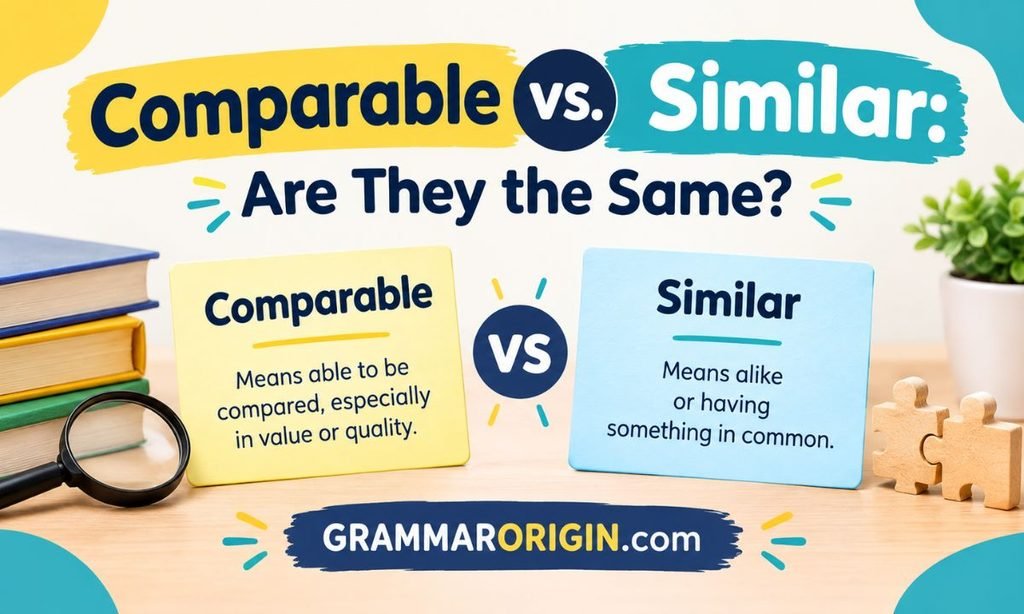
Not quite. “Comparable” suggests things can be measured against each other in a specific way, while “similar” is a broader, looser word for general likeness.
Example
Two houses might be similar in style but only truly comparable once you factor in price, size, and location together.
Comparable vs. Compare
“Compare” is the verb, and “comparable” is the adjective built from it. You compare two things, and if they hold up well against each other, they’re comparable.
Examples
“Let’s compare the two proposals” uses the verb, while “the two proposals are comparable” uses the adjective form.
Industries That Frequently Use the Word Comparable
Several industries lean on “comparable” as a working, technical term rather than just casual vocabulary.
Real Estate
Agents use “comparables,” often shortened to “comps,” to price a property based on similar recent sales nearby.
Example Table
| Property | Size | Recent Sale Price |
| House A | 1,800 sq ft | $310,000 |
| House B (comp) | 1,750 sq ft | $305,000 |
Finance
Analysts compare comparable companies, often called “comps,” to judge whether a stock looks fairly priced.
Example: “We valued the startup using comparable companies in the same industry.”
E-Commerce
Online retailers highlight comparable products to help shoppers weigh similar items before buying.
Example: A shopping site might show “comparable items” under a product that’s out of stock.
Scientific Research
Researchers need comparable conditions across experiments so their results can be trusted and repeated.
Example: “The two trials used comparable dosages to keep the results valid.”
Common Phrases That Use Comparable
Certain set phrases pop up again and again across different fields.
Business
“Comparable market value” shows up constantly in pricing and valuation discussions.
Real Estate
“Comparable sales” is the standard term agents and appraisers rely on.
Education
“Comparable test scores” gets used when schools measure student performance across groups.
Healthcare
“Comparable treatment outcomes” appears often in medical studies and patient reports.
Examples of Comparable in Everyday Conversation
You’ll hear this word constantly outside of formal writing too.
Workplace
“My workload this month is comparable to last month’s.”
Shopping
“This brand’s quality is comparable to the pricier one.”
Education
“Her grades are comparable to her older sibling’s at that age.”
Sports
“The two teams’ records are comparable heading into the playoffs.”
Common Mistakes People Make with Comparable
A few slip-ups show up again and again with this word, beyond just the spelling itself.
Using “Comprable”
This remains the single most common mistake, almost always caused by rushed typing rather than confusion about meaning.
Example: “The prices are comprable” should always read “The prices are comparable.”
Using Comparable Instead of Similar
Some writers use “comparable” when they simply mean “similar,” which can make a sentence sound more technical than intended.
Example: “Their taste in music is similar” reads more naturally than “their taste in music is comparable.”
Comparing Things That Cannot Be Compared
Calling two very different things “comparable” without a shared basis for comparison weakens the sentence’s meaning.
Example: Saying “a car is comparable to a sandwich” doesn’t work because there’s no real basis for comparison.
A Simple Trick to Remember the Correct Spelling
Think of the word “compare” hiding inside “comparable.” If you can spell “compare,” just add “-able” and you’re done.
Example: “Compare” plus “-able” gives you comparable, once you drop the silent “e” at the end of “compare.”
Memory Techniques That Actually Work
A few small tricks make the correct spelling automatic instead of something you second-guess every time.
Method One: Word Family
Group “comparable” with “comparison,” “comparative,” and “comparability.” All four keep the same “compar-” root, which anchors the spelling in your memory.
Method Two: Visual Reminder
Picture the word split as “COMPAR-able,” with the base word “compare” highlighted in your mind before the “-able” ending.
Method Three: Read It Aloud
Say the full word slowly, syllable by syllable, rather than the rushed version you’d use in casual speech. Slowing down helps your brain register every letter.
Comparable Synonyms
Words like similar, equivalent, corresponding, and analogous can often stand in for “comparable,” depending on the sentence.
Example
“The two designs are equivalent in quality” works as a natural substitute for “comparable” in a review or report.
Comparable Antonyms
The opposite of “comparable” is “incomparable,” meaning something so different or extreme that no real comparison is possible.
Example
“Her talent is incomparable” means there’s genuinely nothing else quite like it.
Comparable in Business Writing
Business writing leans on “comparable” constantly, especially in reports, proposals, and pricing discussions.
Correct Usage
Use “comparable” when you’re pointing to a measurable similarity, such as revenue, pricing, or performance.
Example Email Sentence
“Our Q3 numbers are comparable to Q2, with only a small dip in overall sales.”
Comparable in Academic Writing
Academic writing uses “comparable” to describe studies, samples, or conditions that can be fairly measured against each other.
Example
“The researchers selected a comparable control group to strengthen the study’s results.”
Case Study: Why One Missing Letter Matters
A single dropped letter can quietly undercut a piece of writing’s credibility, especially in professional or academic settings.
A business report that repeatedly uses “comprable” instead of comparable can make readers question the writer’s attention to detail, even if the actual data is solid. Consistent, correct spelling protects the polish of the whole document.
Example: A real estate listing that says “comprable properties” instead of “comparable properties” risks looking careless to potential buyers.
Other Commonly Misspelled English Words
“Comparable” isn’t alone. Words like “definitely” (often misspelled “definately”), “separate” (“seperate”), and “accommodate” (“accomodate”) trip up writers for similar reasons.
Example: Just like “comprable,” these errors usually come from typing speed rather than a real misunderstanding of the word.
Quick Reference Guide
| Question | Answer |
| Correct spelling | Comparable |
| Is “comprable” a word | No |
| US vs UK difference | None |
| Common cause of error | Fast typing, dropped letter |
| Word family | Compare, comparison, comparative |
Comparable vs comprable oxford dictionary
The Oxford Dictionary lists only comparable as a valid entry. “Comprable” doesn’t appear at all, which confirms it’s not a recognized spelling variant anywhere.
Example: Searching “comprable” in an Oxford-powered dictionary tool typically redirects straight to the “comparable” entry.
Comparable synonym
If you’re looking for a quick substitute, “similar,” “equivalent,” and “on par with” all work well in place of comparable.
Example: “The two offers are on par with each other” reads naturally as an alternative to saying they’re comparable.
Frequently Asked Questions
Is comprable a correct spelling?
No. “Comprable” isn’t recognized in any major dictionary. The correct spelling is always comparable.
Why do people write comprable instead of comparable?
It usually happens from typing too fast or from how the word sounds when spoken quickly, causing writers to drop the middle “a.”
Does British English spell it differently than American English?
No. Both British and American English use the exact same spelling: comparable.
What’s the difference between comparable and similar?
“Comparable” implies things can be measured against each other in a specific way, while “similar” is a broader term for general likeness.
What is the opposite of comparable?
The opposite is “incomparable,” used to describe something so unique or extreme that no fair comparison exists.
How do you pronounce comparable correctly?
It’s pronounced KOM-per-uh-bul, with the stress on the first syllable rather than the second.
Is comparable used differently in real estate?
Yes. In real estate, “comparables” (or “comps”) refers to similar recently sold properties used to estimate a home’s market value.
Final Thoughts
The rule is simple: comparable is always correct, and “comprable” is a typing error, not a real alternative. The word traces back to “compare,” and remembering that connection makes the correct spelling easy to lock in for good.
Whether you’re writing a business report, a school paper, or a quick email, sticking with comparable keeps your writing accurate and professional every time.

Muhammad Waqas is an English language teacher and grammar expert with over 8 years of experience helping students and professionals improve their writing skills. He specializes in English grammar, vocabulary, communication, and practical language learning. Through GrammarOrigin, Waqas shares clear, easy-to-understand content that helps readers write and speak English with confidence.