
You’ve typed a sentence, paused at “other than” or “other then,” and genuinely weren’t sure which one belonged there. That hesitation is common, and it usually comes down to one letter that changes everything.
Other than is the correct phrase. “Other then” isn’t standard English, and once you know why, you won’t second-guess it again.
What Is the Correct Phrase: Other Than or Other Then?
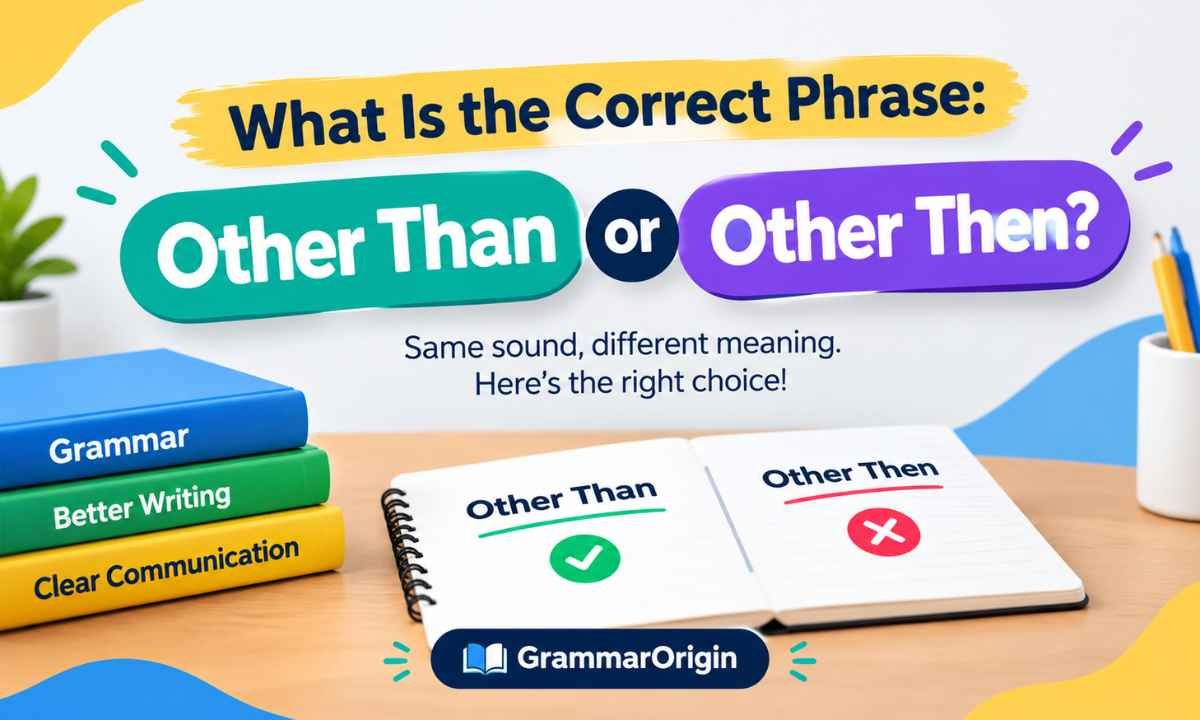
Other than is correct. It’s the only version recognized in dictionaries and grammar guides, and it means “besides” or “except for.”
Examples of Correct Usage
- I don’t eat anything other than grilled chicken and rice.
- Nobody knew about the surprise party other than her sister.
- He hasn’t traveled anywhere other than his home city.
Why People Get Confused
The confusion comes from how similar “than” and “then” sound when spoken quickly. Most people aren’t misunderstanding the grammar; they’re just mishearing the word.
For example, someone reading a sentence aloud might write “other then” simply because that’s the sound their brain registered.
Understanding the Difference Between “Than” and “Then”
These two words look almost identical, but they do completely different jobs in a sentence. Mixing them up changes the meaning, not just the spelling.
What Does “Than” Mean?
Than is used to compare two things. It shows up after words like “more,” “better,” “rather,” and “other,” which is why “more than,” “less than,” and “other than” all follow the same pattern.
Example: “This laptop is faster than my old one.”
What Does “Then” Mean?
Then refers to time or sequence, and it usually works as an adverb of time in a sentence. It tells you when something happened or what comes next.
Example: “We finished dinner, and then we watched a movie.”
Quick Rule to Remember
If you’re comparing two things, use “than.” If you’re talking about time or order, use “then.” That single test settles almost every case.
Example: “I’d rather read than watch TV” (comparison) versus “Read first, then relax” (sequence).
Why “Other Then” Is Usually Incorrect
“Other then” doesn’t function as a real phrase in English. “Other” and “then” simply don’t combine to form a meaningful expression the way “other than” does.
Incorrect Examples
- Other then the rain, the trip was perfect. (incorrect)
- She likes every color other then yellow. (incorrect)
Correct Versions
- Other than the rain, the trip was perfect.
- She likes every color other than yellow.
Can “Other Then” Ever Be Correct?
Only in a very specific case: when “other” and “then” appear as two separate words describing a different moment in time, not as a fixed phrase.
Example: “We’ll catch up another day; we can talk then, at some other time.” Here they’re unrelated words sitting near each other, not the phrase “other than” misspelled.
Other Than Meaning and Usage Explained
“Other than” carries a few related meanings depending on the sentence, but all of them point back to exception or difference.
1. To Mean “Except”
Example: “Nothing other than honesty will fix this situation.”
2. To Mean “Besides”
Example: “Other than coffee, she doesn’t drink much else in the morning.”
3. To Show Difference
Example: “The two proposals were other than similar; they had almost nothing in common.”
Synonyms of “Other Than”
Several words and phrases work as close substitutes for “other than,” depending on tone and context.
- Besides
- Except for
- Apart from
- Aside from
- Barring
Example: “Apart from the noise outside, the office was quiet all afternoon.”
Also Read This Submission vs Submittion: Which Spelling Is Correct?
Common Grammar Mistakes With Other Than
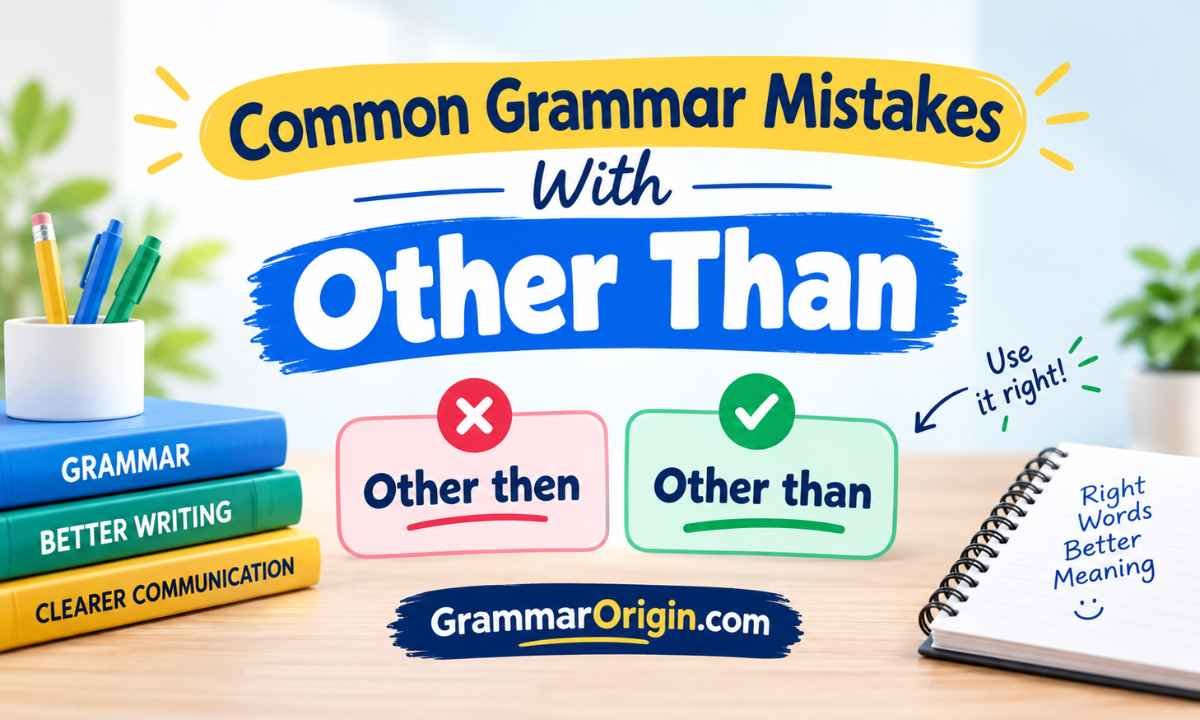
Most writers don’t make this mistake out of ignorance. It usually comes down to speed, habit, or trusting a tool that isn’t built to catch it.
Mistake #1: Using “Then” Instead of “Than”
This is the most frequent version of the error, and it happens across emails, essays, and social posts alike.
Example: “He’s taller then his brother” should read “He’s taller than his brother.”
Mistake #2: Mixing Up Comparison and Time Words
Writers sometimes reach for “then” simply because it feels like the more familiar word in casual speech.
Example: Someone might write “better then ever” when they mean “better than ever.”
Mistake #3: Relying Only on Spellcheck
Basic spellcheckers won’t flag this error because both “than” and “then” are correctly spelled words. The mistake is about meaning, not spelling.
Example: A document can pass spellcheck completely clean and still contain “other then” three times.
Comparison Table: Other Than vs Other Then
| Feature | Other Than | Other Then |
| Grammatically Correct | Yes | No |
| Found in Dictionaries | Yes | No |
| Used for Comparison/Exception | Yes | No |
| Used for Time or Sequence | No | Only as separate words |
| Accepted in Formal Writing | Yes | No |
Common Situations Where “Other Than” Is Used
Seeing the phrase across different settings makes the correct usage easier to remember long-term.
Academic and Formal Writing
Example: “The study found no factors other than temperature that affected the results.”
Business Writing
Example: “We haven’t received payment from anyone other than the client listed above.”
Everyday Conversation
Example: “I’m not doing anything this weekend other than relaxing.”
Real-Life Example: How One Small Grammar Mistake Hurt a Blog’s Credibility
A freelance content writer in the UK once shared her experience after a client rejected an entire batch of blog drafts in 2025. She had written “other then” throughout several articles without noticing.
The client explained that the error wasn’t the only issue, but it made the writing look rushed and unpolished. In a competitive freelance market, small slips like that can cost repeat work.
She started reading her drafts aloud before submitting them, specifically listening for “than” versus “then.” Within a few weeks, the same client rehired her for a bigger project.
2025–2026 Grammar and Writing Statistics
Confusable word pairs remain one of the most common categories of writing errors, even among experienced professionals.
Grammarly’s own data shows that homophone-style mistakes, including “than” and “then,” rank among the most frequently corrected errors across millions of documents. A 2025 report from HubSpot on content quality also noted that grammar slips reduce a reader’s trust in a brand’s writing, even when the actual message is accurate.
Merriam-Webster and other major dictionaries continue to list “than” and “then” as separate entries with distinct definitions, reinforcing that this is a meaning-based mistake rather than a stylistic choice.
Key Statistics
- Homophone confusion is one of the top error categories in grammar-checking tools.
- Readers associate grammar slips with lower perceived professionalism.
- Search engines generally treat “other than” as the standard query, with “other then” appearing mostly as a typo variant.
Easy Tricks to Remember the Difference
A few small memory tricks make this distinction stick without needing to think twice.
Trick #1: “A” for Comparison
“Than” has an A, just like “comparison.” Use it whenever you’re comparing two things.
Example: “She’s smarter than she lets on.”
Trick #2: “E” for Time
“Then” has an E, just like “sequence.” Use it whenever time or order is involved.
Example: “Finish your homework, then go outside.”
Trick #3: Replace the Word
Try swapping in “except for.” If the sentence still makes sense, “than” is correct.
Example: “Other than the traffic, the drive was easy” still works as “Except for the traffic, the drive was easy.”
How to Avoid This Mistake in Professional Writing
A couple of small habits prevent this error from slipping into finished work.
Proofread Slowly
Reading at a slower pace, especially out loud, makes homophone mistakes far easier to catch than skimming does.
Example: Reading “other then” aloud often sounds noticeably off, even when it looks fine on screen.
Use Grammar Tools
Grammarly, Microsoft Editor, and Google Docs’ built-in checker all flag “other then” as a likely error.
Example: Grammarly underlined “other then” in one writer’s draft within seconds of typing it.
Learn Commonly Confused Words
Keeping a short personal list of words you mix up, like “than/then,” “affect/effect,” or “its/it’s,” builds long-term accuracy faster than one-time corrections.
Also Read This Submission vs Submittion: Which Spelling Is Correct?
Other Than or Other Then in a Sentence
Seeing the phrase used naturally, across different tones, reinforces the correct pattern better than a rule alone.
- “Other than a small delay, the flight went smoothly.”
- “I have no complaints other than the slow Wi-Fi.”
- “Other than her, nobody else showed up to the meeting.”
Other Than or Other Then Worksheet
Practicing with quick fill-in exercises helps this rule move from memory into habit.
- Nobody called ______ my mother.
- We ate dinner, and ______ we went for a walk.
- She’s more talented ______ she realizes.
- He has no hobbies ______ reading.
Answers: than, then, than, than.
Other Than or Other Then Examples
More examples across different writing styles make the correct pattern easier to spot instantly.
- Formal: “Other than the noted exceptions, the policy applies to all employees.”
- Casual: “I didn’t do much this weekend other than sleep.”
- Comparative pairing: “This route is longer than the highway, but other than the extra time, it’s more scenic.”
Mini Quiz: Other Than or Other Then
Quiz 1: Spot the Correct Phrase
A) Other then B) Other than Answer: B) Other than
Quiz 2: Than or Then?
“He arrived earlier ______ expected.” A) than B) then Answer: A) than
Quiz 3: Time or Comparison?
“We ate, ______ we left.” A) than B) then Answer: B) then
Quiz 4: Fix the Grammar Mistake
“Nothing other then honesty matters here.” Answer: Change “then” to “than.”
Quiz 5: Choose the Right Meaning
“Other than” most closely means: A) Except for B) At that time Answer: A) Except for
Quiz 6: Quick Grammar Challenge
“She’s taller ______ her sister.” A) than B) then Answer: A) than
Quiz 7: Fill in the Blank
“I have no plans ______ studying tonight.” A) other than B) other then Answer: A) other than
Quiz 8: Common Mistake Check
Which sentence is correct? A) Better then ever B) Better than ever Answer: B) Better than ever
Frequently Asked Questions
Is “other then” ever correct?
Almost never as a fixed phrase. “Other than” is the only correct version when you mean “except for” or “besides.”
Why do people confuse than and then so often?
The two words sound nearly identical in casual speech, so writers often choose the wrong one based on sound instead of meaning.
Does spellcheck catch “other then”?
Basic spellcheck usually misses it, since both “than” and “then” are spelled correctly on their own. Grammar-focused tools catch it more reliably.
What’s an easy way to remember which word to use?
Match “than” with comparison and “then” with time. If you’re comparing two things, use “than”; if you’re describing sequence, use “then.”
Is “other than” formal or casual?
It works in both. You’ll see it in academic writing, business emails, and everyday conversation without sounding out of place.
Can “other than” start a sentence?
Yes. “Other than the delay, everything went as planned” is a perfectly correct sentence structure.
Final Thoughts
Other than is the correct phrase whenever you mean “except for” or “besides,” while “other then” isn’t a real expression in English at all.
Remembering that “than” compares and “then” marks time clears up the confusion for good. Once that rule sticks, “other then” won’t show up in your writing again.

Muhammad Waqas is an English language teacher and grammar expert with over 8 years of experience helping students and professionals improve their writing skills. He specializes in English grammar, vocabulary, communication, and practical language learning. Through GrammarOrigin, Waqas shares clear, easy-to-understand content that helps readers write and speak English with confidence.