
Boujee or bougie? Both are correct, but bougie is the safer spelling for general writing, and boujee is the casual slang version. They mean the same thing.
These words describe someone who loves fancy things, and the tone can be a playful tease or a sharp jab. This guide covers meaning, pronunciation, origin, and examples so you can choose with confidence.
Quick Answer
Bougie is the standard spelling, and boujee is the informal variant. Both mean fancy, focused on wealth, or a little snobby. Merriam-Webster lists bougie first and boujee as a less common variant.
So the boujee or bougie choice comes down to tone, not meaning. Pick bougie when you’re unsure, and pick boujee when the vibe is casual and fun.
- That brunch place is so bougie, but the pancakes are worth it.
- She’s living her boujee dream, one spa day at a time.
Meaning and Definition of Each Word
Both words describe a taste for wealth, status, and nice things, and they sound exactly the same. The real split in boujee or bougie is spelling and tone.
Merriam-Webster marks the main word as informal and usually a little insulting. In other words, it’s slang, and it often carries a bit of criticism.
Bougie
Bougie is the standard spelling. As an adjective, it describes someone who cares a lot about wealth, possessions, and looking respectable. As a noun, it can mean a middle-class person.
He rolled his eyes at the bougies crowding the farmers market with their linen shirts.
Because it’s informal, you’ll mostly hear it in conversation, captions, and casual articles. Think of it as a friendly roast more often than a compliment.
Boujee
Boujee is the informal variant spelling. Merriam-Webster also notes the slang sense of fancy and swanky, or linked to wealth and treating yourself.
The spelling spread through hip-hop, memes, and social media, so it feels trendy and playful. Here’s how it sounds in real life: “Her coffee order is extra boujee today.”
The boujee spelling is often linked to hip-hop and African American Vernacular English (AAVE), so it’s worth using with respect for that culture.
So when you see boujee or bougie online, the spelling usually signals the writer’s vibe, not a different meaning.
Key Differences Between Boujee and Bougie
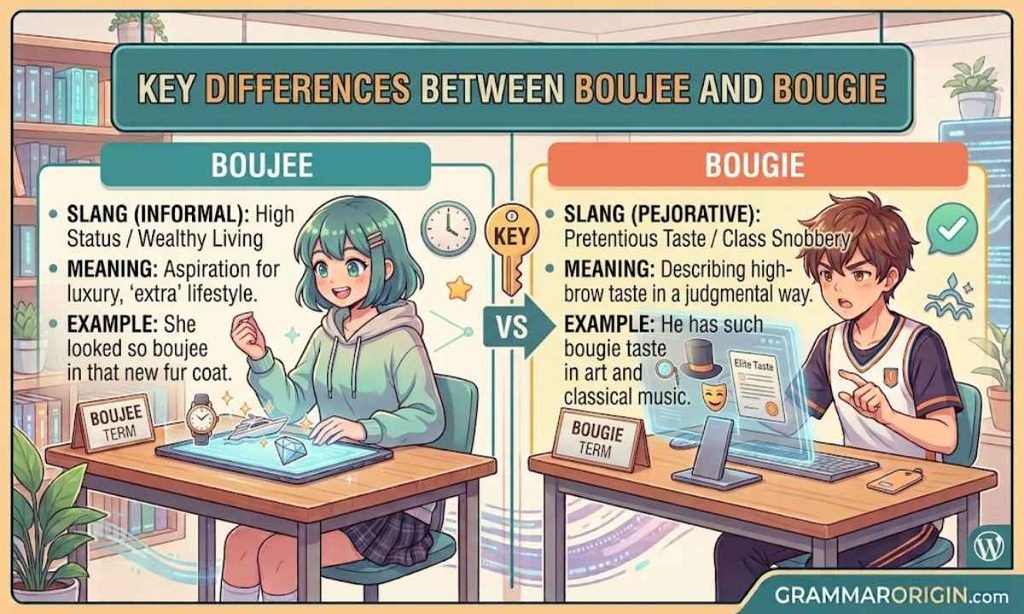
The meaning is the same, so the differences are spelling, tone, and setting. Bougie feels like the default, while boujee feels like pop culture.
- Spelling: bougie keeps the “g” from the older word, and boujee uses “j” to match the sound.
- Tone: bougie leans a bit more critical, and boujee often sounds playful or proud.
- Setting: bougie works in casual articles, and boujee shines in captions and texts.
When people argue about boujee or bougie, they’re really arguing about style, not definition. Neither spelling is formal English, so a school essay or a work report needs a plainer word.
For example, “That candle shop is so bougie” and “That candle shop is so boujee” say the same thing. Only the vibe shifts a little.
Where Did Bougie Come From? (Bourgeois Origin)
Bougie comes from “bourgeois,” a French word for the middle class. People clipped it and respelled it so it matches how it sounds in speech.
In older writing, a bourgeois family simply meant a comfortable, middle-class one. Today, bougie teases someone who loves a nice brunch or a pricey handbag.
Merriam-Webster even defines the adjective as another way of saying bourgeois. That link explains why the word is about status, not just shopping. Over time, the meaning slid from a social class to a lifestyle attitude. Knowing the roots makes the boujee or bougie spelling debate feel less confusing.
Comparison Table
The two words share one meaning, so this boujee or bougie table compares spelling, tone, and best use.
| Feature | Bougie | Boujee |
| Spelling status | Standard, more established | Informal variant |
| Meaning | Fancy, wealth-focused, snobbish | Same, often more playful |
| Tone | Slightly critical | Casual, trendy |
| Best for | General informal writing | Captions, texts, social media |
| Example | The hotel feels very bougie. | Her style is so boujee. |
Examples in Sentences
Examples show that both words mean the same thing, and only the spelling and tone change. Two quick sets below will help.
The pattern is easy to spot once you read a few. In the boujee or bougie debate, the examples matter more than the rules.
Using Bougie:
Use bougie as your default spelling in general writing. Here are some ways it appears:
- The bougie bakery sells a ten-dollar croissant.
- My cousin gets bougie about olive oil.
- It’s not a bougie restaurant, just a nice one.
- We rented a bougie cabin with a hot tub.
- Stop being so bougie, the plastic fork works fine.
Notice that each sentence describes taste or attitude. That’s the core of the word.
Using Boujee:
Use boujee when you want a casual, current feel. Here are some examples:
- Tonight’s plan is a boujee dinner and a movie.
- She posted her boujee brunch with a gold fork.
- Their apartment looks a little boujee for a student rental.
- I’m feeling boujee, so I’m getting the good chocolate.
- He wore his most boujee sneakers to the party.
The tone in these is light and teasing. Nobody’s really mad.
Bad and Boujee: Pop Culture Impact
The Migos song “Bad and Boujee,” featuring Lil Uzi Vert, pushed the boujee spelling into everyday use. After that, the phrase showed up on social media, merchandise, and captions.
“Bad and boujee” came to mean stylish, confident, and a little luxurious. It’s a boast more than a criticism, and fans often use it as a compliment for a confident look or a big night out.
That pop culture moment is one reason younger readers write boujee without thinking twice. Older dictionary entries still lead with bougie, which is why both spellings stay alive. So the boujee or bougie split got a big push from music and social media, not from dictionary rules.
Other Spellings: Bourgie, Boujie, and Bougee
Bourgie and boujie are other informal spellings of the same slang. Merriam-Webster lists bourgie as a variant, and you’ll see boujie in casual posts.
Bougee, on the other hand, is a mistake. It mixes the “g” of bougie with the “ee” ending of boujee.
If you want a clean choice for boujee or bougie, skip the odd ones. Stick with bougie or boujee, and your readers won’t stumble.
Common Mistakes
Most errors in boujee or bougie come from treating the two words as different, or from rare spellings. Watch for these:
- Wrong: “Bougie and boujee mean different things.” Right: They mean the same, with a tone difference.
- Wrong: “Boujee is a mistake.” Right: It’s a recognized informal variant.
- Wrong: “She’s so bougee.” Right: “She’s so bougie.”
- Wrong: Using either word in a formal report. Right: Choose a plain word like “luxurious.”
- Wrong: Switching spellings in one article. Right: Pick one and keep it.
Another trap is assuming it’s always an insult. It depends on the speaker and the smile behind it.
More Posts Signup or Sign Up? Correct Spelling & Difference (2026)
Tips to Remember the Difference
Bougie keeps the “g” from “bourgeois,” and boujee spells the sound. That’s the whole trick.
Here are a few more memory aids:
- Think “bourgeois” and keep the “g”: bougie.
- Think “sounds like it looks”: boujee has the “j” sound.
- When unsure about boujee or bougie, choose bougie.
If you’re writing a caption, boujee feels natural. If you’re writing an article or an email, stay with bougie.
When to Use Each Word
Use bougie for general writing, and use boujee for casual, playful moments. Neither one belongs in a formal report.
- Use bougie in blogs, casual articles, and everyday messages.
- Use boujee in captions, group chats, and pop culture talk.
- Use a plain synonym, like “upscale,” in formal writing.
A food blogger might write, “This is the most bougie pizza I’ve ever had.” A friend might text, “Dinner was so boujee last night.” Both fit their places.
When the boujee or bougie choice affects your brand, look at your audience first. Younger crowds expect boujee, while mixed audiences are fine with bougie.
Grammar Rules
Bougie and boujee follow simple rules, so they’re easy to use. They’re informal words, but they still behave like regular English.
- Use them as adjectives: “a bougie cafe” or “a boujee outfit.”
- Use bougie as a noun for a person: “a bougie,” and “bougies” for the plural.
- Don’t capitalize them unless they start a sentence.
- Use “very” or “so” to boost the feeling: “so bougie.”
- Keep one spelling per piece of writing.
- Skip hyphens, because neither word needs one.
Remember that the boujee or bougie question never changes the grammar. Only the spelling and tone change.
Bougier and Boujiest: Comparative Forms

The comparative is bougier and the superlative is bougiest, which are the “more” and “most” forms. The boujee spelling gets boujier and boujiest, and Merriam-Webster lists these forms.
You can also say “more bougie” or “most bougie,” which sounds a bit more natural to some ears.
Example: “This is the bougiest hotel in the city, and the lobby is even bougier than the rooms.” Another one: “Her taste got boujier after the promotion.”
Synonyms or Related Words
Posh, swanky, upscale, and high-class are close synonyms for the fancy side. For the critical side, try pretentious, snobbish, or materialistic.
Some are friendlier than others. “Classy” is a compliment, while “pretentious” is a complaint. Pick the one that matches your point. If you’re tired of repeating boujee or bougie, these words give you fresh options.
For example, a travel writer might call a hotel upscale, while a friend would call it boujee. If someone is showing off, pretentious is stronger than bougie.
Bougie meaning rich
In slang, bougie can mean acting rich or caring about money and status. It doesn’t always mean the person actually has a lot of money.
Often, it’s about showing a taste for nicer things, like fancy coffee or a designer bag. Someone on a small budget can still be called bougie, and a truly upper-class person might not get the label at all.
Example: “He’s not wealthy, but he’s so bougie about his sneakers.” In boujee or bougie, the word points to attitude, not a bank balance.
Bougie pronunciation
Bougie is pronounced BOO-zhee, with the stress on the first part. The “zh” sounds like the middle of “measure.” Boujee sounds exactly the same, so boujee or bougie makes no difference out loud.
In French, the stress usually lands on the last part, so it sounds closer to boo-ZHEE. The English slang keeps the stress on the front, so the two sound a little different.
Try it out loud: “That’s so BOO-zhee.” Say it a few times, and it’ll feel natural.
Bougie meaning fancy
As slang, bougie can mean fancy, swanky, or upscale. Merriam-Webster says boujee also means linked to wealth or treating yourself.
This side of the word leans more playful. It’s used for hotels, snacks, outfits, and weekend plans that feel a step above the ordinary.
For example: “We stayed in a bougie hotel with a rooftop pool.” Said with a smile, it’s almost a compliment. In boujee or bougie, the fancy sense is the one most people have in mind.
More Posts Signup or Sign Up? Correct Spelling & Difference (2026)
Bougie meaning French
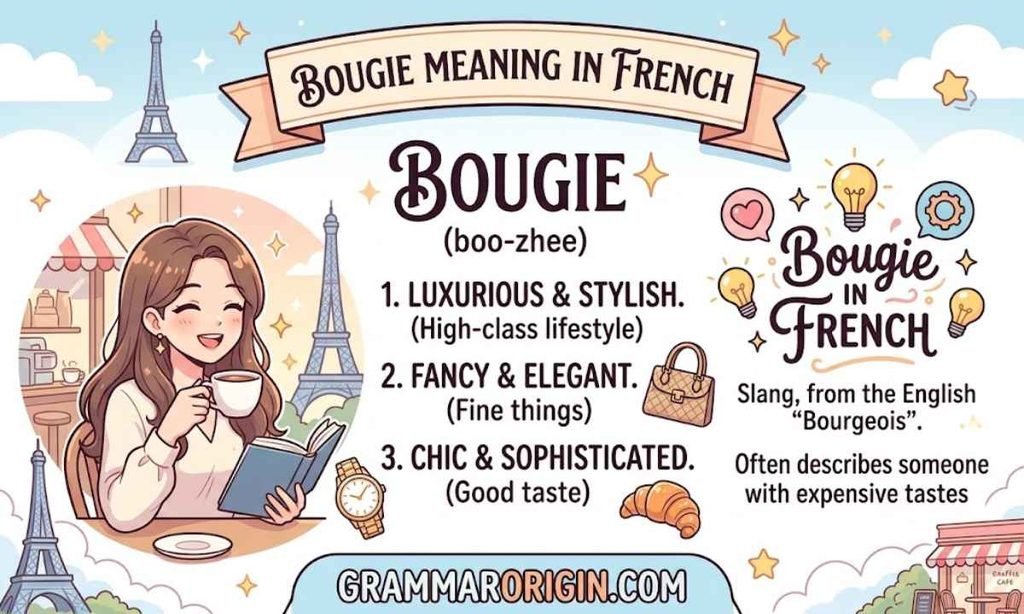
In French, bougie means candle, and it also names the spark plug in a car engine. It isn’t related to the slang meaning in everyday use.
Merriam-Webster lists the candle sense separately in English too. So the same spelling can mean a wax candle or a snobbish attitude.
Here’s the split: the candle word is bougie, and the slang word is bougie too. The slang comes from bourgeois, not from the candle. So whether you write boujee or bougie, the slang has nothing to do with candles.
bougie en anglais
“Bougie en anglais” means “bougie in English.” In English, the French word “bougie” translates to “candle,” while the slang adjective means fancy or wealth-focused.
So the answer depends on which bougie you mean. A French speaker asking for a bougie wants a candle, while an English slang speaker means a fancy vibe.
Example: “J’allume une bougie” means “I’m lighting a candle.” Meanwhile, “That bar is so bougie” uses the English slang. A French reader who looks up boujee or bougie in English may be surprised by the slang.
spell bougie or boujee
Spell it bougie in most writing, and boujee in casual or social media posts. Both are accepted, but bougie is the more established choice.
The simple rule for boujee or bougie is to match your audience. Spell bougie for blogs and emails, and boujee for captions and texts.
Both British English and American English use the two spellings the same way, so region doesn’t decide the choice. Your audience does.
A quick spelling check: bougie has a “g” and ends with “ie,” while boujee has a “j” and ends with “ee.” For example, “bou-g-ie” and “bou-j-ee.”
bougie life
The bougie life means living with nicer taste, like good coffee, cozy hotels, and small luxuries. It’s usually a light, funny phrase.
People say it to tease themselves or friends. A person on a budget can still say they’re “living the bougie life” after buying a fancy latte.
Example: “Sunday plans: farmers market, then a bougie brunch, then a nap.” That’s the bougie life in a sentence.
You’ll also see “bougie aesthetic” and “boujee lifestyle” on TikTok and Instagram. They describe cozy cafes, neat shelves, and nice candles, and the tone is almost always friendly. The phrase works with boujee or bougie, so spell it to match your audience.
Summary
The boujee or bougie question has a short answer. Bougie is the standard spelling, boujee is the casual variant, and both mean fancy or wealth-focused.
Choose by tone and audience, keep one spelling in each piece, and skip odd forms like bougee. Whichever you pick, the boujee or bougie meaning stays the same.
Frequently Asked Questions
What does boujee mean?
Boujee means fancy, swanky, or focused on wealth and nice things. It’s a slang spelling of bougie, and the tone is often playful.
What is a boujee female?
A boujee female is a woman who loves nice things, like good style, spa days, and upscale places. It’s often a playful label, but it can also sound unfair if it assumes too much about her.
What is bougie in Gen Z slang?
In Gen Z slang, bougie means fancy or a bit extra, often said with a smile. People use it for cafes, outfits, and even snacks that feel a little too nice. You’ll hear it a lot on TikTok, often as “bougie on a budget.” Younger people swap boujee or bougie freely, since both feel natural online.
Is bougee an insult?
Bougee is a misspelling of bougie, and bougie can be an insult or a joke. Merriam-Webster says the word is usually meant as a put-down, but friends often use it playfully.
Is it boujee or bougie?
Both are right, but bougie is the more established spelling and boujee is the informal variant. For the boujee or bougie decision, pick bougie for general writing.
Is boujee a real word?
Yes. Boujee is a recognized informal variant, and Merriam-Webster lists it as a less common spelling of bougie.

Muhammad Waqas is an English language teacher and grammar expert with over 8 years of experience helping students and professionals improve their writing skills. He specializes in English grammar, vocabulary, communication, and practical language learning. Through GrammarOrigin, Waqas shares clear, easy-to-understand content that helps readers write and speak English with confidence.