
Compliment or complement? A compliment is a kind remark or a bit of praise, while a complement is something that completes or pairs well with something else. They sound identical, but they do very different jobs.
Mixing them up is easy, and spellcheck won’t save you because both are real words. This guide covers the meanings, the UK angle, memory tricks that actually stick, and odd cases like staff numbers and maths.
Quick Answer
Stuck on compliment or complement? Use compliment when you’re praising someone, and complement when one thing completes or improves another. The spelling gives you a shortcut: complement shares its “e” with complete, and compliment carries the “i” from “I like it.”
Example: “Thanks for the compliment. I think the scarf complements the coat, too.”
Meaning and Definition of Each Word
Compliment or complement? One is about what you say, the other is about what fits. Dictionaries like Merriam-Webster, Oxford and the Cambridge Dictionary list them as separate entries, and each works as a noun and a verb.
Example: “Pass on my compliments to the chef. That sauce was the perfect complement to the lamb.”
There’s a bit of history behind why these confusing words look so alike. Both words trace back to the Latin complēre, “to fill up.” Compliment travelled through Italian and Spanish words for courtesy and picked up the sense of polite speech, while complement stayed close to the idea of making something whole.
1. Compliment
A compliment is a polite remark that shows praise, admiration or respect. As a verb, to compliment someone means to say something nice about them or about something they’ve done.
It lives at the social end of English. You pay a compliment, receive one or return one, and the verb usually takes “on”: you compliment a person on a result. The plural, compliments, can also mean polite regards, as in “give her my compliments.”
Example: My neighbour complimented the garden so warmly that I bought three more rose bushes.
2. Complement
A complement is something that completes, balances or improves another thing. As a verb, it means to go with something so well that the pair works better together.
Example: Her patience complements his speed, so they make a solid team.
Notice that nobody gets praised here. Two things are involved, and each one makes the other better. That “two things fitting” idea is the heart of the word.
Compliment or Complement Meaning
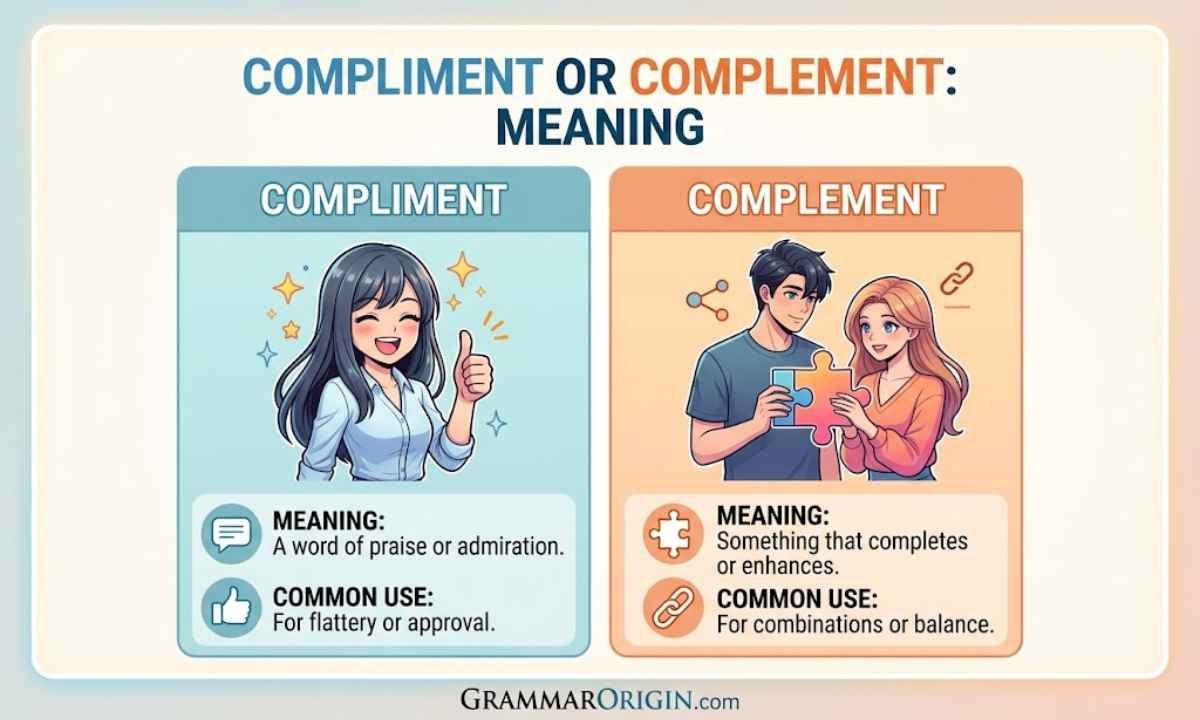
The compliment meaning is praise, and the complement meaning is completion. One is something you say, the other is something that fits.
A quick swap test settles most compliment or complement questions. If “praise” fits, you want compliment. If “complete” or “go well with” fits, you want complement.
Example: “The scarf is a perfect ___ to your coat.” Praise to your coat makes no sense, but “goes well with” does, so the answer is complement.
Are Compliment and Complement Pronounced the Same?
Yes, they’re pronounced exactly the same, which makes them homophones. The stress lands on the first syllable in both words: /ˈkɒmplɪmənt/ in British English and /ˈkɑːmplɪmənt/ in American English.
Example: Say this out loud: “That was a lovely compliment.” Now say it again with complement. Your mouth doesn’t change at all.
The verb forms end in a slightly firmer “-ment” than the nouns, but that shift happens in both words, so it can’t help you tell them apart. Only context does.
That’s why the compliment or complement mix-up mostly happens in writing: you type what you hear, and both spellings are real words, so nothing gets flagged.
Compliment or Complement UK
British English treats compliment or complement exactly like American English: the same spellings and the same meanings. In the usual British vs American English spelling debates, there’s no “-our” versus “-or” split to worry about here.
Where the UK flavour shows up is in set phrases. A printed “with compliments” slip tucked into a business parcel is a very British office habit, and “complementary medicine” is everyday language in UK health talk. The only real difference is the vowel in the first syllable, as shown in the pronunciation above.
Example: The courier clipped the invoice to a compliments slip and left it on the doorstep.
Key Differences Between the Words
The key difference in compliment or complement is purpose: a compliment praises, a complement completes.
Example: The critic paid the chef a compliment, and the wine turned out to be a perfect complement to the lamb.
Here’s how the two split in practice:
- Job: a compliment expresses approval; a complement adds what’s missing.
- What it needs: a compliment needs someone speaking and someone listening, while a complement needs two things that fit.
- Tone: compliments are social and emotional; complements are practical.
- Common partners: you pay, give or receive a compliment, but you complement each other or add a perfect complement.
- Adjectives: complimentary (praising or free) versus complementary (completing).
Is It Compliment or Complement of the Season?

It’s “compliments of the season.” That settles the compliment or complement question for this phrase, and the plural compliments means good wishes or greetings, not praise.
Example: “Compliments of the season to you and your family.”
This is a formal, slightly old-fashioned greeting for Christmas and New Year cards and letters. “Complements of the season” is wrong because nothing is being completed. You may also see “compliments of the house,” which means something is free, and that connects to complimentary, covered below.
Complement or Compliment
The order you type doesn’t matter; the sentence decides whether it’s compliment or complement. Three quick checks will get you to the right word.
- Is someone being praised? Use compliment.
- Do two things fit together or finish each other? Use complement.
- Is something being given for free? Use complimentary.
Example: “Does this tie compliment or complement my shirt?” The tie isn’t praising the shirt, it’s matching it, so the answer is complement.
Comparison Table
At a glance, compliment or complement comes down to praise versus completion.
| Point | Compliment | Complement |
| Core meaning | Praise or kind words | Something that completes or improves |
| Memory hook | “I like it” | “Complete” |
| Parts of speech | Noun, verb | Noun, verb |
| Adjective | Complimentary (praising or free) | Complementary (completing) |
| Typical partners | Pay, give, receive a compliment | A perfect complement, complement each other |
| Usually about | People and what they do | Things, ideas, skills |
| Maths | Never used | Sets, angles, probability |
| Sentence | She complimented my talk. | The slides complement my talk. |
Quick check: “He got a compliment for his slides” is praise. “His slides are a complement to the report” is fit.
Complimentary vs Complementary
Complimentary means expressing praise or given free of charge, while complementary means completing or matching. Once you’ve settled compliment or complement, the adjectives follow the same split.
Example: The hotel served a complimentary breakfast, and its red-and-green logo used complementary colours.
Complimentary comes from the idea of “with the giver’s compliments,” which is why free drinks, tickets and sample copies are all complimentary. It also covers a kind remark, as in a complimentary review.
Complementary describes things that complete each other. Colours opposite on the colour wheel (red and green, blue and orange) are complementary, and so are skills that fill each other’s gaps.
Complementary medicine, used alongside standard treatment, follows the same idea. “Complementary breakfast” is a classic slip: a free breakfast is complimentary.
Read More Baptised or Baptized: Which Spelling Is Correct? (UK vs US)
Difference between Compliment and Complement with Examples

The compliment or complement difference shows best when one situation gets both words.
- She complimented the soup. / She complemented the soup with fresh basil.
- He gave the team a compliment after the demo. / His design skills are a complement to the team’s coding.
- The jacket earned a compliment. / The jacket is a complement to the trousers.
In every pair, the first sentence is about spoken approval and the second is about fit. Same scene, different job. If you can’t decide, ask whether someone is saying something nice or whether two things are working together.
Examples in Sentences
Here are everyday compliment or complement sentences with the right word in each, so you can see the patterns.
Compliment Examples
Compliment shows up as a noun, a verb and a plural.
- That’s the nicest compliment I’ve had all week.
- Her coach complimented her on a clean start.
- Don’t go fishing for compliments; they’ll come on their own.
- Please give my compliments to the kitchen team.
- It was a back-handed compliment, and she knew it.
- The review complimented the camera but not the battery.
Notice the verb pattern: compliment, then the person, then “on” or “for.”
Complement Examples
Complement shows up when two things make each other better, so look for a pair.
- A crisp white wine is the ideal complement to grilled prawns.
- Their strengths complement each other.
- The new bus route complements the existing metro line.
- The ship sailed with its full complement of 120 crew.
- The soft grey sofa complements the warm wooden floor.
- Where others rush, she checks, and that makes her a great complement to the group.
Common Mistakes
The most common compliment or complement slip is swapping the two words and ending up with a sentence that’s grammatical but wrong. Spellcheck stays silent because both words are real.
Example: “Her skills compliment the team” sounds fine, but it says her skills are praising the team. You want complement.
Most errors happen because these are commonly confused words: you type what you hear. A final read-through that asks “compliment or complement, praise or completion?” catches nearly all of them.
Incorrect vs Correct
These six swaps trip people up most often, and each one is easy to fix once you know the reason.
| Incorrect | Correct | Why |
| She gave me a nice ~~complement~~ | She gave me a nice compliment | It’s praise |
| This dress ~~compliments~~ your shoes | This dress complements your shoes | It’s matching |
| He ~~complemented~~ me on my work | He complimented me on my work | He praised me |
| The colours ~~compliment~~ each other | The colours complement each other | They fit together |
| ~~Complements~~ of the season | Compliments of the season | It’s a greeting |
| A ~~complementary~~ breakfast is included | A complimentary breakfast is included | It’s free |
Tips to Remember the Difference
Three simple tricks cover almost every compliment or complement sentence you’ll write.
Example: “That’s a lovely compliment” (I like it) versus “The sauce complements the pasta” (it completes the dish).
1: Compliment = “I like it”
The “i” in compliment stands for “I like it.” If your sentence has that feeling, spell it with an i.
Example: “I like your presentation” becomes “She paid me a compliment on my presentation.”
Picture someone saying “I like your jacket.” That’s a compliment, and the “I” is the very first word.
2: Complement = “Complete”
Complement and complete begin with the same six letters, c-o-m-p-l-e. If you can swap “complete” or “round out” into the sentence, you’ve found a complement.
Think of the word as a puzzle piece. It doesn’t praise anything; it fills a gap.
Example: Rice is the complement to the curry because it completes the plate.
3: Person vs Thing
As a rule of thumb, you compliment people and you complement things. Treat it as a guide, not a law.
Example: She complimented the dessert, then ordered coffee to complement it.
There are exceptions both ways. “His calm manner complements her energy” is about people, and “she complimented the food” is about a thing. The better question is always whether you’re praising or completing.
When to Use Each Word
When you’re deciding compliment or complement, use compliment to praise and complement to complete.
Example: “I’d like to compliment your team; their work will complement ours.”
Use “Compliment” When:
Whenever compliment or complement comes up in a sentence about praise, go with compliment. These are the usual spots:
- You’re praising someone’s effort, taste or looks.
- You’re writing a thank-you note, a review or feedback.
- You’re passing on regards, as in “with compliments.”
Example: “Great job on the launch” is a compliment worth saying out loud.
Use “Complement” When:
Use complement whenever two things fit, finish or improve each other.
Example: The lemon complements the fish rather than covering it up.
- Food or drinks pair well together.
- Colours, furniture or styles match.
- Skills, tools or services fill each other’s gaps.
- You’re talking about a full number of staff or crew.
Compliment or Complement in Business Emails
In business writing, the compliment or complement choice is simple: a compliment is appreciation aimed at people, and a complement describes how things work together.
Example: “Thank you for the kind compliment on the proposal. Our analytics tool will complement your current dashboard.”
Email slips happen when you’re rushing. “Our services compliment yours” accidentally says you’re praising the other company’s services, so it should be “complement.”
A few phrases are worth keeping handy:
- “Please pass on my compliments to the team.”
- “With compliments,” on a short note or cover slip.
- “A complimentary consultation,” meaning a free one.
Grammar Rules (If Applicable)
Both words work as nouns and verbs, so the real traps are the preposition, the plural and the adjective.
There’s one more twist. In grammar, a complement is a word or phrase that completes the meaning of a verb, which is why it’s spelled with an e.
In “She is a pilot,” the phrase is a subject complement, and in “They named her captain,” it’s an object complement.
Example: In “The soup tastes delicious,” the word delicious is the complement.
Read More Baptised or Baptized: Which Spelling Is Correct? (UK vs US)
Compliment (Noun & Verb)
As a noun, compliment means praise. As a verb, it means to praise someone.
- Noun: That was a generous compliment.
- Verb: He complimented her on the speech.
The noun pairs with pay, give and receive, and the plural compliments can mean greetings. The verb takes “on” or “for.” The adjective is complimentary.
Complement (Noun & Verb)
As a noun, complement means something that completes, and it can also mean a full number. As a verb, it means to complete or go well with something.
- Noun: This scarf is a perfect complement to the coat.
- Verb: The colours complement each other.
The verb doesn’t take “on.” You complement something, or complement it with something else. The adjective is complementary.
Synonyms or Related Words
Neither word has a perfect twin, so the best synonym depends on which sense you mean.
Example: “She praised the design” is a looser way of saying “She complimented the design.”
Synonyms for Complement:
Round out, enhance and set off are the closest matches, depending on the sentence.
- Complete
- Round out
- Enhance
- Set off
- Accompany
- Balance
- Go with
- Counterpart
- Finishing touch
Example: Fresh herbs round out the dish because they complement the broth.
Supplement is a close cousin, but it adds something extra, while complement finishes what’s already there.
Synonyms for Compliment:
Praise and commend are the closest matches.
- Praise
- Commend
- Applaud
- Congratulate
- Tribute
- Accolade
- Kind words
- Pat on the back
Example: The jury commended the design for its clean lines.
Flatter is related, but it hints at insincerity, so it isn’t a true match.
Complement or compliment in maths
In maths, there’s no compliment or complement debate: it’s always complement, with an e. You’ll never see “compliment” in a maths textbook.
Example: The complement of {1, 2} in {1, 2, 3, 4} is {3, 4}.
The word shows up in three common places:
- Sets: in set theory, the complement of set A is everything in the universal set that isn’t in A, written A′.
- Angles: complementary angles add up to 90°, so 35° and 55° are complements. Supplementary angles add up to 180°.
- Probability: the complement of an event is everything that isn’t that event, so the complement rule says P(not A) = 1 − P(A).
Computing borrows the word too, as in two’s complement, a way of storing negative numbers.
Staff compliment or complement
For compliment or complement in a staffing sentence, it’s staff complement. A complement here means the full number of people in a team, ward or crew.
A “staff compliment” would only make sense if you meant a kind remark paid to the staff.
Example: The ward is running below its usual staff complement, so the shifts are stretched.
You’ll see the same use in “ship’s complement” and “crew complement.” HR teams and hospitals use it when they plan how many people a team needs.
Summary
Compliment or complement boils down to one question: are you praising, or are you completing? Praise gets the i, completion gets the e, and the swap test backs you up when you’re unsure.
Keep an eye on the lookalike pairs too, such as compliments of the season, a complimentary breakfast and a staff complement. Ask the same question each time, and the right word usually shows up.
Frequently Asked Questions
What’s the difference between complement and compliment?
A compliment is praise, while a complement is something that completes or improves something else. Choosing between compliment or complement gets easy with a swap test: if “praise” fits, use compliment, and if “complete” fits, use complement.
Is free food complimentary or complementary?
Free food is complimentary. The word means “given free, with the host’s compliments.” Complementary describes things that match or complete each other, like complementary flavours.
Is it compliment or complement in the UK?
It’s the same in the UK as anywhere else in English. The spellings and meanings don’t change, though British offices still use “with compliments” slips and “complementary medicine” is common in UK health talk.
What does “complement” mean?
Complement means something that completes, balances or improves another thing. As a verb, it means to go well with something. It can also mean a full number, like a ship’s crew complement, and in grammar it’s a word that completes a verb.
Are compliment and complement homophones?
Yes, they’re pronounced identically, with the stress on the first syllable. That’s why you can’t rely on your ear and have to rely on meaning and spelling instead.
How do I remember which one to use?
Think “I like it” for compliment and “complete” for complement. If your sentence is about praise, use the i. If it’s about two things fitting, use the e.
Is it staff complement or staff compliment?
It’s staff complement, meaning the full number of staff a team or ward has. Staff compliment would mean a kind word paid to the staff.

Muhammad Waqas is an English language teacher and grammar expert with over 8 years of experience helping students and professionals improve their writing skills. He specializes in English grammar, vocabulary, communication, and practical language learning. Through GrammarOrigin, Waqas shares clear, easy-to-understand content that helps readers write and speak English with confidence.