
Honey is the correct spelling, and hunny is just a playful, informal variant you’ll see in texts and Winnie-the-Pooh jokes. So if you’re stuck on hunny or honey, choose honey for anything that matters.
Hunny isn’t random, though. It turns up in pet names, brand names, and captions, which is why people keep searching for it. This guide shows when each one fits, whether you’re writing to a husband, a wife, or anyone else you call by a sweet name.
Quick Answer
Honey is the standard spelling, and it’s the one dictionaries list. Hunny is an informal, eye-dialect spelling that works only in casual, playful writing.
For hunny or honey in an email, school paper, product label, or public post, go with honey. Save hunny for a cute text or a Pooh-style joke.
A quick way to decide: if someone could judge your spelling, write honey. If you’re just being sweet in a chat, hunny won’t hurt anyone.
Meaning and Definition of Each Word
Stir a spoonful of honey into your tea. Thanks for the ride, hunny. Both lines mean the same thing, and only one of them is standard English.
Honey names the sweet, sticky food bees make from flower nectar. It’s also a warm way to address someone you care about. Hunny isn’t a separate word at all. It’s honey spelled the way it sounds, with a playful twist.
So the hunny or honey question is about spelling style, not meaning. Wiktionary calls hunny an eye dialect spelling of honey. That just means it copies how a word sounds instead of how it’s normally written. Both versions are pronounced the same way, HUN-ee (/ˈhʌni/).
Honey
Honey is the correct spelling for both the food and the pet name. You can use it in formal writing, casual writing, and everything in between.
As a noun, honey is the golden food bees make. It also works as an adjective, like honey blonde or honey-colored, and as a way of speaking to someone, like “Thanks, honey.”
The word comes from Old English hunig, which gives honey real history in any hunny or honey comparison. Merriam-Webster and other standard dictionaries list honey as the regular form.
You might wonder why an o says “u” here. The same thing happens in money, monkey, and month. A common explanation is that medieval scribes swapped u for o next to letters like m and n, because the handwriting got hard to read.
The jar of local honey turned thick and grainy after a few cool months. “Thanks for waiting, honey,” she said at the door.
Hunny
Hunny isn’t standard English, but it’s a widely recognized spelling that people use on purpose to sound cute, childish, or flirty.
Its most famous home is Winnie-the-Pooh, where the bear’s love of a pot of “hunny” turned the spelling into a pop culture joke.
A cereal called Hunny B’s, made by Kellogg’s under license from Disney, keeps the idea alive, and so does a rock band named Hunny. That’s one reason the hunny or honey confusion never fades.
Here’s the split in real life. A text that says “Good morning, hunny!” feels sweet. A label that says “Raw hunny for sale” feels like a mistake.
Wiktionary lists the plural as hunnies. Outside playful uses, though, a teacher or editor will likely treat hunny as a misspelling and change it to honey.
Read More Posts Benefitted or Benefited: Which Spelling Is Correct? (US vs UK)
Key Differences Between the Words
The main difference is status. Honey is standard, and hunny is an informal variant, while the meaning and the sound stay exactly the same.
The gap shows up in four places:
- Spelling status: honey is the standard form, and hunny is eye dialect.
- Tone: honey feels neutral or warm, while hunny feels cute, playful, and sometimes babyish.
- Where you’ll see it: honey appears everywhere, while hunny lives in text messages, captions, usernames, and brand names.
- Pronunciation: both are HUN-ee, so you can’t hear the difference out loud.
So hunny or honey isn’t a question about meaning. It’s a question about audience and tone. “I’d love some honey on my toast” works anywhere, and “Love you, hunny!” works in a casual message.
Comparison Table
Here’s the whole hunny or honey difference in one place.
| Feature | Honey | Hunny |
| Standard spelling | Yes | No |
| Dictionary status | Listed as standard | Labeled eye dialect (Wiktionary) |
| Pronunciation | HUN-ee | HUN-ee |
| Tone | Neutral to warm | Cute and playful |
| Safe for formal writing | Yes | No |
| Plural | honeys | hunnies |
| Typical place | Everywhere | Text messages and social media |
| Example sentence | Pass the honey, please. | Hey hunny, miss you! |
Examples in Sentences
Honey fits every sentence below, and hunny fits only the casual ones. Read them in groups so the pattern is easy to spot.
Honey as food
- Drizzle honey over the warm biscuits.
- Raw honey can turn solid when the weather cools.
Honey as a pet name
- Can you grab the keys, honey?
- Thanks for dinner, honey. It was perfect.
Hunny in a playful or casual voice
- Miss you already, hunny!
- Pooh peeked into the pot and whispered, “Is that hunny?”
Notice that in every hunny or honey example, the hunny line sounds light and silly. That’s the whole job of the spelling.
Common Mistakes
The biggest mistake is using hunny where people expect a standard spelling, like a label, a menu, or a school paper. The other errors are smaller, but they’re worth a look.
First, spelling it hunnie, honney, or hony. None of those are accepted forms. Second, assuming hunny is a British spelling. It isn’t, because both American and British English use honey.
Third, forgetting the comma when you speak to someone directly. Fourth, mixing styles in one piece, like honey in one line and hunny in the next. When you check hunny or honey in a draft, check the punctuation and the consistency too.
Wrong: Fresh hunny for sale. Right: Fresh honey for sale.
Wrong: Thanks honey. Right: Thanks, honey.
Tips to Remember the Difference
Think of the o in honey like the o in money and monkey. It’s written as o but sounds like u, and that’s the standard pattern.
Three small hooks help:
- Bees make honey, and that’s a real thing. Hunny is just Pooh’s version of the word.
- Ask yourself if a teacher or editor would read it. If yes, write honey.
- When you’re stuck between hunny or honey, honey is always safe, so default to it.
Say the trio out loud: honey, money, monkey. They look alike, and they sound alike too.
When to Use Each Word
Honey for a cover letter. Hunny for a birthday text. That one-line habit solves most cases of hunny or honey.
Use honey whenever you want to be correct. That means emails, school work, articles, product labels, menus, wedding cards, and anything strangers might read.
Use hunny only when cute is the goal. Think text messages, direct messages, social media captions, usernames, party themes, and Pooh-style jokes. It’s also fine when hunny is part of an official name, like a brand or a band.
Grammar Rules (if applicable)
Yes, a few grammar rules apply. Honey works as a noun, an adjective, and a term of address, and it takes a comma when you speak straight to someone.
- Noun: I put honey in my tea.
- Adjective: She dyed her hair honey blonde.
- Direct address: Add a comma, as in “Come here, honey.”
- Capital letters: write honey in lowercase unless it starts a sentence or works as someone’s name.
- Before a noun: use a hyphen, as in honey-colored walls.
The plural of honey is honeys, and it shows up when you mean different types. The plural of hunny is hunnies, but that’s rare and informal. The hunny or honey choice doesn’t change any other rule, because hunny follows the same pattern.
The market sells three local honeys: clover, orange blossom, and wildflower.
Synonyms or Related Words
Honey’s closest synonyms are other sweet pet names like sweetheart, darling, and sweetie. If you want a different word for the food, you’d use nectar, syrup, or sweetener, though none of them match it exactly.
Most of the related words fall into three groups:
- Pet names: sweetheart, darling, dear, sweetie, babe, love, sugar, sweet pea.
- Short forms: hun and hon, with hon especially common in parts of the United States like Baltimore.
- Related words: honeybee, honeycomb, honeydew, honeysuckle, honeymoon.
Try swapping words in one line: “Good night, sweetheart” and “Good night, honey” carry nearly the same warmth. Choosing between hunny or honey is only one way to say it.
Read More Posts Benefitted or Benefited: Which Spelling Is Correct? (US vs UK)
hunny or honey nickname
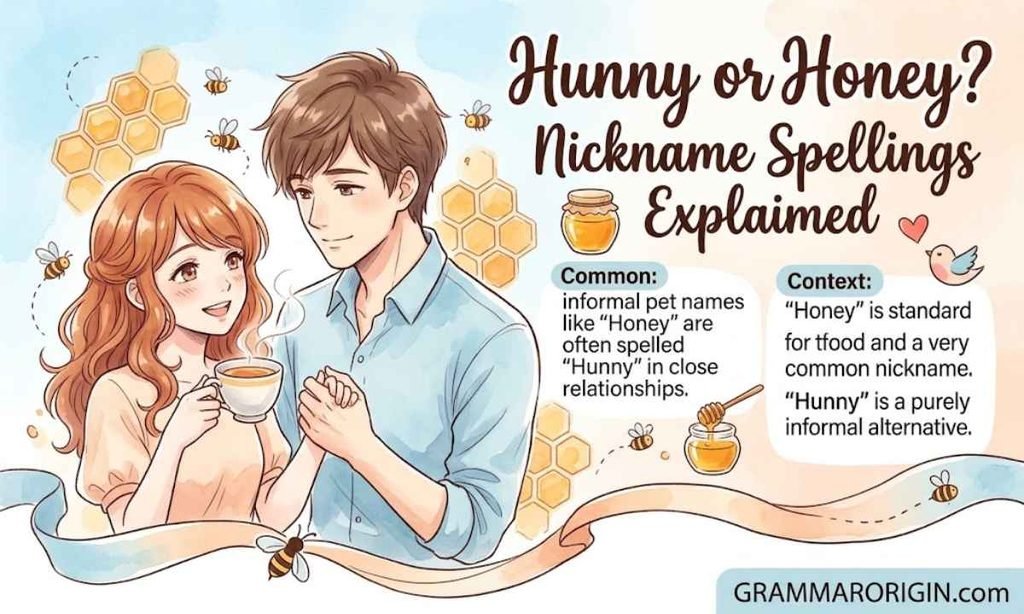
Honey saved in his phone. Hunny typed in a flirty text. Both are common, but they’re not equal.
As a nickname, honey is the correct spelling, and hunny is the playful one. Both are accepted among friends and partners, though only honey works everywhere.
If the nickname stays private, like a saved contact name, spell it any way you like. For a social media bio, a gift, or a wedding sign, honey is safer. The hunny or honey nickname choice really comes down to who will read it.
hunny or honey for husband
For a husband, use honey. It reads warm and sincere, and it fits cards, notes, and speeches without looking silly.
Hunny works for teasing texts, especially if it’s an inside joke between you. For anything your family or friends might read, like an anniversary card or a toast, stick with the standard spelling.
“Happy anniversary, honey. Thank you for every year.” Compare that with a quick text: “Don’t forget the milk, hunny!”
With hunny or honey for a husband, the real question is whether the moment is heartfelt or silly.
hunny or honey for wife
For a wife, honey is also the right spelling, and hunny is a cute option for casual texts. The choice depends on tone and audience, not on who your spouse is.
Some people find hunny adorable. Others find it a bit childish. If you’re not sure how she feels about it, honey is the safer pick, and you can always switch once you know.
“Good night, honey” feels calm and loving. “Love you, hunny!” feels bubbly. In the hunny or honey debate for a wife, both are fine when they match her taste.
is it honey or hunny when talking to female
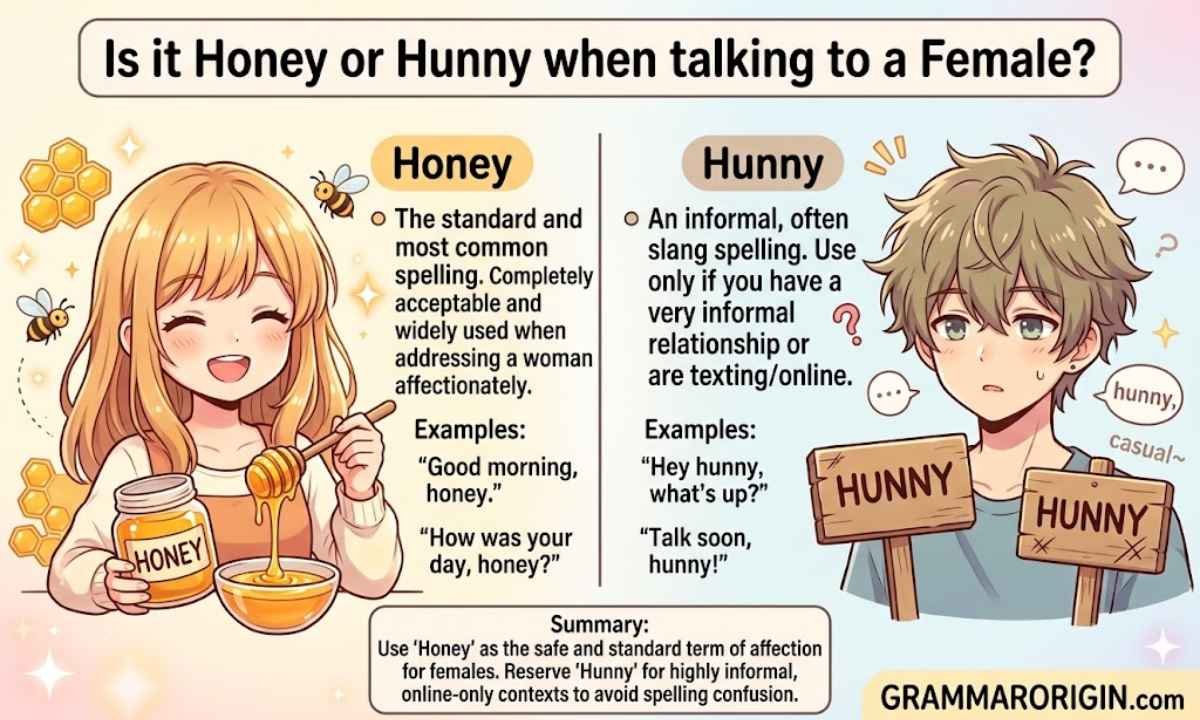
It’s honey. The correct spelling doesn’t change based on who you’re talking to, whether that’s a woman, a man, a child, or a friend.
What does change is whether the pet name fits the situation. With a partner or close friend, honey is natural. With a coworker, a customer, or a stranger, it can sound too familiar, or even like you’re talking down to them, no matter how you spell it.
If you’re speaking to a woman you don’t know well, use her name instead. When hunny or honey is the question for a female in a professional setting, the answer is usually neither.
At home: “Dinner’s ready, honey.” At work: “Hi, Maria, thanks for the update.”
honey meaning in love
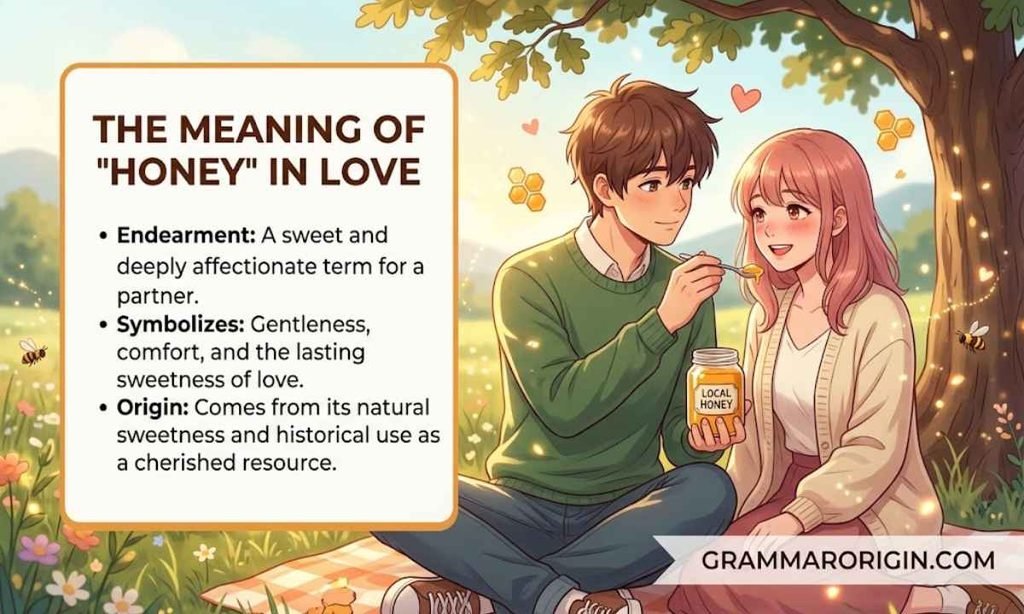
Honey, you make everything better. In love, honey is a term of endearment that means someone is sweet, precious, and dear to you.
The idea comes from the food itself. Honey is sweet, golden, and treasured, so calling a person honey is a way of saying they bring sweetness to your life.
Couples in a romantic relationship use it, but so do parents, grandparents, and close friends. The feeling changes with the voice. It can sound tender, teasing, or flirty depending on how it’s said and who’s listening.
In writing, honey suits cards and love notes. When you ask hunny or honey for love messages, hunny fits light, playful texts, and honey fits anything heartfelt.
Summary
Honey is the correct spelling, and it works in every setting. Hunny is a playful variant that belongs in casual texts and Pooh-style fun.
So with hunny or honey, pick honey when you want to be safe. Keep hunny for moments when cute is the whole point.
Frequently Asked Questions
Do I call her honey or hunny?
Call her honey if you’re writing it formally, and either one in a casual text. That’s the short answer on hunny or honey. Honey is the correct spelling, while hunny is a cute variant.
Out loud there’s no difference, since both sound like HUN-ee. If you’re unsure she’d like it, use her name instead.
What does hunny mean?
Hunny means the same as honey. It’s an informal, playful spelling used for the sweet food or as a pet name, and it’s famous from Winnie-the-Pooh. It isn’t a separate word, and most editors treat it as a playful variant or a misspelling.
Is Hunny flirty?
It can be. Hunny usually sounds cute and playful, so in a text to someone you like it can read as flirty. The spelling alone doesn’t decide it, though. Tone and your relationship do. Whether it’s hunny or honey, keep it away from coworkers and strangers.
Is honey a romantic word?
Yes, honey is a romantic term of endearment, but it isn’t only romantic. Couples use it, and so do parents, grandparents, and friends. Whether it feels romantic depends on who says it and how.

Muhammad Waqas is an English language teacher and grammar expert with over 8 years of experience helping students and professionals improve their writing skills. He specializes in English grammar, vocabulary, communication, and practical language learning. Through GrammarOrigin, Waqas shares clear, easy-to-understand content that helps readers write and speak English with confidence.