
Complimentary means free or full of praise, and complementary means completing or matching. That’s the core of Complimentary vs. Complementary, and the rest of this guide shows you how to use each word with confidence.
The two words sound identical, so only your spelling shows what you mean. You’ll find clear definitions, real examples, angles, hotel and business uses, and easy memory tricks that make the choice automatic.
The Short Answer
Complimentary means free or full of praise. Complementary means completing, matching, or going well with something else.
Here’s each word at work:
- The hotel gave us a complimentary breakfast.
- Her manager left a complimentary comment on the report.
- Blue and orange are complementary colors.
- Their skills are complementary.
The Complimentary vs. Complementary mix-up is a one-letter problem with a big gap in meaning. Both words are adjectives, and both sound exactly alike, so you can’t hear the difference. You can only see it on the page.
A quick swap helps. If “free” or “flattering” fits the sentence, write complimentary. If “matching” or “completing” fits, write complementary.
What Does Complimentary Mean?
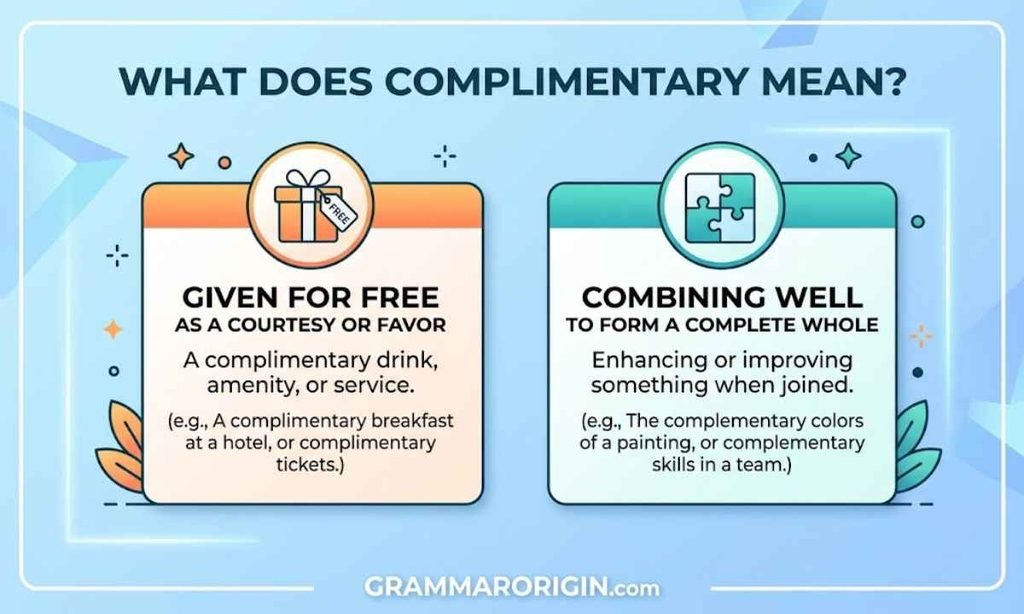
Complimentary means two things: expressing praise, or given free of charge. Both meanings come from the word compliment.
The praise meaning is the older one. The free meaning grew from the idea of a courtesy, a small gift from a host or a business to say thank you. That’s why you’ll see the phrase “compliments of” on free gifts and gift cards.
For praise:
- Her manager made several complimentary remarks about the report.
- The review was complimentary, with no harsh words at all.
For something free:
- Guests get complimentary Wi-Fi.
- The airline offered a complimentary meal after the delay.
- Each speaker received two complimentary tickets.
The dessert is compliments of the chef.
Businesses also use the word for free copies and trials, such as a complimentary copy of a book or a complimentary first consultation. Both senses explain why Complimentary vs. Complementary trips up writers: the praise and the gift grow from compliment, while the other word grows from complement.
What Does Complementary Mean?
Complementary means two things combine to make a stronger or more complete whole. They fit together like pieces of a puzzle.
- The two partners have complementary skills: one designs, and the other manages the money.
- Ginger and lemon have a complementary flavor that works well in tea.
You’ll also see the word in a few special fields:
- Complementary colors sit opposite each other on the color wheel, like blue and orange.
- Complementary angles add up to 90 degrees. There’s a full section on this below.
- Complementary medicine is used alongside standard treatment, not instead of it.
- Complementary DNA strands pair up, with A matching T and C matching G.
Notice that “complementary therapy” is a perfectly correct phrase. It means care that works with a doctor’s treatment.
In design, a complementary color scheme pairs colors from opposite sides of the color wheel, such as red and green, blue and orange, or yellow and purple. The strong contrast makes each color stand out. In Complimentary vs. Complementary terms, this is the word about teamwork, not praise.
- The poster uses a complementary palette of yellow and purple.
Compliment vs Complement (Noun and Verb)
A compliment is praise, and a complement is something that completes. Complimentary comes from compliment, and complementary comes from complement.
| Word | Part of speech | Meaning | Example |
| compliment | Noun, verb | Praise, or to praise | She gave me a compliment on my talk. |
| complement | Noun, verb | Something that completes, or to complete | The scarf is a perfect complement to the coat. |
Here’s how the verbs look in real sentences:
- He complimented the chef on the soup.
- Red wine complements a rich steak.
This pair sits at the heart of Complimentary vs. Complementary, because each adjective borrows its spelling from its noun.
Both words trace back to the Latin word complere, which means “to fill up” or “to complete.” Over time they split into two spellings with two jobs. You may also meet the phrase “a full complement of staff,” which means the complete team.
The One-Letter Difference Worth Knowing
The difference is one letter: complimentary has an i, and complementary has an e. That single letter points to a different root word.
| Word | Spelling clue | Root word | Core meaning |
| complimentary | has pli, like compliment | compliment | praise or free |
| complementary | has ple, like complement | complement | completing or pairing |
Both words share the same start, “compl,” so they blur together fast. The split happens in the middle, at “pli” and “ple.” That one-letter gap is the whole story of Complimentary vs. Complementary.
One sentence can show the whole gap:
- The complimentary wine arrived with dessert. (It was free.)
- The complementary wine pairing lifted the whole meal. (It matched the food.)
Easy Memory Tricks
Link the i in complimentary to “I like it,” and link the e in complementary to “each other.” Those two hooks cover almost every sentence.
Here are the hooks side by side:
- Complimentary: the i stands for “I like it,” which is praise, or a free perk you’re glad to get.
- Complementary: the e stands for “each other,” because the two things complete each other.
These tricks make Complimentary vs. Complementary easy to settle in seconds. You can also use a swap test. Replace the word with “free” or “flattering” for complimentary, and with “matching” or “completing” for complementary.
- The hotel offers complimentary parking. (Swap in “free.” It works.)
- Her scarf is complementary to the coat. (Swap in “matching.” It works.)
Don’t use “complete” as your swap word. A complete breakfast is a full meal, but a complimentary breakfast is a free one, and the two aren’t the same thing.
Read More Related Post Bear Weight or Bare Weight: Which Is Correct? Meaning
Where Writers Go Wrong
The most common slips are using complimentary for colors, skills, or matching ideas, and using complementary for free perks. Both Complimentary vs. Complementary errors come from the identical sound.
Matching ideas:
- Incorrect: The two colors are complimentary.
- Correct: The two colors are complementary.
- Incorrect: Their talents are complimentary to each other.
- Correct: Their talents are complementary to each other.
Free perks:
- Incorrect: Guests receive complementary coffee at check-in.
- Correct: Guests receive complimentary coffee at check-in.
The noun forms trip people up too. Compliment and complement are different words, and each one needs its own spelling.
- Incorrect: Thank you for the lovely complement.
- Correct: Thank you for the lovely compliment.
- Incorrect: The sauce is a compliment to the dish.
- Correct: The sauce is a complement to the dish.
These noun slips are close cousins of the Complimentary vs. Complementary mix-up, and they show up in emails, menus, and school papers.
Context decides some cases, because both words can fit the same noun. Check what you mean, and the spelling follows:
- She booked a complementary therapy session alongside her regular treatment.
- She booked a complimentary therapy session, and it cost nothing.
The first one is care that works with standard medicine. The second one is a free session. Spell checkers can’t tell which one you intended, so the choice is always yours.
Complimentary vs complementary pronunciation
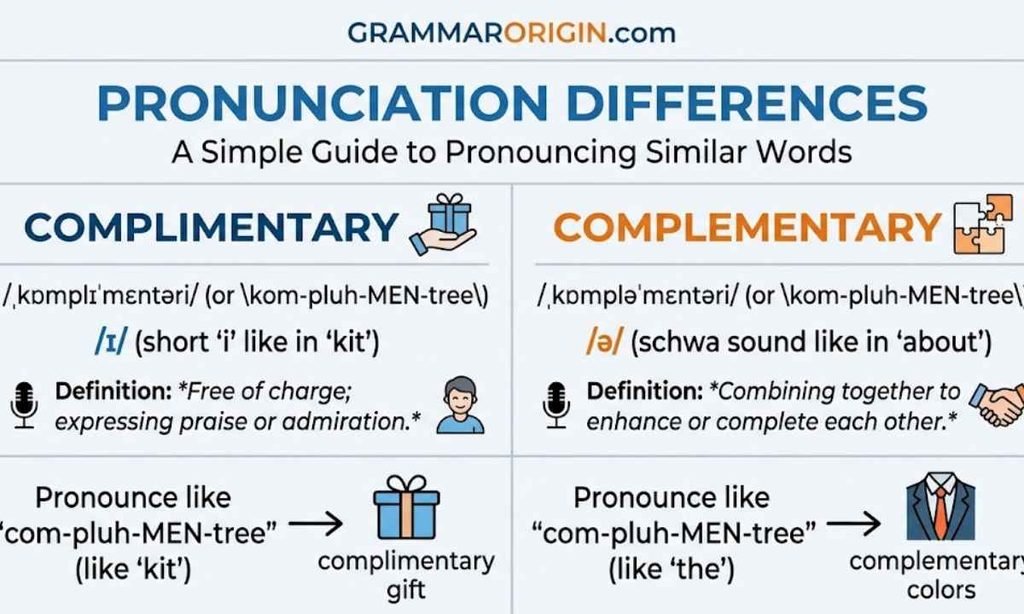
Both words are pronounced exactly the same, so they’re homophones. The stress falls on the third syllable: kom-pluh-MEN-tuh-ree.
In American English, the International Phonetic Alphabet (IPA) shows both words as /ˌkɑːmpləˈmɛntəri/. British speakers usually say the first vowel as /ɒ/, but the two words still match each other.
The unstressed syllables are the reason your ear can’t help. In both words, “pli” and “ple” shrink to a quick “puh,” so the only real beat is MEN. Slow down and say them one after the other, and you’ll hear that they match.
Because your ear can’t separate them, spelling is the only clue. Here’s how each one looks written out:
- complimentary /ˌkɑːmpləˈmɛntəri/
- complementary /ˌkɑːmpləˈmɛntəri/
The nouns behave the same way. Compliment and complement also sound alike, so the Complimentary vs complementary confusion starts well before the adjectives.
Complimentary vs complementary meaning
In meaning, complimentary is about praise and free gifts, while complementary is about completing or matching. Both are adjectives, but they point in different directions.
| Aspect | Complimentary | Complementary |
| Core idea | Praise or free of charge | Completing or going well together |
| Related word | compliment | complement |
| Close synonyms | flattering, free, gratis, courtesy | matching, completing, supporting, harmonious |
| Common partners | breakfast, remarks, tickets, upgrades | colors, skills, angles, therapy |
| Opposite idea | critical or paid | clashing or conflicting |
Complimentary can carry two senses at once. A complimentary review copy of a book is free, and it may also come with kind words. Context tells you which sense matters, and the Complimentary vs complementary spelling stays the same either way.
Use the table as a quick checkpoint. If the sentence is about generosity or kind words, think complimentary. If it’s about two things fitting together, think complementary.
Read More Related Post Bear Weight or Bare Weight: Which Is Correct? Meaning
Complimentary vs complementary examples
Here are real sentences for each word, grouped so you can spot the pattern. Read them out loud, and the meaning will stick.
Complimentary examples:
- The spa offered a complimentary drink on arrival.
- Her teacher gave a complimentary review of the essay.
- The hotel includes complimentary shuttle service to the airport.
- He was handed a complimentary pass for the museum.
- The bakery handed out complimentary samples at the door.
Complementary examples:
- The soft music was complementary to the calm room.
- The team needs complementary strengths, not copies of the same skill.
- Sweet fruit and salty cheese make a complementary snack.
- The two apps are complementary, and each one fills a gap in the other.
- A careful editor and a bold writer make a complementary team.
Practice with these Complimentary vs complementary examples, and your instinct will improve fast.
Complimentary vs complementary angles
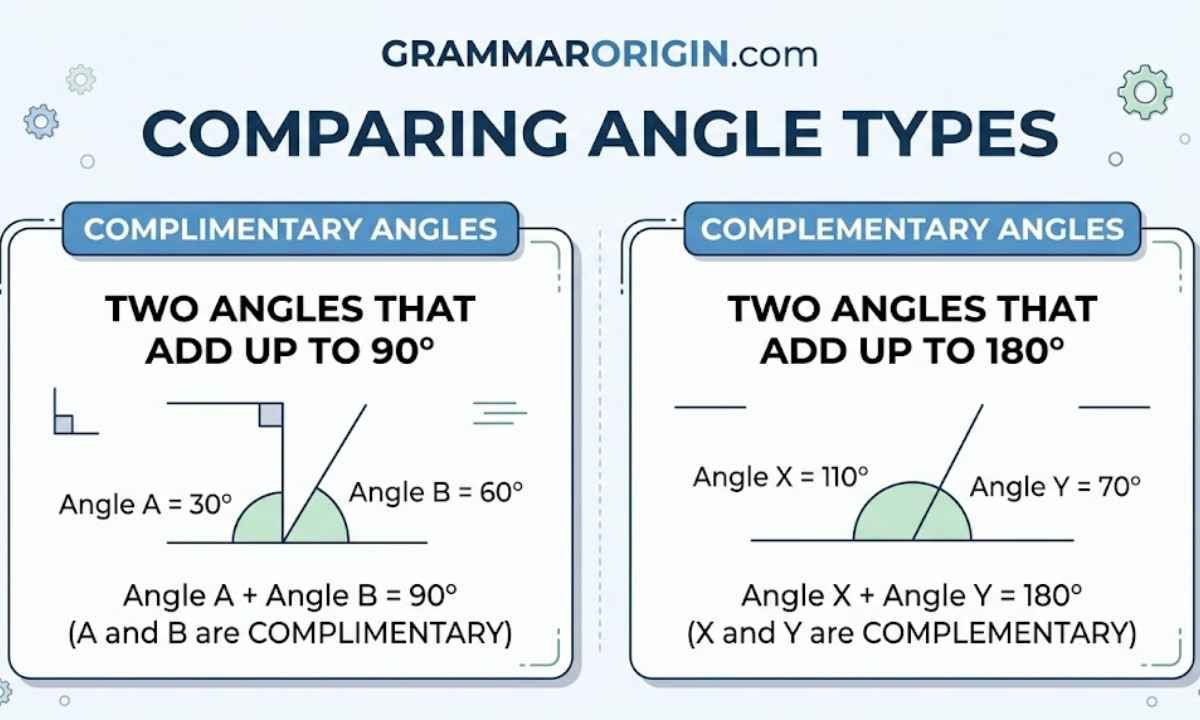
In geometry, the correct term is complementary angles, spelled with an e. Two angles are complementary when they add up to 90 degrees.
“Complimentary angles” is a common misspelling, because the word has nothing to do with praise. Supplementary angles are a different pair, and they add up to 180 degrees.
- A 30 degree angle and a 60 degree angle are complementary.
- A 120 degree angle and a 60 degree angle are supplementary.
- Incorrect: These are complimentary angles.
- Correct: These are complementary angles.
Complementary angles don’t have to touch. Two separate angles of 20 degrees and 70 degrees are complementary because they add up to 90, even if they sit in different shapes. For the Complimentary vs complementary angles question, the math term is always the e version.
To find the complement of an angle, subtract it from 90. The complement of 35 degrees is 90 minus 35, which equals 55 degrees.
Here’s a handy memory hook for the pair. Complementary starts with C, like “corner,” which is a 90 degree right angle. Supplementary starts with S, like “straight,” which is a 180 degree straight line.
Complimentary vs Complementary in Business and Hotels
In hotels and shops, complimentary means free, and complementary means two things work well together. Getting this right matters because the wrong word can change what a customer expects to pay.
Hotels and airlines use complimentary for perks such as breakfast, Wi-Fi, parking, upgrades, and welcome drinks. Some of these come with conditions, so it’s smart to read the fine print before you count on them.
- The suite includes a complimentary welcome drink.
- Parking is complimentary for guests who book directly.
Complementary has its own place in business. In economics, complementary goods are items people use together, like a printer and its ink. When demand for one rises, demand for the other often rises too.
- A printer and its ink are complementary goods.
- The company’s two services are complementary, so customers often buy both.
Job ads use the word too. A hiring manager who asks for “complementary skills” wants a team whose strengths fit together, and a store that offers “complimentary gift wrapping” is giving that service for free.
In business writing, a Complimentary vs. Complementary error can quietly change a promise into a different one.
A short tip for marketing copy: if something costs nothing, write “free” or “complimentary.” If it pairs with a main product, write “complementary.” Mixing them up can make an ad look careless, or worse, misleading.
Conclusion
Complimentary vs. Complementary comes down to one letter and two jobs. Complimentary covers praise and free gifts, while complementary covers things that complete or match each other.
Use the swap test, picture the i for “I like it” and the e for “each other,” and the right spelling will come quickly. Keep this Complimentary vs. Complementary guide handy for the next time you’re writing a hotel notice, a review, or a math answer.
Frequently Asked Questions
Is free food complimentary or complementary?
Free food is complimentary. Complimentary means given at no cost, which settles Complimentary vs. Complementary for food.
Is complimentary free or paid?
Complimentary means free. Check the fine print, because some hotels attach conditions to their complimentary perks.
What is the difference between complement and complementary?
Complement is a noun or verb meaning something that completes. Complementary is the adjective that describes things that complete each other.
What does complimentary mean?
Complimentary means expressing praise or given free of charge. That’s the key idea in Complimentary vs. Complementary.
Is it complimentary or complementary breakfast?
It’s complimentary breakfast when the meal is free. A complementary breakfast would mean one that completes something else, which is rarely what people intend.
Can complementary mean free?
No, complementary never means free. It means completing or matching, so use complimentary for anything given at no cost, and keep Complimentary vs. Complementary straight.

Muhammad Waqas is an English language teacher and grammar expert with over 8 years of experience helping students and professionals improve their writing skills. He specializes in English grammar, vocabulary, communication, and practical language learning. Through GrammarOrigin, Waqas shares clear, easy-to-understand content that helps readers write and speak English with confidence.