
Bear weight is the correct phrase when something carries or supports a load. Bare weight is a slip that mixes up two words with the same sound. If you’ve ever stopped mid-sentence over bear weight or bare weight, this guide settles it.
You’ll get clear meanings, real sentence examples, a quick spelling test, and the injury sense people search for after a bad fall. We’ll also look at the other bear, the animal, and what it weighs in kilograms.
Quick Answer
Bear weight is correct whenever something carries, supports, or handles a load. Bare is a different word that means uncovered, empty, or plain.
Example: The new shelf can bear weight from at least twenty books.
So in the bear weight or bare weight choice, “bear weight” is the right pick for physical loads and for pressure you carry in life. “Bare weight” only sneaks in because the two spellings sound identical.
Meaning and Definition of Each Word
Bear means to carry, support, or put up with something. Bare means uncovered, empty, or stripped back. Keep those two ideas apart and the bear weight or bare weight puzzle mostly solves itself.
1. Bear
Bear is a verb that means to carry, hold up, or endure. It’s also the name of the animal, which makes it a noun too.
Example: Thick steel beams bear the weight of the whole roof.
In the bear weight or bare weight pair, bear is the verb, and it works in two ways.
It can describe real objects like beams, knees, and shelves, which is the literal use. It can also describe pressure like stress, blame, or a bill, which is the figurative use. Its past forms are bore and borne, and we’ll sort those out below.
2. Bare
Bare is an adjective that means uncovered, empty, or basic. It’s also a verb that means to uncover or reveal.
The word comes from Old English, where it meant naked, so all its meanings link back to being exposed. That’s why it loses the bear weight or bare weight contest every time a sentence is about carrying a load.
Example: She stepped onto the bare floor and felt the cold right away.
Example: He bared his teeth like a nervous dog.
Pronunciation and Homophones
Bear and bare sound exactly the same, so you can’t settle bear weight or bare weight by ear. The sound is roughly “bair”, and the usual IPA is /bɛər/. They’re homophones, which means they sound alike but have different spellings and meanings.
Example: A bear can bear plenty of weight, but it won’t rest on bare rock.
That one sentence holds three meanings behind a single sound: the animal, the verb, and the adjective. It’s the reason the bear weight or bare weight mix-up is such a classic homophone error.
It also explains why a spell checker can’t help you. Both spellings are real words, so only the meaning of your sentence shows which one you need.
Key Differences Between the Words
The biggest difference in the bear weight or bare weight question is meaning. Bear is about carrying and enduring, while bare is about being uncovered.
Example: The old beam can bear the weight of the loft.
Example: The old beam looked bare after we stripped the paint.
Here’s how else the two words split apart:
- Meaning: bear carries, supports, or tolerates something, and bare means uncovered or empty.
- Word type: bear is a verb (and a noun for the animal), while bare is an adjective or a verb.
- Forms: bear becomes bore, borne, and bearing, while bare becomes bared and baring.
- With weight: bear weight is a normal phrase, but bare weight doesn’t mean carrying anything.
- Region: both words are spelled the same in American and British English, so bear weight or bare weight is never a UK versus US question.
Comparison Table
This table puts both words from the bear weight or bare weight pair side by side, so you can check a sentence in a few seconds.
| Word | Type | Meaning | Example |
| bear | verb | to carry, support, or endure | The ladder can bear your weight. |
| bear | noun | the large animal | The bear walked into the river. |
| bare | adjective | uncovered, empty, or plain | The room looked bare without furniture. |
| bare | verb | to uncover or reveal | She bared her feelings at last. |
If your sentence is about holding something up, you’re in the first row. Everything else points to bare or to the animal.
Examples in Sentences
Here are ready-to-use sentences for the bear weight or bare weight choice, grouped by what each word means. Look at what the word is doing in each group.
Bear Weight
Bear weight works for objects, bodies, and feelings.
- The old bridge can still bear weight from heavy trucks.
- Gymnasts train their wrists to bear weight during handstands.
- That stool can’t bear weight from two people.
- A good friendship can bear the weight of a hard year.
- He couldn’t bear weight on his sore ankle after the fall.
- The shelves bore the weight of a full library.
Notice the pattern. The word after bear is always a load, whether it’s physical, emotional, or medical. That load is how you settle bear weight or bare weight at a glance.
Bare
Bare describes something uncovered or empty, or it means to uncover.
It never carries anything. It strips something down to its plain, visible state.
- Her bare feet left prints on the wet sand.
- The walls stayed bare until we found some art.
- The cupboard was bare by Friday.
- He bared his teeth at the camera.
- The report lays bare how the budget was spent.
Common Mistakes
Most bear weight or bare weight errors happen because people write the sound they hear instead of the meaning they want. The table below shows five slips that show up again and again.
| Incorrect | Correct | Why |
| The deck can bare weight from a hot tub. | The deck can bear weight from a hot tub. | The deck carries a load. |
| She walked in bear feet. | She walked in bare feet. | Feet with no shoes are uncovered. |
| Please bare with me. | Please bear with me. | It means “be patient.” |
| We did the bear minimum. | We did the bare minimum. | It means nothing extra. |
| He can’t bare the pain. | He can’t bear the pain. | He can’t endure it. |
The “bare with me” slip is the funniest of the group. Read literally, it asks someone to uncover themselves, which is probably not what you meant in a work email.
Is “Bare Weight” Ever Correct?
Not in the sense of carrying a load. Bare weight isn’t a set phrase the way bear weight is.
In rare cases, bare can sit beside weight as an ordinary adjective that means stripped down, such as the bare weight of an empty frame. So the bear weight or bare weight rule holds even in this rare case.
Clearer terms exist, too. Trade and transport writers prefer unladen weight, tare weight, or empty weight, because those can’t be mistaken for a spelling error.
Example: The bare frame is light, but it can still bear weight from a rider.
Tips to Remember the Difference
Start with the swap test. If “carry” or “support” fits your sentence, write bear. If “uncovered” fits, write bare. A few quick checks make the bear weight or bare weight call easy.
- The swap test: Replace the word with “carry” or “support.” If the sentence still works, you need bear.
- The compound test: Ask whether the phrase could become weight-bearing or load-bearing. If it can, bear is the word. Nobody writes “weight-baring.”
- The picture test: Picture a bridge holding up traffic for bear. Picture a leafless tree in January for bare.
- The slow proofread: Spell checkers accept both words, so reread any line with weight, load, burden, or pressure and check the spelling on purpose.
Try it: The tiny balcony can bear weight from two chairs, and “carry” fits there just fine.
Read More Posts Damnit or Dammit: Which Spelling Is Correct? Meaning & Examples
When to Use Each Word
Reach for bear when something is carried, held up, or put up with. Reach for bare when something is uncovered, empty, or stripped back. Use that split whenever bear weight or bare weight trips you up.
Use “Bear”
Use bear for physical loads, feelings you endure, and responsibilities you take on.
- The loft ladder is rated to bear a full adult’s weight.
- Nurses often bear heavy workloads during flu season.
- She’ll bear the cost of the repairs herself.
In every case, something heavy is being held, which is why bear wins the bear weight or bare weight choice. The heaviness can be steel, stress, or an invoice, and bear covers all three.
Use “Bare”
Use bare for surfaces, bodies, and facts that are uncovered or reduced to the basics.
Bare also lives inside fixed phrases like bare minimum and bare facts, where it simply means nothing extra.
- Take your shoes off and walk on the bare floor.
- The flat came with only the bare essentials.
- Her comments bared a deep disagreement.
Common Phrases With Bear and Bare
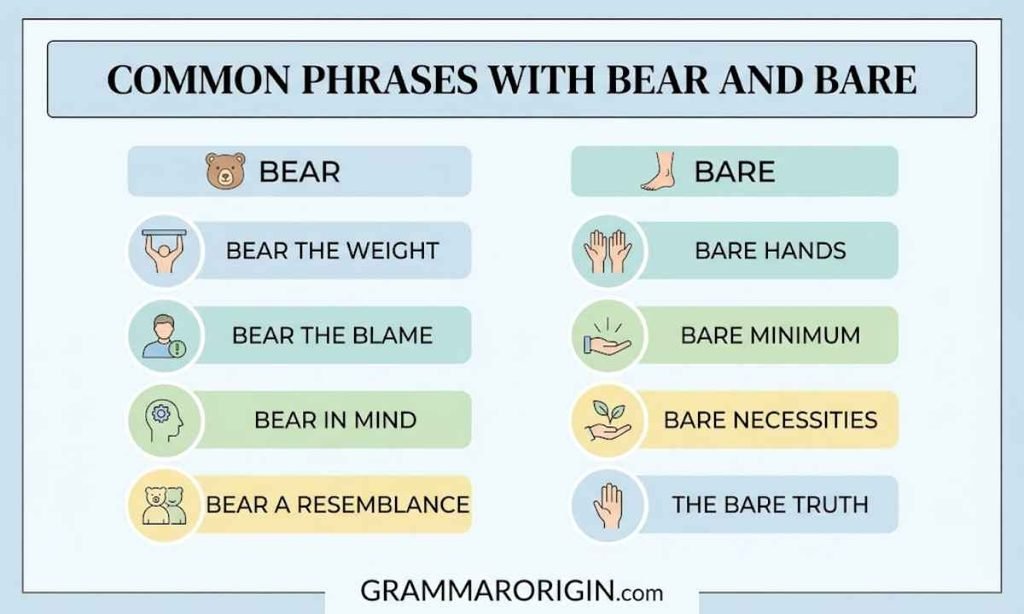
Most phrases that use these words are idioms or fixed expressions, so it helps to learn them as whole chunks. Learn each phrase once, and the bear weight or bare weight choice stops being a problem.
| Phrase | Meaning | Example |
| bear with me | be patient | Please bear with me while the page loads. |
| bear in mind | remember | Bear in mind that the bridge closes at night. |
| bear the cost | pay for something | The company will bear the cost of the move. |
| bear the burden | carry a heavy duty | She had to bear the burden of the final decision. |
| bear fruit | produce results | Months of practice finally bore fruit. |
| bare minimum | the least possible | He did the bare minimum to pass. |
| bare bones | only the basics | It’s a bare bones plan, but it works. |
| lay bare | expose fully | The audit laid bare the mistakes. |
Grammar Rules
Bear is a verb (and an animal noun), while bare is an adjective or a verb. Each follows its own grammar, which is why they can’t swap places in bear weight or bare weight.
Example: The pillar can bear weight, and the bare pillar looked cold.
- In bear weight, bear is a transitive verb, so it takes an object: weight, a cost, or a grudge.
- Use the base form after helpers and “to”: can bear, will bear, to bear.
- Use bore for the simple past: The wall bore the load.
- Use borne after have, has, or had, and in passive phrases like “borne by.” Use born only for birth.
- Bare takes -d in the past, so you get bared, and baring as the -ing form.
- Bare can sit before a noun, as in bare floor. Plain bear can’t, so write weight-bearing instead of “bear weight wall.”
Bear Verb Forms Table
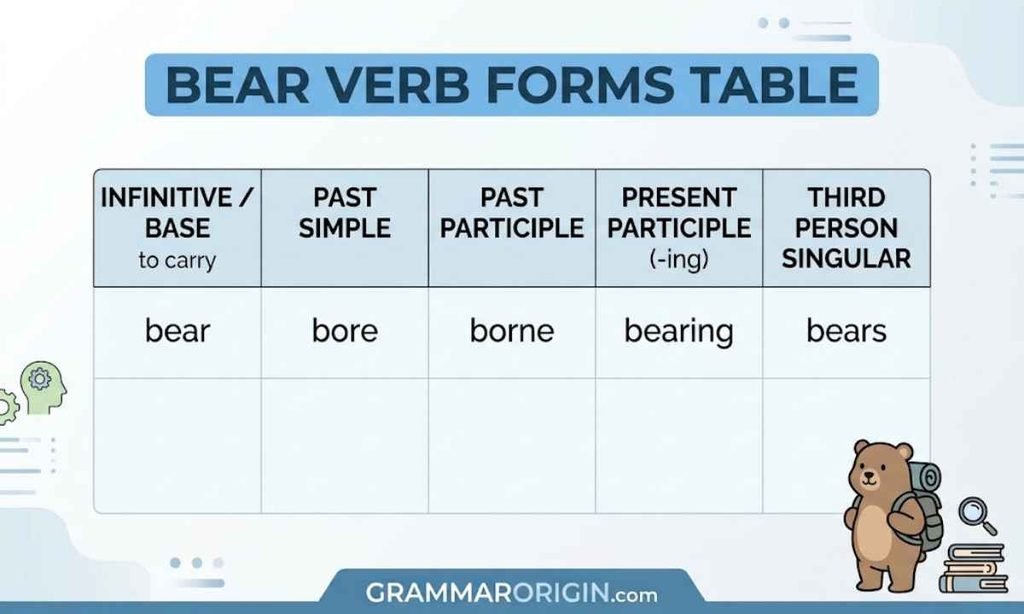
Bear changes shape in the past tense, and that’s where writers who nail bear weight or bare weight still trip. The table lists every form with a short example.
| Form | Word | Example |
| base | bear | The roof can bear snow. |
| third person | bears | The post bears most of the load. |
| simple past | bore | The bridge bore the traffic for decades. |
| past participle | borne | The cost has been borne by the owners. |
| -ing form | bearing | The wall is bearing the weight of the floor above. |
Borne means carried or endured. Born relates to birth, as in “she was born in May.” Borne can also cover giving birth in active sentences, like “she has borne two children.”
Example: The family has borne the cost, and the baby was born in June.
Weight-Bearing and Load-Bearing
Weight-bearing and load-bearing are adjectives built from the -ing form of bear. They always use bear, never bare, so the bear weight or bare weight rule carries over to them.
You’ll see them hyphenated before a noun, as in a load-bearing wall or a weight-bearing exercise. The same pattern gives us non-weight-bearing, a common term in injury care. Writing “weight-baring” or “load-baring” is always a mistake.
Weight-bearing means able to carry weight. A structural engineer checks which walls are load-bearing before a renovation, and fitness guides call walking and jogging weight-bearing exercise because the legs work against gravity.
Example: Builders won’t remove a load-bearing wall without adding a support beam.
Example: Walking and jogging are weight-bearing exercises.
Synonyms or Related Words
Bear has plenty of close synonyms, and so does bare. Few of them are perfect swaps, though, so check the tone. A synonym is also a handy way to double-check bear weight or bare weight.
Bear
Good substitutes include carry, support, hold up, sustain, shoulder, endure, tolerate, withstand, and stand.
Withstand fits forces like wind or snow. Tolerate fits annoyances, and shoulder fits duties.
Example: The old table still supports a heavy lamp.
Example: The tent can withstand strong wind.
Read More Posts Damnit or Dammit: Which Spelling Is Correct? Meaning & Examples
Bare
Good substitutes include naked, uncovered, exposed, empty, plain, stripped, reveal, expose, and uncover.
Plain and stripped suit objects, while naked suits bodies. Reveal and expose suit facts and feelings.
Example: The tree stood exposed and leafless in January.
Weight of a bear in kg
The weight of a bear depends on its species. Adults run from about 25 kg for the sun bear to roughly 700 kg for the largest male polar bears.
| Bear | Typical adult weight | Note |
| Sun bear | about 25 to 65 kg | The smallest bear species |
| Giant panda | about 70 to 130 kg | Males run heavier |
| American black bear | about 40 to 250 kg | Varies by sex and region |
| Brown bear (grizzly bear) | about 130 to 400 kg | Coastal bears grow larger |
| Polar bear | about 150 to 700 kg | Males are far heavier than females |
These are rounded ranges, and real weights shift with age and season. Bears can lose up to roughly 30 percent of their body weight during hibernation, so the same animal weighs less in spring than in autumn. For exact numbers in one region, check a national wildlife agency.
This heading is about the animal, not the verb, but the two do meet. A big polar bear has to bear several hundred kilograms on four paws.
Bear weight or bare weight on foot
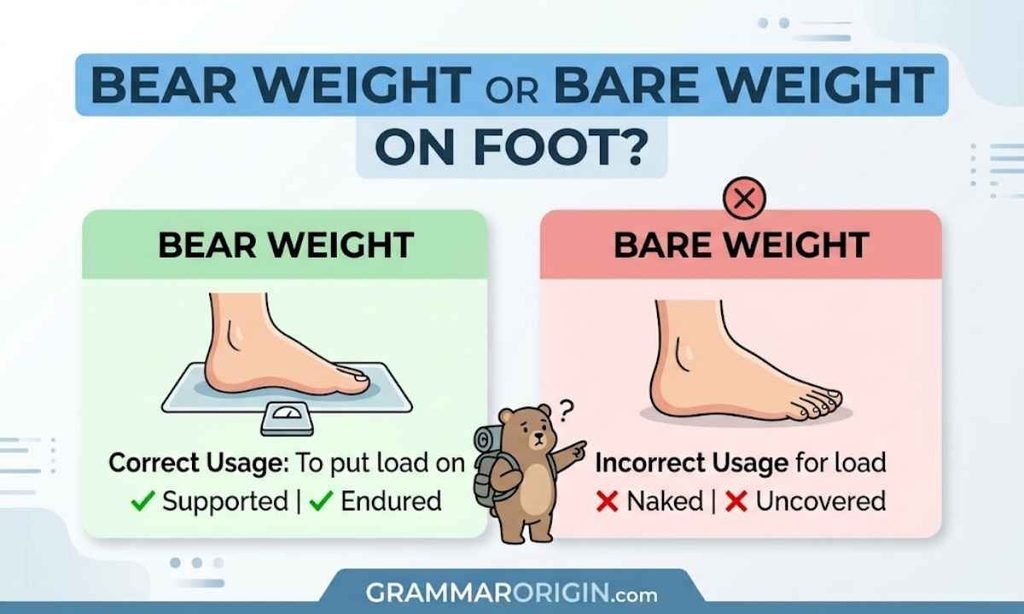
When a doctor or a leaflet says you can’t bear weight on your foot, it means you can’t stand on it. The spelling is bear, even in bear weight or bare weight on foot searches.
Searches like bear weight or bare weight on foot often come from people dealing with an injury, not a grammar question.
Example: After the twist, she couldn’t bear weight on her left foot.
Medical teams use a few set terms to describe how much load an injured leg may take:
- Non-weight-bearing: no weight at all on the limb.
- Partial or toe-touch weight-bearing: a light touch on the floor for balance only.
- Weight-bearing as tolerated: as much weight as feels comfortable.
- Full weight-bearing: normal standing and walking.
Crutches, a walking boot, or a knee scooter often go with the first stages. A physiotherapist or an orthopedic surgeon usually decides when to move on to the next one.
Bare does belong in one related phrase here. A bare foot is simply a foot with no shoe or sock, as in “she couldn’t bear weight on her bare foot.” Both words are spelled correctly there.
If you can’t bear weight after an injury, get checked by a doctor or urgent care, because it can point to a fracture. This guide is about language, not medical advice.
Frequently Asked Questions
Is it bear weight or bare weight?
It’s bear weight. Bear means to carry or support a load, and bare means uncovered. In the bear weight or bare weight choice, only bear fits a sentence about carrying.
Is bare weight ever correct?
Rarely, and never for carrying a load. Bare can describe a stripped-down item, like the bare weight of an empty frame, but unladen weight or tare weight are clearer terms.
Is it bear weight or bare weight on foot after an injury?
It’s bear weight. “Can’t bear weight on foot” means you can’t put your body weight on it, and it’s a good reason to get checked by a doctor.
What is the past tense of bear weight?
In the bear weight or bare weight pair, the simple past is bore weight, as in “the beam bore weight.” The past participle is borne, as in “the beam has borne weight for years.”
Is it weight-bearing or weight-baring?
It’s weight-bearing. The word comes from the -ing form of bear, and it takes a hyphen before a noun, as in a weight-bearing exercise.
How much does a bear weigh in kg?
It depends on the species. Adults range from about 25 kg for a sun bear to roughly 700 kg for a large male polar bear.
Summary
Bear weight is the right spelling for carrying, supporting, or enduring a load. Bare means uncovered or empty. That settles the bear weight or bare weight question in nearly every sentence you’ll write.
Keep the swap test close. If “carry” fits, write bear, and if “uncovered” fits, write bare, and the bear weight or bare weight choice is settled.

Muhammad Waqas is an English language teacher and grammar expert with over 8 years of experience helping students and professionals improve their writing skills. He specializes in English grammar, vocabulary, communication, and practical language learning. Through GrammarOrigin, Waqas shares clear, easy-to-understand content that helps readers write and speak English with confidence.