
The correct spelling is offered, with a single r. “Offerred” is a misspelling that none of the major dictionaries list. So if you’re stuck on offered or offerred in an email or an exam answer, go with the shorter one.
Below you’ll find the stress rule behind the spelling, a side-by-side look at preferred and referred, plus pronunciation, related forms and a short quiz. A few minutes here should settle it for good.
Offered or Offerred: Quick Answer ✅⚡
Offered is correct. Offerred is wrong everywhere, from text messages to signed contracts, because English adds -ed to offer without touching the r.
So when you’re torn between offered or offerred, the answer fits in three words: one r only. The rest of this guide explains why that rule holds.
✔ Main Difference:
The difference is a single letter. Offered has one r, offerred has two, and only the first is a real word.
Take this line from a job email: “The panel offered her the role on Monday.” Add a second r and the sentence suddenly looks careless.
Meaning, grammar and pronunciation stay identical either way, so the extra r adds nothing except the error.
📌 Examples:
Two correct sentences and one wrong one make the pattern easy to spot.
- ✔ A friend offered to feed the cat while we were away.
- ✔ The gym offered a free week to new members.
- ✖ The gym offerred a free week to new members.
The wrong line differs by one letter, which is exactly why it slips past tired eyes.
Definitions with Examples 📖✍️
Offered is the past tense and past participle of offer, while offerred is just a typo with no meaning. That’s why the two definitions below are so different in length.
🟢 Offered (Definition)
Offered means presented or put forward for someone to accept, refuse or consider. It works for a bus seat, a piece of advice or a salary in a formal job letter.
Grammatically, it does two jobs. It’s the simple past (she offered) and the participle that follows has, had or was (it was offered).
📌 Examples:
Offered turns up in the simple past, in perfect tenses and in passive sentences.
- The bakery offered free samples to everyone in line.
- By noon, two vendors had offered discounts.
- I was offered a window seat but chose the aisle.
Each one uses a different tense or voice, yet the spelling never moves.
🔵 Offerred (Definition)
Offerred has no definition because it isn’t a word in standard English. Spell checkers underline it for the same reason.
People type it by analogy with verbs like prefer, which really do double their r. We’ll pull those two cases apart further down.
📌 Examples:
Here are the errors as they usually appear, each followed by its fix.
- ✖ The manager offerred me extra shifts. → ✔ The manager offered me extra shifts.
- ✖ I’ve offerred my seat twice today. → ✔ I’ve offered my seat twice today.
Nothing else in either sentence needs changing. Only the extra r goes.
🟡 Simple Meaning
In plain words, offered means “put on the table,” and offerred means nothing at all.
Say a café offered you a free coffee. It set the coffee in front of you and left the choice with you.
The Origin of Offered 📜
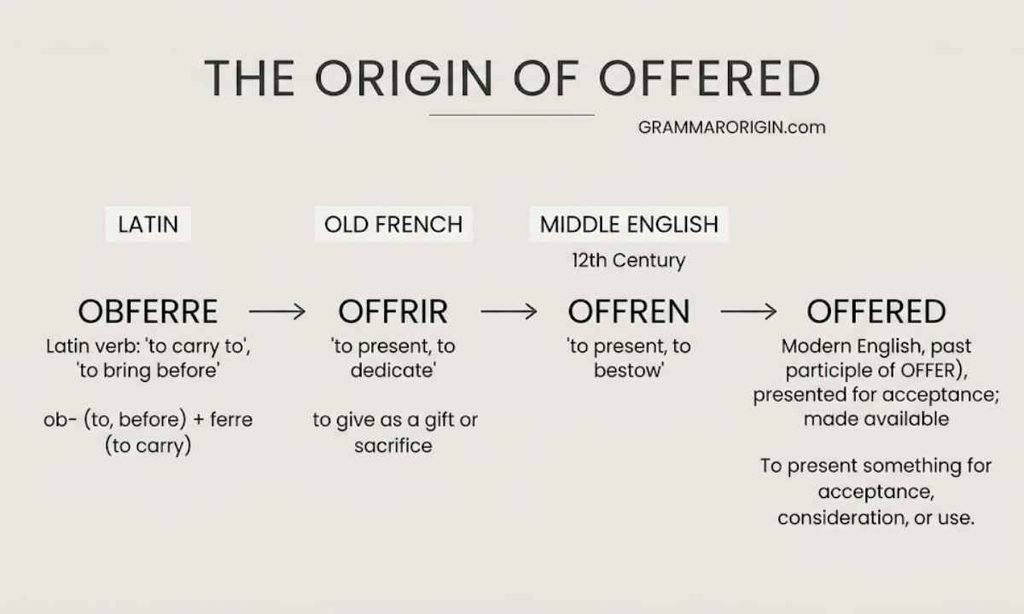
Offered comes from the verb offer, which English took from Latin offerre, “to bring before.” Merriam-Webster and Etymonline both split it into ob- (“toward”) plus ferre (“to carry”).
The word actually arrived twice. Old English offrian brought the religious sense of sacrifice, and Old French offrir later reinforced the everyday sense of proposing something. The “present for acceptance or rejection” meaning dates from the early 1400s.
📚 Rule:
Add -ed to offer and leave the r alone. That’s the whole rule for forming the past tense here.
offer + ed = offered
None of the Latin history changes this, because English -ed spelling follows stress, not ancestry.
🧠 Key Idea:
Stress decides the spelling, not the word’s family tree. Here’s the twist: offer, suffer, differ, prefer, refer and defer all trace back to Latin ferre, yet only the last three double the r.
Look at the results. Suffered and differed keep one r, while preferred and deferred take two. Same root, different stress, different spelling.
Offered vs Offerred: Key Difference 🌍📊
Offered is the standard, correct form, and offerred is a misspelling with one extra r. Everything else, including meaning and sound, is identical.
📊 Comparison Table:
The table puts both spellings next to each other on the points that matter.
| Feature | Offered | Offerred |
| Status | Correct standard spelling | Misspelling |
| Listed in dictionaries | Yes, as a form of offer | No |
| Past tense of offer | Yes | No |
| UK and US English | Accepted in both | Accepted in neither |
| Formal writing | Safe | Marked as an error |
If you’re ever unsure, the “Past tense of offer” row is the quickest check.
📌 Example:
Same sentence, two spellings, and only one passes. “The college offered her a scholarship” is fine, while “The college offerred her a scholarship” gets flagged by any editor or spell checker.
Why “Offered” Is Correct (Easy Rule) 🧠✍️
Offered is correct because the stress in offer falls on the first syllable, so the final r never doubles. Say it aloud and you’ll hear it: OFF-er, with a light, quiet ending.
✔ Simple Rule:
Double the final consonant only when the base word’s last syllable is stressed and ends in one vowel plus one consonant. If the stress sits earlier, just add -ed.
That’s why admit becomes admitted (ad-MIT) but visit becomes visited (VIS-it). Offer lands on the visit side.
📌 Word Stress:
In offer, the stress sits on the first syllable (OF-fer), and the final -fer is a weak “fur” sound. Weak endings don’t get doubled letters.
Clap it out if you like: OF-fer is strong, weak, while pre-FER is weak, strong. Say offer and prefer back to back and notice where your voice lands.
📌 More Examples Like This:
Most verbs that end in -er behave the same way, because English rarely puts stress on a final -er. Look at the pattern: enter → entered, answer → answered, gather → gathered, deliver → delivered, whisper → whispered.
All five keep a single r for the same reason offer does. The stress is up front.
Offered vs Preferred: Why One R and Two R?
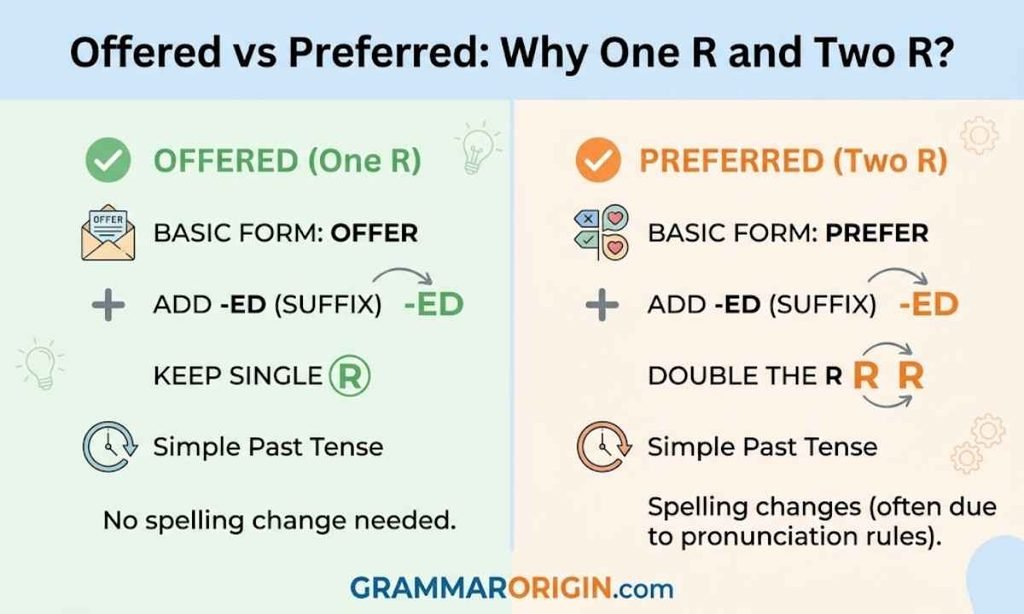
Preferred has two r’s because its stress lands on the last syllable (pre-FER), while offered keeps its stress at the front (OF-fer). That one shift in stress changes the spelling.
Verbs like prefer, refer, defer, infer, confer and transfer all stress the final syllable, so they double: preferred, referred, deferred, inferred, conferred, transferred. The -ing forms follow suit, which is why it’s preferring but offering.
One sentence can hold both: “She preferred tea, but the host offered coffee.” Different stress, different spelling, same -fer ending.
British Spelling Exceptions (travelled, labelled)
British English doubles a final l even when the stress isn’t on it, but that exception never touches offered. Both British and American writers spell it with one r.
The classic pairs are UK travelled and labelled against US traveled and labeled. Cancelled, modelled and levelled follow the same British habit, and all of them involve the letter l, not r.
So if British doubling has ever made you wonder whether offerred might be allowed, it can’t. “The airline offered refunds to passengers who travelled on Friday” is correct British English, and only the second verb changes in American English.
🔤 How to Spell “Offered” Correctly (Common Search Questions)
Spell it o-f-f-e-r-e-d: two f’s, one r, and -ed at the end. The doubled letter in this word is the f, so the r has no reason to double.
Write offered out letter by letter, O, F, F, E, R, E, D, and you can see the double f sitting in the middle. That’s the part worth memorizing.
People often search how to spell offered, offer spelling or spelling of offered. The base word is offer, and the past form is offered. These are the wrong versions you’ll see most often:
- ✖ offerred
- ✖ offerring
- ✖ ofered
- ✖ offerd
Each one adds an r, drops an f or loses an e.
Which Spelling Should You Use? 🎯📝
Use offered every time. No dialect, style guide or exam board accepts offerred.
The same goes for the related forms: offers and offering also keep a single r.
✔ Always Use:
Always use offered for the past tense, with one r, whether you’re writing British or American English. For example, “The hotel offered early check-in at no extra cost.”
❌ Never Use:
Never write offerred or offerring, because neither exists. A line like “They offerred a refund” will be corrected by any editor.
📚 In Exams:
In exams, use offered, because a spelling slip can cost marks and pull attention away from your argument. If you freeze, spell it out: o-f-f-e-r-e-d.
For example: “The author offered a counterargument in the second paragraph.”
📧 In Emails:
In emails, offered keeps you looking careful, especially in a subject line where a typo is the first thing people see.
Picture this subject: “Thank you for the time you offered.”
🏢 In Jobs:
In job applications and offer letters, spell offered correctly, because small errors stand out in professional writing. A line like “I was offered the role in March and accepted by Friday” reads clean and confident.
⚖️ Easy Tip:
Prefer doubles; offer doesn’t. If you can remember that pair, you’ll rarely get this wrong.
Test it on yourself: “I prefer the window seat, and she offered me hers.”
Common Mistakes Offered or Offerred
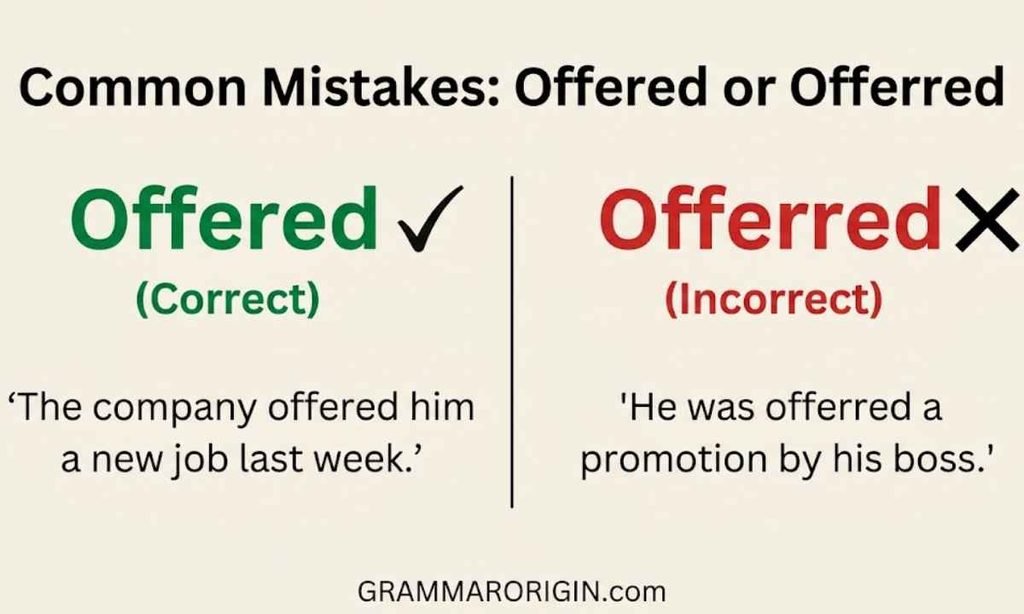
Most mistakes with offered or offerred come from analogy and haste, not from weak English. Five patterns cause nearly all of them.
1. Adding Extra “r”
The most common slip is doubling the r out of habit, because words like preferred and occurred have trained your eye. The doubled letter in offered is the f, which already uses up the word’s double.
For example: ✖ “I offerred to help” becomes ✔ “I offered to help.”
2. Confusing With Other Words
The usual culprit is the -fer family: prefer, refer, defer, transfer. Those double because their stress is last, and offer’s isn’t.
Compare referred with offered. Same ending, different stress. Learners who spell by sound are most exposed here, since offered and offerred sound identical.
3. Fast Typing
Fast typing creates slips like offerd or ofered, which spell checkers usually catch. The trouble starts when you ignore the red line.
“The shop offerd a discount” should read offered. A quick reread of the last sentence before you hit send fixes most of these.
4. Not Knowing Rule
Guessing at the rule means guessing at the spelling. Learn one test instead: is the last syllable of the base word stressed?
Try it. Admit (ad-MIT) gives admitted, while offer (OF-fer) gives offered.
5. Copying Wrong Form
Copying from an old email, a forum post or an autocomplete suggestion spreads the error. Check any doubtful spelling in Cambridge, Merriam-Webster or Oxford before you reuse it.
A wrong “offerred” pasted from last month’s email is still wrong in this month’s.
Read More Related Posts Weather, Whether, or Wether: Which Word Is Correct?
Offered in Everyday Examples 💬
Offered fits any situation where someone puts something forward, so the samples below cover five settings. The single r never changes.
📧 Emails
In emails, offered usually appears when you confirm, thank or decline a proposal.
- “Thank you for the flexibility you offered on the deadline.”
- “Our finance team offered two payment options, and we chose the second.”
🏢 Work
At work, offered covers pay, help, training and deals.
- “My manager offered to review the draft before Friday.”
- “The vendor offered a longer warranty.”
🏠 Daily Use
In daily life, it’s the word for small kindnesses.
- “My cousin offered me a lift home.”
- “The waiter offered a second helping of rice.”
📱 Social Media
Online, offered turns up in comments, reviews and announcements.
- “The creator offered a free template to followers.”
- “Several readers offered tips in the replies.”
📚 School
In classrooms, offered appears whenever teachers or students put something forward.
- “The teacher offered a revision session on Thursday.”
- “A student offered a different reading of the poem.”
📖 Offered Meaning, Forms & Common Confusions
Offered means presented, proposed or provided, and it belongs to a small family of forms that all keep a single r. This section sorts out the meaning and the neighbors.
✔️ Meaning of “Offered”
Offered means someone put something forward for another person to take, refuse or consider. Context decides the shade: a seat, a price, advice or even a sacrifice.
Near-synonyms differ in tone. Proposed suits plans, provided suits supplying, extended suits invitations, and tendered suits formal bids or resignations.
For example: “The firm extended an invitation and offered a hotel room.”
🔤 Related Forms & Spelling Confusion
Offer, offers, offering and offered all keep a single r, and both offerring and offerred are wrong. The -ing form doesn’t double because the stress is still at the front.
Contrast it with preferring, which does double. “The café is offering a discount, though regulars keep preferring the cheaper blend.”
Offered, Offering, Offer, Offers: All Forms
Four forms cover everything, and each has just one r. The table shows what each one does.
| Form | Role | Example |
| offer | Base verb, also a noun | I’ll offer a ride. |
| offers | Third-person singular, plural noun | She offers weekend classes. |
| offering | -ing form, also a noun | The team is offering a trial. |
| offered | Simple past, past participle | They offered a trial. |
Offered also works in the passive: “A trial was offered to every user.”
Offered vs Offeror / Offerer
Offeror and offerer both name the person who makes an offer, while offered is a verb form. Offeror is the usual choice in contract law, where the person receiving the offer is the offeree.
“The offeror sets the terms, and the offeree decides whether to accept.” That’s a language point, not legal advice.
Read More Related Posts Weather, Whether, or Wether: Which Word Is Correct?
⚠️ Common Typing Errors to Avoid
The usual typing errors are offerd, ofered, offred, offerred and offerring. Each one drops, swaps or adds a letter.
“The shop offerd free delivery” should read offered. Autocorrect won’t always rescue you, so a short read-through before sending is the safest check.
Offered: Google Trends & Usage Data 📊
Offered is the form people use and expect, while offerred mostly appears as a typo or as a question about the typo. This section doesn’t quote search numbers, because made-up figures wouldn’t help you. It points to data you can check yourself.
🌍 Trends:
Misspellings get searched mainly by people checking themselves, so the question matters more than the spelling. Open Google Trends, compare offered with offerred, and narrow the region to your own country.
You should see the correct spelling dominate, which is exactly what you’d expect for a word this common.
📊 Region Table:
Every major English-speaking region writes offered. The notes show where nearby spelling habits differ.
| Region | Spelling | Note |
| United States | offered | American English also writes traveled with one l |
| United Kingdom | offered | Doubles final l (travelled), but never the r in offer |
| Canada | offered | Mixes US and UK habits, same spelling here |
| Australia | offered | Follows the British pattern, same spelling here |
| India and Pakistan | offered | Follow British conventions in most formal writing, same spelling here |
🔥 Top 10 Searches:
These ten questions come up around the word again and again, though this isn’t a ranked list pulled from a tool. Each gets a one-line answer.
- Is it offered or offerred? Offered.
- What’s the past tense of offer? Offered.
- Is offerred a word? No, it’s a misspelling.
- Is it offering or offerring? Offering.
- How do you spell offered? O-F-F-E-R-E-D.
- Why does offered have one r? The stress is on the first syllable.
- Offered or offerd? Offered.
- Is offer a noun or a verb? Both.
- Offered vs offering? Offered is past, offering is the -ing form.
- Offeror or offerer? Both exist, and offeror is common in law.
Comparison Table 📋⚖️
Offered, preferred and their relatives differ only because of stress, and the table below shows exactly where the r doubles.
| Base verb | Stress | Past form | -ing form | Doubles the r? |
| offer | OF-fer | offered | offering | No |
| suffer | SUF-fer | suffered | suffering | No |
| differ | DIF-fer | differed | differing | No |
| enter | EN-ter | entered | entering | No |
| prefer | pre-FER | preferred | preferring | Yes |
| refer | re-FER | referred | referring | Yes |
| defer | de-FER | deferred | deferring | Yes |
| transfer (verb) | trans-FER | transferred | transferring | Yes |
| occur | oc-CUR | occurred | occurring | Yes |
If the ending is a loud -fer, double it. If it’s a soft one, don’t: she referred the case, but she offered a view.
Offered pronunciation
Offered has two syllables, OFF-erd, and it’s pronounced /ˈɒf.əd/ in British English and roughly /ˈɔːf.ɚd/ in American English. Some American speakers say the first vowel as /ɑː/ instead.
Say the -ed as a quick /d/, not as an extra syllable. “She offered tea” sounds like “OFF-erd tea.”
In most British accents the r before the d goes silent, while American speakers pronounce it. Either way, offered and offerred sound identical, which is exactly why the wrong spelling survives.
Mini Quiz: Test Yourself
Five quick fill-ins will show whether the stress rule has stuck. Answers follow right after.
- She ___ (offer) to help with the move.
- He ___ (prefer) the window seat.
- The shop is ___ (offer) a discount this week.
- I ___ (refer) him to a specialist.
- They ___ (suffer) no damage in the storm.
Answers: 1. offered, 2. preferred, 3. offering, 4. referred, 5. suffered.
If you got the first, third and fifth right, you’ve got offer’s pattern. The second and fourth are the double-r group.
Final Thoughts
Offered is the only correct spelling, and the single r exists because the stress in offer sits on the first syllable. Whenever offered or offerred crosses your mind, the answer is one r.
The doubled letter in the word is the f, and the doubled r belongs to words like preferred and referred. Keep that contrast handy and the spelling will take care of itself.
Frequently Asked Questions
Is “offerred” spelled correctly?
No. Offerred is a misspelling, and the correct spelling is offered, with one r. Whenever you’re debating offered or offerred, remember that English adds -ed to offer without doubling any letter, and no major dictionary lists offerred.
What is the meaning of offered?
Offered means presented or put forward for someone to accept, refuse or consider. It’s the past tense and past participle of offer, and it covers advice, help, prices and invitations alike.
Which is correct: “offer” or “offered”?
Both are correct, but they belong to different tenses. Use offer for the present or the base form, and offered for the past or after has, had and was.
Is it offering or offerring?
Offering is correct, with one r. The -ing ending follows the same stress rule as offered, so the r never doubles, and offerring isn’t a word. Compare it with preferring, which doubles because prefer stresses its last syllable.
Is it offeror or offerer?
Both spellings exist for the person making an offer. Offeror is mostly used in legal and business writing, while offerer is the plainer general form. Neither one is a verb form, so neither replaces offered.
Why isn’t offered spelled like preferred?
Because the stress is in a different place. Prefer stresses its last syllable (pre-FER), which triggers the doubled r, while offer stresses its first (OF-fer), so nothing doubles. Both end in -fer, which is why the mix-up is so common.
Is offered spelled the same in British and American English?
Yes. Both varieties write offered with a single r. British English doubles a final l in words like travelled, but that habit doesn’t reach offer.

Muhammad Waqas is an English language teacher and grammar expert with over 8 years of experience helping students and professionals improve their writing skills. He specializes in English grammar, vocabulary, communication, and practical language learning. Through GrammarOrigin, Waqas shares clear, easy-to-understand content that helps readers write and speak English with confidence.