
Stopping is the correct spelling, with a double p. In the stopping or stoping question, only one form works in everyday English.
Stoping does exist, but only as a mining term for digging out ore underground. This guide covers the spelling rule, how to say each word, and how to dodge the mistake in emails, reports, and texts.
Stopping or Stoping: Quick Answer
For the stopping or stoping choice, use stopping. It’s the -ing form of the verb stop, and it always takes a double p.
Stoping isn’t a typo in every case. Miners use it for the job of removing ore and leaving an open space underground. Outside mining, though, stoping is simply a misspelling.
Everyday use: She’s stopping at the pharmacy before she comes home.
Mining use: The crew spent the week stoping the ore body on level four.
The Origin of Stopping
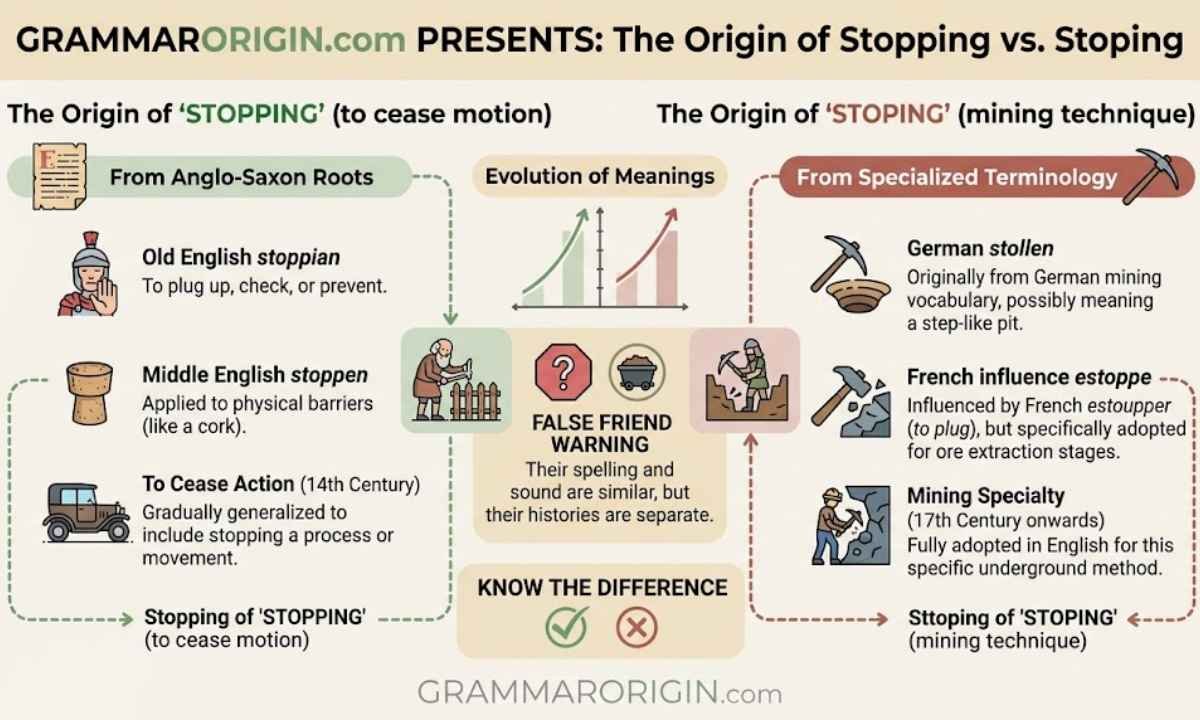
Stop is a very old word, and the double p in stopping isn’t random.
The plumber was stopping the leak with a rag.
Old English had a verb stoppian, which shows up in forstoppian, meaning “to stop up.” Dictionaries trace it back to a Late Latin word linked to stuffing a hole with rough fiber. So the first meaning was plugging a gap, not halting a car.
Middle English turned it into stoppen, and the sense grew to cover anything that blocks or ends movement. As English spelling settled over the centuries, the -ing form settled on the double p too. That history is why the stopping or stoping debate has a clear winner today.
British English vs American English Spelling
Both use stopping, so the stopping or stoping question has no regional split.
The British and American difference shows up with words like travel and cancel. British English doubles the l (travelling, cancelled) even when the last syllable isn’t stressed, and American English usually doesn’t. Stop is a stressed one-syllable word, so both sides double the p.
| Word | British English | American English |
| stop + ing | stopping | stopping |
| stop + ed | stopped | stopped |
| travel + ing | travelling | traveling |
| cancel + ed | cancelled | canceled |
Only the last two rows change by region. Stopping doesn’t.
UK: We’re stopping at the station for ten minutes.
US: We’re stopping at the gas station for ten minutes.
Which Spelling Should You Use?
In the stopping or stoping choice, use stopping in all normal writing. Save stoping for mining and geology.
Everyday: I’m stopping by your office at three.
Technical: Sublevel stoping needs careful planning before any drilling starts.
Here’s how it breaks down by situation:
- School work and exams: stopping
- Emails, reports, and formal documents: stopping
- Social posts and text messages: stopping
- Blogs and websites: stopping, because readers and search engines expect it
- Mining reports and technical papers: stoping, only when you mean the ore-removal process
If no ore is involved, the double p stays. Major dictionaries such as Merriam-Webster, Cambridge Dictionary, and Dictionary.com all list stopping as the -ing form of stop.
Pronunciation: Stopping vs Stoping (IPA)
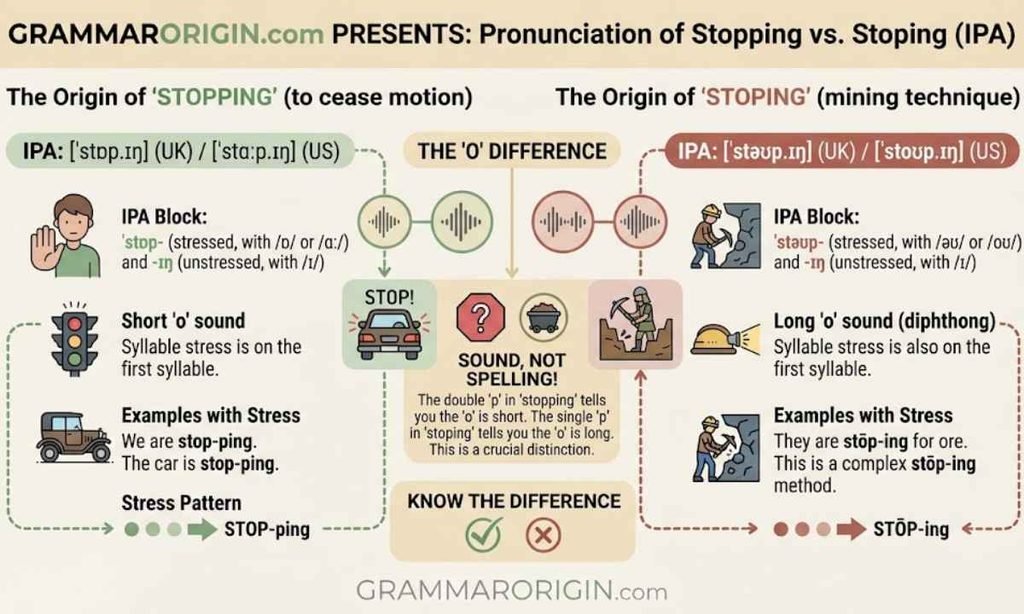
Say both out loud and the spelling follows. Stopping has a short o, and stoping has a long o.
IPA stands for the International Phonetic Alphabet, a system that writes down speech sounds. Here’s how the two words look in it:
| Word | US IPA | UK IPA | Sounds like |
| stopping | /ˈstɑːpɪŋ/ | /ˈstɒpɪŋ/ | STOP-ing, rhymes with shopping |
| stoping | /ˈstoʊpɪŋ/ | /ˈstəʊpɪŋ/ | STOHP-ing, rhymes with hoping |
That vowel gap settles the stopping or stoping question. If you hear a short o, you need the double p.
Short o: The bus keeps stopping every two minutes.
Long o: The miners are stoping the upper section this month.
How to Spell “Stopping” Correctly (Common Questions)
Spell it S-T-O-P-P-I-N-G: the word stop, one extra p, then ing.
People search “how do you spell stopping,” “stopping spelling,” or “is it stopping or stoping” right before they hit send. That’s smart, because the stopping or stoping slip is easy to make when you’re typing fast.
Try saying the word slowly. If you hear a short o, as in “hop,” double the p.
Correct: I’m stopping the meeting at noon.
Incorrect: I’m stoping the meeting at noon.
Why do we double the “p”?
Stop is a one-syllable word with a short vowel and one final consonant, so English tells you to double the final consonant before -ing.
stop becomes stopping
run becomes running
plan becomes planning
begin becomes beginning
The pattern is consonant, vowel, consonant. Doubling the last letter protects the short vowel sound. This is known as the consonant doubling rule. Without it, the o would turn long, which is exactly what happens in hope and hoping.
Longer verbs follow the same rule when the stressed syllable comes last, like begin and commit. If the stress falls earlier, there’s no doubling (open becomes opening). And w, x, and y never double: fix becomes fixing, play becomes playing.
The Hop vs Hope Test
Two tiny words settle this in five seconds: hop becomes hopping, and hope becomes hoping.
Stop sounds like hop, so it takes the double p. Stoping would match hope, and readers would say it with a long o, STOHP-ing. Hope has a silent e that makes the o long, and that e drops before -ing.
hop becomes hopping
hope becomes hoping
stop becomes stopping
Put hop in the same spot as stop. If hopping fits the sound, then stopping needs its double p.
What about “stopped”?
Stopped is correct, with a double p. “Stoped” is a misspelling.
The same rule works before -ed, so stop becomes stopped just as hop becomes hopped. Old books sometimes show stopt, an archaic form that has dropped out of modern writing.
The rain stopped just before sunrise.
Wrong: The rain stoped just before sunrise.
Common Mistakes with Stopping
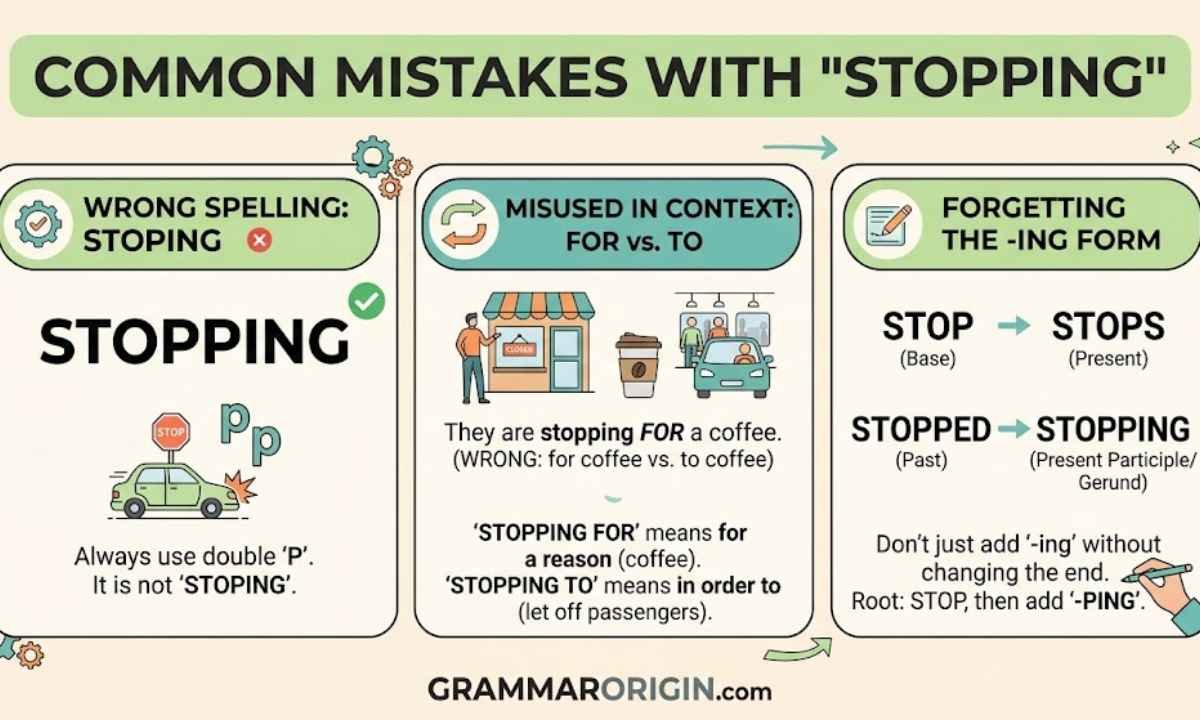
The most common stopping or stoping mistake is dropping the second p. It happens in the -ing form and in the past tense.
Wrong: She’s stoping by later.
Right: She’s stopping by later.
| Mistake | Fix | Why |
| I am stoping here | I am stopping here | The present participle needs the double p |
| The train stoped | The train stopped | The past tense doubles the p too |
| Stoping the car | Stopping the car | Same rule, even in short phrases |
| Stoppping | Stopping | Three p’s is a typing slip |
| We kept stoping | We kept stopping | The ending changes nothing about the base |
Here’s a quick proofreading habit. Before you publish, run a Find search for “stoping” and “stoped.” If the page isn’t about mining, every hit is a typo. Spell check and autocorrect may let stoping slide, since it’s a real mining word.
Other Misspellings: Stoped, Stopin, Stoppin
Each of these is a cousin of the stopping or stoping slip, with the same fix: use stopped or stopping.
- Stoped is missing a p. Write stopped.
- Stopin and stoppin drop the g, usually from fast typing. Write stopping.
- Stoppping has one p too many. Write stopping.
- Stopt is an old past form. Write stopped.
In dialogue, lyrics, and casual texts, you’ll see “stoppin'” with an apostrophe to show a dropped g. That’s a style choice, not standard spelling.
Casual: Just stoppin’ for coffee, back in five.
Standard: I’m stopping for coffee and I’ll be back in five minutes.
Stopping in Everyday Examples
The stopping or stoping answer stays the same in every setting. Here’s how it looks in real situations.
Email: I’ll be stopping by your office around 3 PM.
Text message: Stopping at the store, need anything?
News headline: Rail services are stopping early because of track repairs.
Work report: The team is stopping all side projects until the launch is done.
Directions: The driver is stopping at every marked bus stop.
Customer service: We’re stopping deliveries to that area until Monday.
Notice that stopping can mean two different things. In the work report it means ending something, and in the email it means a short visit. The spelling stays the same either way.
Also Read This Offered or Offerred: Correct Spelling, Rule & Examples
Stopping: Google Trends & Usage Data
In the stopping or stoping comparison, stopping is the everyday form. Stoping mostly shows up in typos and mining pages.
Search numbers shift every month, so it’s best to check them yourself. It takes under a minute:
- Open Google Trends.
- Enter “stopping” and “stoping” as two terms.
- Set the region to Worldwide and the range to the past five years.
- Compare the two lines.
Expect stopping to sit far above stoping. Related searches like “stoping mining” tell you where the rarer word actually lives.
Typical search: how do you spell stopping
Typical search: stoping meaning mining
Keyword Variations Comparison Table
In the stopping or stoping family of spellings, only stoping and stoped cause trouble. Every other form is fine.
| Form | Correct? | Role | Example |
| stop | Yes | Base verb | Please stop here. |
| stops | Yes | Third person singular | The bus stops at nine. |
| stopped | Yes | Past tense | The bus stopped at nine. |
| stopping | Yes | Present participle | The bus is stopping now. |
| stopper | Yes | Noun | Put the stopper back in the bottle. |
| stoppage | Yes | Noun | A work stoppage delayed the project. |
| stoping | Mining only | Verb form of stope | Crews are stoping the ore. |
| stoped | No | Misspelling of stopped | Write stopped instead. |
Stopping vs Stoping: Spelling Rules and Meaning
Stopping means ceasing, pausing, or halting. Stoping is a mining process.
The two words in the stopping or stoping pair look close, but they follow different spelling patterns. Stopping follows the short vowel rule (like hopping), while stoping follows the long vowel pattern (like hoping). That’s why they can’t swap places.
Correct usage:
For stopping or stoping, use stopping in daily English and stoping in mining only.
Daily English: Stopping now would waste everything we’ve built.
Mining: Stoping started once the access ramp reached the ore zone.
Key difference:
The stopping or stoping difference shows up in both meaning and vowel sound.
| Word | Meaning | Vowel sound | Where you’ll see it |
| Stopping | Ceasing, pausing, halting | Short o | Everywhere |
| Stoping | Removing ore underground | Long o | Mining, geology, engineering |
Stoping in Mining
In mining, stoping means taking ore out from underground and leaving an open space called a stope.
A stope is the space, and stoping is the work of excavating it. That mining sense is the only reason stoping isn’t flatly wrong in the stopping or stoping debate. Mining engineers group the work into a few main methods:
- Open stoping: the ore is removed and the space is left open, held up by the surrounding rock.
- Sublevel stoping: ore is broken from levels set between the main tunnels and drawn out below.
- Shrinkage stoping: broken ore stays in the stope for a while so miners can work from the top of the pile.
- Cut-and-fill stoping: ore comes out in slices, and each gap is filled with waste material before the next slice.
Cut-and-fill stoping removes ore in slices and backfills each gap.
Shrinkage stoping keeps broken ore in place as a working platform.
Also Read This Offered or Offerred: Correct Spelling, Rule & Examples
Common search variations explained:
Different search phrases about stopping or stoping, same answer. Here are the usual ones:
- “is it stoping or stopping”: stopping
- “stoping spelling”: stopping, unless you mean the mining term
- “stoping vs stopping”: stopping for general writing
- “stoping meaning”: the process of removing ore underground
- “stopping spelling”: S-T-O-P-P-I-N-G, with a double p
- “how do you spell stopping”: same, double p
Related verb forms (important for clarity)
Stop has four forms. Only the -ing form creates the stopping or stoping confusion, because people drop the p.
| Form | Name | Example |
| stop | Base form | We stop at noon. |
| stops | Third person singular | He stops at noon. |
| stopping | Present participle | They are stopping at noon. |
| stopped | Past tense and past participle | She stopped at noon. |
Are you stopping here, or are you going on?
He stopped the car at the red light.
Stopping or stoping grammar
Grammatically, stopping is the present participle and gerund of the verb stop. Stoping is the matching form of the mining verb stope.
Continuous tense: The bus is stopping at the corner.
Gerund (acts like a noun): Stopping early saved us a lot of money.
Adjective: The car’s stopping distance depends on speed.
Noun: The rest area is a good stopping point.
Those four jobs cover almost every use of stopping, so the stopping or stoping choice never changes. The spelling stays put in all of them.
A small trap sits after the verb stop. Stop plus an -ing word means you quit the action, while stop plus “to” means you pause in order to do something else.
She stopped talking.
She stopped to talk.
Phrasal verbs like stop by, stop over, and stop off take the same ending:
I’m stopping by after work.
We’re stopping over in Doha for a night.
They’re stopping off at the market on the way.
Stopping or stoping synonym
When it comes to stopping or stoping synonyms, stopping has plenty of everyday options, but stoping has none outside mining. Pick the synonym that fits your meaning.
- Ending something: ceasing, quitting, discontinuing
- Pausing: halting, pausing, breaking off
- Blocking: preventing, blocking, obstructing
- Vehicles: braking, pulling up, parking
The factory is ceasing production this month.
Traffic is halting at the crossing.
The crew is pausing work because of rain.
She’s braking gently as the light turns red.
Be careful with “stopping by.” It doesn’t mean ceasing, so quitting or ending won’t fit there. Dropping in is closer.
I’m dropping in on my way home.
In mining, nothing short replaces stoping. Writers usually switch to phrases like ore extraction instead.
Final Thoughts
The stopping or stoping question has a simple answer: write stopping, with two p’s. The short vowel in stop earns the extra p, just like hop turns into hopping.
Keep stoping for mining work, where it names the process of taking out ore and leaving a stope. Anywhere else, spell it stopping and your writing stays clean.
Frequently Asked Questions
What does “stopping” mean?
Stopping means ceasing movement or action, or pausing briefly in a place. It’s the -ing form of the verb stop.
How do you pronounce “stoping”?
Say it STOHP-ing, with a long o like “hoping.” Stopping uses a short o and rhymes with “shopping.”
How do I spell stopping?
Spell it S-T-O-P-P-I-N-G, with a double p. In the stopping or stoping choice, the double p version wins in everyday writing.
What does “stop” mean?
Stop means to cease moving, acting, or operating, or to prevent something from continuing. It’s also a noun, as in “bus stop.”
Is stoping a real word?
Yes, but only in mining, where it means removing ore and leaving an open space called a stope. For the stopping or stoping choice in normal writing, always pick stopping.
Why is “stopped” spelled with two p’s?
It follows the same doubling rule as stopping. A short vowel followed by one final consonant doubles that consonant before -ed.

Muhammad Waqas is an English language teacher and grammar expert with over 8 years of experience helping students and professionals improve their writing skills. He specializes in English grammar, vocabulary, communication, and practical language learning. Through GrammarOrigin, Waqas shares clear, easy-to-understand content that helps readers write and speak English with confidence.