
If you’ve typed “tomatos” and then paused, wondering if that little e was missing, you’re not the only one. Tomatoes is the only correct plural spelling in English, and the other version is a mistake that shows up more often than most people realize.
This guide walks through why that extra letter exists, where the word came from, and how to remember the rule for good. You’ll also find UK, US, and dictionary references, plus real example sentences you can copy.
What the Word “Tomato” Actually Means (And Why It Matters to Spell It Right)
It’s the round, juicy fruit that shows up in salads, sauces, and sandwiches, even though most people treat it like a vegetable in the kitchen. Getting the plural right matters more than it seems.
Menus, recipe blogs, product labels, and school assignments all rely on this word constantly. A misspelled plural on a printed sign or a professional email can quietly chip away at how careful or credible the writer looks, even if the reader never says anything about it.
The Real Reason This Debate Exists: English’s Messy Plural Rules

This mix-up exists because English never settled on one single rule for words ending in -o. Some take -s, some take -es, and a handful accept either.
Look at how inconsistent the pattern gets:
- Piano becomes pianos, with just an s.
- Potato becomes potatoes, with a full es.
- Volcano can go either way, as volcanos or volcanoes.
Because there’s no single formula, writers end up guessing, and the wrong guess is the one that feels right but isn’t. The word’s foreign roots and its pronunciation both play a part, which the next few sections unpack.
So Which Is Correct—Tomatoes or Tomatos?
Tomatoes is correct. Tomatos is not a recognized spelling in any dictionary or style guide.
There’s no British-versus-American split here, no casual exception, and no “it depends on context.” Every major English dictionary lists one form as the sole plural.
✔ Correct: Tomatoes
Use this form every time you’re referring to more than one, in writing, on menus, in recipes, or in casual conversation. It works identically in formal and informal contexts.
✘ Incorrect: Tomatos
This spelling comes from applying the simplest plural rule (just add s) to a word that doesn’t follow it. Treat it the same way you’d treat any other spelling error — fix it on sight.
Understanding “-ES” Plurals for Words Ending in -O
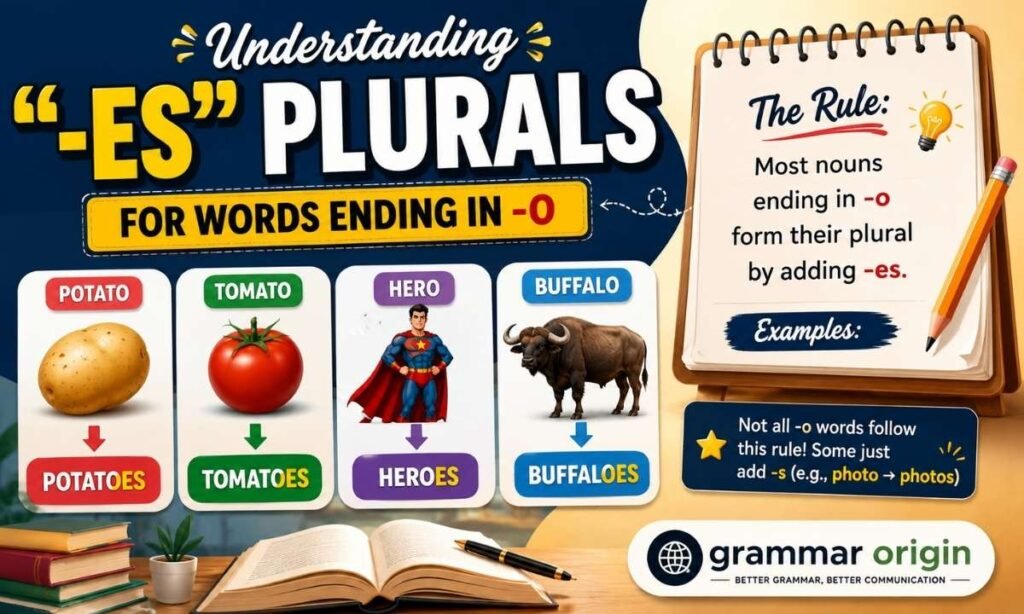
Many English nouns that end in a consonant followed by -o pick up -es rather than a plain -s when they become plural. This is one of the clearest examples of that pattern.
The logic isn’t random. Adding just an s after a vowel-like “oh” sound creates an awkward cluster, so speakers naturally lengthened the ending, and spelling eventually caught up with speech.
When the word ends in a consonant + O → add -ES
- Tomato → tomatoes
- Potato → potatoes
- Hero → heroes
- Echo → echoes
Say both versions out loud back to back. The correctly spelled one simply flows better, which is a big part of why it won out as the standard.
Why “Tomatoes” Takes -ES: The Linguistic Explanation
Three separate forces pushed this spelling toward its current form: where the word came from, how it sounds, and how dictionaries eventually locked it in.
1. Origin (Borrowed Word Behavior)
English pulled this word in from Spanish, and borrowed terms often carry traces of their original pluralization habits with them. That imported pattern nudged early English writers toward the longer plural form.
2. Phonetics (How It Sounds)
Spoken English tends to smooth out clusters that are hard to pronounce cleanly. Adding -es after the closing “oh” sound keeps the word easy to say without clipping it short.
3. Standardization (Dictionaries + Education)
Once dictionaries and schools settled on one spelling, publishers and textbooks followed suit, and the choice became fixed. Today, no reputable dictionary lists the alternative as an accepted variant.
Origin of the Word “Tomato” (Short But Important)
This word traveled through several languages before landing in English, and that journey is part of why its plural looks the way it does.
| Stage | Language | Word | Meaning |
| Original | Nahuatl (Aztec) | tomatl | swelling fruit |
| Borrowed into | Spanish | tomate | the fruit as we know it |
| Adopted by | English | tomato | same fruit, same meaning |
Because English absorbed it through Spanish rather than inventing a local term, the plural pattern that came with it stuck around, shaping the rule still in use today.
Read More Related Post Adapter vs Adaptor
Examples of “Tomatoes” Used Correctly in Sentences
Seeing a word in real sentences makes the correct form stick faster than any rule on its own.
Correct Usage
- I picked ripe tomatoes from the garden this morning.
- These taste much sweeter than the ones from the store.
- Add the chopped tomatoes once the onions have softened.
- The market had four different varieties on display.
Incorrect Usage
- I need two tomatos for this recipe. ✘
- The green ones on the vine aren’t ready yet, but the label still says “tomatos.” ✘
Placed side by side, the incorrect version almost looks like it’s missing a letter, because it is.
Common Spelling Errors People Make (And Why They Happen)
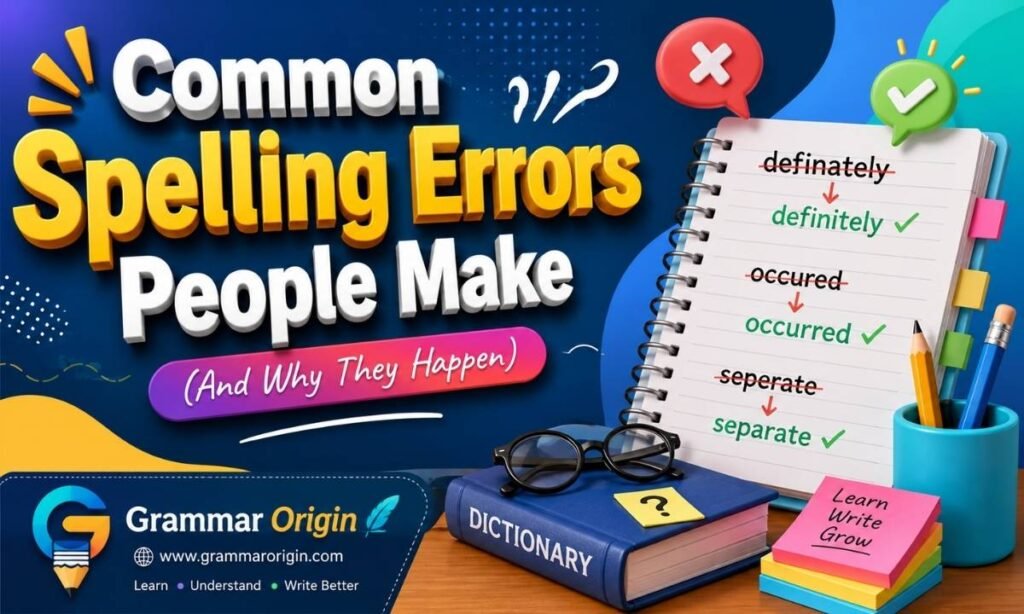
Most people who make this mistake aren’t careless; they’re following a habit that just doesn’t apply here.
1. Over-applying the photo rule
Since “photo” becomes “photos” with a simple s, it’s easy to assume every -o word behaves the same way. Photo is a clipped form of “photograph,” though, which puts it in a completely different category.
2. Phonics confusion
The word ends in a smooth “oh” sound, and sounding it out phonetically often leads writers to add just an s. Spelling rules for -o endings don’t always match what the ear expects.
3. Fast typing + autocorrect
Rushed typing on a phone keyboard can drop letters, and older autocorrect dictionaries have been known to suggest the wrong plural entirely. A quick second glance before hitting send catches most of these slips.
4. Exposure to bad spelling online
Social media posts, casual comments, and unedited product listings spread errors fast, and repeated exposure makes an incorrect form start to look normal. Reading from edited, professionally proofed sources helps counter that drift.
Other Words That Follow the Same Pattern as “Tomatoes”
Several other common nouns ending in a consonant plus -o take the same -es ending.
| Singular | Plural |
| hero | heroes |
| potato | potatoes |
| echo | echoes |
| mosquito | mosquitoes |
| torpedo | torpedoes |
| veto | vetoes |
Once you’ve memorized one word from this list, the rest tend to follow logically, since they all share the same consonant-plus-o ending.
Words Ending in -O That Don’t Add -ES
Not every -o word follows this pattern, and a fair number of common nouns simply add -s instead.
| Singular | Plural |
| photo | photos |
| studio | studios |
| piano | pianos |
| logo | logos |
| video | videos |
Most of these exceptions are either shortened forms of longer words or borrowed from languages like Italian, where the plain -s plural was already standard. Piano, for instance, is a shortened form of “pianoforte.”
How to Always Remember the Correct Spelling “Tomatoes”
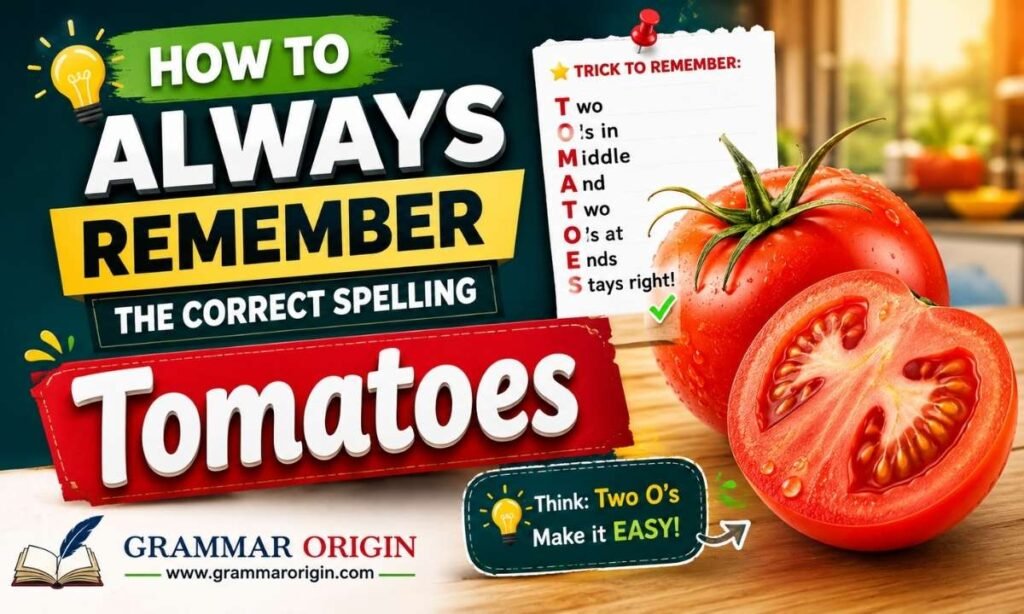
A short memory trick sticks far better than a grammar rule you have to look up every time.
1. The Potato Rule
Potato shares the same ending, and most people already know its plural without thinking twice. Borrow that same confidence here.
2. The “Two Syllable” Trick
Words with two or more syllables that end in a soft “oh” sound often lean toward -es. This word and potato both fit that pattern neatly.
3. The Food Rule
Food-related words ending in -o frequently take -es, while objects and gadgets ending in -o usually just take -s. This one falls on the food side of that line.
4. The “Add an E to Eat” Trick
Since you eat what this word refers to, add an e before the final s. It’s a small, slightly silly hook, but it’s hard to forget once it clicks.
5. The Spanish Memory Hook
The word came into English through the Spanish “tomate.” Remembering that origin can serve as a quick cue that the plain -s shortcut doesn’t apply.
Case Study: Tomato Spelling Errors in the Real World
Spelling mistakes on printed materials aren’t just embarrassing; they can cost real money. Grocery chains, restaurants, and food brands have had to reprint labels, signage, and packaging after a plural slipped through incorrectly.
Once a misspelled label reaches shelves, it tends to circulate on social media faster than any internal proofreading catches it, and competitors rarely miss the chance to point it out. For a business, that kind of small error can quietly undercut how careful and professional the brand looks to customers.
The lesson holds for individual writers too. A menu, a resume, or a client email with the wrong plural sends the same small signal that nobody proofread closely enough.
Read More Related Post Adapter vs Adaptor
A Quick Reference Table: Tomato Plural Rules
Keep this table handy any time you’re second-guessing the spelling.
| Topic | Explanation |
| Correct plural | tomatoes |
| Incorrect spelling | tomatos |
| Reason for -es | Spanish-derived origin + smoother pronunciation |
| Word category | consonant + “o” ending |
| Similar words | potatoes, heroes, echoes, mosquitoes |
| Opposite pattern | photos, pianos, studios, logos |
| UK usage | tomatoes |
| US usage | tomatoes |
| Dictionary status | one form listed; the other not recognized |
Tomatoes or Tomatos UK
British English uses tomatoes exclusively, with no regional spelling variant. The only difference from American usage shows up in pronunciation, not spelling.
British speakers typically say the singular as “tuh-MAH-toh,” with a broad a sound in the middle syllable. Whether spoken with a British or American accent, the written plural stays fixed.
Tomatoes or Tomatos Oxford Dictionary
The Oxford Dictionary lists tomatoes as the only correct plural form. The alternative spelling doesn’t appear as an accepted variant anywhere in Oxford’s entries.
Oxford’s entry, like most major dictionaries, treats this as a fixed irregular plural rather than something with regional flexibility. That consistency is part of why this particular spelling question carries so little ambiguity compared to trickier English plurals.
Tomatoes or Tomatos Oxford
Searching this exact phrase almost always leads back to the same answer: Oxford’s reference sources confirm one spelling as standard, with no dialectal exception carved out for British, Australian, or other Oxford-English-speaking regions.
This matters for students and professional writers in particular, since Oxford spelling conventions are widely used as a style benchmark in academic and publishing work across the Commonwealth.
Tomatoes or Tomatos US
American English also uses tomatoes as the sole plural form, matching British usage exactly on this point. The two dialects diverge on plenty of spelling choices, like “color” versus “colour,” but not this one.
Where American and British English do differ is pronunciation: many Americans say “tuh-MAY-toh,” with a long a sound, compared to the British “tuh-MAH-toh.” The spelling on the page, however, never changes.
Tomatoes or Tomatos Pronunciation
The singular is typically pronounced /təˈmeɪtoʊ/ in American English and /təˈmɑːtoʊ/ in British English, and the plural simply adds a “z” sound at the end.
That pronunciation gap is exactly where the famous “you say tomato, I say tomato” line comes from, but it’s purely about how the word sounds, not how it’s spelled. No matter the accent, the written plural stays the same.
Frequently Asked Questions
Is “tomatos” ever correct in English?
No. This spelling is never correct in standard English, in any dialect or context. The only accepted plural form is tomatoes.
Why does the plural take -es instead of just -s?
The word ends in a consonant followed by “o,” and terms in that category typically take “-es” rather than “-s” in English. This pattern comes from a mix of Spanish origin and how naturally the word flows when spoken aloud.
Do British and American English spell it differently?
No, both dialects use the identical spelling. The only difference between them is pronunciation, not spelling.
What does the Oxford Dictionary say is correct?
Oxford Dictionary lists tomatoes as the only correct plural form. Tomatos does not appear as a recognized variant in Oxford’s reference entries.
What other words follow the same plural pattern?
Potatoes, heroes, echoes, mosquitoes, and torpedoes all follow the same consonant-plus-“o” pattern that produces an “-es” ending. Learning one of these words makes the rest easier to remember.
How is the plural pronounced in American versus British English?
American English typically pronounces it “tuh-MAY-tohz,” while British English favors “tuh-MAH-tohz.” Both refer to the same correctly spelled word.
Why do some -o words only add -s instead of -es?
Words like photo, piano, and studio are either shortened forms of longer words or borrowed from languages where the plain “-s” plural was already standard. That’s why they skip the “-es” pattern seen here.
Is “tomato’s” the same as “tomatoes”?
No, these two forms serve different purposes entirely. Tomatoes is the plural, while tomato’s shows possession, as in “the tomato’s skin was starting to split.”
Conclusion
The spelling question comes down to one simple answer: tomatoes is correct, and tomatos is not, in every English-speaking region and every dictionary that covers the word. That consistency makes it one of the easier irregular plurals to lock in permanently once the reasoning behind it clicks.
Whether you’re writing a shopping list, a recipe, or a professional document, remembering that this word follows the same “-es” pattern as potato should keep the mistake from creeping back in.

Muhammad Waqas is an English language teacher and grammar expert with over 8 years of experience helping students and professionals improve their writing skills. He specializes in English grammar, vocabulary, communication, and practical language learning. Through GrammarOrigin, Waqas shares clear, easy-to-understand content that helps readers write and speak English with confidence.