
You’re texting your mom and you pause. Do you type “momma” or “mama”? Both look right, both sound the same out loud, and somehow that makes the choice feel harder, not easier.
Here’s the short version: they mean the same thing, but one leans standard and global while the other carries a distinct regional flavor. This guide walks through the meaning, tone, pronunciation, and every context where one fits better than the other.
Quick Answer
Mama is the more standard, globally recognized word for mother. Momma is a phonetic Southern American variation with the same meaning.
- Use mama for general writing, children’s content, and international audiences.
- Use momma for Southern dialect, storytelling, or a nostalgic, personal tone.
- Neither belongs in formal writing — use mother instead.
If you’re ever unsure which one fits, mama is the safer default.
What Does “Mama” Mean?
Mama is an informal, affectionate word for mother, used across dozens of languages and cultures. It’s frequently one of the first words a baby learns to say.
The word shows up in English, Spanish, French-derived forms, and many other language families with almost identical sounds. That overlap isn’t a coincidence — it comes from how easily infants produce the “ma” sound.
Common Uses of “Mama”
- A toddler calling out to their mother
- A gentle, everyday term of endearment within a family
- Song lyrics, children’s books, and storytelling
- Adults using it affectionately, regardless of age
Examples:
- “Mama, look what I found!”
- “I couldn’t have done it without you, Mama.”
- “She’s a new mama figuring things out one day at a time.”
Tone and Feeling
This word reads as warm, gentle, and a little childlike, even when adults use it. It fits naturally into American English and is understood in British English too, though British adults use it less often in daily speech.
What Does “Momma” Mean?
Momma carries the exact same meaning as mama — the difference sits entirely in spelling and regional flavor. It reflects how the word gets pronounced in parts of the American South and Midwest.
Visually, the double “m” plus “o” spelling leans into a heavier, rounder vowel sound that some speakers naturally produce. It’s less about grammar and more about capturing a specific voice on the page.
Common Uses of “Momma”
- Southern American dialogue and storytelling
- Nostalgic or emotionally-driven writing
- Casual, folksy speech patterns
Examples:
- “My momma raised five kids on her own.”
- “That’s exactly what momma used to say.”
- “Momma’s cooking always beat the restaurant food.”
Tone and Feeling
This spelling feels folksy, personal, and distinctly tied to Southern U.S. culture. Outside America, it can come across as informal or even unfamiliar, since it rarely appears in British or Australian English.
Momma vs Mama: Side-by-Side Comparison
Mama wins on global recognition; momma wins on regional authenticity and emotional color.
| Feature | Mama | Momma |
| Meaning | Mother (informal) | Same meaning |
| Formality | Informal | Informal |
| Region | Global | Mainly U.S. South/Midwest |
| Spelling type | Standard informal | Phonetic/dialect variation |
| Safe for general writing? | Yes | Only in regional or storytelling context |
American vs British English Differences
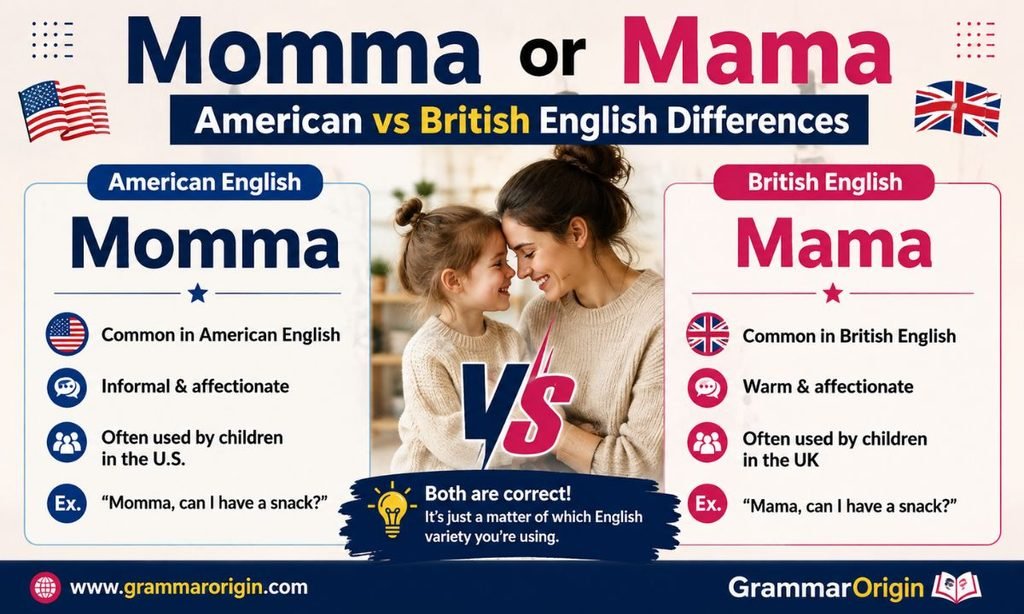
American English uses both spellings freely, while British English rarely reaches for the Southern variant at all. In the UK, “mum” is the everyday informal choice, not either of these two.
- American English: both spellings are common, but the double-m version is tied closely to Southern identity.
- British English: “mum” and “mummy” dominate; the standard global spelling shows up mostly in baby talk, and the Southern variant is genuinely rare.
Writing for a global audience? Stick with the standard spelling, or use “mother” for anything formal.
When Should You Use “Mama”?
Reach for this spelling whenever you want a warm tone that still reads as broadly accessible. It works for children’s content, personal essays, song lyrics, and social captions.
It’s also the safer pick for SEO and international content, since search engines and readers worldwide recognize it instantly.
Example: “Becoming a mama taught me more patience than I ever thought I had.”
Also Read This Performed vs Preformed
When Should You Use “Momma”?
Choose this spelling when you’re capturing a Southern voice, writing dialogue, or leaning into a nostalgic, personal story. It signals region and character in a way the standard spelling can’t.
Example: “Momma never let us leave the table without finishing our greens.”
If your content is aimed at a broad or professional audience, the standard spelling is usually the better call.
Common Mistakes to Avoid
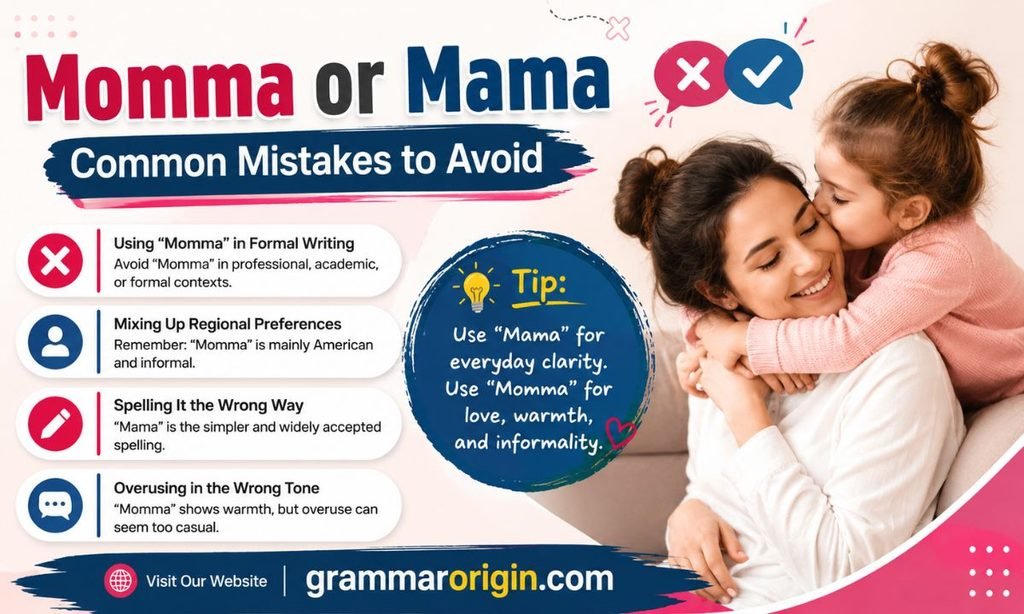
Most errors here come from mismatched tone rather than actual grammar rules.
1. Using “Momma” in Formal Writing
Wrong: “My momma attended the board meeting.” Right: “My mother attended the board meeting.”
2. Mixing Regional Tone Unintentionally
Switching between the two spellings mid-piece — without a clear reason — makes writing feel inconsistent and can confuse the reader about setting or voice.
3. Confusing “Mama” With “Mamma”
“Mamma,” with a double m and single a, is a separate, less common spelling that shows up in older British usage and titles like Mamma Mia! It isn’t standard in everyday modern writing.
4. Overusing Informal Terms
Academic papers, business emails, and professional reports should stick with “mother” or “parent” — never either informal spelling.
Is One More Correct Than the Other?
Both spellings are grammatically valid informal words for mother — neither is “wrong.” The real difference is standardization: one is the default choice recognized worldwide, the other is a regional variant tied to a specific American dialect.
Dictionaries like Merriam-Webster list the standard spelling as the primary entry, with the Southern variant noted as a chiefly American, informal alternative. That’s a useful tiebreaker if you need one.
Cultural and Emotional Context
Variations of this word appear across an enormous range of languages — Spanish, French (as “maman”), Hindi, Mandarin, Swahili, and many more — making it one of the most universally recognized human sounds.
The Southern spelling, meanwhile, carries a distinctly American warmth. It shows up constantly in country music lyrics, rural storytelling, and family memoirs where a specific regional voice matters.
Real-Life Example Sentences
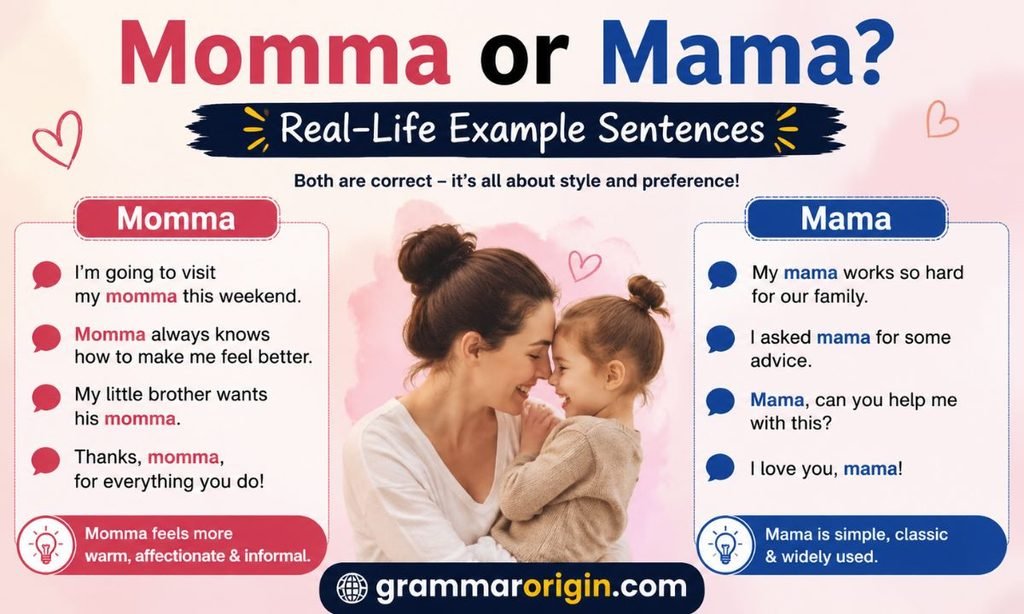
Using the standard spelling:
- “Mama, I made it home safe.”
- “She’s a strong mama juggling three jobs.”
- “Every mama deserves a day off.”
Using the Southern spelling:
- “Momma taught me to fix a flat tire before I could drive.”
- “I’m heading home to see momma this weekend.”
- “Listen to your momma — she’s usually right.”
The emotional warmth stays the same in both; only the regional accent on the page changes.
Momma or Mama Reddit
On forums like Reddit, most threads land on the same conclusion: both spellings are fine, and the “right” one depends entirely on the speaker’s own upbringing and region. Southern U.S. users often defend the double-m spelling as simply how they’ve always written it, not as slang or a mistake.
Non-American commenters frequently mention that neither spelling feels natural to them, since “mum” or “mom” is what they grew up using instead.
Mama vs Momma Pronunciation
Despite the spelling difference, both words are typically pronounced the same way: /ˈmɑː.mə/, with stress on the first syllable. The spelling doesn’t usually change how the word sounds out loud — it changes how a writer wants that sound to look on the page.
Some Southern speakers do stretch the first vowel slightly, which is likely why the double-m spelling developed in the first place, as a way to capture that fuller sound in writing.
Also Read This Performed vs Preformed
Momma or Mama Bear
“Mama bear” is a widely recognized phrase describing a fiercely protective mother, human or animal. It almost always uses the standard spelling — the Southern version exists but is far less common in print, songs, or everyday conversation.
Example: “She turned into a total mama bear the moment anyone criticized her kid.”
“Mama” or “Momma” in the South
In the American South, the double-m spelling is deeply woven into everyday speech, family storytelling, and regional identity. It’s not considered a mistake there — it’s simply the natural, expected way to write the word people actually say.
Outside the South, readers may see it as a stylistic choice meant to signal setting or character rather than a spelling people use day to day.
Mommas or Mama’s
These two forms serve completely different grammatical jobs, and mixing them up is a common slip. The plural form means more than one mother figure. The possessive form shows something belongs to one mother.
- Plural: “All the mommas gathered for the school pickup line.”
- Possessive: “That’s mama’s favorite chair.”
Read the sentence back — if you mean “belonging to,” you need the apostrophe; if you mean “more than one,” you don’t.
Mama or Mamma Italian
In Italian, the double-m, single-a spelling is the standard word for mother, and it’s the spelling behind the famous phrase “Mamma Mia.” This is a genuinely different word from the English version, even though they sound almost identical and share the same root meaning.
English writers sometimes borrow this Italian spelling by accident, which is exactly the kind of mix-up covered earlier in the common mistakes section.
How Do You Spell Mama and Papa
The standard English spellings use four letters each, no double consonants, both stressed on the first syllable. These are the versions you’ll find in most dictionaries and children’s books.
The Southern variants follow the same phonetic logic but are regional stylistic choices rather than dictionary-standard spellings.
Final thoughts
Choosing between these two spellings really comes down to audience and tone, not right versus wrong. The standard spelling works almost everywhere, while the Southern variant adds a specific, personal voice when that’s exactly what a piece of writing needs.
When you’re unsure which one fits, default to mama — it’s globally understood, dictionary-preferred, and rarely feels out of place.
Frequently Asked Questions
Is the Southern spelling a real, correctly spelled word?
Yes. It’s a recognized, dictionary-listed informal variant, most common in Southern American English rather than a spelling mistake.
Which spelling should I use for SEO content?
The standard spelling generally performs better for broad, international search intent, since it’s the more universally searched and recognized form.
Can adults use either word, or is it just for kids?
Adults use both regularly and affectionately, especially in family conversations, social posts, and personal writing — age doesn’t restrict either spelling.
Is the Italian spelling the same as the Southern American one?
No. They’re spelled almost identically but come from different languages and traditions — one is tied to older British and Italian usage, the other to Southern American speech.
Do British speakers ever use these words?
Rarely for the Southern spelling, and only occasionally for the standard one — “mum” and “mummy” remain the everyday informal choices across the UK.
Why do the two spellings sound identical when spoken?
Both are typically pronounced /ˈmɑː.mə/. The spelling difference exists mainly to represent regional voice and tone in writing, not to signal a different pronunciation.
Should I use these words in a formal essay or report?
No. Formal writing calls for “mother” or “parent” — both informal spellings should be reserved for casual, personal, or creative contexts.

Muhammad Waqas is an English language teacher and grammar expert with over 8 years of experience helping students and professionals improve their writing skills. He specializes in English grammar, vocabulary, communication, and practical language learning. Through GrammarOrigin, Waqas shares clear, easy-to-understand content that helps readers write and speak English with confidence.