
Dammit is the correct spelling, and damnit is a common mistake. If you’ve ever frozen mid-text over damnit or dammit, the rule is simple, and the reason behind it is worth knowing.
Here you’ll find the meaning, origin, pronunciation, real examples, and tone tips behind damnit or dammit, plus a short look at the Dammit Doll. There are safe alternatives for work emails too.
Quick Answer
Dammit is the standard spelling, and damnit is a misspelling. When you’re choosing between damnit or dammit, write dammit.
Example: Dammit, I left my charger at the office again.
The two-word form, damn it, is also correct and a little more traditional. The only version that isn’t accepted is the one that glues “damn” and “it” together without changing the spelling.
What Does “Dammit” Mean?
Dammit is an informal exclamation that shows frustration, annoyance, or disappointment. It’s simply “damn it” said and spelled as one quick word.
People reach for it when a plan falls apart, when they drop something, or when a laptop freezes. It’s a reaction word, so it usually stands alone or sits at the edge of a sentence.
- Dammit, the printer jammed again.
- I can’t find my keys, dammit.
- Dammit, I was so close to finishing.
Dictionaries label it a mild expletive. That means it’s too rude for formal writing, but it’s nowhere near the strongest language people use.
Knowing the meaning first makes the damnit or dammit choice easier, because you can see it’s just a spoken reaction written down.
Origin and History of Dammit
Dammit is more than a century old. Dictionary.com dates its first recorded use to between 1905 and 1910.
Example: Think of gonna and wanna, which also began as spellings that copy casual speech.
The word grew out of damn, which came into English from Old French and goes back to the Latin damnare, meaning to condemn. Over time, damn became a mild curse, and “damn it” got squeezed into a single written word.
Dictionaries call this kind of respelling eye dialect. It means the spelling shows how people really say a word, not how its root is written.
That history explains why damnit or dammit still comes up today. One spelling settled into the dictionaries, and the other stayed around as an easy slip.
Pronunciation and the Silent N
Dammit is pronounced “DAM-it”, and the IPA is /ˈdæmɪt/. The n in damn is silent, so you never hear an “n” in the spoken word.
That silent n is the whole reason damnit or dammit trips people up. The ear hears “dam-it”, but the eye remembers “damn”.
American and British speakers say it the same way, so there’s no regional pronunciation to learn. The stress falls on the first syllable.
Example: In damn it, the n makes no sound, so the two words are spoken as “dam it”.
Damnit vs Dammit: What’s the Difference?
In the damnit or dammit comparison, dammit is the accepted spelling, while damnit is a nonstandard variant that shows up mostly in quick texts and typos. The meaning is identical, and only the spelling changes.
| Spelling | Status | Where you’ll see it |
| dammit | Standard, listed in dictionaries | Books, news, dialogue |
| damnit | Nonstandard | Texts, comments, quick posts |
| damn it | Correct two-word form | Any writing that wants the plain form |
Standard: Dammit, we missed the train.
Nonstandard: Damnit, we missed the train.
Dictionary.com even redirects a search for damnit to its dammit entry. When you proofread, treat damnit as a typo and fix it.
Why Do People Write “Damnit”?
People write damnit because they hold on to the spelling of damn. The root word ends in n, so adding “it” to it feels natural, even though the n is never spoken.
Example: Compare damned and damning. Both keep the n in the spelling, so damnit looks like it belongs to the same family.
It’s a logical instinct, and plenty of careful writers fall for it. The n even comes back out loud in damnation, where you can hear it clearly.
So the root really does have an n. It just goes quiet in the short form, and that’s the gap between damnit or dammit.
Why “Dammit” Is the Correct Form
Dammit is correct because dictionaries list it and because it spells the word the way it’s said. The silent n drops out, and the doubled m shows the short vowel sound in “dam”.
Other casual spellings work the same way. Each one blends a phrase into one word and changes the spelling to match speech:
- Gimme a minute.
- Lemme check the schedule.
- Dunno, honestly.
Dammit follows that same path, which is why it sits comfortably next to words like gimme and lemme. Between sound, dictionaries, and print history, damnit or dammit isn’t a close call.
You can trust dammit in dialogue, captions, and casual posts.
Read More Posts Monkeys or Monkies? Correct Plural, Rule & Examples (2026)
Damn It vs Dammit vs Damnit
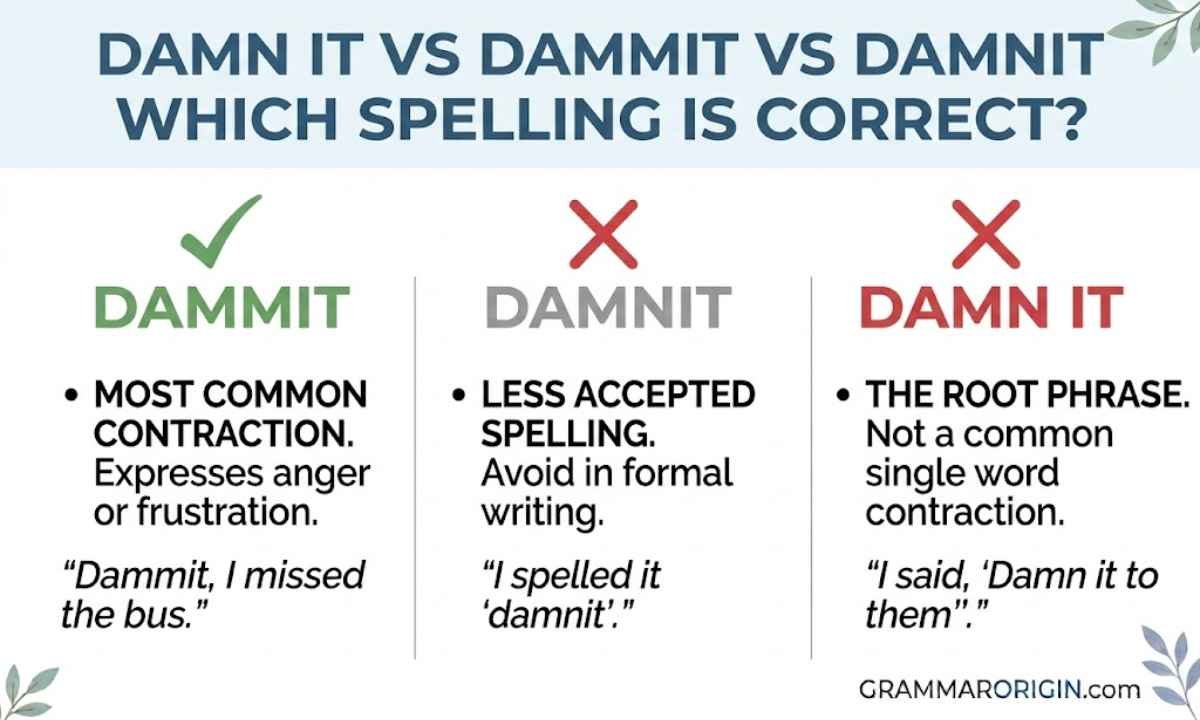
Damn it and dammit are both correct, and damnit is the odd one out in the damnit or dammit pair. Think of damn it as the full form and dammit as its one-word shortcut.
Example: Damn it, I forgot the password. Dammit, I forgot the password. Both lines are right, and only the look changes.
| Form | Words | Correct? | Best use |
| damn it | two words | Yes | Everyday writing, fiction |
| dammit | one word | Yes | Quick, punchy exclamations |
| damnit | one word | No | Nowhere, so fix it |
Some writers prefer damn it in careful prose because it shows the root word. Others like dammit because it looks like the sound. Pick one and keep it consistent through the whole piece.
One more trap is splitting it as “dam it.” A dam is a wall that holds back water, so “dam it” would mean blocking a stream, not venting. For the exclamation, it’s always damn it or dammit.
Real-Life Examples of “Dammit” in Sentences
Dammit works best at the start or end of a short sentence, where it carries the feeling. Seeing damnit or dammit in real sentences helps the right spelling stick:
- Dammit, I missed the bus by two minutes.
- He whispered, “Dammit,” and rubbed his eyes.
- I told you I’d finish this, dammit.
- Dammit, the file didn’t save.
- Oh, dammit, I just locked myself out.
- We lost the match by one point, dammit.
Titles show the spelling in print too. Blink-182 released a song called “Dammit” in 1997, and “Dammit Janet” is a well-known number from The Rocky Horror Show, which opened in 1973.
Both titles use the one-word spelling, which backs up what dictionaries say.
Punctuation tip: when dammit opens a sentence, follow it with a comma. When it needs more force, use an exclamation mark, but keep those rare.
Common Mistakes to Avoid
Most damnit or dammit mistakes come down to three habits: writing damnit, using it in the wrong setting, and using it too often. Each one weakens your writing in a different way.
1. Writing “Damnit”
Damnit is the most common slip, and the fix is quick. Change it to dammit, or split it into damn it.
Incorrect: Damnit, I forgot again.
Correct: Dammit, I forgot again.
Whenever you’re stuck on damnit or dammit, remember that only one of them is in the dictionary. A quick find-and-replace before you publish catches the rest.
2. Using It in Formal Writing
Don’t use dammit in formal writing. It’s informal and mildly rude, so it doesn’t belong in essays, reports, or professional emails. In fact, the damnit or dammit question never comes up in formal writing, because neither one belongs there.
Swap it for calmer wording like “that’s frustrating,” “I’m disappointed,” or “unfortunately.”
Example: Instead of “Dammit, the report failed to upload,” write “Unfortunately, the report failed to upload.”
3. Overusing It
Use dammit sparingly, because too much of it loses its punch. A word meant for a sudden burst of feeling stops working when every sentence has it.
Example: One dammit in a scene feels real. Five on a single page feels like noise.
Read More Posts Monkeys or Monkies? Correct Plural, Rule & Examples (2026)
American vs British English Usage
The damnit or dammit answer is the same on both sides of the Atlantic, because both American and British English spell it dammit. The difference is in how often each group reaches for it.
Example: Dash it all, we’ve missed the last train.
The two big dictionaries describe it a little differently. Dictionary.com’s American entry calls it a mild expletive, while the Collins English Dictionary, a British publisher, calls it a contracted form of damn it. They agree on the spelling.
British speakers often pick milder local options like blast, bother, or dash it all. Even so, dammit is understood in both countries.
Synonyms and Related Expressions
If dammit feels too blunt, or you’d rather skip the damnit or dammit question altogether, you have plenty of options. Pick one based on your audience, your tone, and how strong the feeling is.
Many of these are minced oaths, which are softened stand-ins for stronger words. They let you vent without the edge.
Example: Instead of dammit, you could say darn it to a coworker.
Mild Alternatives
Mild options suit workplaces, family chats, and anything you’d say around kids.
- Oh no
- Oops
- Shoot
- Rats
- Bummer
Example: Shoot, I forgot the attachment.
Moderate Expressions
Moderate options add a little more bite without turning harsh.
- Darn it
- Dang it
- Blast
- Drat
- Dash it all (more common in British English)
Example: Dang it, the battery died again.
Stronger Expressions
Stronger options show more feeling through emphasis, not heavy language.
- Damn it (the full form)
- For crying out loud
- You’ve got to be kidding me
- Good grief
Harsher swear words exist, but we’ve left them out to keep this guide clean.
Example: For crying out loud, who left the door open?
When Should You Use “Dammit”?
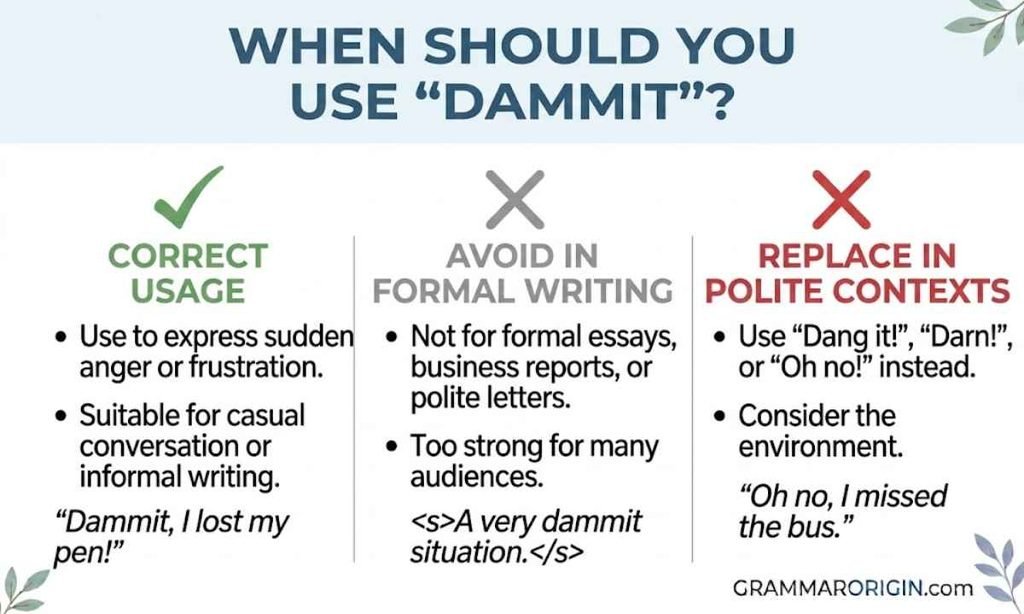
Use dammit in casual speech, texts, and fictional dialogue where frustration feels natural. Skip it when you need a polite, neutral, or professional tone. Once you’ve settled damnit or dammit, the real question is whether the moment suits it.
Good fits include:
- Dialogue in a story or script
- Texts and chats with friends
- Quick social posts
- Venting to yourself
Poor fits include:
- Work emails and reports
- School essays
- Customer messages
- Anything a manager or teacher will read
Example: “Dammit, Jo,” he muttered, “that was my last coffee filter.”
Writers often use it in dialogue to show a character’s mood in a single beat.
Is “Dammit” a Bad Word?
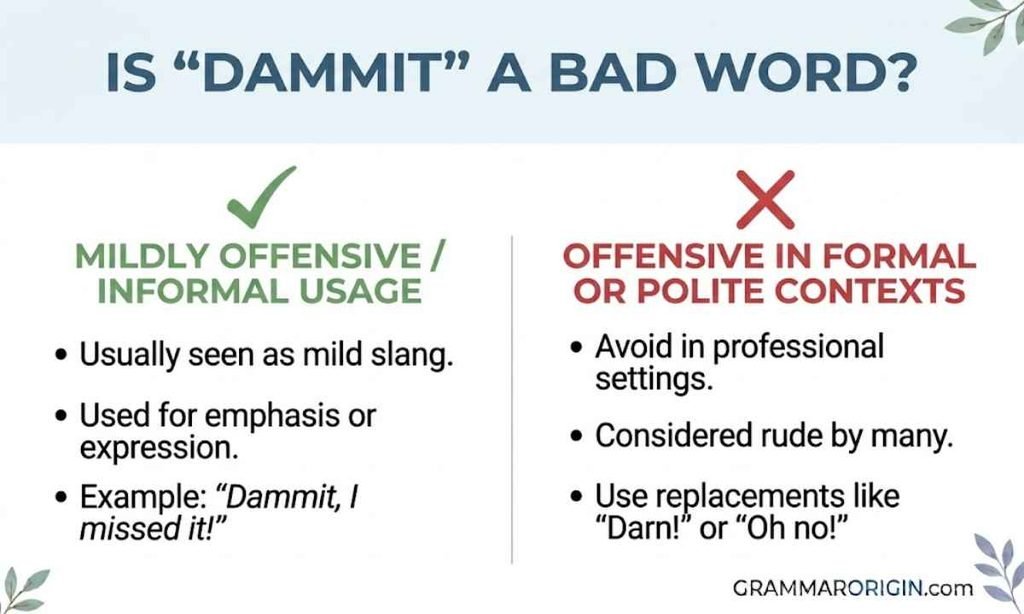
Dammit is a mild swear word, not a harsh one, but it can still bother some people. Dictionaries label it a mild expletive.
The word damn started with the idea of condemning someone, including in a religious sense, and some listeners still hear that edge. Whether it’s fine depends on the room.
Example: A text to a friend (“Dammit, I’m late.”) is usually fine. A note to a brand-new client isn’t.
Broadcast and workplace standards vary by country, channel, and company. Check the rules before using it in anything public-facing. Whichever way you spell it, the damnit or dammit choice doesn’t change how strong the word feels.
Dammit Doll
A Dammit Doll is a soft, stuffed stress-relief doll with long, dangling legs. You hold it by the legs and thump it on a desk when you need to let off steam.
Many come with a short, humorous poem attached that explains how to use the doll. We won’t quote one here, because those poems are someone’s creative work, but they’re easy to find on craft sites.
Example: She kept a Dammit Doll on her desk for rough Mondays.
People also sew their own from patterns, using scrap fabric or yarn, and the dolls are a popular office gift. The exact origin isn’t well documented, so be careful with any site that names a firm date or inventor.
It’s a bit of humor, not a treatment. If stress is weighing on you for weeks, talking to a doctor or counselor will help far more than a doll. The name uses the one-word spelling too, so even the doll follows the damnit or dammit rule.
Frequently Asked Questions
Is it damnit or dammit?
It’s dammit. In the damnit or dammit choice, damnit is the misspelling, even though you’ll see it in casual posts. Dictionaries list dammit, and damn it is the correct two-word form.
Is damn it the same as dammit?
Yes. Damn it is the two-word form, and dammit is the one-word version. They mean exactly the same thing.
Should I write damnit or dammit in fiction dialogue?
Write dammit. It matches how the word sounds, and readers will see it as the standard spelling. Damn it also works if you like a more traditional look, but keep one form through the whole story.
Is dammit a contraction?
It works like one, but it’s really a respelling of “damn it.” The Collins English Dictionary calls it a contracted form, while Dictionary.com labels it eye dialect. Either way, it’s informal.
Is dammit a bad word?
It’s a mild swear word. It’s fine among friends, but it doesn’t belong in professional or school writing.
Is it dam it or damn it?
It’s damn it. A dam is a wall that holds back water, so “dam it” has a different meaning. For the exclamation, use damn it or dammit.
What can I say instead of dammit at work?
Try “that’s frustrating,” “oh no,” or “unfortunately.” Darn it and dang it also work in relaxed teams.
Final Thoughts
Dammit is the right spelling, damn it is the right two-word form, and damnit is the one to avoid. That settles damnit or dammit for good.
Keep the silent n in mind. It explains why damnit or dammit confuses so many writers, and it shows why dammit is the spelling that matches the sound.

Muhammad Waqas is an English language teacher and grammar expert with over 8 years of experience helping students and professionals improve their writing skills. He specializes in English grammar, vocabulary, communication, and practical language learning. Through GrammarOrigin, Waqas shares clear, easy-to-understand content that helps readers write and speak English with confidence.