
Bellow means to shout or roar, while below means lower than or underneath. Stuck on bellow or below? Ask if the sentence is about a loud sound or about position, and the choice gets easy.
This guide explains both meanings, how each word sounds, and the tricky word “bellows.” You’ll also get a quick swap test and a fix for the typo that spellcheck misses.
Bellow
Bellow is a verb and a noun that means a loud, deep roar. People bellow when they’re angry or need to be heard, and animals like bulls and alligators do it too.
The word is said BEL-oh, with the stress on the first part. A bellow is bigger than a plain shout. It’s deep, loud, and often dramatic. The forms are bellow, bellows, bellowed, and bellowing. Those verb forms are one big difference in the bellow or below pair.
Example: The site manager bellowed across the scaffolding until the crane finally stopped.
Bellow is also a surname. The best-known example is the novelist Saul Bellow, who won the Nobel Prize in Literature in 1976. So a capital B can point to a person, not a sound.
How to Use “Bellow” in a Sentence
Use bellow when a person or an animal makes a loud, deep sound. It can be an action (a verb) or the sound itself (a noun).
- The ferry captain had to bellow through the fog so the dock crew could hear him.
- “Not that door!” Mara bellowed down the stairs.
- A hoarse bellow came from the reeds, and the kayakers stopped paddling.
As a verb, bellow often takes an object (bellow orders) or a direction word (bellow at the referee, bellow out a laugh, bellow with rage). As a noun, it often follows “let out” or “a bellow of.”
It’s a strong word, so use it when the volume really matters. If someone simply called across a room, “called” is a better fit.
Bellows – The Noun Form
Bellows is a different noun. It’s a tool that pumps air, like the one beside an old fireplace. Merriam-Webster lists it as plural in form, but it takes a singular or plural verb, so “a bellows” and “a pair of bellows” are both fine.
Context keeps it clear, because “bellows” is also the verb form of bellow (“he bellows”). Accordions, old cameras, and pipe organs have bellows too. These are folds or chambers that push air in and out.
Example: The blacksmith worked the bellows until the coals glowed orange. Across the yard, his helper bellows for more charcoal.
Below
Below is a preposition and an adverb. It means lower than, under, or less than, and it never describes a sound.
Example: The valley below the ridge was already in shadow.
Say it bih-LOW, with the stress on the second part. It rhymes with “go.” It does three jobs: position (the cellar is below the kitchen), amount (below ten degrees), and rank or level (below the passing mark).
Rarely, it’s used as a noun or an adjective, and the FAQs cover that. None of these jobs overlap with bellow, so the bellow or below choice is rarely a close call.
How to Use “Below” in a Sentence
Use below when you place something lower, smaller, or less than something else.
It can come before a noun (“below the window”) or stand alone at the end (“the traffic below”). It’s also the easy way to point readers further down a page, which is where most bellow or below slips happen.
Under often means touching or covered, while below just means lower. A cat sleeps under the table, but a shelf hangs below the window.
Example: The hikers set up their tents below the tree line, where the wind finally calmed.
Bellow or Below – Quick Answer
Bellow means a loud, deep shout or roar. Below means lower than, under, or less than.
| Word | Sounds like | Part of speech | Meaning | Example |
| Bellow | BEL-oh | Verb, noun | To roar or shout; a deep, loud cry | The coach bellowed a warning. |
| Below | bih-LOW | Preposition, adverb | Lower than, under, or less than | The answer is below the chart. |
If the sentence is about sound, write bellow. If it’s about position, level, or amount, write below. A handy hook is that bell means noise and low means lower.
The Oxford English Dictionary and Cambridge Dictionary both list bellow as a verb and a noun, and below mainly as a preposition and an adverb. Settle bellow or below by meaning first, and the spelling follows.
The Origin of Bellow and Below
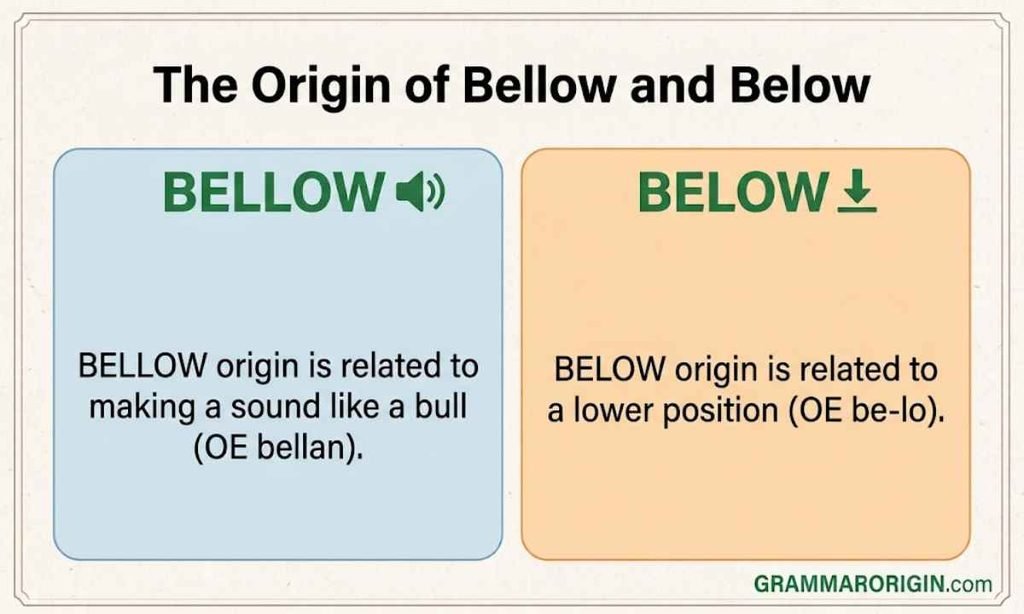
The two words in the bellow or below pair aren’t related. Bellow comes from an old word for roaring, and below is built from a prefix plus “low.”
Example: Below, beneath, and beside all start with be- plus a simple word, so they’re easy to read.
Bellow grew out of sound itself, so it works more like an echo of the noise it names.
The Etymology of “Bellow”
Bellow came into English in the Middle English period, most likely from the Old English word bylgan, which means to roar.
Example: A bellow and the German word bellen (“to bark”) both copy an animal’s cry.
Experts say the root is imitative, which means it was made to sound like the noise it names. Sources disagree about more distant relatives, so be careful with far-off links.
The Etymology of “Below”
Below is be- plus low, joined in Middle English around the early 1300s. Early spellings looked something like bilooghe.
That’s why the meaning is easy to remember. The word explains itself once you see the two pieces.
Example: Read below as “at a low spot,” and you’ll never confuse it with a roar.
British English vs. American English Spelling
There’s no difference when it comes to bellow or below. British and American English spell both words the same way and use them the same way.
Example: A Premier League manager bellowed from the touchline, and a Little League coach bellowed from the dugout. Same word, same spelling.
Unlike color and colour, neither word has a regional twin. The final -ow sounds a little different in London and Chicago, but the stress stays the same: BEL-oh for the roar, bih-LOW for position.
Which Spelling Should You Use?
Try the swap test. If “roar” or “shout” fits, write bellow. If “under” or “less than” fits, write below.
- The crowd began to ___ when the goal went in. “Roar” fits, so it’s bellow.
- Scores fell ___ the passing mark. “Under” fits, so it’s below.
A second check is grammar. If the word needs an ending like -ed or -ing, or it follows “to” as an action, it must be bellow, because below can’t be a verb.
The third check is your ear. Stress on the first part means bellow, and stress on the second part means below. Whenever a bellow or below doubt pops up mid-draft, these three checks take under ten seconds.
Common Mistakes with Bellow or Below
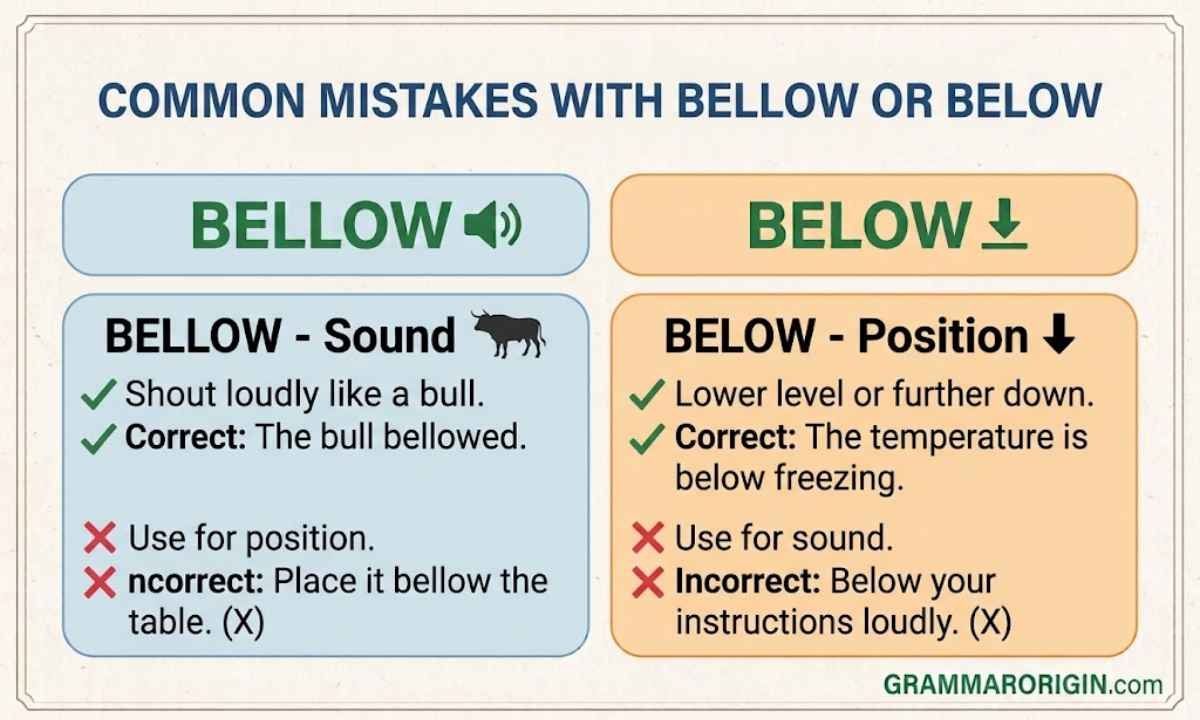
Most bellow or below mix-ups are typos. Like many commonly confused words, this pair causes spelling mistakes more than real misunderstandings.
Below is so common that the usual slip is typing bellow when you mean below. Spellcheck stays quiet because both are real words. The examples that follow show the patterns to watch.
Wrong: “Please see the instructions bellow.”
This is wrong because the writer means lower on the page, and bellow only means sound. It’s the most common bellow or below error.
Right: “Please see the instructions below.”
Below is correct because it points the reader further down.
Example: Our shipping policy is explained below the product photos.
You can also write “the instructions that follow” for variety.
Wrong: “The crowd started to below in excitement.”
This is wrong because “to below” asks below to be a verb, and it never is. After “to,” you need an action word.
Right: “The crowd started to bellow in excitement.”
Bellow is correct here because it’s the verb for a loud roar. “Roar” would work too, but bellow sounds deeper and longer.
Example: When the substitute scored, the away end began to bellow his name.
Wrong: “His voice was a low bellow as he read the notes.”
It depends on what “low” means. The sentence fails only if low means quiet, because a quiet bellow contradicts itself.
If low means deep, the sentence is fine. Otherwise, pick a softer word.
Example: His voice was a low murmur as he read the notes.
Wrong: “Temperatures fell bellow zero.”
This is wrong because temperature is a level, and levels take below. You’ll see this typo in weather posts and money headlines.
Right: “Temperatures fell below zero.”
Below is correct whenever a number drops under a mark. For age rules, “under 18” or “17 and younger” is usually clearer than “below 18.”
Example: Overnight lows slid below freezing across the plains.
Read More Posts Upmost or Utmost? Correct Usage, Rules & Examples
Bellow or Below in Everyday Examples
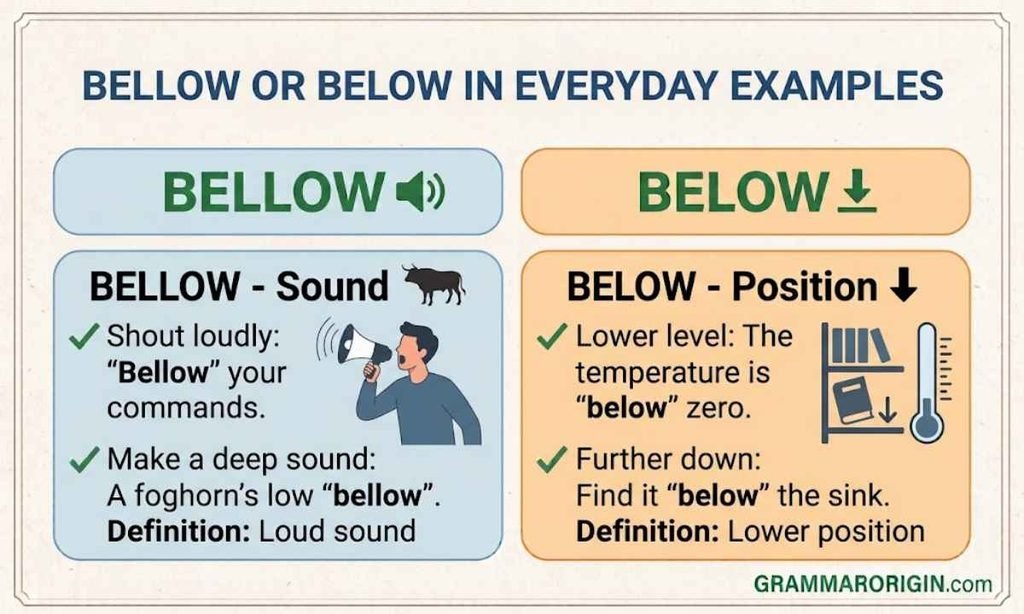
In daily life you’ll see below all the time and bellow only now and then, mostly in stories, sports news, and nature writing.
Bellow in real life:
- “Get down from there!” he bellowed.
- Male alligators bellow in spring to attract mates.
- The loud drums made the coach bellow just to be heard.
Below in real life:
- The invoice details are listed below.
- A large part of the Netherlands sits below sea level.
- The crew slept below deck during the storm.
Spot the difference in these bellow or below examples? Every bellow sentence has a voice in it. Every below sentence has a place, a level, or a number.
Common Phrases & Idioms
Sound phrases use bellow, and level or rank phrases use below. Learning a few set phrases makes bellow or below feel automatic.
- Bellow like a bull: to shout very loudly, usually in anger.
- Let out a bellow: to release one big roar.
- Below the belt: unfair. It comes from boxing, where a punch under the belt is a foul.
- Below average: lower than the usual amount, as in “rainfall was below average.”
- Below par: usually worse than expected. In golf it’s good news, because fewer strokes than par wins.
- Down below: a place underneath, like the lower deck of a ship.
Example: Dad bellowed like a bull when the power went out mid-game. His joke about my cooking was below the belt, but he laughed anyway.
Synonyms & Antonyms
Roar, shout, and holler are close to bellow, and the opposite is whisper. For below, think beneath, under, and underneath, with above as the opposite.
Shout is the general word, yell is sharper, holler is casual, and roar suits animals and crowds. Bellow is deep and drawn out. “Boom” and “thunder” work when a voice sounds huge.
Among the position words, under suggests touching or covering, and beneath can also mean lower in status. Below simply means lower. A synonym is also a handy way to test a bellow or below choice.
Example: She muttered her complaint instead of bellowing it. The cat slept under the table, but the clock hung above the door.
Read More Posts Upmost or Utmost? Correct Usage, Rules & Examples
Bellow or Below – Google Trends & Usage Data
In the bellow or below pair, below is the far bigger word. ProWritingAid’s grammar guide says it appears about 294 times more often than bellow.
Exact ratios change depending on the texts measured, so treat one figure as a rough guide. You can see the pattern yourself by comparing both words in Google Trends, which shows relative interest on a scale of 0 to 100 instead of raw counts.
That gap explains why bellow or below mistakes mostly run one way. A word you type all day is the one your fingers rewrite on autopilot. People who search bellow vs below are most likely checking a spelling.
Example: A novelist might use bellow a dozen times in a book, while a project manager types below a dozen times before lunch.
Keyword Comparison Table
Here’s the full bellow or below comparison in one place. Save it as a cheat sheet.
| Feature | Bellow | Below |
| Part of speech | Verb, noun | Preposition, adverb (rarely noun or adjective) |
| Core idea | A loud, deep roar or shout | Lower than, under, less than |
| Stress | BEL-oh | bih-LOW |
| Takes -ed or -ing? | Yes: bellowed, bellowing | No |
| Swap test | Roar, shout | Under, beneath, less than |
| Usually found in | Fiction, sports, nature writing | Emails, instructions, weather, money |
| Memory hook | Bell means noise | Low means lower |
| Spellcheck risk | Real word, so errors slip through | Real word, so errors slip through |
| UK vs US | Same | Same |
| Example | The sergeant bellowed the order. | The form is below the text. |
Please see below or bellow
It’s “please see below.” Writing bellow there would suggest you’re shouting at the reader.
Example: Hi Dana, the new timeline is below. Let me know if the dates work.
Spellcheck won’t catch the error, because bellow is a real word. A quick Ctrl+F for “bellow” before you hit send takes five seconds. This is the bellow or below mistake people make most often at work.
Safe wording includes “see below,” “as mentioned below,” “listed below,” “please find the details below,” and “my replies are below.” For clarity, some editors prefer pointing to something specific, like “see the table below.”
Final Thoughts
The bellow or below question comes down to sound versus position. Bellow roars, below sits lower, and the swap test settles any doubt in seconds.
Keep the two hooks handy for any future bellow or below doubt: bell for noise, low for lower. And if you ever write “please see bellow” in an email, your reader might hear the shouting before they read the details.
Frequently Asked Questions
Is it bellow or below when something is underneath?
It’s below. Bellow only means a loud sound or shout, never position.
Is it “see below” or “see bellow”?
It’s “see below.” The writer means lower on the page, and only below can do that, which is why bellow or below typos pile up in emails.
Are bellow and below pronounced the same?
No. Saying them aloud is the quickest way to hear the bellow or below split. Bellow is BEL-oh, with the stress on the first part, and below is bih-LOW, with the stress on the second.
What is the past tense of bellow?
The past tense is bellowed, and the present participle is bellowing. The third-person present is bellows, as in “she bellows.”
Is “bellows” singular or plural?
It’s plural in form, but it can take a singular or plural verb, according to Merriam-Webster. You can say “a bellows” for one device or “a pair of bellows.”
Is it correct to say “the below”?
It’s accepted, as in “the below chart,” and dictionaries record it as an adjective use. Some editors prefer “the chart below” or “the following chart,” so check your style guide.
Which is more common, bellow or below?
Below, by a wide margin. ProWritingAid estimates it’s about 294 times more frequent, which is why bellow-for-below typos are the more likely error.

Muhammad Waqas is an English language teacher and grammar expert with over 8 years of experience helping students and professionals improve their writing skills. He specializes in English grammar, vocabulary, communication, and practical language learning. Through GrammarOrigin, Waqas shares clear, easy-to-understand content that helps readers write and speak English with confidence.