
Monkeys is the correct plural of monkey, and monkies is an obsolete spelling. If you’re torn between monkeys or monkies, the rule is short: when a vowel comes before the final y, you just add s.
This guide shows why the rule works, where the old spelling came from, and which words follow the same pattern. You’ll also get real examples, two small exceptions, and the money and monies mix-up.
Monkeys or Monkies – Quick Answer
Monkeys is the correct spelling. Monkies is an old form that you’ll only meet in early printed texts.
- Correct plural: monkeys
- Obsolete spelling: monkies (not used in modern English)
- Rule: vowel + y, so add s
- Same pattern: key, keys; donkey, donkeys; valley, valleys
Dictionary.com gives the plural as monkeys, not monkies, and Wiktionary tags monkies as obsolete.
Example: We counted nine monkeys in the trees beside the river.
Read More posts Bellow or Below? Correct Spelling, Meaning & Examples (2026)
Is It Spelled Monkeys or Monkies?
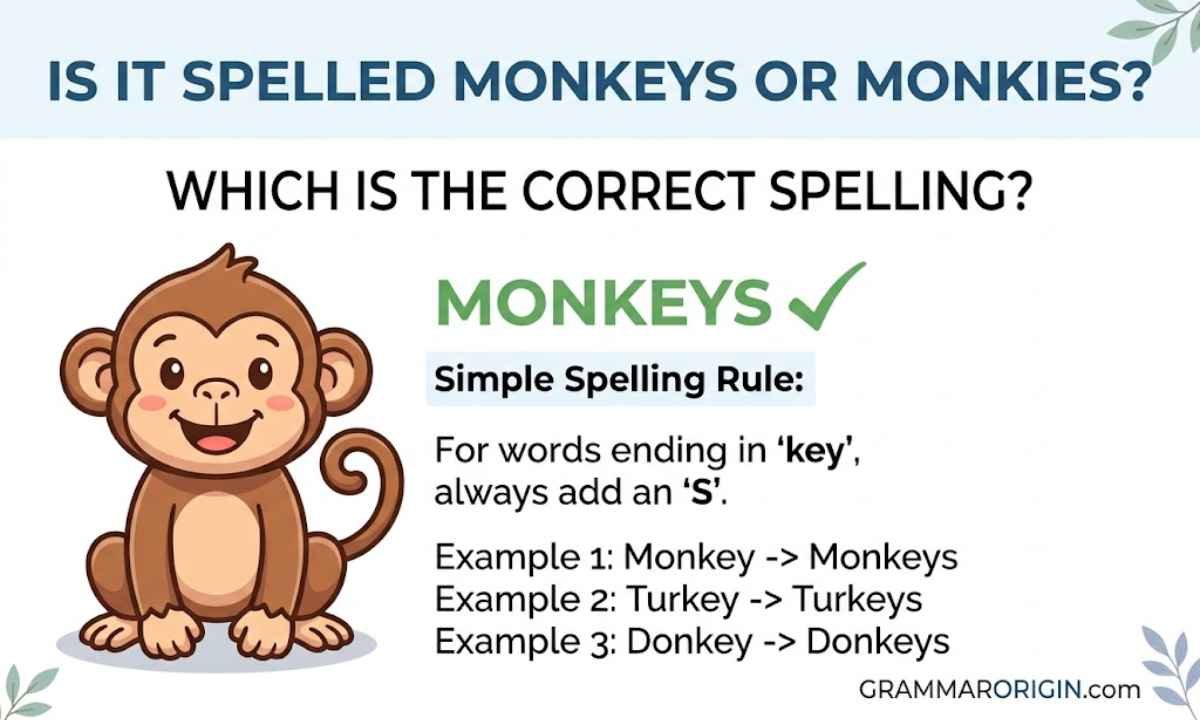
It’s spelled monkeys. Monkey ends in e plus y, so the plural just takes an s.
Example: One monkey, two monkeys. One key, two keys.
Here’s a two-step check for any word ending in y. If a vowel (a, e, i, o, u) comes before the y, add s. If a consonant comes before it, drop the y and add ies. Monkey is in the first group, so monkeys or monkies is never a real toss-up.
The Origin of Monkeys or Monkies
Monkies is an older spelling that appeared in early printed English, before spelling was fixed.
In Shakespeare’s The Merchant of Venice, Shylock says he wouldn’t trade a certain ring for “a wilderness of monkeys.” Early printed editions use the old ie ending, and modern editions use monkeys.
The word monkey itself reached English in the 1500s. Its exact origin is uncertain, and some sources point to Middle Low German or Dutch.
Example: A modern edition prints “a wilderness of monkeys,” while an early printing shows the old form.
British English vs American English Spelling
There’s no difference in monkeys or monkies between British and American English. Both use monkeys.
Unlike colour and color, this word has no regional twin. Australian and Canadian English use the same plural too.
Example: A zookeeper in Leeds and a zookeeper in Ohio both write monkeys on the sign.
Which Spelling Should You Use?
Use monkeys every time in modern writing. Use monkies only if you’re quoting an old text word for word.
That covers essays, emails, news stories, captions, and texts. A modern reader will treat monkies as a typo, so the monkeys or monkies choice is easy.
Example: If you quote an early printing exactly, you may keep the old monkies. In your own sentence, write monkeys.
Why Is It “Monkeys” and Not “Monkies”?
It’s monkeys because monkey ends in a vowel plus y, and English only turns y into ies after a consonant. The two sections below explain why the monkeys or monkies question has a firm answer.
Why “monkeys” ends in a -y and “s” letter
The y stays because the e before it already supplies the vowel sound, so nothing needs to change. You just add an s.
Compare baby. There, the y is the only vowel sound, so it swaps to i. In monkey, the letters ey work together as one sound (the “ee” at the end), so the y is left alone.
Example: Monkey plus s gives monkeys. The ey stays in one piece.
Why is the plural of monkey monkeys and not monkies?
The y-to-ies change only happens after a consonant, and monkey has a vowel before its y.
Example: Baby becomes babies, but monkey becomes monkeys.
Consonant plus y gives ies: baby, babies; city, cities; party, parties. Vowel plus y gives s: key, keys; boy, boys; valley, valleys.
Exceptions to the Rule
The vowel plus y rule has very few exceptions, and monkey isn’t one of them.
Words ending in -quy, like soliloquy, become soliloquies, because the u in qu acts like a consonant. Family names usually keep their form and just add s, as in the Kennedys.
Example: The Kennedys sat in the front row while the actor delivered three soliloquies.
Read More posts Bellow or Below? Correct Spelling, Meaning & Examples (2026)
Common Mistakes with Monkeys or Monkies
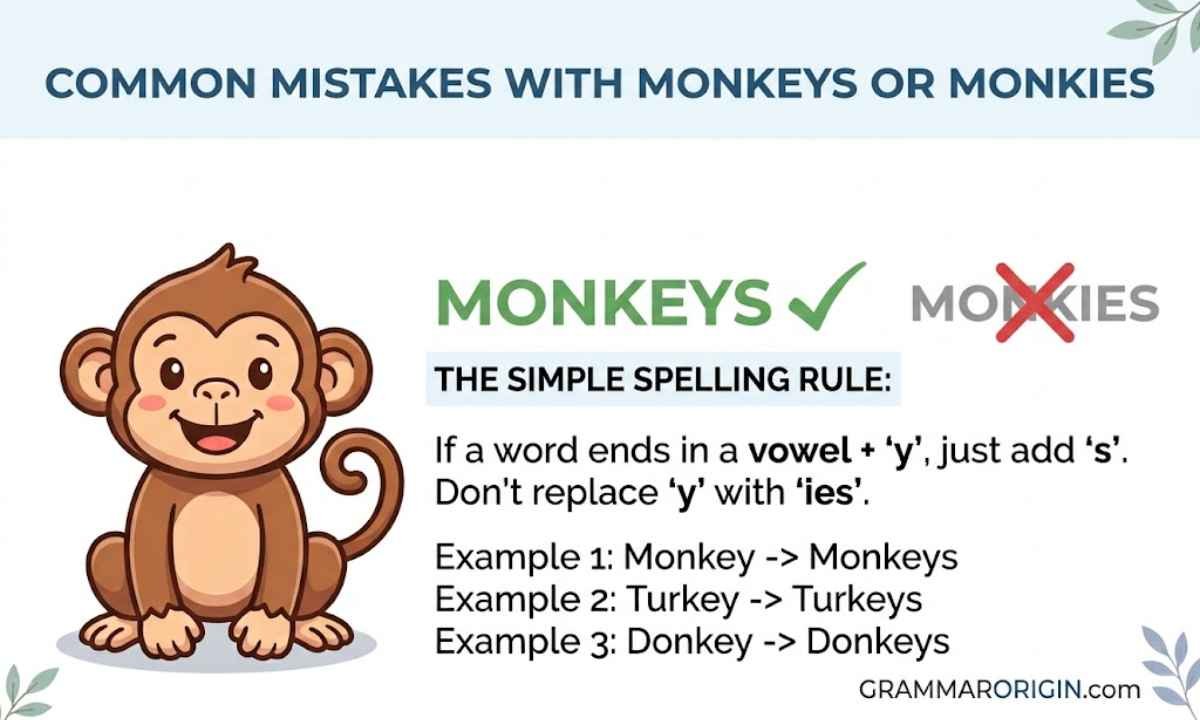
The biggest mistake is using the ies rule on every word that ends in y. Four habits cause most slips with monkeys or monkies.
- Using the ies rule everywhere. The rule only covers words with a consonant before the y.
- Spelling by ear. The ending of monkey sounds like “ee,” and so does the ending of babies.
- Trusting spellcheck. Monkies is a recorded old spelling, so don’t assume every tool will flag it.
- Adding an apostrophe. Writing “two monkey’s” turns a plain plural into a possessive.
Example: Wrong: “Two monkey’s sat on the fence.” Right: “Two monkeys sat on the fence.”
Monkeys or Monkies in Everyday Examples
In everyday writing, monkeys is the only form you’ll need, from homework to headlines.
- School: Our project compares how howler monkeys and spider monkeys move through the trees.
- News: The sanctuary moved fourteen rescued monkeys into a bigger habitat.
- Chat: Did you see those monkeys fighting over the banana?
- Science: Old World monkeys live in Africa and Asia, while New World monkeys live in Central and South America.
A group of monkeys is called a troop. Also, monkeys aren’t apes: most monkeys have tails, and apes don’t.
Common Phrases & Idioms with Monkey
Monkey appears in many fixed phrases, and the plural stays monkeys whenever you mean more than one.
- Monkey business: silly or sneaky behavior.
- Barrel of monkeys: used in “more fun than a barrel of monkeys.”
- Monkey see, monkey do: copying what others do.
- A monkey on your back: a problem that’s hard to shake.
Monkey also works as a verb. The forms are monkeys, monkeyed, and monkeying, and the y stays because a vowel comes before it.
Example: The twins monkeyed with the radio all afternoon.
Monkeys or Monkies – Google Trends & Usage Data
Monkeys is the standard spelling in dictionaries and modern books, and monkies is labeled obsolete.
We’re not quoting search numbers, because they change by date and region. You can check them yourself: Google Books Ngram Viewer charts how often each spelling appears in printed books by year, and Google Trends shows relative search interest on a 0 to 100 scale.
People who search monkeys or monkies are most likely checking a spelling after a moment of doubt.
Example: Type monkeys and monkies into Ngram Viewer, widen the date range, and compare the two lines.
Comparison Table (Keyword Variations)
Here’s the whole monkeys or monkies topic in one table.
| Question | Answer |
| Monkeys or monkies? | Monkeys |
| Is monkies ever correct? | Only when quoting an old text exactly |
| Rule used | Vowel + y: add s |
| Words with the same rule | key, donkey, turkey, valley, chimney |
| Words that change to ies | baby, city, party, story |
| Possessive singular and plural | the monkey’s tail; the monkeys’ habitat |
| Verb forms | monkeys, monkeyed, monkeying |
| UK vs US | No difference |
| Example | The monkeys crossed the bridge. |
Plural of monkey and donkey
The plural of monkey is monkeys, and the plural of donkey is donkeys. Both end in ey, so both just add s.
Example: The farmer fed the donkeys while the children watched the monkeys.
Other words in the family include turkey, turkeys; jockey, jockeys; and trolley, trolleys. Baby changes to babies because a consonant comes before the y, but monkey and donkey stay the same. That contrast is the whole monkeys or monkies story in miniature.
Monkies vs Monies vs Moneys
Monkies is obsolete, but monies and moneys are both accepted plurals of money.
Money is usually uncountable, so you rarely need a plural. When you do, to mean separate sums or funds, dictionaries list both forms, and monies is common in legal and financial writing. Monies being accepted doesn’t make monkies acceptable.
Example: The trust released all monies owed, and the museum counted the moneys it received.
Summary
Monkeys is the plural to use. Monkies is an old spelling that modern English no longer accepts.
Remember one rule: a vowel before the y means you add s. That’s why it’s monkeys, donkeys, and keys, but babies and cities. Whenever you wonder about monkeys or monkies, run that check and you’ll have your answer.
Frequently Asked Questions
Is it monkeys or monkies?
It’s monkeys. Monkey ends in a vowel plus y, so the plural just adds s.
Is “monkies” ever correct?
Not in modern writing. You’d only keep it when quoting an old text exactly as it was printed.
What is the plural of donkey?
The plural is donkeys. Like monkey, donkey has a vowel before the y, so it just takes an s.
What is the possessive of monkeys?
For one monkey, write monkey’s, as in “the monkey’s tail.” For several, write monkeys’, as in “the monkeys’ habitat.”
Do British and American English spell monkeys differently?
No. Both use monkeys, and neither accepts monkies in modern writing.
Why isn’t it monkies like babies?
Baby ends in a consonant plus y, so the y changes to ies. Monkey has a vowel before the y, so it only adds s.
Can I use monkeys or monkies in a caption or on social media?
Use monkeys. The same rule applies to captions, texts, and posts, and monkies would look like a typo.

Muhammad Waqas is an English language teacher and grammar expert with over 8 years of experience helping students and professionals improve their writing skills. He specializes in English grammar, vocabulary, communication, and practical language learning. Through GrammarOrigin, Waqas shares clear, easy-to-understand content that helps readers write and speak English with confidence.