
You’ve typed the sentence, then paused. Is it “choosing” or “chosing”? Only one of these spellings is real English, and the answer is choosing. Chosing has no dictionary entry, no grammatical role, and no valid use in any context.
This guide covers the definition, the grammar rule behind the spelling, pronunciation, examples across everyday situations, and a quick self-test so the choosing or chosing question never trips you up again.
Comparison Overview
Choosing is correct; chosing is a spelling error with nothing behind it. The mix-up usually starts because the base verb “choose” already looks a little unusual, and people guess wrong when adding “-ing.” Once you see the pattern once, it sticks for good.
| Aspect | Choosing | Chosing |
| Standard spelling | Yes | No |
| Dictionary entry | Yes | No |
| Grammatical role | Present participle / gerund | None |
| Safe for formal writing | Yes | Never |
| Typical cause | – | Dropped letter, fast typing |
Definition of Choosing
Choosing is the present participle of “choose,” and it describes the act of selecting or deciding between two or more things. It shows up in ongoing actions, something happening right now, not something finished.
A person who says “I’m choosing a laptop” hasn’t made the purchase yet; they’re still weighing the options. That’s the whole idea behind choosing meaning: an active, unfinished decision. Merriam-Webster and other major English dictionaries list choosing under the verb “choose,” confirming it as the only accepted form.
Definition of Chosing
Chosing isn’t a word. It carries no meaning, no dictionary listing, and no accepted place in written or spoken English.
Is choosing a word that gets confused with something real? Yes, with “chose,” the past tense, and occasionally with “chosen.” Chosing itself, though, is just a slip that happens when a writer drops a letter mid-type.
Main Differences Between Choosing and Chosing
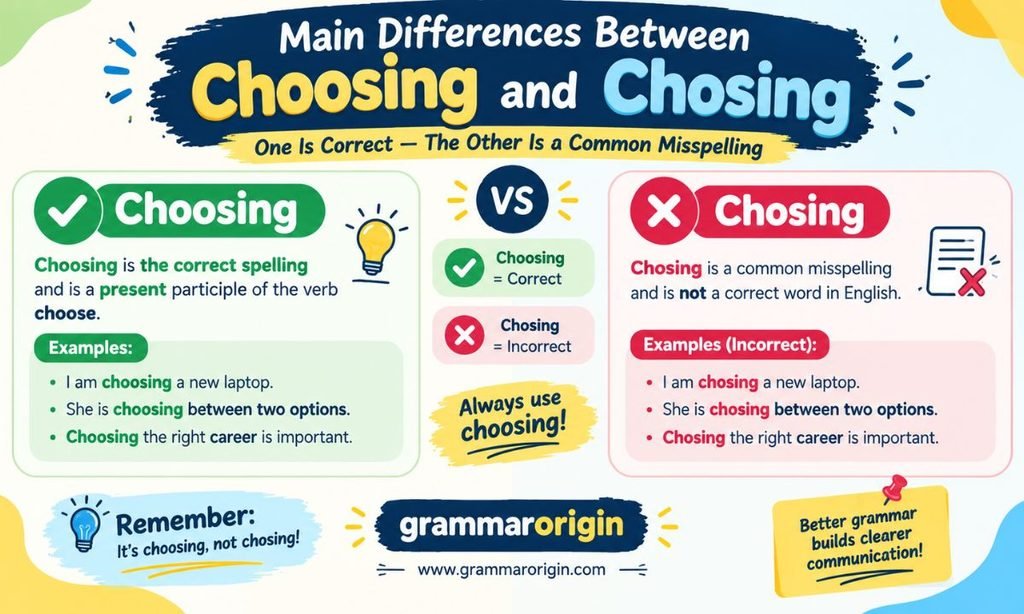
The gap between choosing or chosing comes down to one missing letter and a broken spelling rule. “Choose” keeps its double “o” in every form except the past tense, and chosing ignores that.
| Feature | Choosing | Chosing |
| Root verb | Choose | Attempted form of choose |
| Vowel pattern | Keeps both “o” letters | Drops one “o” |
| Function | Verb (continuous tense) / noun (gerund) | None |
| Recognized by editors, teachers, dictionaries | Always | Never |
| Sample sentence | She’s choosing a college. | She’s chosing a college. (incorrect) |
Choose, Chooses, Choosing, Chose, Chosen (Full Verb Family Table)
Seeing the whole verb family side by side makes the choosing correct spelling far easier to remember, since the pattern repeats across every tense.
| Form | Type | Example |
| Choose | Base / present | I choose comfort over style. |
| Chooses | Present, third person | He chooses carefully every time. |
| Choosing | Present participle / gerund | We’re choosing paint for the kitchen. |
| Chose | Simple past | She chose the window seat. |
| Chosen | Past participle | The winner has been chosen. |
“Chose” drops both o’s naturally; that’s the irregular past tense, and it’s the form people sometimes confuse with choosing. Chose and choosing describe different moments in time, so mixing them changes the meaning of a sentence, not just the spelling.
Also Read This Taken vs Taking: What’s the Difference?
Grammar Guide
How each term is used in sentences
Choosing in a sentence almost always pairs with a helping verb like “is,” “am,” “are,” “was,” or “were,” or it stands alone as a gerund. Chosing never appears correctly in any sentence, formal or casual.
- She is choosing her outfit for the interview.
- Choosing a career takes patience.
- They were choosing between two apartments.
Common mistakes learners make
The most frequent error is dropping the second “o” while typing quickly, especially on mobile keyboards. A second, less common mistake is swapping choosing for chose, which changes the tense entirely.
Some learners also assume the silent “e” and one of the “o” letters both disappear together, since that pattern happens with words like “make” turning into “making.” Choose doesn’t follow that shortcut.
Simple rules to remember
Drop only the silent “e” at the end of choose, and keep every other letter untouched. That single move gets you from choose to choosing every time, with zero exceptions.
Quick tips for writing and speaking
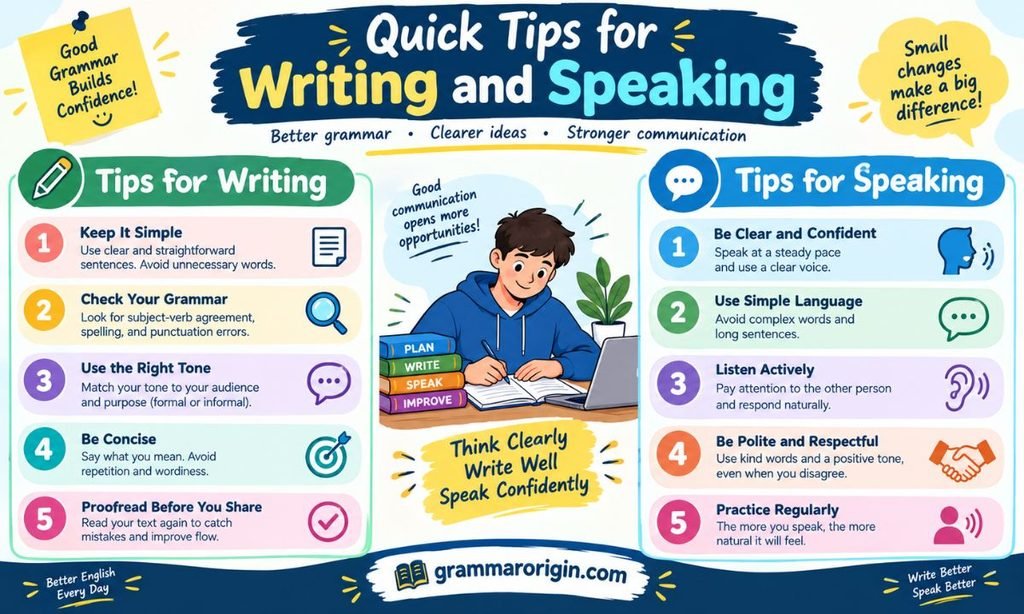
Say the word slowly, “choo-sing,” and you’ll hear the long “oo” sound that confirms both o’s belong there. If you’re typing fast, a quick glance back at any sentence with “choosing” catches the error before it reaches a reader.
Pronunciation of Choosing
Choosing pronunciation follows the pattern /ˈtʃuːzɪŋ/, said as “CHOO-zing,” with a long “oo” and a soft “z” sound in the middle. There’s no regional split here; American, British, and Australian speakers all say it the same way.
Breaking it into three parts helps: “choo” (rhymes with “too”), then a “z” sound rather than a hard “s,” then the familiar “-ing” ending. Getting the “z” sound right also reinforces why the spelling keeps its shape, since chosing would actually change how the word sounds if it were real.
When to Use Each One
Use choosing any time you’re describing an active, unfinished decision, such as picking a restaurant, comparing job offers, or deciding what to wear. It also works as a gerund, meaning it can act like a noun: “Choosing wisely pays off.”
- Choosing a university program
- Choosing between two job offers
- Choosing the right words in an email
There’s no situation where chosing belongs, not in texting, not in casual notes, not anywhere.
When NOT to Use Each One
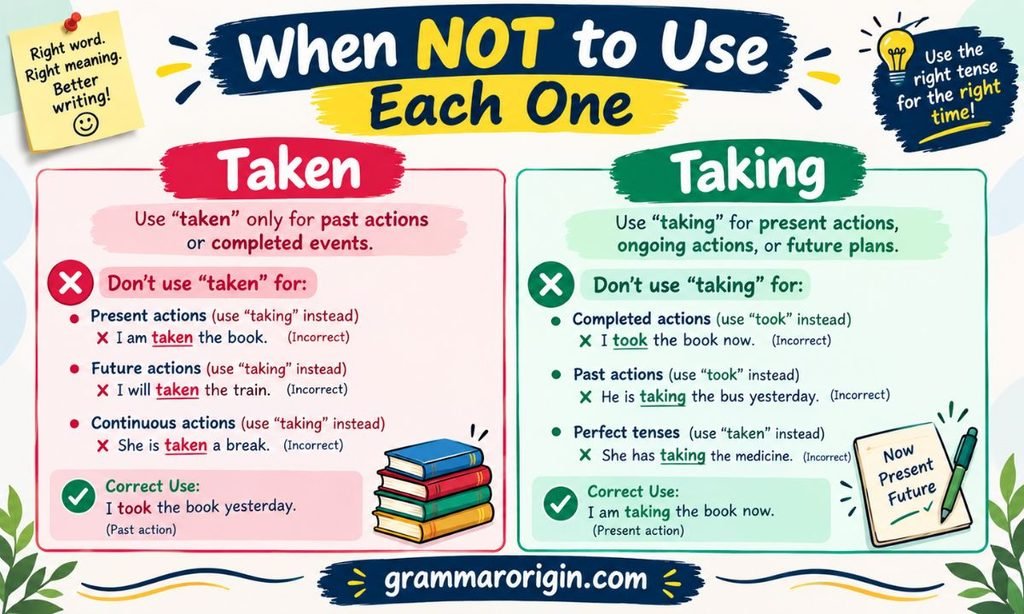
Don’t use choosing when you mean a decision that’s already been made; that calls for “chose” or “chosen” instead. Saying “I’m choosing that car yesterday” mixes tenses and reads as a grammar slip, not just an awkward sentence.
Chosing has no correct use anywhere, so the rule here is simple: if you’re about to type it, stop and swap in choosing.
Which One to Use (Decision Guide)
If the action is happening right now or hasn’t wrapped up yet, choosing is the word you want. If you catch yourself writing chosing, that’s your signal to pause and correct it before you hit send or publish.
A fast mental check: replace the word with “selecting.” If that swap makes sense in the sentence, choosing is the right call every time.
Real-World Practical Examples
Choosing Examples
- Education: He’s choosing which electives to take next semester.
- Workplace: The hiring panel is choosing between three finalists.
- Everyday life: I’m choosing tea over coffee this morning.
- Technology: Shoppers are choosing between two phone models.
- Relationships: She’s choosing her words carefully during the conversation.
Chosing Examples
- Incorrect: He’s chosing which electives to take. Correct: He’s choosing which electives to take.
- Incorrect: The panel is chosing a finalist. Correct: The panel is choosing a finalist.
- Incorrect: I’m chosing tea today. Correct: I’m choosing tea today.
Every line on the left side above is wrong; there’s no context that fixes it.
Synonyms of Choosing
If you want variety in your writing instead of repeating “choosing” every line, a few close alternatives work well depending on tone. This also answers the common search for a chosing or choosing synonym, since chosing has none; these synonyms belong strictly to choosing.
- Selecting
- Picking
- Deciding on
- Opting for
- Settling on
“She’s opting for the smaller apartment” carries roughly the same meaning as “She’s choosing the smaller apartment,” just with a slightly different feel.
Also Read This Taken vs Taking: What’s the Difference?
Self-Assessment (Fill in the Blanks)
Test yourself before checking the answers below.
- I am ______ a birthday gift for my sister.
- They were ______ between two flights.
- She kept ______ the wrong file by mistake.
- We are ______ a name for the new puppy.
- He is ______ his classes for next year.
- The committee is ______ a winner right now.
- I’m still ______ what to cook tonight.
- You should avoid writing “______” instead of “choosing.”
- She is ______ between honesty and comfort.
- The team is ______ a new logo design.
Answers
- choosing
- choosing
- choosing
- choosing
- choosing
- choosing
- choosing
- chosing (the incorrect form to avoid)
- choosing
- choosing
Final Verdict
Choosing is the only accepted spelling, and chosing carries no legitimate use in English. The rule behind it is short enough to memorize in one read: keep both o’s from “choose,” drop only the silent “e,” and add “-ing.”
Whenever you’re unsure mid-sentence, saying the word aloud or swapping in “selecting” settles the choosing or chosing question in seconds.
Conclusion About Choosing Vs Chosing
Getting this one right is a small habit that pays off in every email, essay, or caption you write. Choosing keeps its place as the correct, professional, dictionary-approved form, while chosing stays a typo with no exceptions.
Next time you’re deciding between choosing or chosing, trust the double “o,” and the rest takes care of itself.
Frequently Asked Questions
Is “choosing” the correct spelling?
Yes, choosing is the only correct spelling recognized by every major English dictionary. Chosing is a common typo, not an alternate spelling.
Is chosing a real word in any dialect?
No, chosing doesn’t appear in American, British, or Australian English. Spell-checkers and style guides all flag it as an error.
What is the correct verb form of choose in present continuous?
The present continuous form is choosing, used with “is,” “am,” or “are.” For example: “They are choosing a venue for the event.”
How do I pronounce choosing correctly?
Choosing is pronounced /ˈtʃuːzɪŋ/, or “CHOO-zing,” with a long “oo” sound and a soft “z.” The pronunciation stays the same across English-speaking regions.
What’s the difference between choose and chose?
Choose is the base, present-tense form, while chose is the simple past tense. “I choose the blue shirt” describes now; “I chose the blue shirt” describes something already decided.
Why do people write chosing by mistake?
Fast typing and mishearing the pronunciation both play a role, since the sound doesn’t obviously signal two o’s. Once the double-o pattern is memorized, the mistake tends to disappear.
Can chosing ever be correct in casual writing or texting?
No, even in the most casual context, chosing is still wrong. Choosing works everywhere, in formal writing, casual notes, and spoken conversation, without exception.

Muhammad Waqas is an English language teacher and grammar expert with over 8 years of experience helping students and professionals improve their writing skills. He specializes in English grammar, vocabulary, communication, and practical language learning. Through GrammarOrigin, Waqas shares clear, easy-to-understand content that helps readers write and speak English with confidence.