
So, emphasise or emphasize? Both are correct. Emphasize is the standard spelling in American English, emphasise is the standard in British English, and the meaning is exactly the same.
This guide shows where each spelling came from, which one suits your readers, and the slip-ups that catch people out, including the stubborn “emphasize on”. There’s a short practice set at the end, too.
Emphasize or Emphasise – Quick Answer
Both spellings are correct, and the only real difference is region. Write emphasize for a US audience and emphasise for readers in the UK, Australia or New Zealand.
| Question | Answer |
| Which spelling is correct? | Both |
| American English | emphasize (with a z) |
| British English | emphasise (with an s) |
| Same meaning? | Yes |
| Same pronunciation? | Yes, EM-fuh-size |
| Noun form | emphasis, in both |
Not sure who’ll read your work? Pick one spelling and keep it from the first line to the last. Consistency beats guessing the region.
Example: The manager will emphasize safety in every training session (US). The same sentence for a London office reads: the manager will emphasise safety in every training session.
The Origin of Emphasise or Emphasize
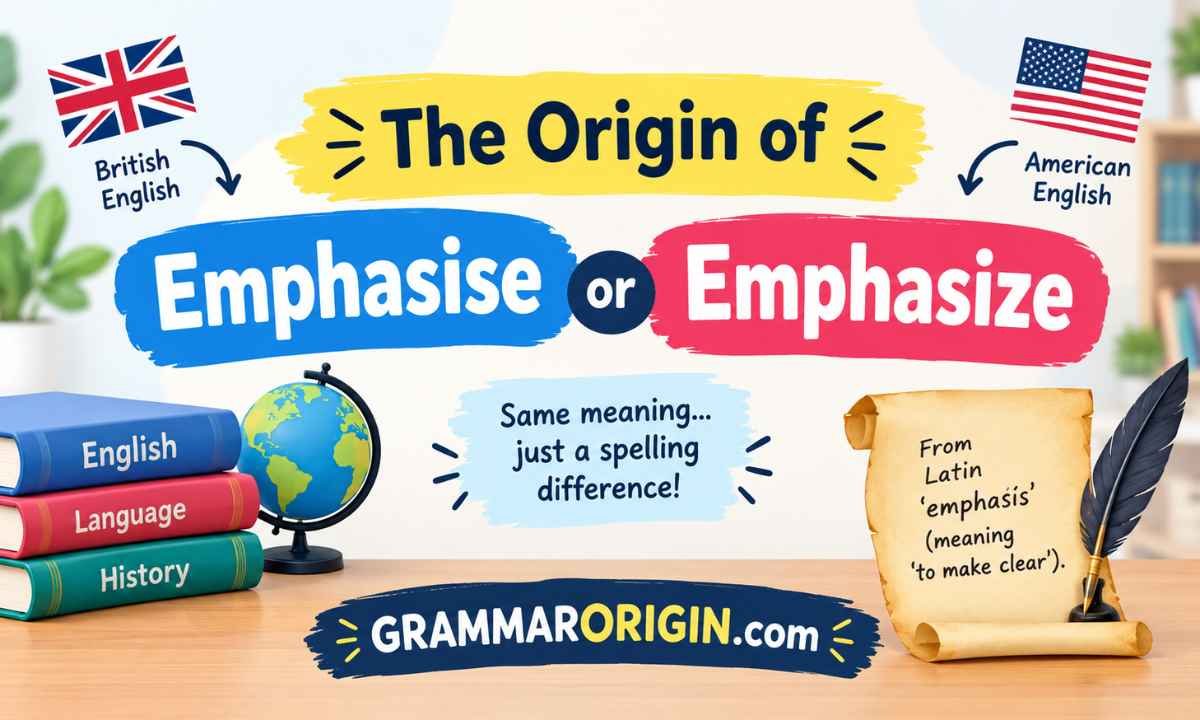
Both spellings grow from one Greek root. They split later, when English borrowed the verb ending in two different ways.
The noun emphasis comes from Greek émphasis, tied to emphainein, “to show” or “to make appear”. English picked it up in the 1500s as a rhetorical term for meaning that’s implied rather than spelled out. The everyday sense of “stress” grew from there, and the verb was built on the noun afterwards.
Example: A teacher who taps the board twice is using emphasis. The same teacher who says “this bit matters” is choosing to emphasise it.
Emphasise
Emphasise is the British spelling. It leans on the French -iser ending that shaped a lot of English verbs, and over time -ise became the everyday default across Britain and much of the Commonwealth.
Its relatives are words you probably write without thinking: organise, realise, recognise. If you already spell those with an s, emphasise follows the same pattern.
Example: The school newsletter will emphasise hand-washing this winter.
Emphasize
Emphasize keeps the -ize ending, which goes back to the Greek -izein. American English made it the standard, and Noah Webster’s 1828 dictionary helped cement the habit.
Here’s the twist. Oxford University Press also prefers -ize, even for British English. That’s why you’ll bump into emphasize in UK academic writing and never once suspect a typo.
Example: The professor will emphasize primary sources in the seminar.
British English vs American English Spelling (emphasise vs emphasize)
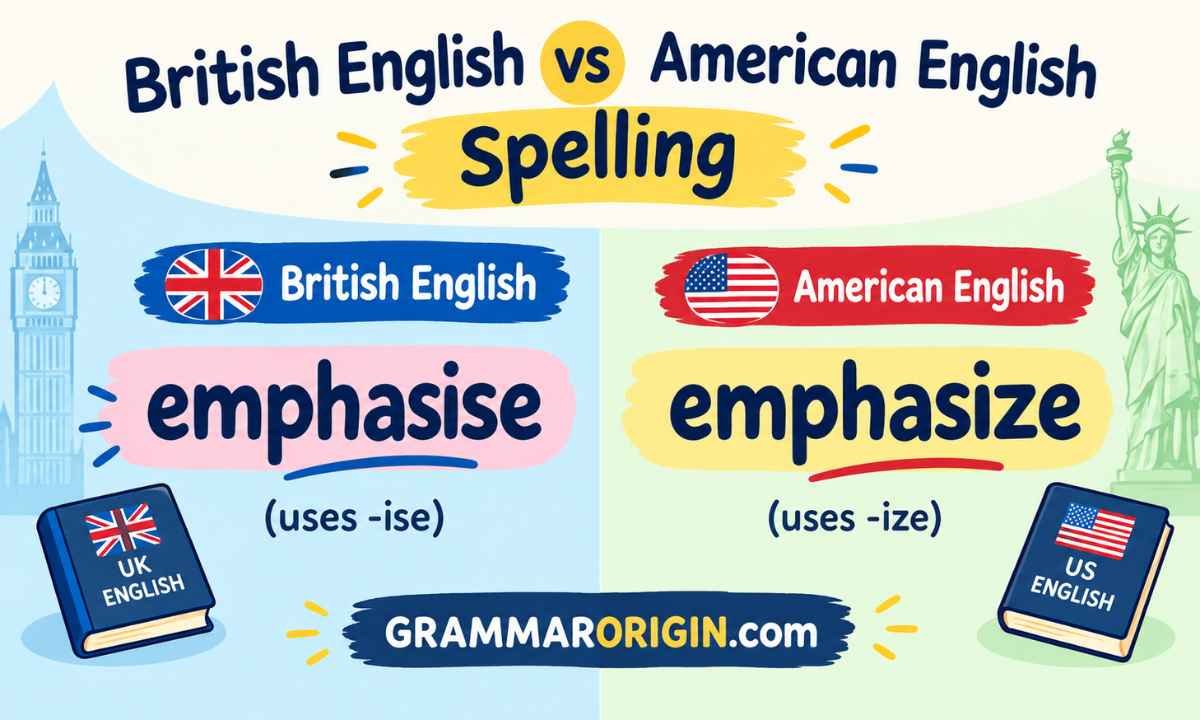
American English uses -ize, while British English mostly uses -ise. The big exception is Oxford spelling, a British style that keeps -ize.
Here’s how it breaks down by region:
- United States: emphasize, organize, realize, analyze
- United Kingdom: emphasise, organise, realise, analyse (Oxford style: emphasize, organize, realize, analyse)
- Australia, New Zealand, South Africa: emphasise and the other -ise forms
- Canada: mostly emphasize, like its southern neighbour
- India: mainly British conventions, though -ize shows up in some academic and publishing house styles
Style guides tell the same story. AP and the Chicago Manual of Style go with -ize, while The Guardian’s style guide and much of UK newsroom and government writing lean towards -ise.
Example: A Sydney agency’s brief might say the campaign should emphasise local suppliers. The Toronto version of that brief would say emphasize.
Also Read This Excell or Excel: Which Spelling Is Correct? (2026 Guide)
Which Spelling Should You Use? emphasize vs emphasise/emphasises or emphasizes
Match the spelling to your reader’s country, then use it every single time. US readers get emphasize, emphasizes, emphasized and emphasizing, while UK, Australian and New Zealand readers get the -ise set.
A few quick rules of thumb:
- US employer, university or publication: use -ize.
- UK, Australian or New Zealand audience: use -ise.
- Global audience with no clear region: either works, though -ize is the safer pick because nearly every reader and spellchecker recognises it.
- A style guide or house rule: it beats everything above.
- An academic journal: follow its author guidelines, since some UK journals use Oxford -ize.
Every form of the verb should match the root you chose:
| Form | American | British |
| Base verb | emphasize | emphasise |
| Third person | emphasizes | emphasises |
| Past tense | emphasized | emphasised |
| Present participle | emphasizing | emphasising |
| Noun | emphasis | emphasis |
Example: The guide emphasizes planning and the coach emphasized it again last week (US). In the UK version, the guide emphasises planning and the coach emphasised it again last week.
Other -ise and -ize Words: organise, realise, analyse
Most -ise/-ize verbs follow the same regional split, but not all of them. A blind swap of every s for a z will hand you typos like “advertize”.
Some words stay -ise everywhere: advertise, advise, compromise, exercise, improvise, revise, supervise, surprise. In those, the “ise” is part of the word itself rather than a suffix.
Others split by region, just like emphasise or emphasize: organise/organize, realise/realize, recognise/recognize, apologise/apologize.
Then there’s analyse. Americans write analyze, but even Oxford style keeps analyse, because its ending isn’t the -ize suffix at all.
Example: We’ll advertise the role first, then organise the interviews (UK). The US version keeps advertise and switches to organize.
How to change UK/US spelling in Word & Google Docs
Set your proofing language once, and your spellchecker will flag the wrong variety for you. It takes about ten seconds.
- Word: select everything with Ctrl+A (Cmd+A on a Mac), open the Review tab, choose Language, then Set Proofing Language, and pick English (United Kingdom) or English (United States). Menus shift a little between versions.
- Google Docs: open File, then Language, and pick your English variety.
- Grammarly and similar tools: choose your English dialect in the settings.
Fixing a finished document is even quicker. Use find and replace to swap “emphasiz” for “emphasis” and every -ize form flips to -ise in one go.
Example: Before the swap, the memo said the team emphasized speed and emphasizes quality. After it, the memo says the team emphasised speed and emphasises quality.
Common Mistakes with Emphasise or Emphasize
The most common mistake is mixing both spellings in one document. Close behind is adding “on” after the verb.
- Mixing spellings. Emphasize in paragraph one and emphasise in paragraph five reads as careless.
- Writing “emphasize on”. The verb doesn’t need a preposition.
- Using the verb where the noun belongs. “Give more emphasise” should be “give more emphasis”.
- Ignoring the reader’s country. An American-spelled CV can look off to a UK hiring manager, and the reverse is true too.
- Stressing the wrong syllable out loud. More on that in the pronunciation section.
Example: Wrong: the report emphasizes cost, but the summary emphasises speed. Right: the report emphasizes cost, and the summary emphasizes speed.
Emphasize on or Emphasize? (Grammar Fix)
Just emphasize. The verb takes its object directly, so “on” has no job to do.
People add it because “focus on”, “insist on” and “stress on” all sound so natural. The noun does take “on” though, as in “place emphasis on”.
Example: Wrong: she emphasised on punctuality. Right: she emphasised punctuality. Also right: she put emphasis on punctuality.
Emphasise or Emphasize in Everyday Examples
In everyday writing, the spelling changes with the audience and nothing else in the sentence has to. Here’s the same idea across school, work, public notices and casual chat.
At school
- US: The teacher will emphasize clear thesis statements in every essay.
- UK: The teacher will emphasise clear thesis statements in every essay.
At work
- US: Our onboarding deck emphasizes customer service.
- UK: Our induction pack emphasises customer service.
In public notices
- US: The city notice emphasized the new recycling rules.
- UK: The council notice emphasised the new recycling rules.
In casual talk
- US: “I can’t emphasize enough how good that pasta was.”
- UK: “I can’t emphasise enough how good that pasta was.”
When the audience is mixed
- Parents should emphasize kindness at home. (Swap in emphasise if your readers are British.)
Notice that vocabulary shifts along with spelling: onboarding becomes induction, and city becomes council. A UK reader picks up on the whole package, not just the z.
Emphasise or Emphasize – Google Trends & Usage Data
Emphasize tends to lead in global web content because so much of the web is American. Emphasise holds its ground in UK, Australian and New Zealand writing. Exact percentages move around, so it’s smarter to check the data yourself than to trust a number from a random blog.
Here’s a two-minute way to do it:
| Tool | What to do | What it shows |
| Google Trends | Compare “emphasise” and “emphasize”, then filter by the UK, the US, Australia and India | Relative search interest by region |
| Google Books Ngram Viewer | Enter both spellings, then switch between the American English and British English corpora | How often each appears in published books over time |
A couple of reading tips. Trends measures searches, not writing, and plenty of those searches come from people checking the spelling. Ngram measures books, so it lags behind today’s web.
Example: Run emphasise against emphasize for the UK, then again for the US, and you’ll typically see the leading spelling flip between the two.
The takeaway is simple. Local readers beat global averages, so write for the country in front of you.
Comparison Table – Emphasise vs Emphasize
Emphasise is the British form and emphasize is the American one, and everything else about the two words matches. This table puts the differences side by side.
| Feature | Emphasise | Emphasize |
| Spelling | -ise (with an s) | -ize (with a z) |
| Main regions | UK, Australia, New Zealand, South Africa | US, most of Canada |
| Also common in | Everyday UK writing | Oxford-style British and academic writing |
| Third person | emphasises | emphasizes |
| Past tense | emphasised | emphasized |
| Present participle | emphasising | emphasizing |
| Noun | emphasis | emphasis |
| Style guides | The Guardian, UK newsrooms | AP, Chicago, Oxford |
| Pronunciation | /ˈɛm.fə.saɪz/ | /ˈɛm.fə.saɪz/ |
| Meaning | To give special importance to something | Identical |
| “Emphasise on” correct? | No | No |
| Spellchecker setting | English (UK) | English (US) |
Example: A US-set spellchecker will usually underline emphasise, while a UK-set one is happy with it.
Emphasise or emphasize synonyms
Stress, highlight, underscore and accentuate are the closest synonyms. They aren’t perfect swaps, though, so each one suits a slightly different sentence.
| Synonym | Works best when | Example |
| stress | you’re giving spoken or written weight to a point | The coach stressed the importance of sleep. |
| highlight | you’re pointing something out so people notice it | The report highlights three risks. |
| underscore | you’re reinforcing a point that’s already made | The results underscore the need for training. |
| accentuate | you’re making a feature more noticeable | The lighting accentuates the room’s height. |
| underline | you’re literally or figuratively marking something | The email underlines the deadline. |
| call attention to | you want a plainer, more conversational phrase | She called attention to the error. |
The opposite direction has its own set: downplay, understate, play down and gloss over. You’ll also see de-emphasise and de-emphasize, which follow the same s/z split as the main verb.
Example: The manager wanted to emphasise growth, so the deck downplayed last year’s dip.
Also Read This Excell or Excel: Which Spelling Is Correct? (2026 Guide)
Emphasise or emphasize pronunciation
Both spellings sound identical: EM-fuh-size, written /ˈɛm.fə.saɪz/, with the stress on the first syllable. The s or z changes nothing about the sound.
It has three syllables. The middle one is a relaxed “fuh”, and the ending rhymes with size and eyes.
Some speakers stress the second syllable, and there’s a reason. In emphatic, the stress does move to the middle (em-FAT-ik), so the sound carries over by mistake. The noun stays put: emphasis is EM-fuh-sis, and its plural, emphases, is EM-fuh-seez.
Example: The last sound in emphasize matches realize and organize, so if you can say those, you can say this one.
Quick Practice: Choose the Right Spelling
Try these five, then check the answers underneath.
- A US college essay: “The author will ____ the role of trade.”
- A UK newspaper headline: “Minister to ____ climate goals.”
- A blog written for readers around the world: “We ____ clear writing.”
- Fix this: “She emphasised on the budget.”
- Fill the gap: “The teacher put extra ____ on spelling.”
Answers:
- emphasize, because the audience is American.
- emphasise, because the audience is British.
- Either works. Pick one and stay with it.
- She emphasised the budget, or she put emphasis on the budget.
- emphasis, since the sentence needs a noun.
Final Thoughts
Emphasise or emphasize comes down to your reader. Choose emphasize for a US audience and emphasise for a UK, Australian or New Zealand one, and either way you’re right.
What actually hurts your writing is mixing the two, or tacking “on” after the verb. Set your spellchecker, stay consistent, and the whole question goes away.
Frequently Asked Questions
What does “emphasise” mean?
It means to give something special importance or extra attention, in speech or in writing. Emphasise is the British spelling of emphasize, and you can do it by repeating a point, slowing down, or using italics.
What does “emphasis” mean?
Emphasis is the noun: the special importance, stress or attention given to something. It’s spelled the same in British and American English, and the plural is emphases.
When to use emphasize?
Use emphasize when you’re writing for an American audience or following a US style guide such as AP or Chicago. It’s also a safe pick when you’re torn between emphasise or emphasize for readers around the world.
Example: Our US launch email will emphasize free shipping.
How do you spell “emphasize” in the UK?
In the UK, the usual spelling is emphasise, with an s. Emphasize with a z also appears in Oxford-style British writing, so you may see both.
Is “emphasize on” correct?
No. Emphasize takes a direct object, so write “emphasize the point”, not “emphasize on the point”. If you want the preposition, switch to the noun: “place emphasis on the point”.
Is emphasize accepted in British English?
Yes. Emphasize is accepted in British English, especially in Oxford-style publishing and academic journals, though emphasise is more common in everyday UK writing. For most UK readers, emphasise or emphasize is a style choice rather than a spelling error.

Muhammad Waqas is an English language teacher and grammar expert with over 8 years of experience helping students and professionals improve their writing skills. He specializes in English grammar, vocabulary, communication, and practical language learning. Through GrammarOrigin, Waqas shares clear, easy-to-understand content that helps readers write and speak English with confidence.