
Excel is the correct spelling, and “Excell” is a common mistake. When you ask Excell or Excel, the answer is always the version with one L, whether you mean the verb or the Microsoft spreadsheet program.
The Excell or Excel mix-up happens because so many English words end in a double L. This guide explains the spelling rule, the meaning, real examples and easy tricks, so you never second-guess the word again.
Excell or Excel: What Is the Correct Spelling?
The correct spelling is excel, with a single L. “Excell” isn’t a word in British English, American English or any other standard variety.
Major dictionaries such as Oxford, Cambridge and Merriam-Webster list excel with one L as the main entry. Microsoft uses the same spelling for its spreadsheet software, so the verb and the product agree.
Quick facts for reference:
- Correct: excel, a verb pronounced ik-SEL, meaning to do something very well.
- Wrong: excell, which has no dictionary entry.
- Verb forms: excel, excels, excelled, excelling.
- Related words: excellent, excellence, excellently.
- Origin: Latin excellere, through Old French exceller.
- Software: Microsoft Excel, always with a capital E.
- The spelling is the same in the UK and the US.
Example: Maya wants to excel in her final exams.
The Correct Answer
The answer is excel. One L, five letters: E-X-C-E-L.
You’ll only see two L’s when an ending is added, as in excelled and excelling. That’s a spelling rule, not a second spelling of the base word, and we’ll cover it below.
Example: He hopes to excel as a designer.
Why “Excel” Is the Only Accepted Form
Excel is the only accepted form because dictionaries, style guides and the word’s Latin root all point to one L. No reliable source lists “excell” as a variant, even an informal one.
The word comes from the Latin excellere, meaning to rise above or surpass. It reached English by way of Old French and has been part of the language since the late 15th century.
Example: Look it up in any dictionary and you’ll find excel, with no entry for excell.
Example Sentences Using “Excel”
Seeing the word in a sentence is the quickest way to lock in the spelling. Here are the main forms in real use.
- Many students excel when they get regular feedback.
- She excels at explaining hard ideas simply.
- He excelled in every science class.
- They’re excelling in their new roles.
- You can excel at chess if you practice daily.
Example: My brother excels at fixing old bikes.
Why People Write “Excell” Anyway
People write “excell” because English has lots of double-L words like well, spell and install, and the eye expects a pair. Fast typing and autocorrect slips add to it.
Words such as compel and expel also end in one L, but they double it in compelled and expelled. Writers see two L’s in the past tense, then carry them back to the base word by mistake.
Example: A tired student types, “I want to excell at math,” and never notices.
Excel vs Excell: Key Differences Explained Clearly
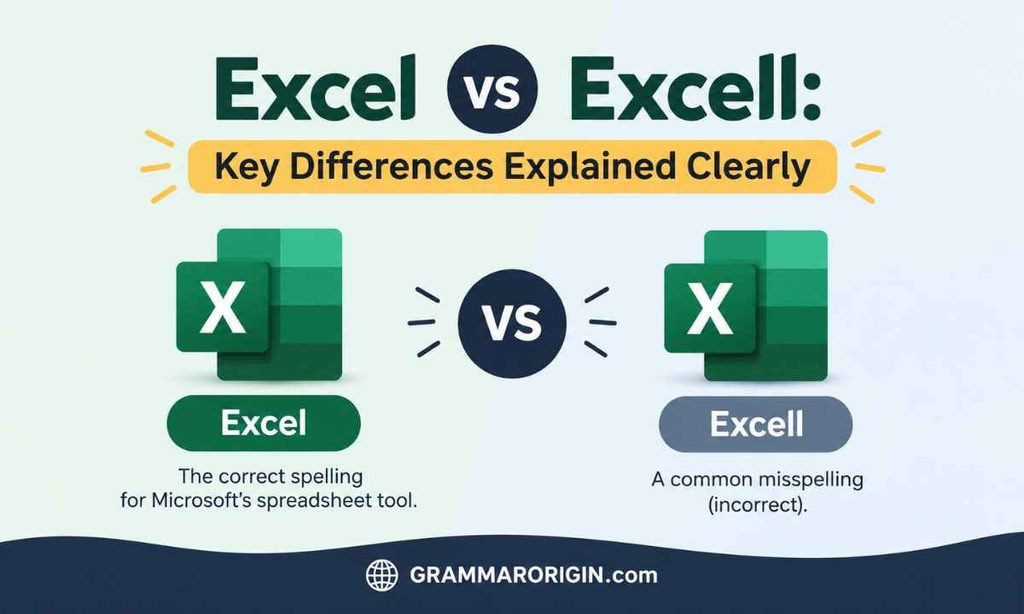
Excel is a real word, and Excell isn’t. There’s no difference in meaning to compare, because “Excell” doesn’t have a meaning of its own.
The real difference is trust. One spelling is standard and safe, and the other looks like a slip.
Example: “She will excel here” is correct, and “she will excell here” is not.
Quick Comparison Table
The table below puts the two spellings side by side, so you can scan it in a few seconds.
| Feature | Excel | Excell |
| Real English word | Yes | No |
| Part of speech | Verb | None |
| Meaning | To do very well, to surpass others | No meaning |
| In major dictionaries | Yes | No |
| Verb forms | excels, excelled, excelling | Not applicable |
| UK and US spelling | Same in both | Wrong in both |
| Software name | Microsoft Excel | Wrong spelling |
| Example | “She wants to excel.” | “She wants to excell.” |
Example: If you’re unsure, the table’s answer is always Excel.
What This Difference Really Means in Writing
The Excell or Excel slip looks tiny, but one wrong letter can make a careful piece look rushed. Readers often treat spelling as a quick sign of how much care went into the work.
That matters most in resumes, school essays, client emails and web pages. A common verb is the last place you want a typo.
Example: A resume line that says “I excel at project planning” reads clean and confident.
Excell or Excel in British vs American English
There’s no British versus American split for this word. Both varieties spell it excel, and both double the L in excelled and excelling.
That surprises people who know travel, which becomes travelled in British English and traveled in American English. The difference exists because travel stresses its first syllable, while excel stresses its last.
Example: Both a London paper and a Texas paper would write excelled.
Meaning and Usage of Excel (With Real Examples)
Excel means to be very good at something, usually better than most people around you. It’s a verb, so it describes what someone does.
Use it for skills, subjects, jobs and activities. You can also use it for a person or team that beats a standard.
Example: The team excels when the pressure is on.
Also Read This Lended vs Lent: Which Is Correct? Past Tense of Lend Explain
What Does “Excel” Actually Mean?
Excel means to do something exceptionally well or to be better than others at it. It’s about standing out, not just trying hard.
Handy synonyms include shine, stand out, outperform, surpass and thrive. Both “excel at” and “excel in” are common, and “at” often goes with a skill while “in” often goes with a subject or field.
Example: She excels at public speaking and in history.
Excel Pronunciation and Word Origin
Excel is pronounced ik-SEL, with the stress on the second syllable. That stress is the key to its spelling rule.
The word shares a root with excellent and excellence, which all trace back to the Latin excellere. Those relatives have two L’s, and that’s one more reason the base word gets misspelled.
Example: Say “ik-SEL” out loud, and the stress lands on the last syllable.
Excel the Verb vs Microsoft Excel the Software
The verb is written in lowercase, while the software is a brand name with a capital E. Both use one L.
Microsoft first released its spreadsheet program in 1985, and it’s now used for budgets, data lists, charts and formulas. Some people type “excell” when they search for it, which is another reason the wrong spelling keeps spreading.
Example: Priya built her budget in Excel, and she’d say she excels at spreadsheets.
Common Contexts Where “Excel” Appears
You’ll see excel in school, at work and in personal growth. It shows up whenever someone talks about doing something well.
Example: “Students who excel often review their notes daily.”
Academic Use
In school, excel describes strong results in a subject or exam. Teachers use it in reports and recommendation letters.
Example: Omar excels in mathematics.
Professional Use
At work, it describes strong skills in a role. Managers use it in reviews, job ads and references.
Example: Lena excels at managing client accounts.
Personal Development
In personal growth, excel is about pushing your own limits. It often appears in goals and coaching talk.
Example: You’ll excel at a new language if you speak it every day.
Verb Forms of Excel
The verb has four forms: excel, excels, excelled and excelling. Only excelled and excelling carry a double L.
Use excel for the base and plural forms, excels for he, she and it, excelled for the past and excelling for ongoing action.
Example: She excelled last term and is still excelling now.
Excel Spelling Rule: Why Excelled and Excelling Have Double L
The L doubles because excel ends in a stressed syllable, and the ending -ed or -ing starts with a vowel. The extra L keeps the vowel sound short.
Excels doesn’t double, because -s isn’t a vowel ending. The same rule gives us compelled, expelled and referred.
Example: Excel becomes excelled, but excel becomes excels with one L.
Real-Life Case Study: A Small Spelling Mistake With Big Impact
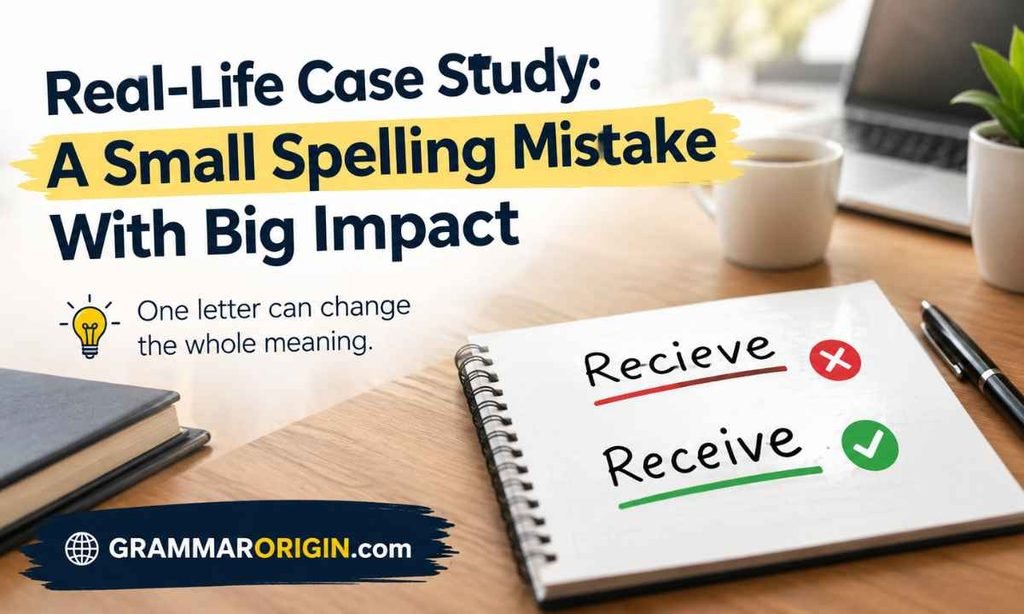
Here’s an illustrative scenario, not a documented event. It shows how one misspelled verb can change how a strong application is read.
Imagine a marketing graduate who sends out a solid resume. It lists clear results, but the summary line says, “I excell at campaign planning.”
A recruiter skims it and stops at the word. Nothing else is wrong, yet the typo sits in the very sentence meant to show skill.
The graduate isn’t shortlisted, and later feedback mentions attention to detail. The skills were real, but the first impression wasn’t.
A two-minute proofread would have fixed it. That’s the lesson: check the words you use to sell yourself.
Example: “I excel at campaign planning” would have passed without a second look.
Data-Backed Insights: Why This Confusion Still Exists in 2026
The Excell or Excel confusion survives because of a few facts you can check yourself. It isn’t because writers are careless.
First, English has a huge number of double-L words, so the eye expects a pair. Second, excelled and excelling really do contain two L’s, so learners see both versions in print.
Third, Microsoft Excel appears on screens everywhere, and people often misspell brand names they see daily. Fourth, phone typing and autocorrect still slip, and AI drafts can repeat a typo if the source has one.
Dictionaries haven’t changed their answer. Oxford, Cambridge and Merriam-Webster all list excel with one L in 2026.
Example: A student sees “excelled” in a textbook and then writes excell in a text message.
Why “Excell or Excel” Matters in SEO and Digital Writing
The spelling matters online because it affects how clearly your page matches what people type and how much readers trust you. It’s a small detail with a real effect.
Search engines often correct obvious typos, so a single mistake won’t always cost you traffic. It can still hurt clarity, clicks and trust.
Example: A page titled “Best Excel tips for beginners” looks trustworthy at a glance.
SEO Impact of Wrong Spelling
A wrong spelling can weaken the match between your page and the words people search. It can also make your snippet look careless in the results.
Titles, headings, URLs and meta descriptions carry the most weight. A typo in any of them is worth fixing right away.
Example: “Excell shortcuts” and “Excel shortcuts” may look close, but only one looks professional.
What Happens When You Use “Excell” Online
Readers may lose trust, click away faster or doubt the rest of the page. Your brand can look sloppy, especially on product or tutorial pages.
There’s one exception. On a spelling guide like this one, you can mention the wrong form on purpose, as long as it’s clearly labeled as a mistake.
Example: A software tutorial with “Excell formulas” in the heading feels unreliable before anyone reads it.
Best Practice for Writers and SEO
Use excel in your title, headings, URL, meta description and image alt text. Keep the spelling the same everywhere.
Capitalize Excel when you mean the Microsoft software, and use lowercase for the verb. Run a quick search for “excell” in your draft before you publish.
Example: Write “Microsoft Excel formulas” for the software and “she’ll excel at data work” for the verb.
How to Remember the Correct Spelling Easily
The easiest way to remember it is that the base word has one L and only picks up a second one when an ending is added. A few small tricks make that stick.
Example: One L alone, two L’s with -ed or -ing: excel, excelled.
Also Read This Lended vs Lent: Which Is Correct? Past Tense of Lend Explain
Simple Memory Hacks That Work
Try these three tricks to settle any Excell or Excel doubt, and pick the one that feels natural to you.
- Say ik-SEL out loud. The word ends on the L sound, and nothing follows it.
- Link it to excellent. Excellent adds letters after the L, and excel simply stops.
- Think “stop at one” for the base word and “add one” only with -ed or -ing.
Example: “Excel stops at one L, but excelled adds one more.”
Quick Mental Checklist
Run through these four questions before you hit publish or send.
- Is this the base word or a form with an ending?
- If there’s no ending, do I have exactly one L?
- Does it match how a dictionary writes it?
- If it’s the software, did I use a capital E?
Example: “She wants to excel” passes every check.
Step-by-Step: Avoid Spelling Mistakes Like This
You can avoid the Excell or Excel mistake with five habits: use tools, read aloud, learn confusing words, proofread twice and keep building word awareness. None of them takes long.
Example: A 60-second review can save you from writing excell in a client email.
Use Spell Check Tools
Turn on spell check in your word processor, browser and phone. Tools like Grammarly and Google Docs will usually underline “excell.”
Don’t accept every suggestion without looking, though. Tools sometimes miss context or push you toward the wrong word.
Example: Google Docs underlines excell in red, so you can fix it before sending.
Read Your Writing Aloud
Reading aloud slows you down, so your eyes catch what they’d normally skip. It works well for short, important texts like a resume summary.
Example: Reading “I excel at planning” aloud makes each word land, including the spelling you just checked.
Learn Common Confusions
Some words share the same doubling rule, and learning them together helps. Once you know the pattern, you don’t have to memorize each word separately.
- compel becomes compelled
- expel becomes expelled
- refer becomes referred
- excel becomes excelled
Example: If you can spell compelled, you can spell excelled.
Proofread Twice
Read once for meaning and once only for spelling. Splitting the job makes you notice errors you’d miss in a single pass.
Example: On the second pass, you spot excell even though the sentence sounded fine.
Build Word Awareness
The more you read well-edited writing, the more correct spellings feel normal. Keep a short list of words you’ve mixed up before.
Example: Add excel to your list, and check it whenever you write about skills.
Pros and Cons of Correct vs Incorrect Usage
In the Excell or Excel choice, using excel helps you look clear and credible, and using excell does the opposite. The gap is small in effort but big in impression.
Example: “I excel at editing” builds trust, while “I excell at editing” chips away at it.
Using “Excel” (Correct)
- Makes your writing look careful and professional.
- Matches every major dictionary and style guide.
- Keeps your titles and headings clean for readers and search engines.
- Works in both British and American English.
Example: A cover letter that says “I excel in team settings” reads smoothly.
Using “Excell” (Incorrect)
- Looks like a typo, even in an otherwise strong piece.
- Can lower reader trust in resumes, essays and web pages.
- Makes your page look careless in search results.
- Has no support from any dictionary.
Example: A headline that says “How to excell at work” weakens the advice inside.
Mini Quiz: Test Your Understanding of Excell or Excel
Take this short quiz to check what you’ve learned. The answers are right below each question.
Example: Question: Which is correct, excel or excell? Answer: Excel.
Which Sentence Is Correct?
Pick the sentence with the right spelling. Answers are in brackets.
- A) She wants to excell in music. B) She wants to excel in music. (Answer: B)
- A) He excelled at swimming. B) He excelld at swimming. (Answer: A)
- A) They are excelling in class. B) They are exceling in class. (Answer: A)
Example: “She excels at chess” is correct, and “she excells at chess” is not.
Choose the Correct Spelling
Fill in the blank with the right form. Answers are in brackets.
- You can ____ at anything with practice. (excel)
- Last year, Tom ____ in every subject. (excelled)
- She is ____ at her new job. (excelling)
Example: “You can excel at anything with practice.”
Excell or excel In school
In school, always write excel, excels, excelled or excelling. Teachers mark “excell” as a spelling error in essays, reports and exams.
Try this one: “Ravi ____ in science every year.” The answer is excels, with one L and an s.
Example: “Ravi excels in science” is correct in a school report.
How to spell excell
The word people are looking for is spelled E-X-C-E-L, and “excell” is a common misspelling of it. There’s no dictionary spelling with two L’s on the base word.
If you typed “how to spell excell,” the answer is excel. Write it once in a sentence to lock it in.
Example: “I know how to spell excel now.”
Frequently Asked Questions
Excell or Excel: which is correct?
Excel is correct. It’s spelled with one L, and “excell” is a misspelling.
Is Excell ever correct?
No. Excell isn’t a word in any major English dictionary, and it isn’t correct in British or American English.
Why does excelled have two L’s?
Excelled has two L’s because excel ends in a stressed syllable and -ed starts with a vowel. The final consonant doubles, just like in compelled and expelled.
Is excel spelled the same in British and American English?
Yes. Both varieties write excel, excelled and excelling in exactly the same way.
What does excel mean?
Excel means to do something very well or to be better than others at it. It’s a verb, as in “She excels at math.”
Is Microsoft Excel spelled with one L or two?
One L. The software name is Microsoft Excel, and it uses the same spelling as the verb, with a capital E.
Why do people mix up Excell or Excel?
They mix up Excell or Excel because English has many double-L words, the past tense really does have two L’s, and fast typing causes slips. The software name, seen daily, adds to the confusion.
Final Thoughts
Excel is the only correct spelling, and excell is a mistake. The base word has one L, and a second appears only in excelled and excelling.
Whenever you doubt the Excell or Excel choice, say ik-SEL, check for an ending and write one L. That small habit keeps your writing clear and trustworthy.

Muhammad Waqas is an English language teacher and grammar expert with over 8 years of experience helping students and professionals improve their writing skills. He specializes in English grammar, vocabulary, communication, and practical language learning. Through GrammarOrigin, Waqas shares clear, easy-to-understand content that helps readers write and speak English with confidence.