
Suprise vs Surprise is a quick one to settle: surprise is the correct spelling, and suprise is a misspelling that drops the first r. The word has two r’s, and it’s spelled exactly the same in the UK, the US and everywhere else English is written.
This guide covers the meaning, the pronunciation, the French roots and a few simple tricks that fix the Suprise vs Surprise mix-up for good. You’ll also find real examples, a short spelling test and a clear answer for UK writers.
Suprise vs. Surprise: The Quick Answer
Surprise is the only correct spelling. Suprise is never right, in any dialect or any kind of writing.
Here’s the difference at a glance.
| Spelling | Correct? | What it means |
| Surprise | Yes | An unexpected event, or the act of catching someone off guard |
| Suprise | No | A misspelling with a missing r |
Right: My sister planned a surprise for Dad’s birthday.
Wrong: My sister planned a suprise for Dad’s birthday.
The correct spelling of surprise works in emails, essays, job applications, captions and text messages. A spell checker flags the other version right away, and readers notice it just as fast.
Is “Suprise” a Real Word?
No. Suprise isn’t an English word. It’s a typo that shows up so often that it looks real, and it adds to the confusion over the surprise spelling.
Dictionaries list surprise and nothing else for this meaning. When you write the shorter version, you’ve simply made a spelling mistake by leaving out a letter.
Plenty of words get the same treatment:
accomodate instead of accommodate
embarass instead of embarrass
reccomend instead of recommend
They’re common slips, but they’re still slips.
Why Do People Misspell Surprise as Suprise?
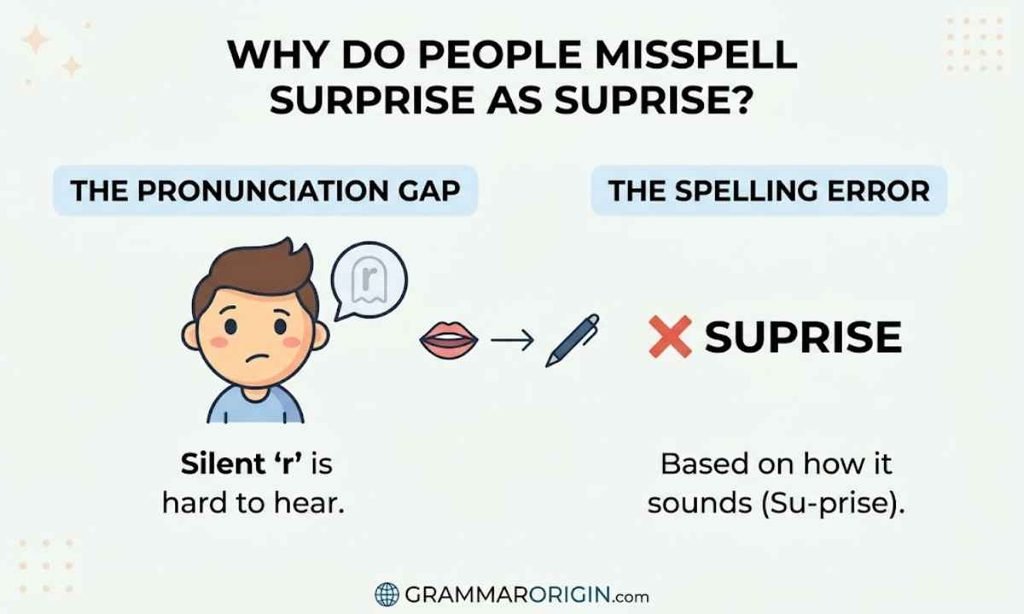
Mostly because we say the word fast, and the first r almost disappears in speech. It comes down to a gap between sound and spelling. Add quick typing and an odd French spelling, and the mistake makes sense.
Four small things push people toward the Suprise vs Surprise error. Let’s take them one at a time.
The Missing “R” Problem
Surprise has two r’s, one in the sur part and one in the prise part. The first one is the easiest to lose.
Here’s how the letters line up:
Correct: S-U-R-P-R-I-S-E
Missing r: S-U-P-R-I-S-E
Your eyes read words by their whole shape, so the shorter version doesn’t look strange at a glance. That’s why proofreading misses it.
Pronunciation Doesn’t Help
In everyday speech, the first syllable sounds like “suh,” not “sur.” The stress lands on the second syllable, so the first one gets squashed, and the r can feel like a silent r.
When you write what you hear, which is called phonetic spelling, an r goes missing. English has plenty of words where the sound hides the spelling:
Wednesday (often said “Wenz-day”)
comfortable (often said “comf-ter-ble”)
interesting (often said “in-tress-ting”)
Fast Typing Causes Errors
Your fingers often move faster than your attention, and a letter before a P is easy to skip. Even careful writers do it.
Typed fast: I have a suprise for you.
What you meant: I have a surprise for you.
Turn on your spell checker and autocorrect, but don’t trust them blindly. A quick re-read of the word still catches what software misses.
English Has Many Irregular Spellings
English borrows from French, Latin, Norse, German and more, so spelling doesn’t always follow sound. Surprise is one of the French imports.
The ending tells the story. Words like enterprise, comprise and apprise all share that same -prise ending, and they all come from the French verb family around prendre, “to take.”
What Does Surprise Mean?
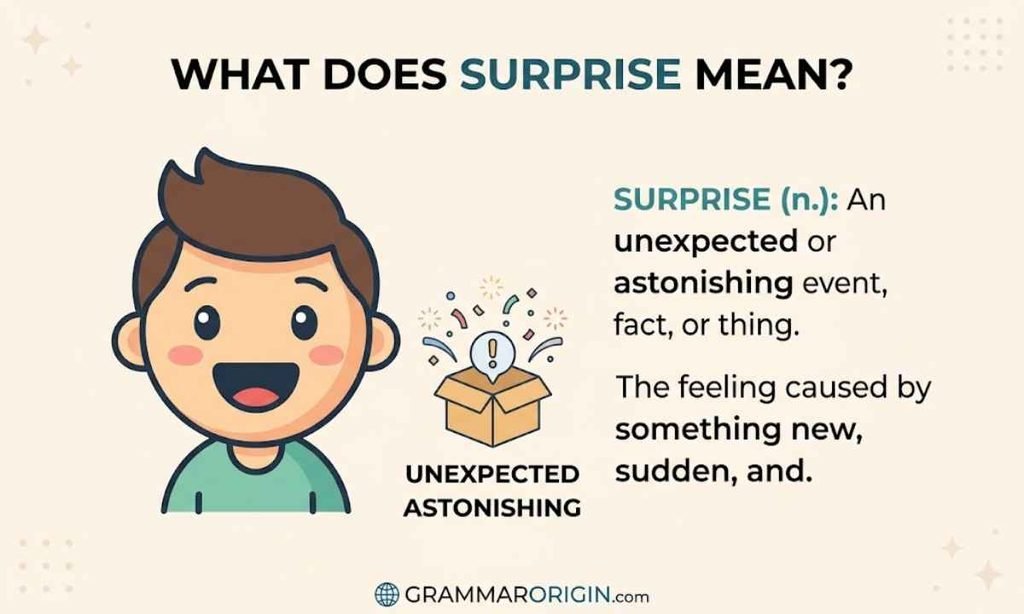
Surprise means something unexpected, or to catch someone off guard. It works as a noun and a verb, and it also appears as a modifier and an exclamation.
Let’s look at each use, starting with the noun.
Surprise as a Noun
As a noun, a surprise is an unexpected event, gift or piece of news. This is the surprise meaning most people look up. It can also mean the feeling you get when something unexpected happens.
Examples
Her promotion came as a complete surprise.
The surprise on his face said it all.
The cake was a lovely surprise after a long week.
Surprise as a Verb
As a verb, to surprise someone is to catch them off guard or to amaze them. It takes an object: you surprise someone.
Notice that the verb keeps both r’s in every form, including surprised and surprising.
Examples
The final scene surprised the whole audience.
His quick decision surprised his family.
Don’t surprise the dog while it’s sleeping.
Surprise as an Adjective and Interjection
Surprise also works as a modifier in front of another noun, and as an exclamation on its own. The spelling never changes.
The exclamation is what people shout when a guest walks through the door:
Surprise! Happy birthday!
As a modifier, it describes things that happen without warning:
We held a surprise inspection on Monday.
The band played a surprise set after midnight.
Definitions of Surprise
Dictionaries such as Merriam-Webster, the Oxford English Dictionary and the Cambridge Dictionary give the surprise definition in much the same way. The meaning stays close to “unexpected” in every role.
| Part of speech | Definition | Example |
| Noun | An unexpected event, fact or feeling | The result was a surprise. |
| Verb | To catch someone off guard or amaze them | The news surprised me. |
| Modifier | Happening without warning | A surprise visit |
| Interjection | A shout when something unexpected is revealed | Surprise! |
Surprised At, By, or To?
Use surprised by for the cause, surprised at for a reaction to a thing or result, and surprised to before a verb. In casual use, “at” and “by” often swap without trouble.
Look at these side by side:
I was surprised by the size of the crowd.
She was surprised at how quickly it sold out.
We were surprised to see him there.
The noun has its own patterns too. Something can “come as a surprise to” someone, and a sudden attack “takes you by surprise.” Both phrases need the double r.
How to Pronounce Surprise Correctly
Say it as suh-PRIZE or sur-PRIZE, with the stress on the second syllable. The final sound is a Z, even though the spelling ends in -se.
Two accents handle the first syllable a little differently, which is covered in the IPA section below.
International Phonetic Alphabet (IPA)
American English: /sərˈpraɪz/
British English: /səˈpraɪz/
The only real difference is the first syllable. Americans usually sound the r there, while most British speakers don’t, because standard British English is non-rhotic (it drops the r when no vowel follows).
Pronunciation Breakdown
| Syllable | Sound | Tip |
| sur | sər (US) or sə (UK) | Weak, unstressed |
| prise | praɪz | Stressed, rhymes with “size” |
The second part sounds just like the word “prize.” That’s useful for remembering the sound, but not the spelling, because the written ending is -ise.
The Origin and History of the Word Surprise
Surprise came into English from French, and the French root verb means “to take.” That origin explains both the meaning and the double r.
Knowing where a word comes from often makes the spelling feel less random.
French Origins
The word comes from Old French surprendre, built from two pieces. The English noun comes from the French past participle, surprise.
| Piece | Meaning |
| sur- | over, upon |
| prendre | to take |
The original sense was to seize or overtake someone unexpectedly. When the word moved into Middle English, it kept that idea, and later English settled on the milder meaning of catching someone off guard. That’s the short etymology of surprise.
Why the Correct Spelling Matters
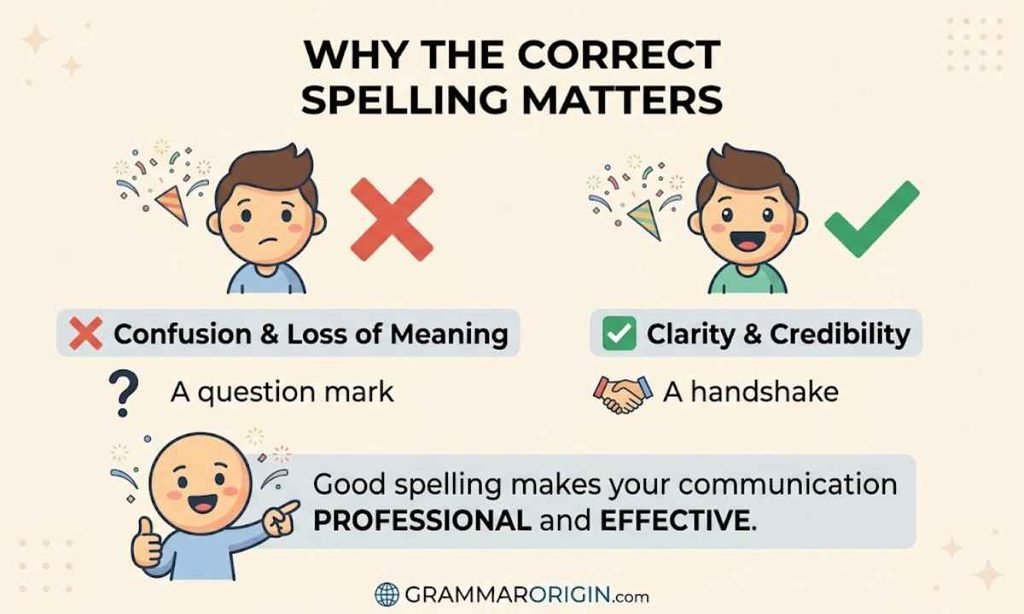
Because one missing letter changes how readers judge the rest of your writing. It’s a tiny detail with a surprisingly big effect.
Here’s where it shows up most.
Professionalism
A typo in an email or report can make a careful piece of work look rushed. Clients and managers notice small errors quickly.
Credibility
Readers often judge how much to trust you by how clean your writing is. A misspelled common word weakens a strong argument.
Search Engine Visibility
Search engines usually forgive typos in what people type. But a misspelled title or heading looks careless and can cost you clicks and trust.
Academic Performance
Many teachers and exam markers deduct marks for spelling errors. A simple word like surprise is an easy place to lose them.
Common Forms of the Word Surprise
Every form keeps both r’s. Only the ending changes.
| Form | Part of speech | Example |
| surprise | noun or verb | The gift was a surprise. |
| surprises | noun or verb | Life is full of surprises. |
| surprised | verb or adjective | I was surprised to win. |
| surprising | adjective | A surprising result |
| surprisingly | adverb | Surprisingly, it worked. |
Common Misspellings of Surprise
Dropping the first r is the most common slip in the Suprise vs Surprise mix-up, but it’s not the only one. These common spelling errors show what goes wrong in each case.
| Incorrect | Correct | What went wrong |
| suprise | surprise | The first r is missing |
| surpise | surprise | The second r is missing |
| surpirse | surprise | Two letters are swapped |
| suprize | surprise | Missing r and the wrong ending |
| surprize | surprise | The wrong -ize ending |
| suprised | surprised | The first r is missing |
| suprising | surprising | The first r is missing |
Is Surprize Ever Correct?
Not today. Surprize is an old variant spelling that’s now treated as archaic (old-fashioned), so use surprise.
Here’s a point that trips people up. Some words have an -ize and -ise split, like organize and organise. Surprise isn’t one of them: it ends in -ise in both American and British English.
Other words that must end in -ise everywhere include advise, revise, comprise and disguise.
Old: Nobody writes surprize anymore.
Modern: Everybody writes surprise.
Read More A Lot or Alot Explained: Correct Spelling, Meaning & Examples
Examples of Surprise in Everyday Sentences
Surprise appears in everyday sentences at home, at school, at work and in entertainment. Here are a few, grouped by where you’d hear them.
Family Situations
We planned a surprise anniversary dinner for our parents.
The kids hid a surprise gift behind the sofa.
School Situations
The teacher announced a surprise quiz on Friday.
Winning the award was a pleasant surprise for the whole class.
Workplace Situations
The new manager’s decision surprised everyone on the team.
The company announced a surprise bonus before the holidays.
Entertainment
The film had a surprise ending that nobody saw coming.
The magician’s last trick surprised even the people in the front row.
Common Phrases That Use the Word Surprise
Surprise shows up in many everyday phrases, and the double r stays the same in all of them. Here are the ones you’ll meet most often.
Pleasant Surprise
A pleasant surprise is something unexpected that turns out well.
The refund check was a pleasant surprise.
Surprise Party
A surprise party is a celebration planned without the guest of honor knowing.
Her coworkers threw her a surprise party on her last day.
Surprise Guest
A surprise guest is someone who turns up without being expected.
Our cousin was the surprise guest at dinner.
Surprise Announcement
A surprise announcement is news that arrives with no warning.
The team made a surprise announcement about the new office.
Surprise Attack
A surprise attack is a strike launched without warning.
Historians often describe the battle as a surprise attack at dawn.
Why “Surprise” Contains Two R’s
Because the word is built from two French pieces, sur and prise, and each piece keeps its own r. Drop either one and the word breaks.
Think of it as two short chunks glued together:
sur + prise = surprise
Once you see the chunks, the missing-r mistake becomes much harder to make.
Memory Tricks to Remember the Correct Spelling
Three quick tricks work best: think of the prize, give each chunk its own r, and say the word slowly. Each one takes only a few seconds to learn.
Trick One: Remember the Prize
The ending sounds like “prize,” so picture an unexpected prize. Just remember that the spelling uses an s, not a z.
Prize in your head: sur-prize
Prize on the page: sur-prise
Say the sound, then write the letters. That one swap keeps you away from the old surprize spelling.
Trick Two: Think of Two Surprises
Two chunks, two r’s. Give each chunk its own r.
Sur has one r, and prise has one r. Two small surprises sitting side by side.
If you ever doubt the spelling, count them: one in the first half, one in the second.
Trick Three: Say It Slowly
Say each chunk out loud before you write it. Slow speech brings the first r back.
Fast: suh-prize
Slow: sur–prize
It feels silly, but a slow, careful pronunciation fixes the spelling more often than you’d expect.
Case Study: Why People Search for “Suprise vs. Surprise”
People search for it because the word sounds shorter than it’s spelled. That gap between sound and spelling creates the same questions again and again.
You can see the pattern in the way people phrase their searches for the Suprise vs Surprise answer:
is it suprise or surprise
how do you spell surprise
surprise or suprise uk
suprise vs surprise meaning
Writing guides give the same answer every time. Grammarly’s explainer on this word, for example, says there’s only one generally accepted spelling, and that the old surprize variant is now archaic.
Spell checkers agree too. The mistake isn’t a matter of taste or region, which is exactly why it’s worth fixing early.
A Quick Spelling Test
Pick the correct sentence in each pair. The answers follow right after.
- A) I have a suprise for you. B) I have a surprise for you.
- A) The ending was a huge surprise. B) The ending was a huge suprise.
- A) Her gift suprised me. B) Her gift surprised me.
Answers: 1 B, 2 A, 3 B.
If you got all three, you’ve got the Suprise vs Surprise rule down.
Surprise vs. Suprise Comparison Table
The table below puts the two spellings side by side.
| Feature | Surprise | Suprise |
| Correct English word | Yes | No |
| Listed in dictionaries | Yes | No |
| Fine in formal writing | Yes | No |
| Accepted in academic papers | Yes | No |
| Passes a spell check | Yes | No |
| Safe for professional use | Yes | No |
Words Similar to Surprise
Close alternatives include astonishment, amazement, shock, wonder and startle. Each one carries a slightly different strength of feeling.
| Word | Meaning |
| astonishment | Great surprise, often mixed with disbelief |
| amazement | Strong surprise, usually positive |
| shock | Sudden, often unpleasant surprise |
| wonder | Surprise mixed with admiration |
| startle | A brief jump of surprise or alarm |
| bombshell | Shocking news nobody expected |
Examples
The announcement caused real astonishment in the room.
Her success filled the family with amazement.
The ending came as a shock.
How Children and English Learners Often Spell Surprise
They tend to write what they hear, so they drop an r or swap the ending. It’s a normal stage, not a sign of weak spelling.
Common attempts look like this:
suprise
suprize
surpise
surpirse
Three habits help: split the word into sur and prise, say each chunk out loud, and trace the word a few times with a finger. Short, regular practice works better than one long session.
Read More A Lot or Alot Explained: Correct Spelling, Meaning & Examples
Simple Exercises to Remember the Correct Spelling
Two quick drills lock the spelling in: a fill-in-the-blank and a write-it-out routine. Try them once today and once tomorrow.
Fill in the Blank
Complete each sentence with the correct form.
- The gift was a ______.
- Her decision ______ everyone.
- The movie had a ______ ending.
- It was a ______ result.
Answers: 1 surprise, 2 surprised, 3 surprise, 4 surprising.
Write the Word Five Times
Write the word five times, but say the chunks aloud as you go.
sur-prise
sur-prise
sur-prise
sur-prise
sur-prise
Repetition teaches your hand the pattern, and the chunks keep both r’s in place.
Surprise or suprise uk
It’s surprise in the UK too. British and American English share the same spelling, so there’s no regional version of suprise.
The only difference is the sound. Most British accents don’t pronounce an r when no vowel follows it, so the first syllable sounds like “suh.” That’s the main reason UK writers drop the letter, and it’s the same British vs American English gap you see in many other words.
US: sur-prise, with an audible r in the first syllable.
UK: suh-prise, but still written surprise.
And remember the -ise ending isn’t a British quirk here. Surprise ends in -ise in the US as well.
Suprise vs surprise meaning
Surprise has a meaning, and suprise doesn’t. The misspelled form borrows the meaning of the real word, but dictionaries don’t recognize it.
So the Suprise vs Surprise question isn’t about two different meanings. It’s about one meaning and one wrong way to write it.
What readers see: The party was a suprise.
What you meant: The party was a surprise.
Final Thoughts
The Suprise vs Surprise question has one answer: surprise, with two r’s and an -ise ending. Suprise is a slip of the finger and the ear, nothing more.
Split the word into sur and prise, say it slowly, and check it once before you hit send. That’s all it takes to get it right every time.
Frequently Asked Questions
Is it suprise or surprise?
It’s surprise. Suprise is a misspelling that leaves out the first r.
What is the difference between suprise vs surprise?
There’s no difference in meaning. Suprise is only a misspelling, and surprise is the correct word for something unexpected.
Is surprize a correct spelling?
No. Surprize is an old variant that’s now considered archaic, so write surprise instead.
Is suprise correct in British English?
No. British English uses surprise just like American English. Only the pronunciation of the first syllable differs.
How can I remember the spelling of surprise?
Split it into two chunks, sur and prise, and give each chunk its own r. Then say each chunk out loud as you write it.
Is surprise a noun or a verb?
It’s both. As a noun it means something unexpected, and as a verb it means to catch someone off guard.

Muhammad Waqas is an English language teacher and grammar expert with over 8 years of experience helping students and professionals improve their writing skills. He specializes in English grammar, vocabulary, communication, and practical language learning. Through GrammarOrigin, Waqas shares clear, easy-to-understand content that helps readers write and speak English with confidence.