
You’re writing a sentence, you reach that familiar word pair, and your fingers just stop. Should it have a hyphen or not?
This guide answers the long term or long-term question for good. You’ll get the exact rule, real sentence examples, style guide notes, and a quick test to make it stick.
Quick Answer
Both spellings are correct. The choice simply depends on the job the phrase is doing in your sentence.
- Hyphenated form: used as an adjective, placed right before a noun. Example: a five-year contract.
- Open form: used as a noun phrase, usually after a small connecting word. Example: plan for the future.
Is “longterm” correct?
No. Written as one solid word, it isn’t accepted in standard English.
You might spot it in a rushed text message or a domain name, but formal writing, resumes, and published articles should avoid this spelling entirely.
When to use “long term”
Reach for the two-word, open form when you’re naming a stretch of time rather than describing something.
- in the long term
- over the long term
- for the long term
- thinking long term
When to use “long-term”
Add the hyphen the moment the phrase sits directly in front of a noun and describes it.
- long-term plan
- long-term care
- long-term investor
- long-term impact
One-line grammar rule you can memorize
If a noun follows right after, add the hyphen. If nothing follows, or a verb sits before it, leave the hyphen out.
That single line solves most of the confusion around this pair of words.
What Does “Long-Term” Mean?
This hyphenated form is a compound adjective, and its whole job is to describe a noun that comes right after it. The hyphen fuses two words into one descriptive unit.
Think of phrases like long-term goals, long-term debt, or long-term memory loss. In each case, both words team up to answer one question: what kind?
Writers rely on this joined form in business proposals, medical notes, and academic papers because it removes any doubt about which noun is being modified. Drop the hyphen here, and a reader’s eye has to work harder to follow the sentence.
What Does “Long Term” Mean?
The open, two-word version functions as a noun phrase that names a future stretch of time. It isn’t describing anything else here; it’s the subject or object on its own.
You’ll usually find it trailing a preposition such as in, over, or for, or sitting right after a linking verb like is or was.
- Her strategy pays off eventually.
- We’re building relationships that last, not chasing quick wins.
- Their results were disappointing over time.
None of these sentences use the phrase to modify another word. It’s simply naming a timeframe.
The Simple Grammar Rule (Easy Memory Trick)
Here’s a trick that removes the guesswork almost instantly.
- Look at the next word right after the phrase.
- Is a noun sitting there? Add the hyphen, as in a five-year budget.
- Is there no noun, or does a verb come before it? Skip the hyphen, as in the budget will last for years.
A second trick works well too. Swap the phrase for a single word like “lasting.” If “a lasting plan” sounds natural, the hyphenated version belongs there. If “the plan is lasting” fits better, drop the hyphen.
Also Read This Loosing vs Losing: What’s the Correct Spelling & Difference?
Long Term vs Long-Term (Side-by-Side Comparison)
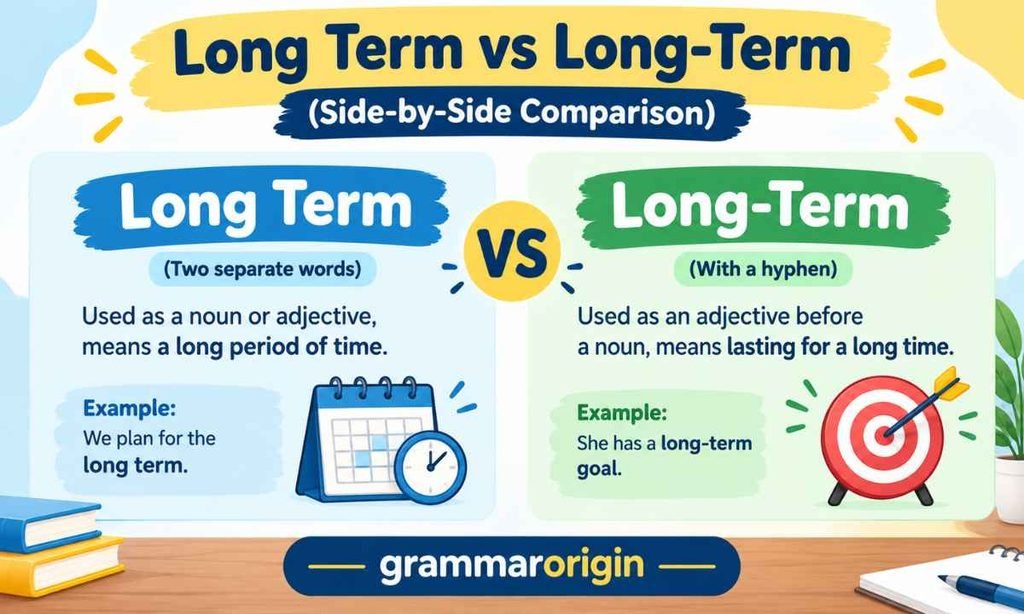
| Feature | Open Form (no hyphen) | Hyphenated Form |
| Grammatical role | Noun phrase | Compound adjective |
| Position in sentence | After a verb or preposition | Directly before a noun |
| Refers to | A period of time | A trait of the noun |
| Sample sentence | “We’re planning for the future.” | “We signed a multi-year lease.” |
| Common companions | in, over, for, was, is | plan, goal, effect, care, strategy |
Once this table clicks, you’ll rarely need to pause mid-sentence again. Your eye starts catching the pattern on its own.
What Do Style Guides Say? (APA, Chicago, AP, Oxford)
Every major style authority agrees on the underlying rule, even if their wording varies slightly.
| Style Guide | Position | Example |
| APA (7th edition) | Hyphenate before a noun | working memory that lasts years |
| Chicago Manual of Style | Hyphenate before a noun; open elsewhere | a lasting contract |
| AP Stylebook | Same positional rule; stresses headline consistency | Growth Plans That Last |
| Oxford and Merriam-Webster | List the hyphenated spelling as the standard adjective entry | ongoing patient care |
None of these guides accept the closed, one-word spelling. That alone shows how rare and non-standard it really is.
Why Do People Get Confused?
The mix-up isn’t really about vocabulary. It comes down to a few habits in how people read and write English.
- Spoken English gives no clues at all, since you can’t hear a hyphen.
- Texting apps strip hyphens out constantly, training people to drop them everywhere.
- Some websites and even news outlets are inconsistent, so readers absorb mixed signals.
- The rule feels like a one-off exception, when it actually applies to many similar word pairs.
- Most people proofread for spelling, not sentence position, and this rule is entirely about position.
Once you know these five triggers, spotting your own mistakes gets a lot faster.
Common Mistakes Writers Make
| Mistake | Why It’s Wrong | Fix |
| “Their plan is hyphenated-form.” | No noun follows, so the hyphen isn’t needed | “Their plan will last for years.” |
| “A open-form contract for growth.” | A noun follows directly, so it needs a hyphen | “A well-structured contract for growth.” |
| “We need onewordform solutions.” | The closed spelling isn’t standard English | “We need lasting solutions.” |
| “The plan runs open-form, with a hyphen.” | Hyphen not needed after a preposition | “The plan runs for years, without a hyphen.” |
| Mixing both styles in one document | Undermines consistency and polish | Apply the correct form to each sentence, every time |
A quick habit fixes most of these. Before you publish anything, check whether a noun sits right next to the phrase, and let that decide the spelling.
Is “Longterm” Correct?
No, the closed, single-word spelling has no standing in formal English. Dictionaries, style guides, and grammar checkers all flag it.
You’ll occasionally see it in a brand name or a rushed message, but outside of branding, it has no place in essays, reports, resumes, or published articles.
Stick with the two accepted spellings only: the open noun phrase, or the hyphenated adjective.
Real-Life Usage Examples (High SEO Value)
Seeing the rule applied across different contexts makes it stick faster than any explanation alone.
Success – Success is a noun, so when the phrase sits right before it, hyphenate: Their long-term success came from consistent execution, not luck.
Relationship – Same logic applies here: She’s looking for a long-term relationship, not a fling. But as a standalone phrase: In the long run, relationships built on trust tend to last.
Goal – He set a long-term goal to retire by 50. Compare that with: Over time, small habits compound into big results.
Memory – In psychology writing, this pairing is almost always hyphenated: Long-term memory stores information for years, unlike short-term recall.
Effects – Doctors are still studying the long-term effects of the treatment. As a standalone reference: The effects, over time, turned out to be mild.
Capitalization – In finance content, capitalization is the noun being described: Long-term capitalization strategies focus on equity over debt.
Medium to long-term – This three-part phrase behaves the same way. When it precedes a noun, hyphenate the whole modifier, as in a medium to long-term investment plan.
Usage Across Industries
| Industry | Example |
| Finance | Patient investors typically ride out market dips instead of panic-selling. |
| Healthcare | Care facilities serve patients with chronic or age-related conditions. |
| Business | A company with a clear multi-year strategy survives downturns more easily. |
| Real Estate | An extended lease gives tenants more stability than month-to-month renting. |
| Psychology | Lasting memory relies on different brain regions than short-term recall. |
| Personal Finance | Saving consistently pays off far more over time than one lucky windfall. |
A Brief History of “Long-Term” in English
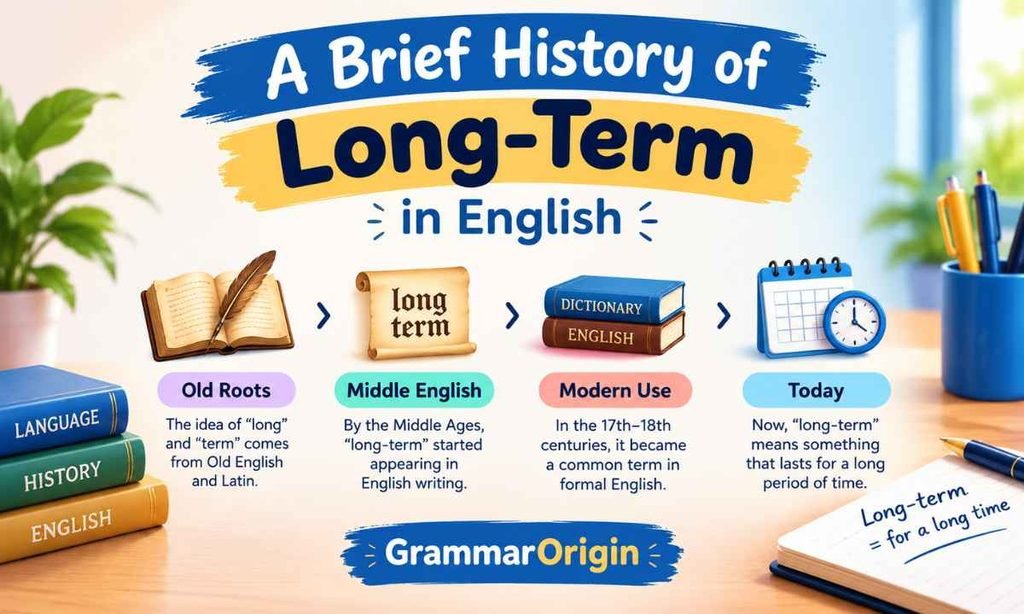
The phrase first showed up in nineteenth-century financial and insurance writing, describing policies or debts that stretched over many years. Spelling wasn’t fully standardized back then, so both open and hyphenated forms floated around.
As compound adjectives became more common in edited English, writers settled on the hyphen to avoid ambiguity before a noun. By the mid-1900s, the hyphenated version was dominant in professional and academic writing, while the open form kept its place in everyday speech.
Also Read This Loosing vs Losing: What’s the Correct Spelling & Difference?
Synonyms for “Long Term” and “Long-Term”
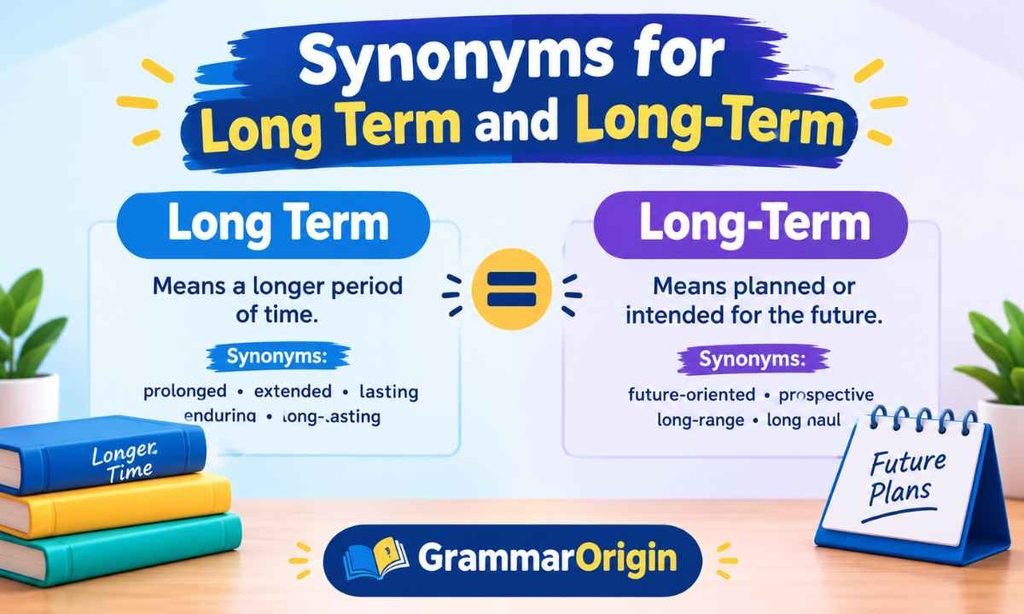
Swapping in a synonym now and then keeps your writing from repeating the same words too often.
| Form | Context | Alternatives |
| Open noun phrase | General | the future, eventual outcome, extended period |
| Open noun phrase | Finance | investment horizon, extended timeframe |
| Hyphenated adjective | Business | ongoing, sustained, strategic |
| Hyphenated adjective | Health | chronic, lasting, extended |
| Hyphenated adjective | Relationships | committed, enduring, lasting |
Quick Grammar Test (Interactive Section)
Try filling in each blank before checking the answers below.
- We’re saving for the future. (open form / hyphenated form)
- This is a lasting client relationship. (open form / hyphenated form)
- Doctors recommend ongoing therapy for this condition. (open form / hyphenated form)
- Their profits grew steadily, over time, thanks to patience. (open form / hyphenated form)
- She has a lasting plan for her business. (open form / hyphenated form)
Answers: 1. open form, since it follows “for” · 2. hyphenated form, since it comes before “relationship” · 3. hyphenated form, since it comes before “therapy” · 4. open form, since it follows “over” · 5. hyphenated form, since it comes before “plan”
If you got four or five right, the rule has already clicked for you.
Frequently Asked Questions
Is long term one word or hyphenated?
It’s neither one solid word nor always hyphenated. It depends on the sentence. Use two open words as a noun phrase, and add the hyphen only when it precedes a noun.
Does long-term care have a hyphen?
Yes. “Care” is the noun being described, so this phrase always takes the hyphen, as in ongoing care coverage for patients.
Is it long term or longer term?
These are different phrases with different meanings. One refers to an extended period generally, while the comparative version means a duration that is longer than something else being compared. Check which comparison your sentence actually needs.
Does Grammarly flag this phrase as an error?
Most grammar checkers, including Grammarly, flag a missing hyphen before a noun and suggest adding one. They generally leave the open form alone after prepositions or verbs.
Is the hyphenated form always required?
No. It’s needed only when the phrase functions as an adjective directly before a noun. After a verb or preposition, the open form is correct.
Which form is correct in headlines and titles?
Headlines that use the phrase as an adjective before a noun should still hyphenate it, even in title case, such as “Growth Strategies Built to Last.”
Is there a difference between US and UK English here?
Not really. Both follow the same positional rule, though British publications are occasionally looser with hyphenation in casual writing.
Final Thoughts
The choice between long term or long-term isn’t about preference. It’s about where the phrase sits in your sentence, so hyphenate before a noun and leave it open everywhere else.
Keep the comparison table and the mistakes list from this guide nearby while you edit. With a little practice, you won’t need to pause on that hyphen again.

Muhammad Waqas is an English language teacher and grammar expert with over 8 years of experience helping students and professionals improve their writing skills. He specializes in English grammar, vocabulary, communication, and practical language learning. Through GrammarOrigin, Waqas shares clear, easy-to-understand content that helps readers write and speak English with confidence.