
Focusses or focuses? If you’ve typed both versions and second-guessed yourself, you’re not alone. This single letter difference confuses writers across the US, UK, Canada, and Australia every single day.
The short answer to the focusses or focuses question: focuses is the standard spelling almost everywhere, while focusses is a rare British variant. This guide breaks down the origin, the regional rules, and exactly when each spelling actually fits.
Focusses
Focusses is the less common spelling of the two. It shows up mainly in older British texts and occasionally in formal UK writing, though even in the UK it’s now the minority choice.
You’ll rarely see focusses in American, Canadian, or everyday online writing. In the ongoing focusses or focuses debate, this spelling exists and is technically correct in specific contexts, but it’s fading out of regular use.
Focuses
Focuses is the spelling almost everyone reaches for today. It works as the third-person singular verb form (he focuses, she focuses) and as the plural of the noun focus.
American English, Canadian English, and modern British English all lean on focuses. It’s the safer, more universally understood choice for any audience.
Focusses or Focuses: Quick Answer
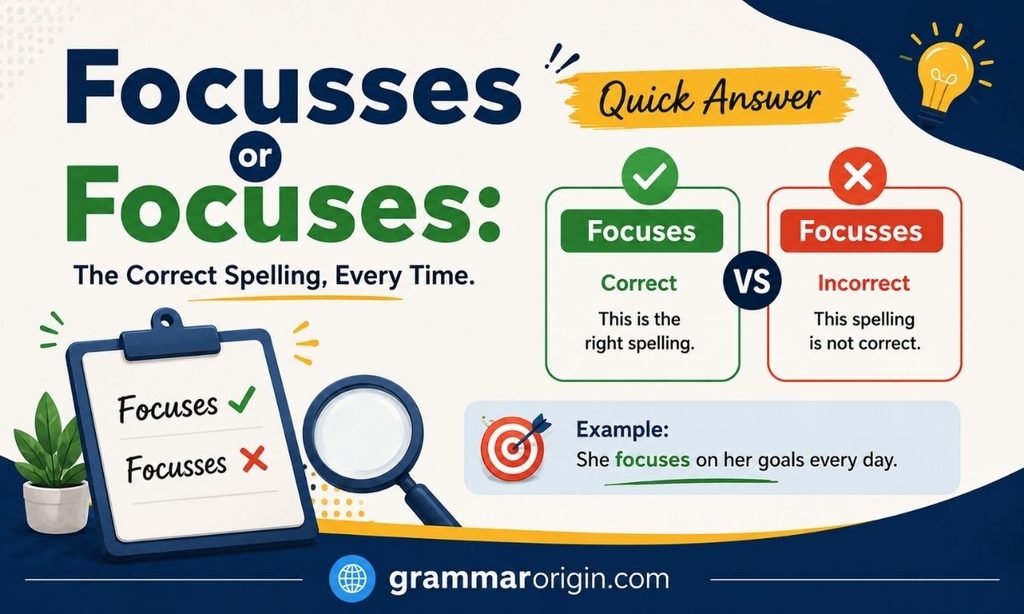
Use focuses in almost every situation. It’s correct in American, British, Canadian, and Australian English, and it reads as modern and professional everywhere.
Focusses only shows up as an older, regional UK variant. Unless you’re deliberately matching a traditional British style, focuses is the safer pick.
- The team focuses on quality control. (correct everywhere)
- She focusses on her research daily. (older UK style, still understood)
Stick with focuses for emails, reports, essays, and web content. It removes any doubt for a global reader.
The Origin of Focusses or Focuses
The word focus comes from Latin, where it originally meant “hearth” or “fireplace.” The meaning shifted over time to describe a central point, first in optics and geometry, then in everyday speech.
English speakers needed a way to add an -s ending for the verb and plural forms. American spelling settled on a single s (focuses), following the general pattern used for most English words ending in -us. British spelling, at certain points in history, doubled the consonant instead, producing focusses.
That double-s habit wasn’t unique to this word. It followed a broader (and inconsistent) British tendency to double a final consonant before adding a suffix, especially in words carrying a short vowel sound.
Why Does British English Double the “S”?
The doubling pattern comes from a spelling convention where British English sometimes doubles a final consonant before adding -ed, -ing, or -es, particularly when the last syllable carries the stress. Think of traveling versus travelling, or canceled versus cancelled.
With focus, the stress actually falls on the first syllable, not the last one, so the doubling rule doesn’t strictly apply by the book. That’s likely why focusses never became as firmly established as travelling or cancelled, even in the UK.
Also Read This Pre vs Post: Meaning, Rules & Examples Explained
Which Spelling Should You Use?
Your audience decides the focusses or focuses question. If you’re writing for an American, Canadian, or global readership, focuses is the clear choice every time.
If you’re writing for a British audience and want a slightly more traditional or literary tone, focusses is understood, though focuses still works fine there too. When in doubt, focuses is the spelling that never looks out of place.
Focusses or Focuses: UK vs US vs Canada vs Australia vs NZ
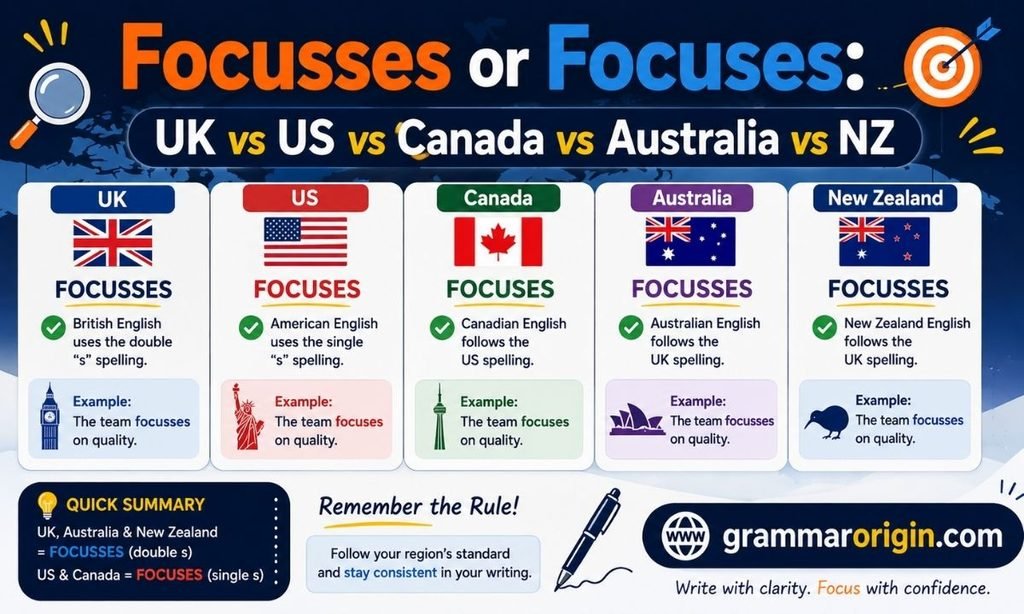
Regional preference plays a bigger role in the focusses or focuses debate than most grammar questions. Here’s how each major English-speaking region actually uses the word.
| Region | Preferred Spelling | Notes |
| United States | focuses | Standard everywhere, no real use of focusses |
| United Kingdom | focuses | Focusses exists but has declined sharply since the 1980s |
| Canada | focuses | Follows American conventions closely |
| Australia | focuses | Focusses is technically accepted but rarely used |
| New Zealand | focuses | Focusses appears occasionally in older or formal writing but isn’t the norm |
Across every region on this list, focuses comes out ahead. Even where focusses is accepted, it’s the exception rather than the rule.
What Do Oxford and Cambridge Dictionaries Say?
On the focusses or focuses question, major dictionaries treat focuses as the primary spelling and focusses as a secondary, regional variant. The Cambridge Dictionary lists focuses as the standard entry, with focusses noted separately as a British form.
Oxford’s references follow a similar pattern, recognizing focusses as a valid but less frequent British spelling rather than an error. Collins Dictionary specifically tags focusses as a UK variant, which lines up with how rarely it appears outside British texts.
None of these dictionaries call focusses incorrect. They simply confirm what usage data already shows: it’s a real word, just not the one people reach for anymore.
Focuses vs Focusses and Related Forms (Complete Usage Guide)
The focusses or focuses confusion doesn’t stop with this one pair. Related words follow a similar, if slightly separate, pattern.
- Focus vs focuses: Focus is the base verb and noun. Focuses is the form used with he, she, or it, as in He focuses on his goals.
- Focuses vs focusses: Both technically exist, but focuses is the version used almost everywhere today.
- Focusing vs focussing: American English uses focusing. British English sometimes uses focussing, though focusing is gaining ground there too.
- Focused vs focussed: Same pattern. Focused dominates in the US, while focussed still appears in some UK writing.
- Focuses vs foci: Focuses is the everyday plural. Foci is the Latin-style plural used mostly in academic or scientific writing.
If you remember just one thing from this section, remember this: focuses, focusing, and focused work correctly in any English-speaking country.
Common Mistakes with Focusses or Focuses
A few recurring focusses or focuses errors show up again and again in everyday writing.
- Wrong: She focuss on her tasks. Correct: She focuses on her tasks. (missing the final e)
- Mixing spellings in one document, using focusses in paragraph one and focuses in paragraph three, is a common error. Pick one and stay consistent.
- Treating focuses as a plural noun form only is another common error. It’s primarily a verb form, though it can describe multiple points of focus too.
- Confusing focusses with focussing or focussed is common too. These follow the same regional pattern but aren’t the same word.
Consistency matters more than which variant you pick. Switching mid-document is the mistake that actually gets noticed.
Common Search Confusions About Focuses and Focusses
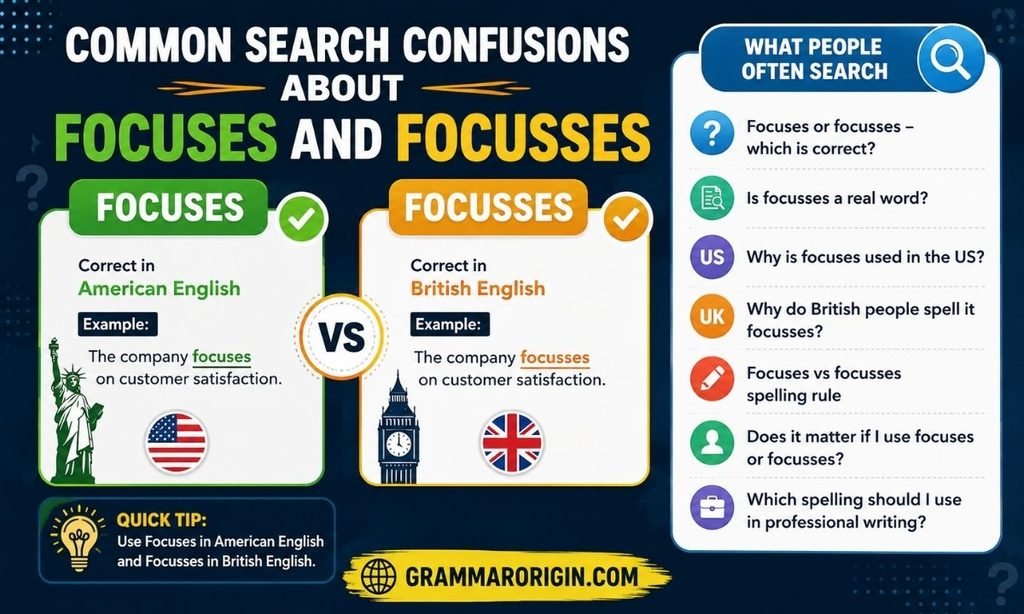
People searching the focusses or focuses topic often type variations that aren’t real words at all. Here’s what those searches usually mean.
- “Focuss” or “focusess”: Both are typos. The correct spelling is focuses.
- “Is focusses a word?” Yes, it’s a recognized British variant, just an uncommon one.
- “He focus or he focuses?” He focuses is correct. Subject-verb agreement requires the -s ending here.
- “Focus or focused?” Focus is present tense, and focused is past tense.
- “Focuses meaning”: It means concentrating attention on something, or serving as the central point of something.
Most of these searches trace back to the same root question: which spelling is actually correct. The answer stays consistent across all of them: focuses.
Also Read This Pre vs Post: Meaning, Rules & Examples Explained
Focusses or Focuses in Everyday Examples
Seeing focusses or focuses used in real contexts makes the distinction easier to remember.
Work emails:
- Our team focuses on client retention this quarter.
News writing:
- The report focuses on regional economic growth.
Academic writing:
- This study focuses on long-term memory patterns.
Older British style:
- The committee focusses on policy review annually.
Across nearly all of these contexts, focuses is what a modern reader expects to see, regardless of which country they’re writing from.
Focusses or Focuses: Google Trends & Usage Data
Search and usage data both settle the focusses or focuses question in the same direction. Focuses appears far more often than focusses across books, news archives, and everyday web content, in every English-speaking country.
Historical language data shows focusses had a small rise in usage during the 1980s, mostly in British publications, before steadily declining afterward. Focuses, meanwhile, has climbed fairly steadily since the mid-20th century and now dominates in professional and academic writing worldwide.
Even UK newspapers and journals now favor focuses in most published content, which says a lot about where the spelling is actually heading.
Comparison Table: Focusses vs Focuses
| Feature | Focuses | Focusses |
| Regions used | US, UK, Canada, Australia, NZ | Mainly UK, occasionally Australia/NZ |
| Modern usage | Very common | Rare, declining |
| Dictionary status | Primary spelling | Accepted regional variant |
| Best for | Any audience, global writing | Traditional or literary UK tone |
| Risk of confusion | Low | Higher outside the UK |
Summary
Focuses is the spelling to reach for in almost every situation. American, British, Canadian, Australian, and New Zealand readers all recognize it as standard. Focusses still exists and isn’t wrong, but it’s become a rare, older variant rather than a real alternative.
When you’re unsure, default to focuses. It’s the version dictionaries list first, the one usage data supports, and the one that reads correctly no matter where your audience is from.
Frequently Asked Questions
Is focusses correct in UK English?
People searching focusses or focuses uk usually want a quick answer: yes, focusses is accepted in British English, though it’s a minority spelling even there. Focuses is now more common in UK writing overall.
Which spelling should I use for a global audience?
Use focuses. Whether the search is focusses or focuses us or any other region, it’s understood and considered standard in every major English-speaking country, which removes any risk of confusion.
Is focusses used in Australia or Canada?
For focusses or focuses australia and focusses or focuses canada searches, the pattern is the same: focusses is technically accepted in Australia but rarely used, and it’s essentially absent from Canadian writing, where focuses matches American conventions.
What does the Oxford Dictionary say about focusses?
Oxford recognizes focusses as a valid British variant while treating focuses as the more frequent, standard spelling across dictionaries and modern usage.
Is focusses common in New Zealand English?
For anyone checking focusses or focuses nz specifically, the answer is not particularly. New Zealand writing generally favors focuses, with focusses appearing only occasionally in older or more formal text.
What does focuses actually mean?
The focusses or focuses meaning stays the same either way: it means to concentrate attention or effort on something, or it refers to multiple central points of interest, depending on the sentence.
Can I mix focuses and focusses in the same piece of writing?
You shouldn’t. Pick one spelling and use it consistently throughout a single document, since switching between the two looks like an error rather than a style choice.

Muhammad Waqas is an English language teacher and grammar expert with over 8 years of experience helping students and professionals improve their writing skills. He specializes in English grammar, vocabulary, communication, and practical language learning. Through GrammarOrigin, Waqas shares clear, easy-to-understand content that helps readers write and speak English with confidence.