
Two tiny prefixes, one huge source of confusion. Pre vs post comes down to a single question: does something happen before an event, or after it? Get that answer right, and every word built from these prefixes starts to make sense.
You’ll see pre vs post show up in hospital charts, marketing calendars, research papers, and everyday conversation. This guide breaks down where each prefix comes from, how to use them without second-guessing yourself, and where mixing them up can cause real problems.
Understanding What “Pre” and “Post” Mean
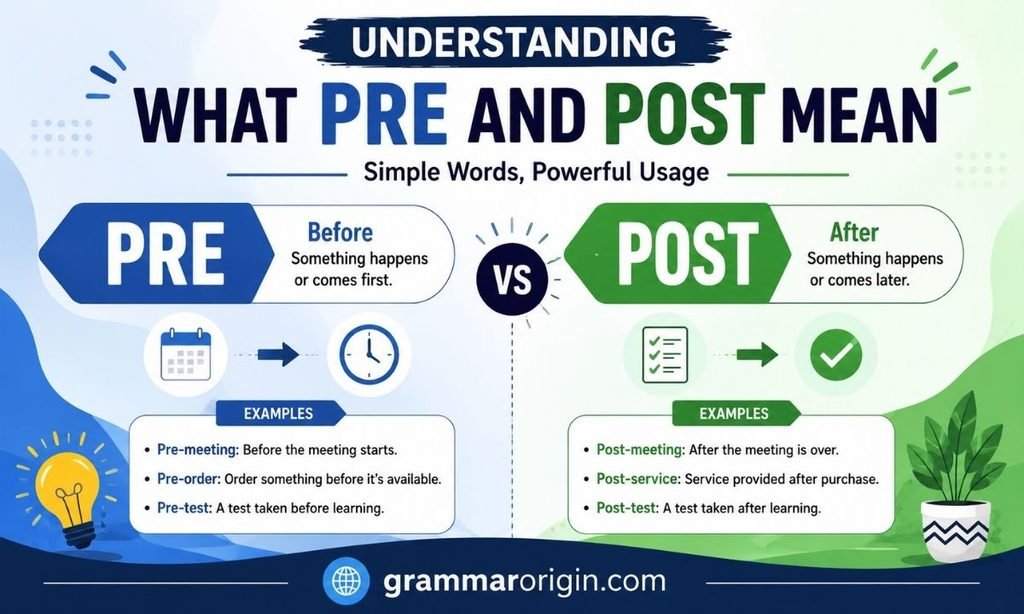
Pre- means before, and post- means after. That’s the whole rule in one line, and it’s the core of the pre vs post question.
Once you attach these prefixes to a real word, the meaning shifts fast. A pre-inspection happens before a property changes hands. A post-inspection report gets written once the work is done.
Picture a straight line with one fixed point in the middle, say a launch, a surgery, or a test. That point is the “main event.” Pre- points to everything sitting on the left side of it. Post- points to everything on the right.
Most people already sense this from context. The tricky part isn’t the definition. It’s remembering which side of the timeline a word belongs to when you’re writing fast, which is really the whole point of understanding pre vs post.
The Origins of “Pre” and “Post”
Both prefixes trace back to Latin, and their meanings haven’t changed much in centuries. Pre- comes from prae, meaning “in front of” or “before.” Post- comes straight from the Latin post, meaning “after” or “behind in time.”
| Prefix | Latin Root | Core Meaning | Everyday Example |
| Pre- | prae | before | prepay, preview |
| Post- | post | after | postpone, postscript |
Latin grammar leaned heavily on prefixes to mark time and position, and English absorbed thousands of these words through French, science, and law. That’s a big reason pre and post show up so often in medical and academic writing specifically. Those fields borrowed a lot of Latin terms directly.
How “Pre” Functions in English
Pre- signals that something happens ahead of a main event, often as preparation for it.
When to Use Pre-
Reach for pre- when you’re describing:
- A step taken in advance (pre-book, pre-pay)
- A condition that already existed (pre-existing)
- An early stage of something larger (pre-production, pre-launch)
- A moment right before an event starts (pre-game, pre-dawn)
Common Word Formations with Pre-
| Word | What It Actually Means |
| Preheat | Warm something up before cooking |
| Preorder | Reserve an item before its release date |
| Prerequisite | A requirement you must meet first |
| Preliminary | An early round or draft before the final one |
| Prepay | Pay in advance of a service |
Quick Rule of Thumb
Swap the prefix out for “before the.” If the sentence still reads naturally, pre- is your answer. Pre-treatment becomes “treatment before the procedure,” and that checks out fine.
Also Read This Its Self or Itself? The Correct Usage Guide
How “Post” Functions in English
Post- flips the direction entirely. It marks whatever comes after the main event has already happened.
When to Use Post-
Use post- for:
- Effects or reactions that follow something (post-trauma, post-shock)
- A phase that starts once an event ends (post-production, post-season)
- Time periods that follow a major event (post-war, post-2020)
- Academic stages that come after a degree (postgraduate)
Common Word Formations with Post-
| Word | What It Actually Means |
| Postgraduate | Studies pursued after finishing a bachelor’s degree |
| Postmortem | An examination or review done after death or after an event |
| Postpone | Push a plan back to a later time |
| Post-production | Editing and finishing work done after filming wraps |
| Postscript | A note added after the main letter is finished |
Quick Rule of Thumb
Try swapping in “after the” instead. Post-op becomes “after the operation,” which makes sense, so post- is correct there.
Pre vs Post: A Clear Comparison
Set side by side, the contrast in pre vs post becomes obvious almost right away.
| Prefix | Meaning | Sample Word | What It Signals |
| Pre- | before | pre-test | knowledge measured before a lesson |
| Post- | after | post-test | knowledge measured after a lesson |
| Pre- | before | pre-release | version shipped ahead of the public launch |
| Post- | after | post-release | updates issued once the product is live |
Side-by-Side Examples
- Pre-workout vs post-workout
- Pre-surgery vs post-surgery
- Pre-event vs post-event
- Pre-pandemic vs post-pandemic
- Pre-interview vs post-interview
Notice how flipping just one prefix reverses the entire timeline of the sentence. That’s the whole reason pre vs post trips people up. The words look nearly identical but point in opposite directions.
Pre vs Post vs During
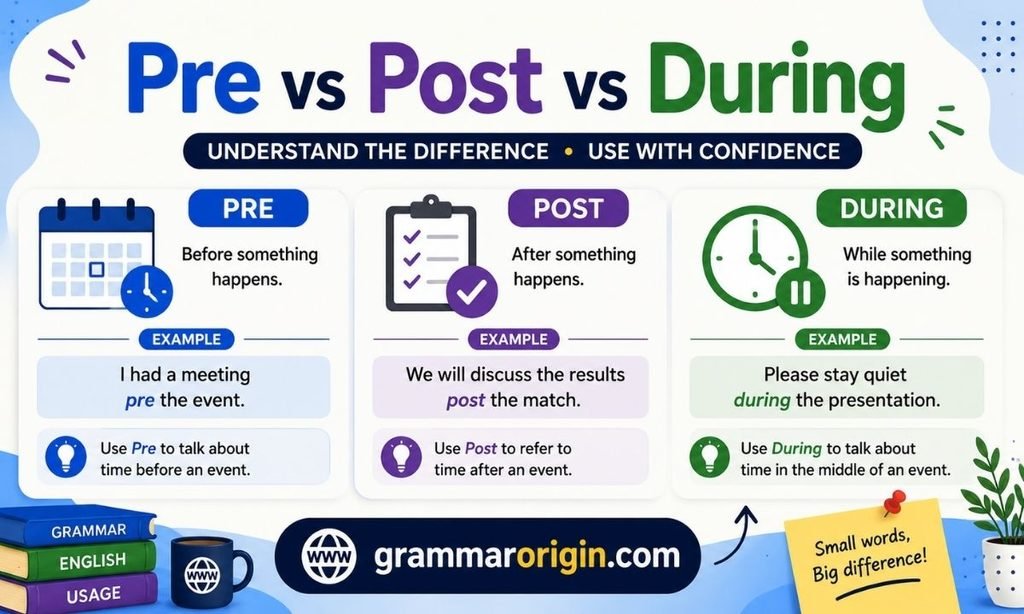
Adding a third option, during, often clears up confusion that pre vs post alone can’t fix. During describes the window while an event is actively happening, not before it starts or after it wraps up.
Take a job interview. Pre-interview covers your prep the night before, during-interview covers the actual conversation, and post-interview covers your follow-up email. All three describe the same event from three different angles.
| Stage | Example Phrase | Timing |
| Pre | pre-flight checklist | before the flight departs |
| During | in-flight service | while the flight is happening |
| Post | post-flight review | after the flight lands |
Writers sometimes reach for pre- or post- when “during” was the accurate word the whole time. If an action is happening in real time, not before or after, during (or “in-” as a prefix) is usually the better fit. This is one part of pre vs post that most guides skip entirely.
Where the Difference Really Matters
Some fields can’t afford to get this wrong. A swapped prefix in the wrong context doesn’t just read oddly. It changes facts.
1. Medicine
The pre vs post distinction matters most in medicine. Hospitals rely on pre-operative and post-operative labels to separate prep instructions from recovery instructions. Mixing those charts up isn’t a grammar slip. It’s a safety risk.
2. Education
Schools use the pre vs post idea constantly. Teachers give pre-tests to see what students already know, then run post-tests afterward to measure what actually stuck. Swap the labels and the whole data set becomes meaningless.
3. Business and Marketing
Marketing teams plan pre-launch buzz, things like teasers, waitlists, and early access, separately from post-launch work like support and performance tracking. Each phase needs its own plan, so the labels have to stay accurate.
4. Research and Data Analysis
Researchers compare pre-intervention data against post-intervention data to prove whether a program actually worked. If those labels get flipped in a spreadsheet, the whole study’s conclusion could read backward. This is exactly the kind of pre vs post mix-up that damages a study’s credibility.
Avoiding Common Mistakes with Pre and Post
Even confident writers slip up here sometimes. These are the three patterns worth watching for.
Mistake 1: Using Pre and Post Interchangeably
This is the single biggest pre vs post mistake writers make. They aren’t synonyms, and they aren’t flexible. Pre- and post- point in opposite directions every time. Writing “post-approval needed before submitting” reverses the intended meaning completely.
Mistake 2: Adding Them When Not Needed
Not every word needs a timing prefix bolted onto it. “Pre-planned in advance” is redundant. “Planned in advance” already says it, and “pre-planned” alone works fine without the extra phrase.
Mistake 3: Confusing Meaning Because of Similar Sound
Words like precede and proceed sound almost identical but mean very different things. One means “come before,” the other means “move forward.” A quick pause before using either one saves an awkward correction later.
Words That Only Take Pre- or Only Take Post- (Exceptions)
Not every root word fits the standard pre vs post pattern, and not every one pairs neatly with both prefixes. Some terms settled into one form long ago and never developed a matching counterpart.
| Pre-Only Words | Post-Only Words |
| Prequel | Postscript |
| Preemie | Postmortem |
| Precocious | Posthumous |
| Prefatory | Postprandial |
There’s no “postquel” in common use. Writers say “sequel” instead. The same goes for “posthumous,” which doesn’t have a natural “prehumous” opposite. When a word feels off in reverse, it’s worth checking a dictionary instead of forcing a pairing that never existed.
Practical Tips to Improve Prefix Usage
A handful of small habits make choosing correctly between pre vs post almost automatic.
1. Translate the Prefix
Mentally swap pre- for “before” and post- for “after” every time you’re unsure. The sentence usually tells you right away which one fits.
2. Break Down the Word
Split the word into its parts. Postsecondary becomes “post plus secondary,” meaning after secondary school. Prehistoric becomes “pre plus historic,” meaning before recorded history.
3. Use the Before/After Test
Put the actual words “before the” or “after the” into the sentence. If it reads naturally, you picked the right prefix.
4. Think in Terms of Timelines
Picture a straight line with the event marked in the center. Pre- sits to the left, post- sits to the right. Nothing complicated beyond that image.
5. Learn Through Real-World Examples
The fastest way to lock this rule in is repetition through real sentences, not abstract definitions. Read a handful of pre-post pairs in context and the pattern sticks on its own.
Also Read This Its Self or Itself? The Correct Usage Guide
Hyphenation & Spelling Rules for Pre- and Post-
Hyphens aren’t always required, and modern style guides tend to drop them where the word reads clearly without one.
- Preexisting is increasingly written without a hyphen, though pre-existing still appears in older style guides.
- Hyphenate when a proper noun follows: post-World War II, pre-Renaissance.
- Drop the hyphen for well-established compounds: postgraduate, prepay, postpone.
- When two vowels collide awkwardly, a hyphen usually helps readability, though both forms often appear in print.
When you’re unsure, check a current dictionary. Hyphenation habits shift over time, and house style guides don’t always agree with each other.
Case Studies: Real Applications of Pre vs Post
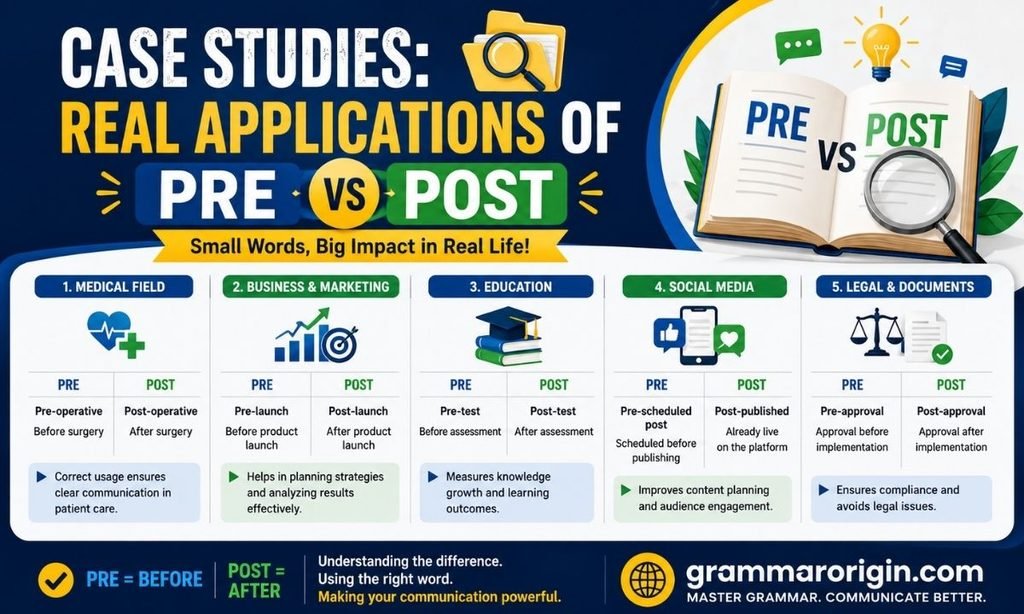
These real-world cases show how a pre vs post mix-up plays out in practice.
Case Study 1: Marketing Launch Strategy
A phone manufacturer split its campaign into two clear phases. Pre-launch work covered teaser videos and influencer previews, while post-launch work covered customer support tickets and update rollouts. Keeping the labels straight kept both teams working from the same calendar.
Case Study 2: Hospital Procedure
A surgical team documented pre-operative steps, like fasting windows, consent forms, and bloodwork, separately from post-operative steps like medication schedules and physiotherapy. The separation isn’t just organizational. It’s a legal safeguard too.
Case Study 3: Academic Research
A university psychology department ran a pre-intervention stress survey, delivered an eight-week program, then followed up with a post-intervention survey. The gap between the two data sets became the actual measure of whether the program worked.
Helpful Quotes on Language and Meaning
Linguist David Crystal has long argued that small grammatical markers, prefixes among them, carry a lot of weight in how clearly a sentence communicates timing and sequence. That point applies directly to how pre and post function in everyday writing.
Merriam-Webster’s usage notes on Latin-derived prefixes make a similar point. Precision in word-building often matters more in technical fields than in casual speech, which is exactly why medicine and research lean on these prefixes so heavily.
Quick Practice: Test Yourself
Try filling in the blank with pre- or post- before checking the answer beneath each line.
- The nurse reviewed the ___-operative checklist with the patient. Answer: pre (before the operation)
- Sales dipped slightly during the ___-holiday season. Answer: post (after the holidays)
- Students took a ___-test before the unit began. Answer: pre
- The team ran a ___-mortem meeting after the failed launch. Answer: post
If you got all four right, the before/after substitution trick has already become second nature, and the pre vs post distinction should feel much less confusing now.
Frequently Asked Questions
What does “pre” mean?
Pre- means before. It marks something that happens earlier than, or in preparation for, a main event, as in pre-test or pre-launch.
What are some common pre and post examples?
Common pairs include pre-test and post-test, pre-war and post-war, pre-surgery and post-surgery, and pre-launch and post-launch. Each pair shows the same event from opposite sides of the timeline.
What is the basic pre post meaning in one sentence?
Pre- points to “before the event,” and post- points to “after the event.” The entire pre vs post distinction rests on that one timing difference.
How is pre vs post vs during different?
Pre- and post- describe the time before and after an event, while during describes the period while the event is actively happening, like pre-flight, in-flight, and post-flight.
Does post mean before or after?
Post- always means after. It never signals something happening earlier. If a word describes something before an event, pre- is the correct prefix instead.
Can pre and post ever be used interchangeably?
No. They describe opposite points on a timeline, so swapping one for the other reverses the sentence’s intended meaning entirely.
Where does the prefix pre- come from?
Pre- comes from the Latin word prae, meaning “before” or “in front of,” and has been part of English since at least the 14th century.
Final Thoughts
The pre vs post question comes down to one simple test: does the word describe something before an event, or after it? Once that question feels automatic, every compound word built from these prefixes stops being a guessing game.
Medical notes, marketing timelines, or research reports all depend on the same small distinction. Get the pre vs post timeline right, and the rest of the sentence takes care of itself.

Muhammad Waqas is an English language teacher and grammar expert with over 8 years of experience helping students and professionals improve their writing skills. He specializes in English grammar, vocabulary, communication, and practical language learning. Through GrammarOrigin, Waqas shares clear, easy-to-understand content that helps readers write and speak English with confidence.