
You’ve typed the word, paused, and stared at it for a second too long. Is itTargetted or Targeted You’re not the only one who’s hit this wall — it trips up native speakers just as often as learners.
The short version: one of those two forms is the spelling you want, every time, in every English-speaking country. Below, you’ll find the exact rule behind it, real examples, and answers to the smaller questions people ask alongside this one.
Quick Answer
Targeted is correct. Targetted is a misspelling — it doesn’t appear in any major dictionary as a standard variant.
This holds true whether you’re writing for a US, UK, Australian, or Canadian audience. The word follows a straightforward spelling convention that a lot of people simply never learned, which is exactly why the confusion keeps spreading.
Targetted vs Targeted at a Glance
| Form | Status | Notes |
| Targeted | Correct | Past tense/participle and adjective form |
| Targetted | Incorrect | Common typo, not recognized in dictionaries |
| Targeting | Correct | Present participle/gerund |
| Targetting | Incorrect | Same error, applied to the -ing form |
Both the verb form and the adjective form of “target” only ever take one extra t. If you remember nothing else from this page, remember that.
Which Spelling Is Correct: Targetted or Targeted?
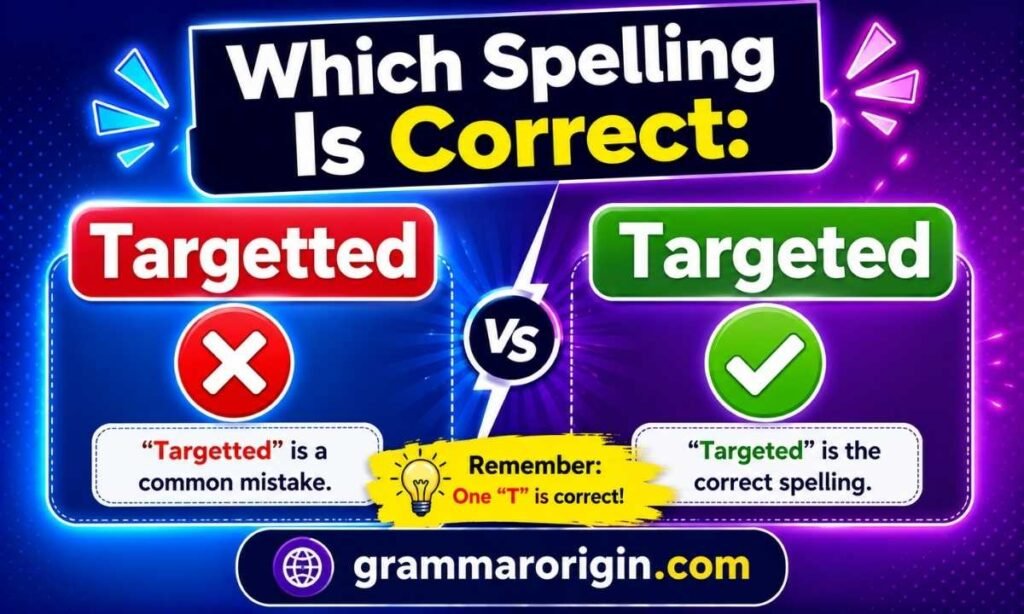
Targeted, without question. It’s the form printed in dictionaries, taught in style guides, and used by professional editors across every English-speaking market.
The base verb means to aim at or focus on something specific. Add the -ed ending for past tense, and English doesn’t ask you to double the final letter. Writers sometimes double it out of habit, borrowing a pattern from words like “stopped” or “planned,” but that pattern doesn’t apply here.
What Does “Targeted” Mean?
Targeted describes something aimed at, directed toward, or intended for a specific person, group, or goal. It shows up constantly in business writing, healthcare, education, and advertising.
A few quick examples of the sense it carries:
- A targeted email campaign reaches a chosen segment of customers, not everyone on the list.
- A targeted therapy attacks a specific cause of illness rather than treating symptoms broadly.
- A targeted lesson plan zeroes in on the exact skill a student is struggling with.
In each case, the word signals precision — something chosen on purpose rather than applied at random.
Why Is “Targeted” Spelled with One T?
English doubles a final consonant before -ed or -ing only when the last syllable of a word is stressed and ends in a single consonant after a single vowel. This is often called the consonant doubling rule, and “target” doesn’t meet that condition, so it keeps one t.
Say it out loud: TAR-get. The stress lands on the first syllable, not the second. Compare that to a word like “admit,” where the stress falls on the second syllable (ad-MIT) — that’s why “admit” becomes “admitted,” doubling the t, while target doesn’t.
| Word | Stress | Past Form |
| Target | TAR-get | Targeted |
| Visit | VIS-it | Visited |
| Enter | EN-ter | Entered |
| Admit | ad-MIT | Admitted |
| Prefer | pre-FER | Preferred |
Once you hear the difference in stress, the spelling stops feeling arbitrary. It’s a rule, not an exception someone made up.
Why Do People Write “Targetted”?
Most people write targetted because they’re pattern-matching against other -ed words that do double their final consonant, like “stopped” or “cancelled.” The brain assumes consistency where English doesn’t actually offer any — a common grammar mistake rooted in habit, not carelessness.
A few other reasons the spelling mistake spreads:
- Visual habit — seeing double letters in similar-looking words like “committed” or “regretted” and assuming target behaves the same way.
- Autocorrect gaps — some spellcheckers miss it because the doubled form still parses as a plausible word shape.
- Copying from unreliable sources — once a misspelling appears on enough blogs or forums, people start treating it as normal.
None of these reasons make the spelling correct. They just explain why it keeps showing up.
Also Read This Past Tense of Run
Targeting vs Targetting: Which Is Correct?
Targeting is correct. The same stress rule covered above applies here too — the -ing form never doubles that final letter either.
You’ll see targeting in phrases like audience targeting or campaign targeting strategy. The double-t version isn’t recognized in any dictionary, so treat it as an error to catch before you hit publish.
Is “Targetted” Ever Correct in British English?
No. This is one of the most persistent myths about the word — that British English somehow prefers the double-t version the way it prefers “colour” over “color.” It doesn’t.
British and American dictionaries agree on this one completely. There’s no regional split here, unlike genuine US/UK differences such as “traveling” vs “travelling.” If someone tells you targetted is standard in the UK, they’re mixing it up with a different word pattern entirely.
Examples of “Targeted” in Sentences
Seeing targeted in context makes the correct spelling stick faster than memorizing a rule alone.
Business Examples
- The startup ran a targeted ad campaign aimed at small business owners.
- Our sales team built an outreach list based on last quarter’s buying data.
- The retailer sent discount codes to a specific group of lapsed customers.
Academic Examples
- The researchers designed a targeted intervention for struggling first-year students.
- Her thesis included a focused review of climate policy in coastal cities.
- The university offered extra tutoring aimed only at students behind in math.
Everyday Examples
- He gave his teammate targeted feedback right after the match.
- The doctor recommended an exercise routine aimed specifically at her lower back.
- Her essay revisions were specific and precise, not vague notes.
Common Words Similar to Targeted
A handful of English words follow this same “no doubling” pattern as target, and a few well-known ones get misspelled for the same reason.
| Correct | Common Misspelling | Pattern |
| Targeted | Targetted | Unstressed final syllable |
| Benefited | Benefitted | Unstressed final syllable |
| Focused | Focussed | Regional variant, not a true error |
| Marketed | Marketted | Unstressed final syllable |
| Visited | Visitted | Unstressed final syllable |
Notice the theme: whenever the stress sits earlier in the word, English tends to skip the doubled consonant. That pattern isn’t limited to “target” — it’s a small rule worth keeping in your back pocket for other words too.
Targetted or targeted British spelling
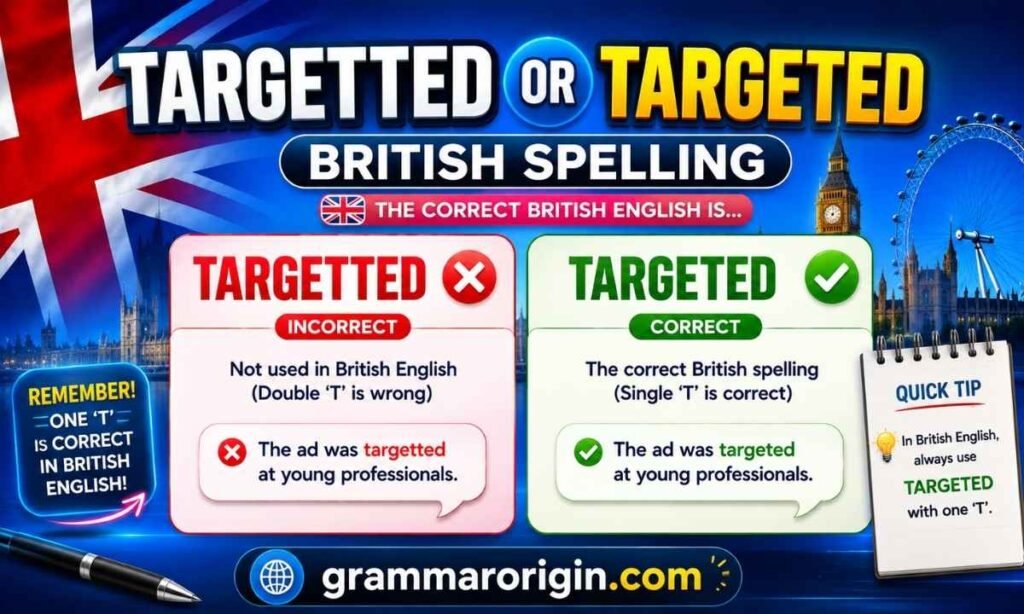
There is no separate British spelling for this word — targeted is standard in both British and American English.
Some genuine US/UK spelling gaps exist (“colour” vs “color,” “organise” vs “organize”), but this isn’t one of them. UK dictionaries and style guides, including those used by British newspapers and publishers, list “targeted” as the only accepted form.
Targetted or targeted synonym
Words with a similar meaning to targeted include aimed, focused, directed, tailored, customized, and specific.
Which synonym fits best depends on tone:
- Use tailored or customized in marketing copy — it sounds more personal.
- Use directed or aimed in more formal or academic writing.
- Use focused when you want to emphasize concentration of effort rather than a specific audience.
Swapping in a synonym occasionally also helps your writing avoid repeating the same word too often.
Also Read This Past Tense of Run
Targetted or targeted meaning
The meaning of targeted is “aimed at, chosen for, or directed toward a specific person, group, or purpose.” It’s the adjective and past-tense form of the verb “target.”
You’ll see it used two ways grammatically. As a verb: “The campaign targeted young professionals.” As an adjective: “This is a targeted approach to weight training.” Both carry the same core sense of deliberate focus.
Targetted or targeted grammar
Grammatically, targeted functions as either the past tense/past participle of the verb “target” or as an adjective modifying a noun.
As a verb, its conjugation follows a regular pattern, unlike irregular verbs such as “go → went.” As an adjective, it typically sits before a noun, as in “targeted therapy” or “targeted audience.” The spelling doesn’t change based on which role it’s playing — it’s always one t.
Targetted or targeted oxford dictionary
Oxford’s dictionary entries list targeted as the standard spelling for both the past tense of “target” and its adjective form, with no double-t variant recognized as standard.
This matches Merriam-Webster and Cambridge Dictionary as well — all three major English-language references agree on the single-t spelling. When a word shows this level of agreement across dictionaries from different countries, it’s about as settled as spelling questions get.
Targeted pronunciation
Targeted is pronounced /ˈtɑːr.ɡɪ.tɪd/ in most dictionaries, with three syllables and the stress on the first one: TAR-guh-tid.
Breaking it down syllable by syllable:
- TAR — stressed, rhymes with “car”
- guh — short, unstressed
- tid — short, unstressed, ends the word
That first-syllable stress is the same detail that explains the spelling rule above — it’s not a coincidence that pronunciation and spelling line up here.
Targeted in Marketing, SEO, and Cybersecurity
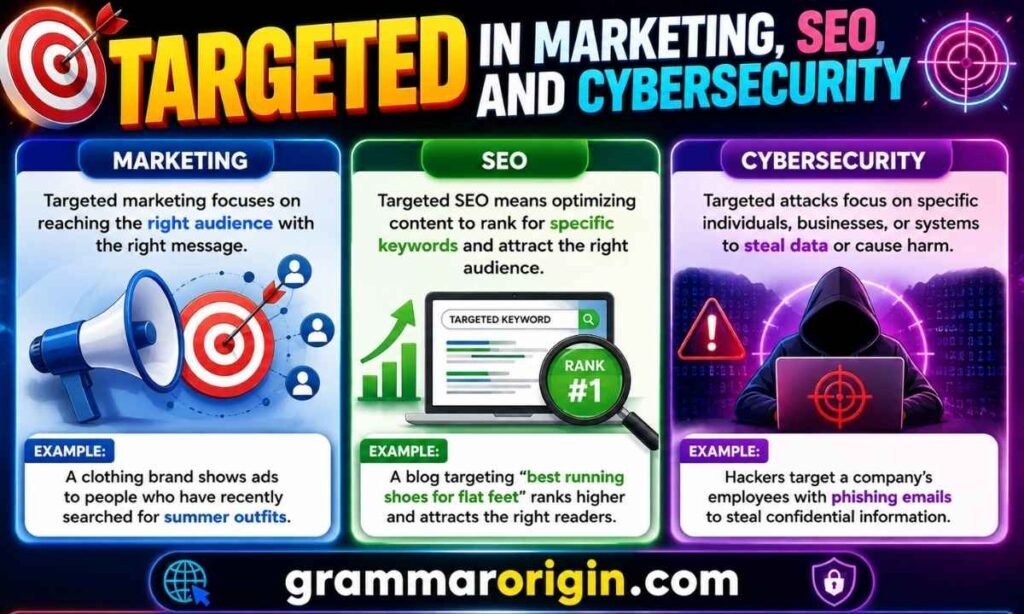
Outside of grammar guides, targeted shows up constantly in industry-specific phrases, and getting the spelling right matters even more in professional contexts.
In digital marketing, you’ll see targeted advertising, targeted keywords, and audience segments — terms describing an effort aimed at a specific group rather than a general one. In cybersecurity, a targeted attack is aimed at one particular organization or individual, as opposed to a broad, random one. Misspelling the word in a report, proposal, or campaign name can look careless in front of a client or employer, which is one more reason it’s worth locking in the right form.
Frequently Asked Questions
Is targetted a real word?
No. “Targetted” doesn’t appear as a standard entry in any major English dictionary — it’s a common misspelling of targeted.
Why is targeted spelled with one T?
Because the stress falls on the first syllable, not the last. English only doubles a final consonant before -ed when the last syllable is stressed, so this word keeps a single t.
Is targetted correct in any style guide?
No major style guide — not AP, not Chicago, not Oxford — lists “targetted” as an accepted alternative. Treat it as an error in any formal or professional writing.
Do American and British English spell it differently?
No. Both use targeted. This is one of the rare cases where American and British spelling agree completely.
How do you spell the -ing form of target?
Targeting, with a single t. The same stress rule applies here as it does to “targeted.”
What’s the difference between targeted and untargeted?
Targeted means aimed at a specific group or purpose, while untargeted means broad or unfocused, without a specific audience or goal in mind.
Can targeted be used as both a verb and an adjective?
Yes. As a verb, it’s the past tense of “target” (“She targeted the wrong audience”). As an adjective, it describes a noun directly, as in “a targeted campaign.”
Final Thoughts
Targeted is the correct spelling — full stop, no regional exceptions, no dictionary disagreement. The rule comes down to where the stress falls in the word, and once that clicks, the spelling stops being a guessing game.
Keep the single-t version in mind for “targeting” too, and you’ll have this entire word family covered for emails, reports, ad copy, or anything else you write.

Muhammad Waqas is an English language teacher and grammar expert with over 8 years of experience helping students and professionals improve their writing skills. He specializes in English grammar, vocabulary, communication, and practical language learning. Through GrammarOrigin, Waqas shares clear, easy-to-understand content that helps readers write and speak English with confidence.