
Short answer: both “long term” and “long-term” are correct. It depends on grammar, not personal taste, and the one-word version doesn’t hold up in standard English no matter how often you spot it online.
Ever typed this phrase, paused halfway through, and second-guessed the hyphen? You’re not alone there. Students, marketers, even editors who do this for a living still trip over it.
Here’s the part nobody tells you: the rule takes about thirty seconds to learn. This guide walks through it with plain examples, a few real style-guide references, and a quiz at the end if you want to check yourself.
What Is the Correct Spelling: Long Term or Longterm?
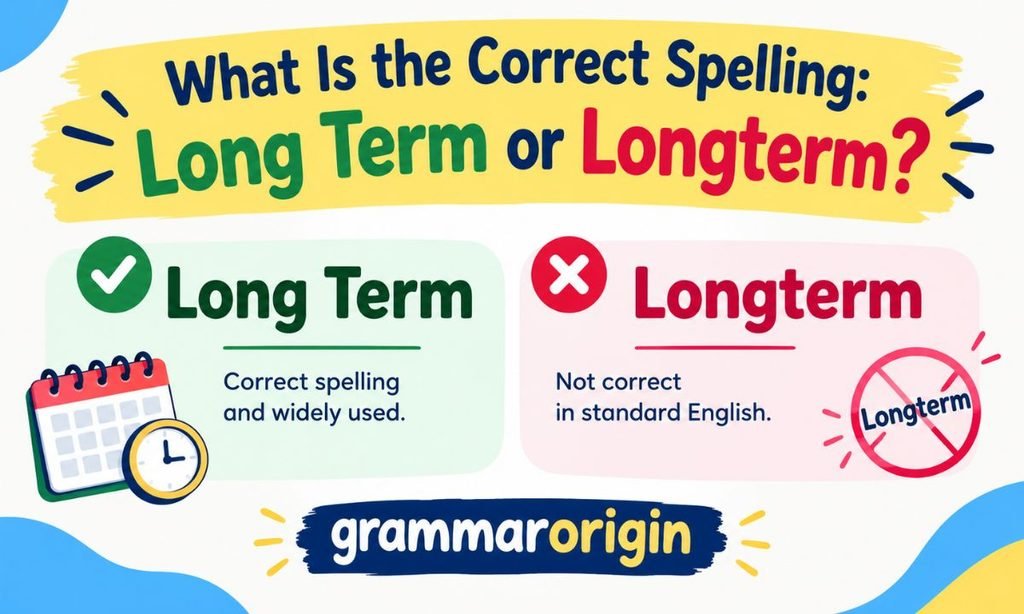
Both the two-word form and the hyphenated form are accepted in standard English. Which one you use depends entirely on how the phrase is working in your sentence. The single fused spelling isn’t recognized by any major dictionary or professional style guide, full stop.
Example: “We need a longterm plan” should actually read “long-term plan.”
Quick Answer
| Form | Correct? | Function |
| Long term | Yes | Noun phrase |
| Long-term | Yes | Compound adjective |
| Longterm | No | Not standard in formal writing |
Why the Confusion Exists
It’s not a random mix-up. English genuinely does fuse compound words over time. Email started life as “e-mail.” Website used to be two words. Online carried a hyphen for years before anyone dropped it.
So people see that trend and figure this phrase must be next in line. It isn’t, at least not yet, and not anywhere careful writing still matters.
Dictionary Consensus
Check Merriam-Webster, Oxford, or Cambridge and you’ll find the same thing every time: the open and hyphenated forms listed as standard, and nothing recognizing the fused spelling as a variant.
That gap matters more than people think. Dictionaries tend to lag behind internet habits rather than lead them, so if the editorial standard hasn’t caught up yet, your writing shouldn’t get there first either.
Where Does “Longterm” Come From?
It’s older than most people assume. The closed spelling turns up in insurance paperwork as far back as 1876, describing extended policy periods, which is roughly where the two words first started sticking together on paper.
Example: Old insurance ledgers list “longterm disability” as one word, and that habit never fully died out in niche industry jargon, even after general writing split it back into two.
That narrow, industry-specific origin is exactly why the closed form still shows up in policy documents or database field names today. It’s a leftover, not a new grammar trend catching on.
Understanding the Difference Between Long Term and Long-Term
One question decides everything here: is the phrase naming a stretch of time, or is it describing something else? That’s the whole rule, really.
Example: “The plan covers the long term” names a period, so it stays open. “The plan is a long-term commitment” describes the commitment, so the hyphen kicks in.
Long Term as a Noun Phrase
When it refers to an extended stretch of time, acting as the subject or object in a sentence, it stays open. No hyphen needed.
Example: “She’s more focused on the long term than on next quarter’s numbers.”
Long-Term as a Compound Adjective
Put the words directly in front of a noun and they’re describing it now, which means the hyphen has to join them into a single modifier.
Example: “He signed a long-term lease before moving into the apartment.”
Easy Rule to Remember
One test, every time: does a noun sit right after it? If yes, hyphenate. If the phrase is standing on its own, leave it open.
Why Longterm Is Usually Incorrect
The closed spelling is everywhere online, sure, but showing up often and being correct are two different things. Editors and style guides still reject it whenever the writing is meant to look polished.
Also Read This Carrer vs Career: Which Spelling Is Correct? (2026 Guide)
The Internet Does Not Always Follow Grammar Rules
Captions, comment sections, quick marketing copy, all of it drops hyphens for speed. That’s fine for a tweet. It doesn’t make the shortcut grammatically correct, though; it just makes it common.
Example: “goals only, no shortcuts” reads fine as a casual caption, but the same habit in a resume or a client report starts to look careless fast.
Professional Writing Standards
There’s a practical reason editors steer away from the fused version: it makes otherwise clean writing look rushed. Readers pick up on small inconsistencies even when they couldn’t tell you exactly what’s bothering them.
Business proposals, academic papers, legal documents, none of them use the closed form as a rule, because clarity is worth more than saving one keystroke.
When Might You See Longterm?
Occasionally a brand name, a software field, or a product label will use the fused spelling anyway. That’s a stylistic call somebody made, not a grammar exception.
Example: A database column named “longterm_status” is just a coding shortcut. It has nothing to say about how the phrase should look in an article or an email.
What Do AP Style and Chicago Manual of Style Say?
Both of them agree on this: hyphenate before a noun, drop the hyphen once the phrase stands alone after a verb. Same rule, stated slightly differently by two of the biggest names in editorial style.
Example: AP-style copy prints “long-term investment strategy,” hyphen intact, but drops it entirely once the phrase stands on its own in a sentence.
Merriam-Webster’s usage notes land in the same place: hyphenated as the adjective, open as the noun phrase. None of these authorities give the one-word spelling any real footing.
Long Term vs Long-Term: Real Examples
Reading the rule is one thing. Seeing it play out across a few different fields tends to make it stick a lot faster.
Example 1: Business Writing
A lot of writers would type “The company follows a long term growth strategy” without thinking twice. It should read “long-term,” since the phrase is directly modifying “strategy.”
Example 2: Investment Discussion
Here’s one that flips the usual mistake: “Experienced investors focus on the long-term” isn’t right. Drop the hyphen. The phrase is standing alone as a noun here, not describing anything.
Example 3: Education
Both forms show up correctly in the same context. “Teachers encourage long-term study habits” needs the hyphen; “the benefits show up over time” doesn’t, because the role each phrase plays is different.
Example 4: Healthcare
Same logic applies. “The patient needs long-term care” takes the hyphen because it sits before a noun, while “doctors are weighing the bigger picture” has no phrase left to hyphenate at all.
American English vs British English Usage
Both American and British English run on the exact same hyphenation logic, so the core grammar rule doesn’t shift depending on which side of the Atlantic you’re writing for.
Example: A British financial report and an American one would both print “long-term liabilities,” hyphen and all, and both would drop it the moment the phrase stands alone.
Where they do diverge a little is headline style. British headlines tend to hyphenate compound phrases more freely for the sake of compactness, in spots where American style guides would just leave a space.
Long-Term vs Similar Words: Longtime, Long-Standing, Long-Lasting
People mix these up constantly, and it’s easy to see why. They all touch on duration, but each one follows its own spelling pattern.
| Word | Spelling | Typical Use |
| Long-term | Hyphenated before a noun | Duration-based plans, effects, goals |
| Longtime | One word | Describes a person’s role or relationship |
| Long-standing | Hyphenated | Something that’s lasted for years |
| Long-lasting | Hyphenated | Physical durability |
Example: “My longtime colleague gave me solid advice about our long-standing partnership” gets both terms right, and each one is following a different rule.
A Simple Step-by-Step Method to Choose the Correct Form
This works even when you’re editing fast and don’t have time to think through grammar theory from scratch.
Step 1: Find the Phrase
Spot the words in your sentence first. Nothing else matters until you’ve located them.
Step 2: Check What Comes Next
Look at the word sitting right after it. Is it a noun?
Step 3: Use a Hyphen If Needed
If a noun follows, join the words with a hyphen, the same way it works in “contract” or “relationship” from the examples above.
Step 4: Leave It Open If It Stands Alone
Nothing being modified directly? Keep it as two open words, like “planning for the future.”
Step 5: Avoid the Fused Spelling
Unless you’re matching an existing brand name or a database field somebody else already built, don’t combine the words into one.
Case Study: How a Small Business Improved Its Professional Writing
A regional accounting firm learned this one the hard way back in 2025. A client flagged inconsistent grammar across a batch of proposals, and when the team dug in, they found three different spellings of the same phrase scattered across contracts, emails, and their own website.
Some staff wrote the open form. Others hyphenated it without thinking. A few had just picked up the fused spelling somewhere online and never questioned it. None of this was a disaster by itself, but stacked together, it made the firm’s materials look a little less put-together during client reviews.
Management ended up writing a one-page internal style note: hyphenate before a noun, leave it open when it stands alone, skip the one-word version entirely. Within two months, proofreading corrections had dropped noticeably, and junior staff stopped asking which spelling was “the right one.”
There’s a bigger takeaway buried in there. Small punctuation habits quietly shape how trustworthy a business looks on paper, whether the reader ever consciously clocks it or not.
Grammar Trends and Language Data in 2025–2026
Language keeps moving, especially online, but not every compound word merges at the same pace. Some take decades. Some never fully commit either way.
Growth of Compound Words
Website, email, healthcare, all of them started as two words or hyphenated forms before eventually settling into a single word over years, sometimes decades, of everyday use.
What Current Usage Shows
Publishing data from 2025 and 2026 still points the same direction: the hyphenated form dominates as the adjective, the open form holds steady as the noun phrase, and the fused spelling mostly turns up in casual, unedited text.
What This Means for Writers
Language keeps evolving fast online, sure, but professional publishing hasn’t budged toward the one-word spelling. Sticking with the two traditional forms means you’re following today’s standard, not last decade’s habit.
Common Mistakes Writers Make
Four errors cover almost every mistake tied to this phrase, and honestly, most writers only ever make one or two of them repeatedly.
Mistake 1: Omitting the Hyphen
“We need a long term plan” is missing something. The phrase sits directly before “plan,” so it needs to read “long-term plan,” hyphen and all.
Mistake 2: Adding an Unnecessary Hyphen
Flip side of the same coin: “Success depends on thinking about the long-term” has one hyphen too many. Nothing follows the phrase here, so it should stay open: “the long term.”
Mistake 3: Writing Longterm as One Word
This is the big one. “We need a longterm solution” should read “long-term solution,” and it’s probably the single most common slip tied to this whole topic.
Also Read This Carrer vs Career: Which Spelling Is Correct? (2026 Guide)
Mistake 4: Switching Between Forms
Using two or three different spellings across the same document is its own problem, even when each individual instance happens to be technically fine on its own. Consistency matters just as much as correctness.
Mini Quiz: Long Term or Longterm
Fifteen quick checks. See how many you get without scrolling back up.
Mini Quiz 1: Spot the Correct Form
Only one of these is standard English: Longterm, or Long term? It’s the two-word version.
Mini Quiz 2: Add the Hyphen?
“We signed a ___ contract.” Fill it in with the hyphenated form, “long-term,” since a noun follows right away.
Mini Quiz 3: Quick Grammar Check
“Thinking about the long ___.” No hyphen belongs here. Just “term,” standing on its own.
Mini Quiz 4: True or False
The fused spelling is accepted in professional publishing. False, and it’s not particularly close.
Mini Quiz 5: Choose the Winner
For a business report, “Long-term strategy” beats “Longterm strategy” every time.
Mini Quiz 6: Fill in the Blank
“Investors often focus on the long ___.” The missing word is simply “term.”
Mini Quiz 7: Hyphen Hero
Where does the hyphen actually go? Right before the noun it’s modifying, never at the end of a sentence.
Mini Quiz 8: Fast Choice
“Long-term goals” is correct. “Long term goals,” without the hyphen, isn’t.
Mini Quiz 9: True or False
Can this phrase work as a noun all by itself? Yes, it absolutely can.
Mini Quiz 10: Find the Correct Sentence
Between “We have a long-term solution” and “We have a longterm solution,” only the first one holds up.
Mini Quiz 11: One Word or Two?
Is this phrase usually written as one fused word? No. It’s either two open words or hyphenated, depending on what it’s doing in the sentence.
Mini Quiz 12: Grammar Challenge
“Planning for the long term” is right. Add a hyphen there and you’ve broken the rule for no reason.
Mini Quiz 13: Easy Pick
Between “Longterm investment” and “Long-term investment,” the hyphenated version wins, no contest.
Mini Quiz 14: Quick Knowledge Test
What do grammarians call the hyphenated form when it sits before a noun? A compound adjective, not a verb.
Mini Quiz 15: Final Grammar Check
“We created a ___ growth plan.” Go with “long-term.” A noun follows immediately, so the hyphen belongs.
Frequently Asked Questions
Is longterm one word or two?
It’s normally two words, or hyphenated, depending on its grammatical role. The single fused spelling isn’t standard in formal English, no matter how often it pops up in casual writing.
Is “long term relationship” written with a hyphen?
Yes. The phrase is directly describing “relationship,” so it should read “long-term relationship.” Drop the noun and you’d drop the hyphen too.
Should long-term always have a hyphen?
No, not always. It only needs one when it’s sitting directly before a noun, working as a single descriptive unit.
Is long term correct without a hyphen?
Yes, whenever it’s acting as a noun rather than describing something else, like in “the benefits appear over time.”
Which spelling do AP Style and Chicago Manual recommend?
Both land on the same answer: hyphenate before a noun, drop it when the phrase stands alone. It’s one of the rare cases where the major style guides fully agree.
Is longterm accepted in any dictionary?
Not as the preferred spelling, no. Every major dictionary still lists the two traditional forms as the standard.
How can I remember this rule quickly?
Check what comes right after the phrase. Noun follows? Hyphenate. Nothing follows? Leave it open. That’s really the whole rule.
Final Thoughts
It really comes down to one quick check: does a noun follow the phrase directly? If yes, add the hyphen. If the phrase is standing alone, keep it as two open words and move on.
The fused spelling still isn’t accepted by dictionaries, style guides, or professional editors heading into 2026. Stick with the two standard forms, and your writing stays accurate without you having to think about it twice.

Muhammad Waqas is an English language teacher and grammar expert with over 8 years of experience helping students and professionals improve their writing skills. He specializes in English grammar, vocabulary, communication, and practical language learning. Through GrammarOrigin, Waqas shares clear, easy-to-understand content that helps readers write and speak English with confidence.