
Typing fast on your phone and suddenly second-guessing whether it’s “of course” or “ofcourse”? You’re not alone — this is one of the most searched spelling mix-ups in English. The short version: only one of these is real.
“Of course” is the correct, dictionary-recognized spelling. The merged version is not a word — it’s a typing habit that snuck into casual writing. Below, we’ll break down why the split matters, how to use the phrase correctly, and where people usually go wrong.
Quick Answer
“Of course” is correct. “Ofcourse” is not a real word in any English dictionary, formal or informal.
✅ Of course — always two separate words, used in speech, email, and writing. ❌ Ofcourse — a merged spelling error, never accepted in standard English.
The rule doesn’t bend for texting, social captions, or quick replies either. If you’re aiming for clean, professional writing, the two-word form is the only version that belongs on the page.
What Does “Of Course” Mean in English?
This phrase means yes, certainly, or naturally — it signals that something is expected or beyond doubt. Say your friend asks, “Can you cover my shift tomorrow?” and you answer with it — you’re confirming without hesitation.
Grammatically, it functions as an adverbial expression. It attaches to a statement and adds certainty or agreement, rather than acting as a noun or verb itself.
You’ll hear it constantly — in texts, meetings, customer service replies, even in movie dialogue. It’s flexible enough to sound warm in casual chat and still hold up in a formal email.
Is “Ofcourse” a Word in English?
No. This spelling doesn’t appear in Merriam-Webster, Cambridge, or Oxford — none of the major dictionaries list it as a valid entry.
It shows up constantly online because people type the phrase quickly and skip the space. Phones and keyboards don’t always flag it, so the mistake spreads through texts, comments, and social captions.
That doesn’t make it acceptable in essays, resumes, or business writing. Spell-checkers built into Word and Google Docs will usually catch the error and suggest the split version — a good sign of how firmly grammar rules reject it.
Why People Confuse “Of Course” and “Ofcourse”
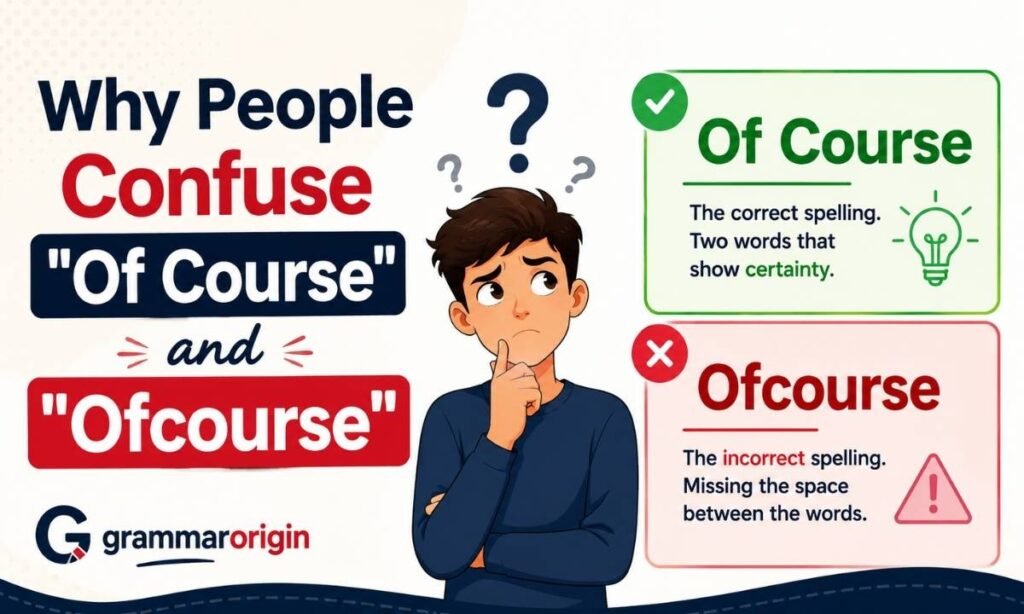
The confusion comes down to how the phrase sounds when spoken — it blends into what feels like one smooth syllable string. Your ear hears one unit, so your fingers sometimes type one word.
English also has genuine compound words like “however” or “sometimes,” which trains the brain to expect merging. This expression simply never followed that pattern, even though it behaves similarly in speech.
Autocorrect adds to the problem. Some keyboards won’t underline the mistake as an error, which quietly reinforces the habit every time you type it without a second thought.
Grammar Breakdown of “Of Course”
This phrase pairs a preposition (“of”) with a noun (“course”) — the same structure you’ll find in expressions like “in fact” or “at least.” None of these ever fuse into single words.
| Word | Part of Speech | Role |
| Of | Preposition | Connects the phrase to the sentence |
| Course | Noun | Refers to the natural path or flow of events |
Because it’s a prepositional phrase rather than a compound noun, English grammar has no mechanism for combining the two words into a single unit — spoken rhythm aside.
How to Use “Of Course” in Sentences (With Examples)
Use this expression whenever you want to confirm, agree, or grant permission clearly. It works at the start, middle, or end of a sentence.
- “Of course, I’ll send that file over today.”
- “You can borrow the car, of course.”
- “She’ll help you — she always does.”
Notice the comma pattern: when it opens a sentence, a comma usually follows; when it’s inserted mid-sentence, commas wrap around it.
Also Read This Optimize or Optimise
Formal vs Informal Use of “Of Course”
This phrase works in both formal and informal writing — the spelling never changes, only the tone around it does.
In a business email: “Of course, we’ll accommodate the revised deadline.” The same words work just as well in a text to a friend — only the punctuation shifts from a comma to an exclamation mark.
Watch out for sarcasm, though. Said with clipped emphasis, the same reply can sound irritated rather than agreeable — tone carries more weight here than in most phrases.
Common Mistakes Learners Make
The biggest slip is a simple spelling mistake — merging the words into one, especially in emails or exam answers where it stands out immediately to a grader.
- Writing it as a single word
- Confusing it with “off course” (which means deviating from a path)
- Overusing it until it sounds repetitive in formal writing
- Skipping the comma when it opens or interrupts a sentence
A quick proofreading pass — searching your document for the merged version — catches most of these before they ship.
Synonyms and Alternatives to “Of Course”
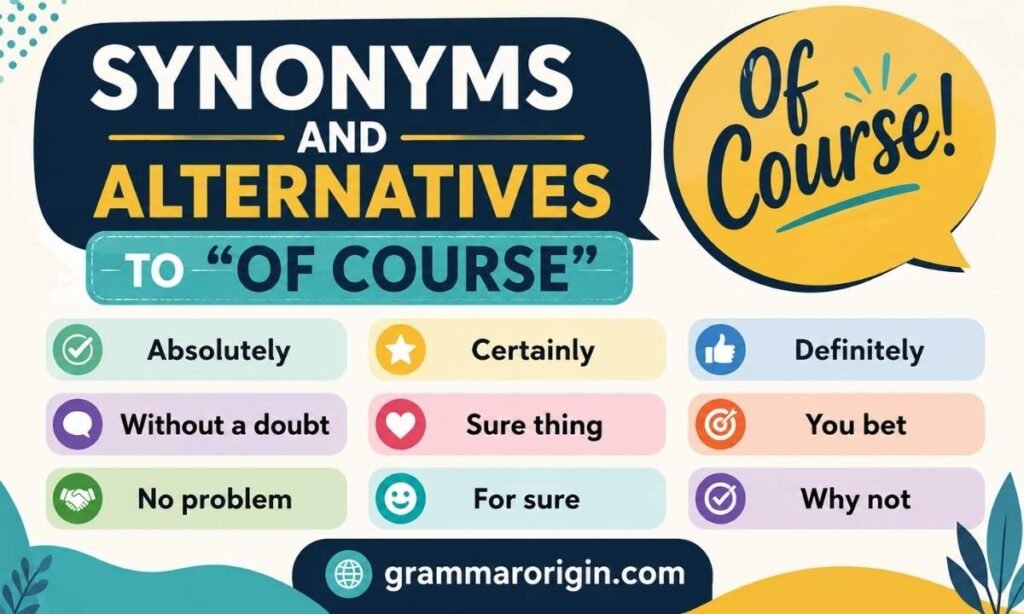
Repeating the same phrase in every paragraph gets stale fast, so it helps to have backup options depending on tone.
| Synonym | Tone | Best For |
| Certainly | Formal, polished | Business emails |
| Absolutely | Warm, enthusiastic | Customer service |
| Naturally | Neutral, measured | Academic writing |
| Sure | Casual, friendly | Texting, chats |
| Without question | Firm, assertive | Persuasive writing |
Swapping in these alternatives keeps your writing varied without losing the underlying meaning of agreement or certainty.
Of Course in Real-Life Communication Scenarios
In customer support, a reassuring line about processing a refund right away softens a routine task into something that feels personal.
At work, agreeing to “move the meeting” this way reads as collaborative rather than curt. In texting, a simple confirmation carries warmth without needing extra words.
Interviews and academic discussions use it too — answering “that’s a fair point” with this phrase signals confidence without sounding dismissive.
Quick Comparison Table
| Form | Correct? | Word Type | Example | Formality |
| Of course | Yes | Prepositional phrase | “Of course, I’ll help.” | Formal & informal |
| Ofcourse | No | Spelling error | Not used in correct writing | Neither |
| Off course | Yes (different meaning) | Adjective/adverb phrase | “The ship drifted off course.” | Formal & informal |
| Offcourse | No | Spelling error | Not used in correct writing | Neither |
This table settles the four look-alikes side by side — only two of them are actually valid English.
Of course or ofcourse in english
In standard English, the two-word spelling is the only accepted one — the merged form has no dictionary entry and no grammatical basis for existing as one word.
This holds true across British and American English alike. Neither variety merges it, which is unusual for such a commonly spoken expression.
If you’re writing for an English-speaking audience anywhere, splitting the words is the safe, universally correct choice.
Of course or ofcourse grammar
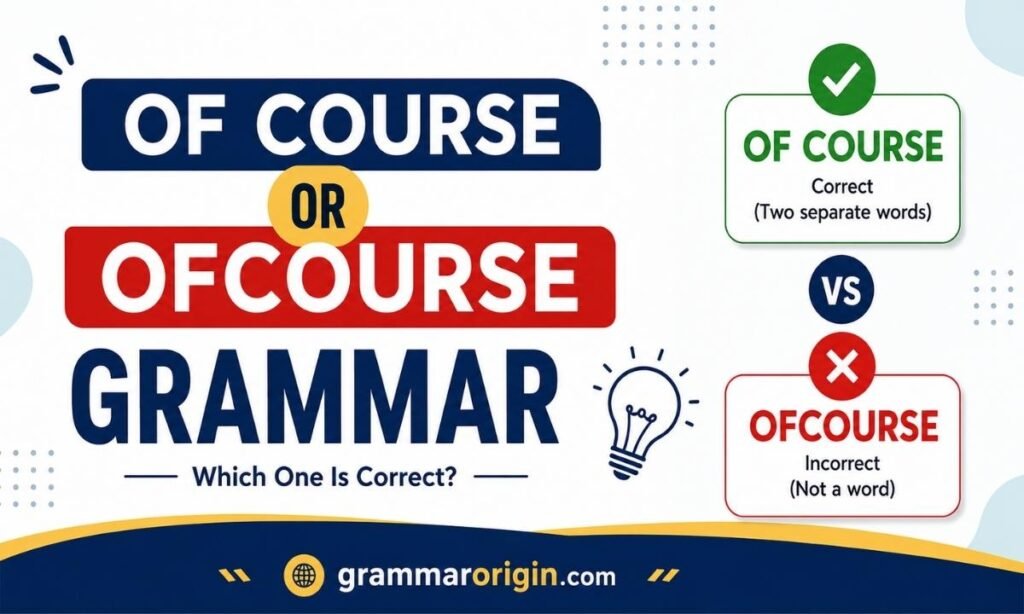
Grammatically, this is a fixed prepositional phrase, and fixed phrases in English don’t get restructured just because they’re said quickly.
The one-word version fails on structural grounds too — English doesn’t compound a preposition and a noun this way outside a small, established set like “into” or “onto,” and “course” was never part of that set.
So the rule is simple: preposition plus noun stays separated unless the dictionary explicitly says otherwise, and it doesn’t here.
Of course or ofcourse examples
Correct: “We can reschedule, of course.” / “I’ll bring the documents, of course.”
Incorrect: merging any of those into a single word breaks the rule every time — no exceptions for shorter sentences or casual tone.
Reading both versions side by side makes the pattern obvious — the wrong one simply drops the space that the right one keeps.
Also Read This Optimize or Optimise
Yes of course meaning
Pairing “yes” with this phrase doubles down on agreement — it’s stronger and warmer than a plain “yes” on its own. The second half adds reassurance that the answer was never in doubt.
You’ll hear it most in spoken replies: “Can I ask you something?” “Yes, of course — go ahead.” It signals openness rather than reluctant permission.
Written with a comma in between, it reads as enthusiastic agreement rather than a flat confirmation.
Of Course series
Some readers search this term expecting a show, book series, or media title — but there isn’t a widely known franchise by that exact name. Most results referencing it point back to grammar guides, not entertainment.
If you came here looking for a TV series or book collection, this article won’t cover that — it focuses purely on the grammar and correct spelling of the expression itself.
For anyone researching how the phrase appears in titles or dialogue, the same rule applies everywhere: two words, no exceptions.
Of course or of cause
“Of cause” is not correct — it’s a mishearing of the real phrase, mixing up two words that sound somewhat similar but mean completely different things. “Cause” refers to a reason or origin, not certainty.
Someone might type it this way after mishearing the expression in speech or confusing it with words like “because.” Neither dictionary nor grammar guide recognizes “of cause” as an idiom.
Stick with the correct spelling whenever you’re expressing agreement or certainty — “cause” only belongs in sentences about reasons, as in “the cause of the delay.”
Frequently Asked Questions
Is “ofcourse” a real word?
No. It isn’t listed in any major English dictionary and isn’t accepted in formal or informal writing.
Why is “of course” always two words?
Because it’s a prepositional phrase — “of” plus “course” — and English grammar never compounds these two into a single word.
Can I use this phrase in professional emails?
Yes. It reads as polite and confident in business communication, as long as you don’t overuse it in the same message.
What’s the difference between “of course” and “off course”?
One means certainly or naturally, while the other describes something deviating from its intended path, like a plane or ship.
Is “of cause” ever correct?
No. It’s a common mishearing and has no accepted meaning of its own in English.
Does “of course” ever sound rude or sarcastic?
It can, depending on tone. Said flatly or with emphasis on frustration, it can sound sarcastic rather than agreeable.
What can I use instead to avoid repetition?
Try “certainly,” “absolutely,” “naturally,” or “sure” — each carries a slightly different tone while keeping the same meaning.
Final Thoughts
“Of course” is the only correct spelling — two separate words, accepted in every dictionary and every style guide. The merged version is a typing habit, not a word, and it has no place in careful writing.
Once you remember the “preposition plus noun” structure, the rule sticks for good. Keep the space between the two words, and your writing stays clear, polished, and error-free every time.

Muhammad Waqas is an English language teacher and grammar expert with over 8 years of experience helping students and professionals improve their writing skills. He specializes in English grammar, vocabulary, communication, and practical language learning. Through GrammarOrigin, Waqas shares clear, easy-to-understand content that helps readers write and speak English with confidence.